
Threshold drawing, mathematics and everyday care
Kolam Traditions
An everyday and festival threshold practice whose dots, lines, materials and meanings vary across homes, regions and generations.
Orientation
Quick overview
Kolam is a threshold drawing practice strongly associated with Tamil Nadu and also found in other South Indian settings. Designs may be made with rice flour, stone powder or other materials, using dots, looping lines, connected forms or freehand motifs. Everyday kolam can be quick and compact; festival work may be larger and more elaborate.[1]
IGNCA's cultural inventory emphasizes women's transmission, dotted grids, interlaced lines and geometric memory. That record is a valuable overview, but it should not turn gender or ritual explanation into a universal rule. Men and children also draw kolam, commercial powders are common, and apartments, paved streets and time pressure reshape practice.
Kolam attracts mathematical and computing interest because patterns can be described through symmetry, paths, repetition and rule-based construction. That analysis reveals structure without replacing the maker's bodily skill, aesthetic judgment, household routine or religious interpretation.[2]
LIVING TRADITION
Materials, hands and the threshold
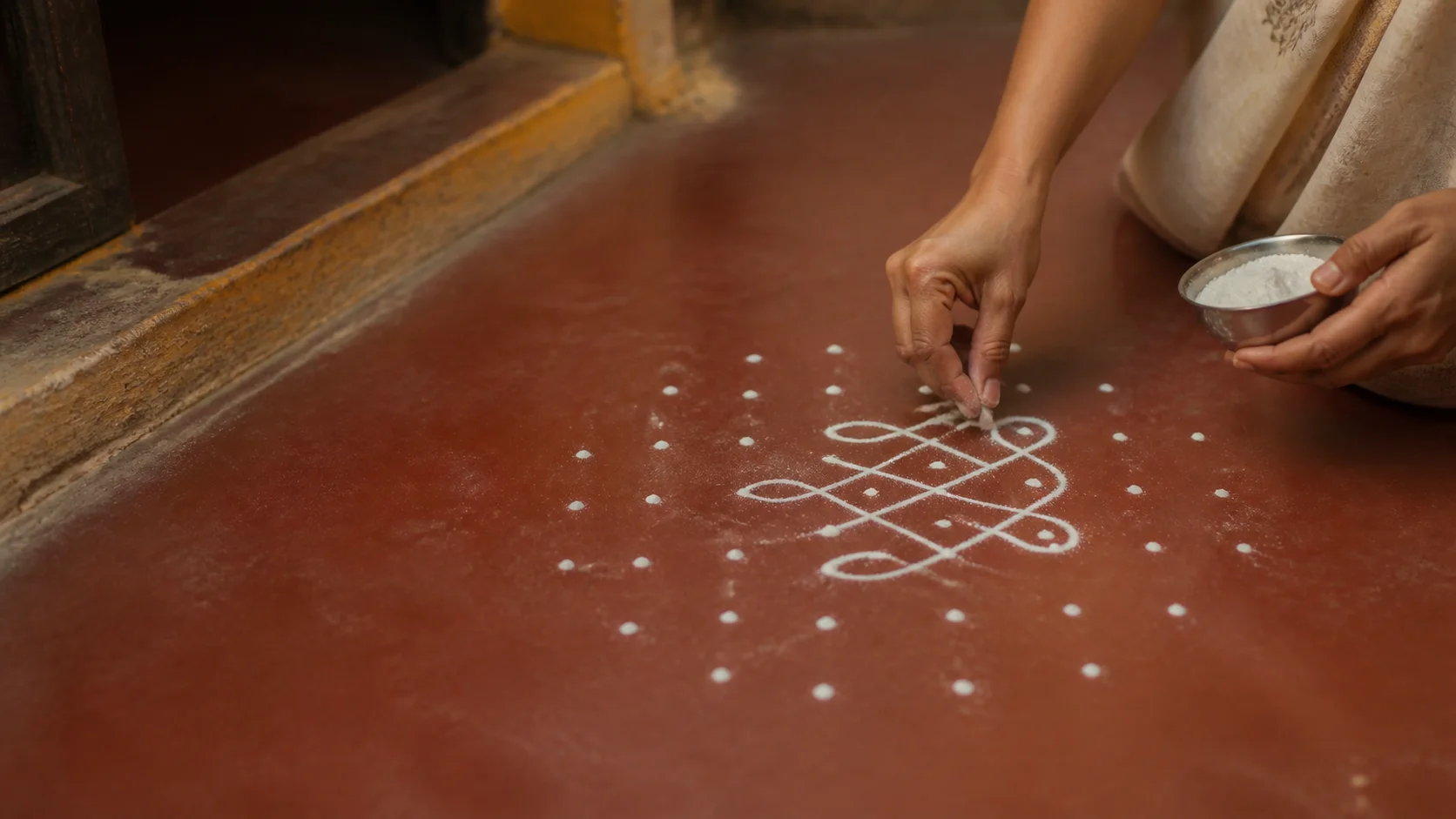
A maker commonly controls a fine stream of powder between fingers while moving the arm and body across the surface. Preparation can include sweeping, dampening or smoothing the ground. Surface, weather and material alter the line. Rice flour may be chosen in some households; white stone powder or prepared mixtures may offer durability and convenience elsewhere.
The threshold matters because it joins inside and outside, domestic routine and public visibility. Some makers connect kolam with auspiciousness, welcome, protection or devotion. Others emphasize habit, beauty, discipline or identity. These meanings can coexist, and not every maker explains the practice in the same way.[1]
VISUAL GRAMMAR
Pulli grids, looping paths and freehand forms
Pulli kolam begins from an arranged field of dots. Lines may encircle dots in continuous loops or connect them into repeated units. Sikku forms are especially associated with interlaced paths. Other designs use straight segments, curves, flowers, birds, lamps, pots or seasonal motifs without the same dot logic.
A finished pattern can conceal its sequence of construction. Watching the order of movement shows how memory and problem solving work together. Small deviations are not automatically mistakes; the hand may adjust spacing to the actual threshold. Printed diagrams teach one abstraction, while floor practice responds to friction, wind, moisture and available room.
MODERN PRACTICE
Daily rhythm, Margazhi and Pongal
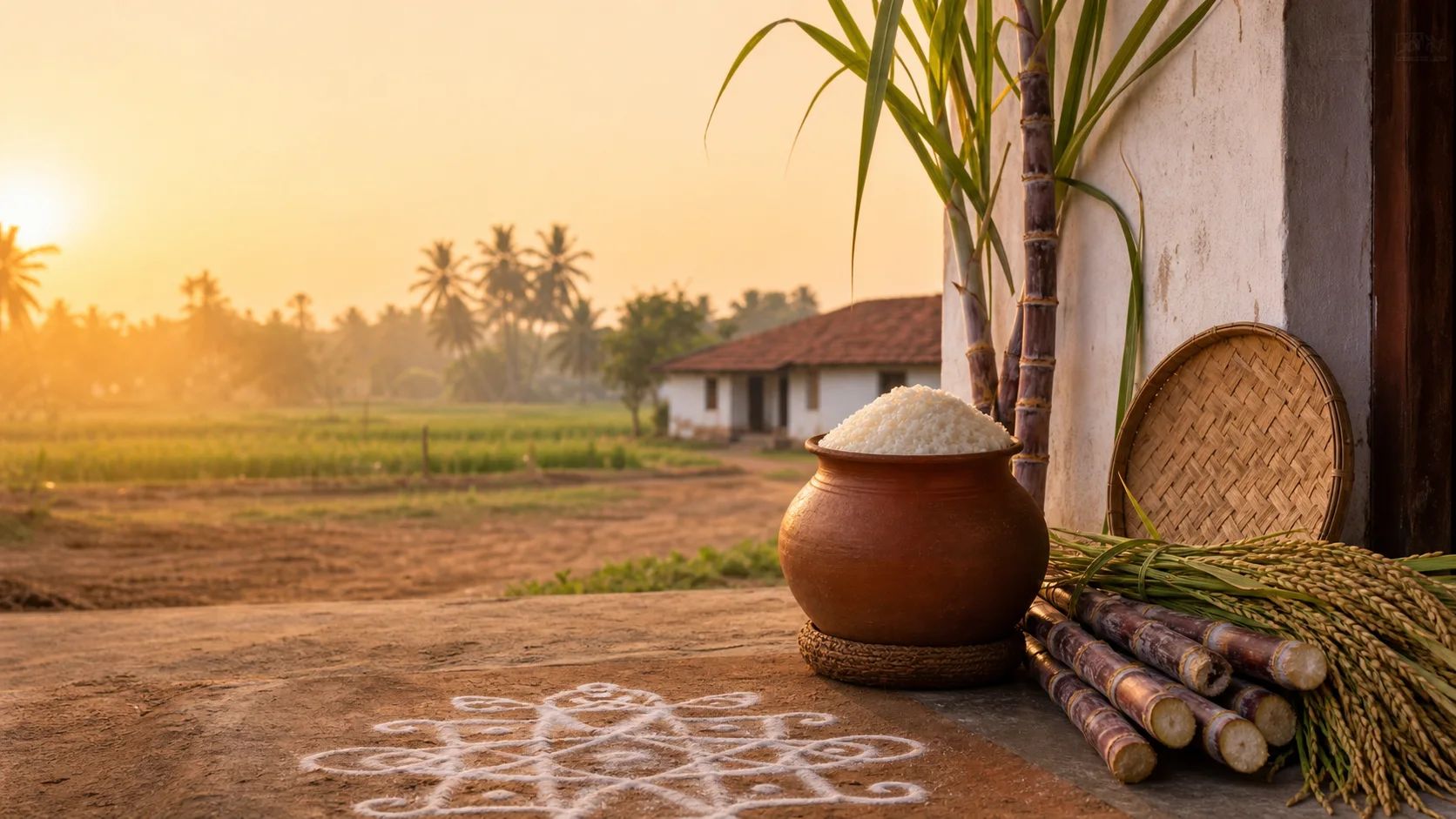
Some households draw kolam daily at dawn; others do so on selected days or festivals. Frequency depends on family practice, work schedules, housing and surface. The IGNCA archive notes Margazhi as a period associated with larger designs and public attention. Pongal designs may incorporate harvest imagery, but festival motifs do not define all kolam.[2]
Competitions, magazines, workshops and social media have expanded circulation. Digital grids let patterns travel quickly, while vinyl stickers and painted kolam reduce repeated labor. These adaptations can support continuity or change the relationship between body, impermanence and threshold; makers assess that trade-off differently.
DOCUMENTED STUDY
Mathematics without reducing the art to an equation
Dots create coordinates; symmetry organizes reflection and rotation; looping forms raise questions about paths, enclosure and repetition. Researchers in mathematics and computer science have used kolam to investigate pattern languages. IGNCA's archive explicitly notes this interest and the way designs cluster into families.[2]
Mathematical description is one lens. It can model a line without explaining why a maker chose it for a funeral, wedding, Friday, Margazhi morning or ordinary Tuesday. The strongest learning combines analysis with practitioner testimony and close observation of making.
CLAIM CHECK
Rice flour, insects and ecological claims
A widely repeated explanation says rice-flour kolam feeds ants, birds or other small creatures. This may express a meaningful ethic in some accounts, and edible flour can be consumed. It should not be universalized when many kolams use mineral or synthetic powders, surfaces are treated with chemicals, or makers give other explanations.
No broad environmental benefit should be inferred from the name kolam alone. Ask what material is used and how residue is managed. Avoid glitter, plastic additions or pigments that can enter drains unless their safety is established. Modest, biodegradable material can align practice with care, but ecology requires specific evidence.
CULTURAL CONTINUITY
Learning, authorship and change
Many learners acquire patterns from mothers, grandmothers, neighbors or peers, building a repertoire through repetition. That familiar story should not make designs ownerless. Contemporary artists and teachers may create named original work, publish books or charge for instruction. Credit should follow the source whenever it is known.
Urbanization does not simply erase kolam. It changes scale, surface, time and audience. A small apartment-threshold pattern, a school mathematics exercise and a large community competition belong to different settings. Continuity lies partly in the ability to adapt while makers continue debating what the practice means.
Editorial method
How to read a living culture carefully
These principles keep practice, history, memory and modern representation in proportion.
A cultural practice is not a specimen sealed at one date. It is learned, repeated, adjusted, argued over and sometimes deliberately revived. Household routine, hereditary training, religious observance, public institution, classroom, stage, market and social media can all sustain the same named tradition in different ways. This guide therefore identifies the setting behind a claim instead of treating one version as the Tamil version.
Documented history and community memory answer different questions. An archive can date an organization or law; a repertoire can preserve techniques not fully explained in writing; an oral account can reveal how practitioners understand continuity. The page labels these forms of evidence so a meaningful tradition is not dismissed for lacking an inscription, and a compelling story is not quietly converted into a settled historical fact.
Terms used in English often flatten distinctions. Classical, folk, ritual, domestic, sacred, secular, traditional and modern are useful only when the page explains who is using the label and why. A practice may move between these categories over time. It can also carry unequal histories involving caste, gender, patronage, labor and access, even when a present performance is celebratory.
Variation is not an exception to be corrected. District, language register, religion, community, occupation, age, migration and family history all influence practice. This page describes patterns supported by the cited institutions while leaving room for people whose experience differs. Phrases such as 'many households' or 'in some performance lineages' are intentional evidence controls, not vagueness.
Responsible participation begins with context and consent. Observe before entering a working space; ask before photographing a person, ceremony, lesson or design; pay clearly for instruction or craft; follow venue and household rules; and avoid asking a practitioner to stage sacred or private activity as entertainment. Cultural respect is practical behavior, not a decorative disclaimer.
Archives have their own silences. Court, temple and government records often preserve patrons, rules and institutions more readily than the voices of performers, artisans and household practitioners. Photographs may be staged or captioned by outsiders. A catalogue can identify an object while omitting who prepared its materials or taught the technique. Reading against these gaps is necessary, but a gap cannot be filled with an attractive invention.
Transmission is rarely a clean line from an ancient text to a present learner. People learn by watching, correcting, repeating, listening, memorizing, improvising and discussing. Printed manuals, recordings and online demonstrations can widen access while leaving tacit skills difficult to capture. When a page says a tradition is transmitted, it should ask what is transmitted, by whom, in which setting and under what conditions.
Language matters because technical terms do not always map neatly into English. A translation may clarify a first encounter while losing social register, poetic resonance or several possible meanings. This guide keeps essential Tamil or specialist words where they help and explains them in context. It avoids treating an English gloss as the complete definition of a term used differently by practitioners.
Institutions preserve and reshape culture at the same time. An academy can stabilize a curriculum, a museum can conserve material, a government inventory can make a practice visible and a festival can create paid stages. Each also selects what counts as representative. Institutional recognition is therefore evidence of recognition and activity, not proof that one approved version exhausts a tradition.
Migration and digital circulation create new cultural geographies. A practice learned in Madurai may be taught in Singapore, Toronto or Dubai; a pattern posted online may return to Tamil Nadu in altered form. Diaspora continuity is not a lesser copy, yet its setting differs from a temple, agrarian household or Chennai concert hall. Place remains important without becoming a purity test.
Cultural continuity includes disagreement. Practitioners may debate costume, repertoire, religious meaning, ownership, caste history, innovation or commercial use. Reporting that debate does not weaken the tradition. It shows that people care enough to contest its future. The editorial task is to identify positions and evidence fairly rather than manufacture a unanimous community voice.
Time words require care. Ancient, classical, medieval, traditional and modern are not interchangeable compliments. An old text can describe a concept without proving that today's full practice existed in the same form; a modern institution can preserve older material while changing presentation. Whenever chronology matters, a page should name the evidence and the particular feature being dated instead of assigning one age to the whole tradition.
Religious significance is also situated. A movement, pattern, song, object or festival action may be an offering in one setting, an artistic study in another and a marker of family identity elsewhere. Sacred meaning should be reported through practitioners and responsible institutions. It should neither be dismissed as folklore nor converted into a universal instruction for every reader.
The visitor's presence changes a cultural setting. Cameras alter attention, applause can interrupt ritual timing, and requests for explanation can add unpaid work. A responsible encounter accepts that some knowledge is private, specialist or learned slowly. The aim is not to collect every symbol in one visit, but to leave with a more accurate sense of people, place, skill and uncertainty.
Material details deserve the same care as celebrated meanings. Powder, thread, instrument wood, costume stitching, floor surface, fuel and storage all influence what can be made. Substitution may respond to price, regulation, ecology or access. Documenting those choices helps explain how practice continues without judging every new material as decline or every old material as inherently superior.
Finally, evidence should remain traceable. A reader ought to be able to distinguish a government inventory from a practitioner's account, a peer-reviewed argument from institutional history and a current programme from a permanent fact. The numbered sources on this page are a starting set rather than a claim to final authority. Future revision should add practitioner-led and Tamil-language scholarship wherever rights and reliable access permit.
Practical participation
Experience This Culture
Learn from a willing practitioner and treat the threshold as someone else's living space.
Watch the sequence
Notice dots, hand movement and corrections before copying a finished form.
Ask about material
Rice flour and prepared powder behave differently.
Credit the teacher
Patterns may come from family memory, books or named artists.
Leave access clear
Never block a doorway or damage an existing kolam.
Regional orientation
Geographic context
This is place-name context, not a claim that a cultural boundary can be drawn as a precise modern polygon.
Household and public practice varies by place and community
Google Maps is provided only as an orientation fallback. It does not verify cultural boundaries, opening hours, businesses, events or access.
Visual guide
Images with explicit provenance
All images are original project-created editorial representations. They are not documentary records of a named person, maker, performance, meal, business or historical event.

Questions
Frequently asked questions
Does everyone in Tamil Nadu practise this tradition?
No. Participation and meaning vary by region, community, religion, household, profession and generation.
Is the practice unchanged from ancient times?
No living practice is unchanged. This guide separates older textual or material evidence from later institutions and present-day practice.
Can visitors photograph it?
Permission depends on the person, household, venue and ritual setting. Ask first and follow local rules.
Are generated images documentary evidence?
No. Project-created visuals are labelled editorial and should not be used as evidence for a person, place or event.
How were claims reviewed?
Institutional, government and academic sources were checked, and uncertain or contested claims remain labelled as such.
Is every kolam made with rice flour?
No. Materials include rice flour, stone powder and other prepared media depending on household, surface and purpose.
Is kolam the same as every Indian rangoli form?
They are related floor-art traditions, but names, techniques, materials and regional histories should remain specific.
Editorial trust
Sources and further reading
Claims are cited inline. Source type, author or institution, publication information and review date are visible here.
- 1Kolam: Ritualistic Threshold Drawings and Designs of Tamil NaduIndira Gandhi National Centre for the ArtsIntangible Cultural Heritage inventory · Government cultural inventory · Reviewed 9 August 2026
- 2From the IGNCA Archives: Martha Strawn Kolam CollectionIndira Gandhi National Centre for the ArtsArchive note · Government cultural archive · Reviewed 9 August 2026
- 3Pongal FestivalMinistry of Tourism, Government of IndiaCurrent institutional overview · Official festival record · Reviewed 9 August 2026
Fact and sensitivity review: Documented history, living tradition, oral tradition, religious significance and modern practice were checked as separate claim types on 9 August 2026. Food pages were also reviewed for unsupported origin, GI, health, restaurant, price and availability claims.