
Harvest, household and regional practice
Pongal in Tamil Nadu
A four-part harvest season understood through household practice, agriculture, food, cattle, kinship and changing urban life, without turning one observance into a rule for every Tamil family.
Orientation
Quick overview
Pongal is among Tamil Nadu's most widely recognized festivals, but it is better understood as a sequence of related observances than as one identical event. Government cultural summaries commonly describe Bhogi, Surya or Thai Pongal, Mattu Pongal and Kaanum Pongal. Their emphasis changes across agricultural households, cities, religious communities and families living outside the state.[1]
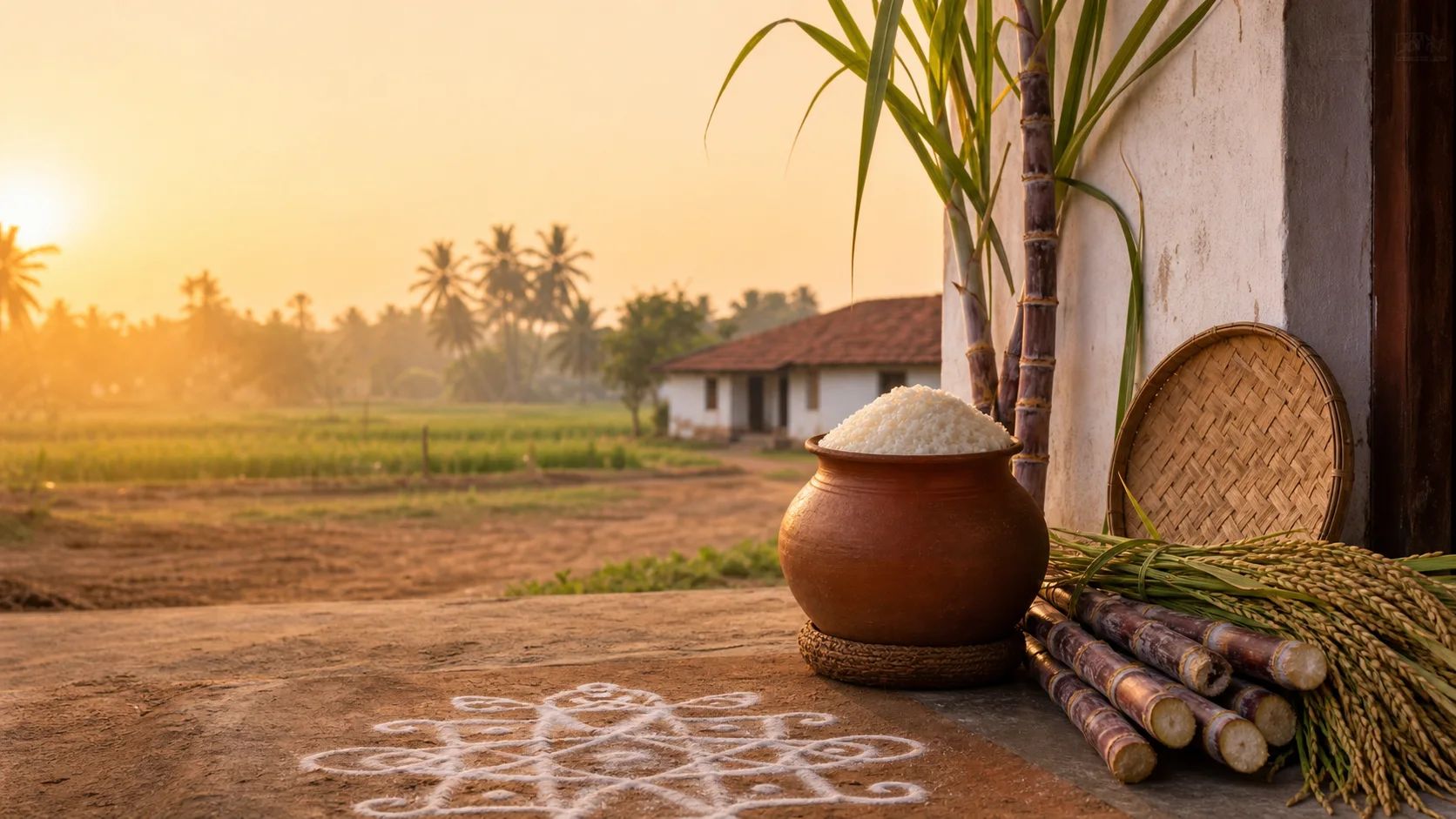
The word pongal is also associated with the act of boiling over and with a rice preparation. In many homes, fresh rice is cooked with milk and allowed to rise in a decorated pot while family members mark abundance. This recognizable scene should not erase households that use different vessels, ingredients, spaces or ritual forms.
Sugarcane, turmeric plants, paddy, kolam, cattle and shared meals often appear in visual accounts because they connect celebration with cultivation. Their availability and meaning are not uniform. Urban families may adapt the observance to apartments and purchased produce; rural observance also changes with crop, labor, irrigation and local custom.
LIVING TRADITION
Four observances, connected but distinct
Bhogi is generally described as the opening observance and is associated with clearing, renewal and the close of the previous seasonal cycle. Public summaries often foreground the burning of discarded objects. That practice raises present-day fire and air-quality concerns, and it should not be treated as required cultural performance. Many families mark renewal through cleaning, decoration, prayer or gathering instead.
Thai Pongal places the cooking and sharing of pongal at the center in many homes. Mattu Pongal turns attention toward cattle and the agricultural relationships they embody. Kaanum Pongal is often associated with visits, outdoor gathering and kinship. The Ministry of Tourism records this four-part sequence, but a household may observe some days more strongly than others.[1]
MODERN PRACTICE
Household, rural and urban settings
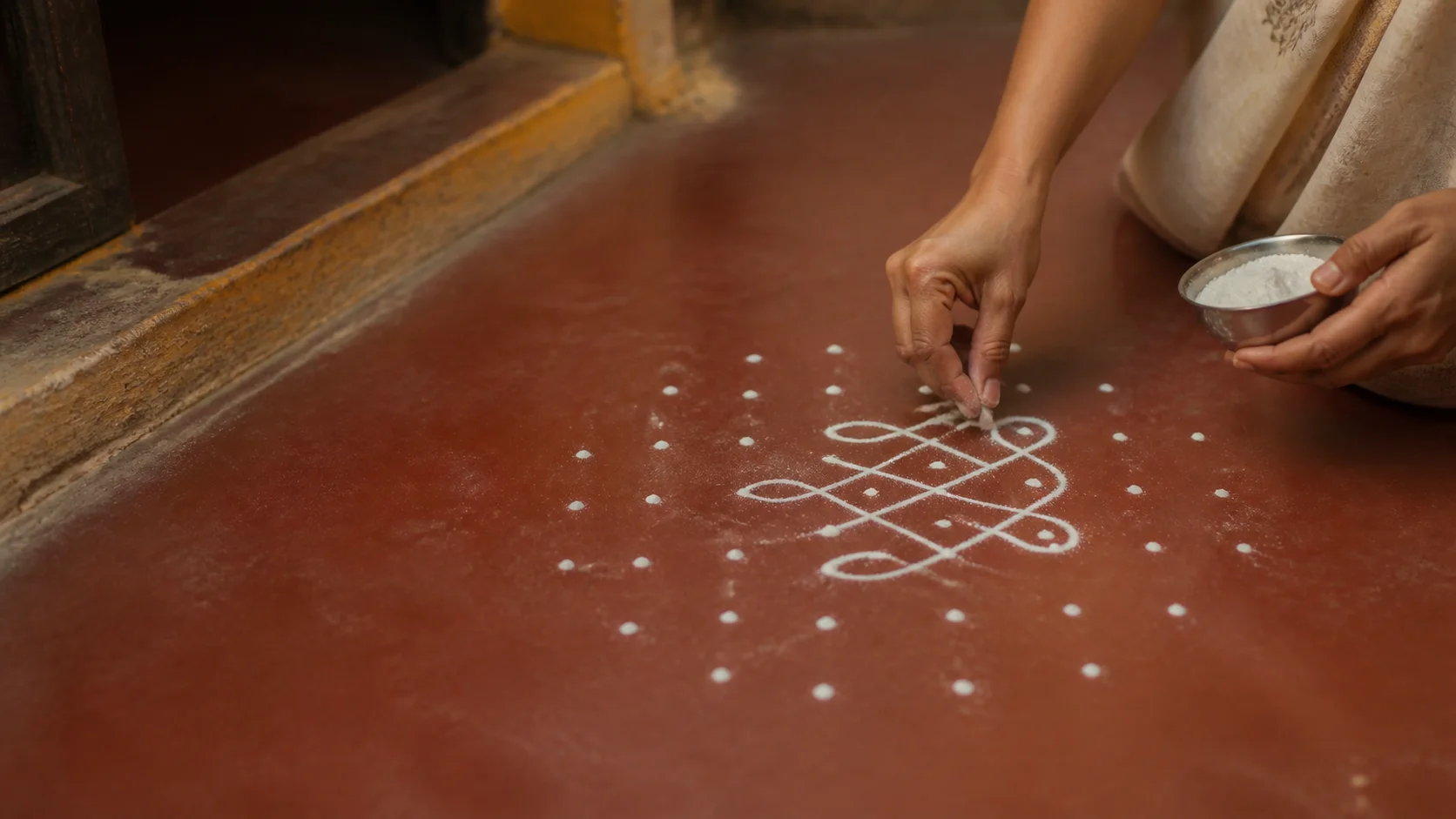
At home, preparation can include cleaning, new kolam, arranging sugarcane, cooking, offerings and a meal. These tasks are distributed differently by family, gender and generation. Describing them as effortless women's tradition hides planning and labor. In cities, balcony pots, compact kolam and community events may replace courtyard or field settings without making the observance less meaningful.
Agricultural celebration must also be read against changing rural life. Mechanization, migration, debt, water, crop choice and non-farm work alter how families relate to a harvest festival. Pongal can express continuity and pride while also carrying memories of work that is physically demanding and unevenly rewarded.
FOODWAYS
The pot, the meal and what is shared
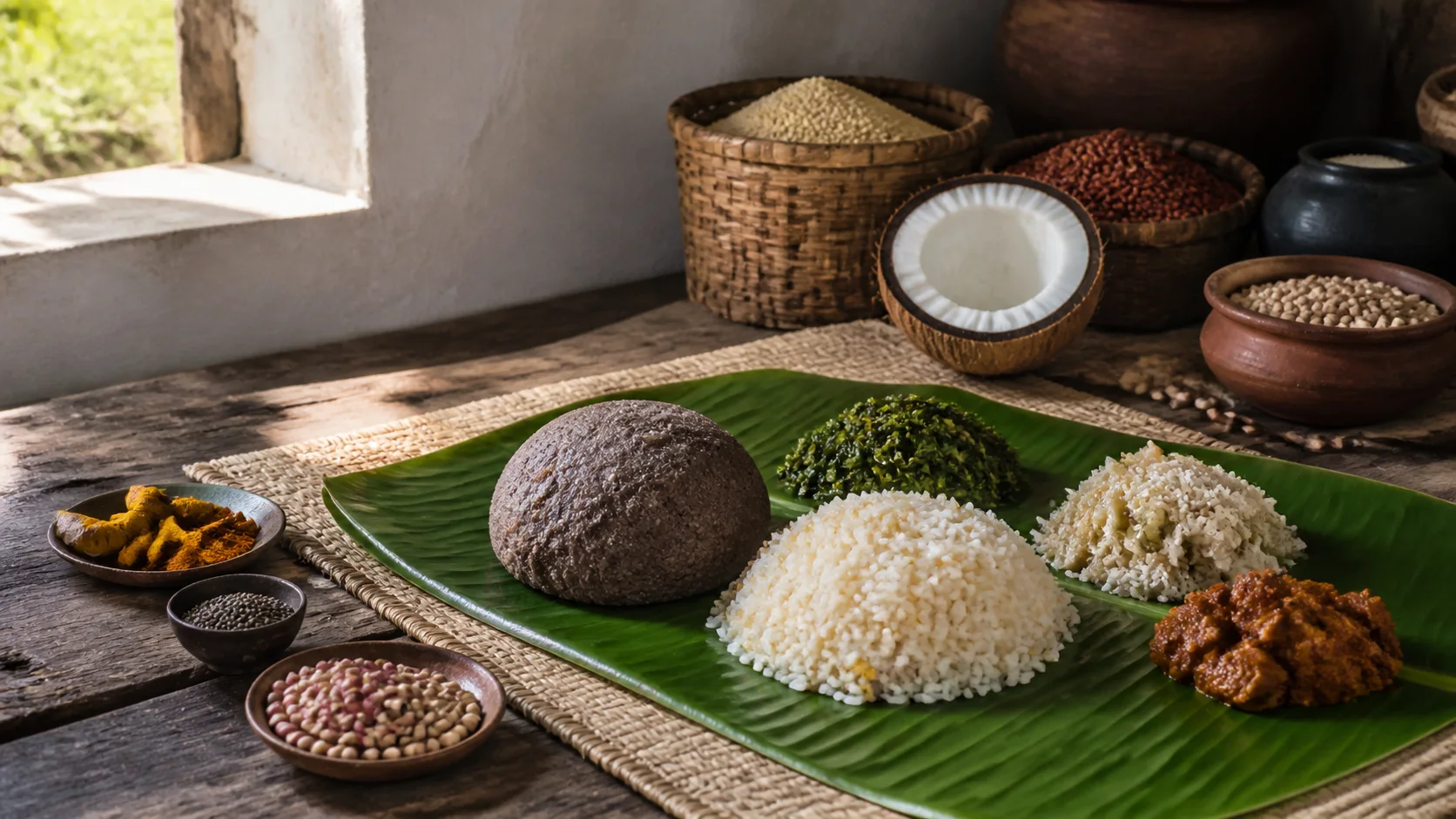
Sweet pongal and ven pongal are familiar preparations, but the festival meal is not one fixed statewide menu. Rice, milk, jaggery, pulses, ghee, cashew, pepper and other ingredients appear in different combinations and dietary contexts. Some foods are offerings; others belong to the family meal. Availability, household custom and religious practice shape the table.
The moment of boiling over is frequently interpreted as abundance and auspicious increase. This is a living cultural meaning rather than a scientific forecast of prosperity. Visitors invited into a home should follow the host's lead, wait before photographing or tasting, and avoid asking a family to repeat a moment for the camera.
REGIONAL PRACTICE
Kolam, cattle and southern public traditions
Kolam can become larger or more elaborate in the Pongal season, with dots, looping lines, plants, pots, sugarcane or cattle-related motifs. It remains a separate, varied threshold-art practice and is not merely festival decoration. The dedicated kolam guide explains its daily, mathematical and contemporary contexts.[3]
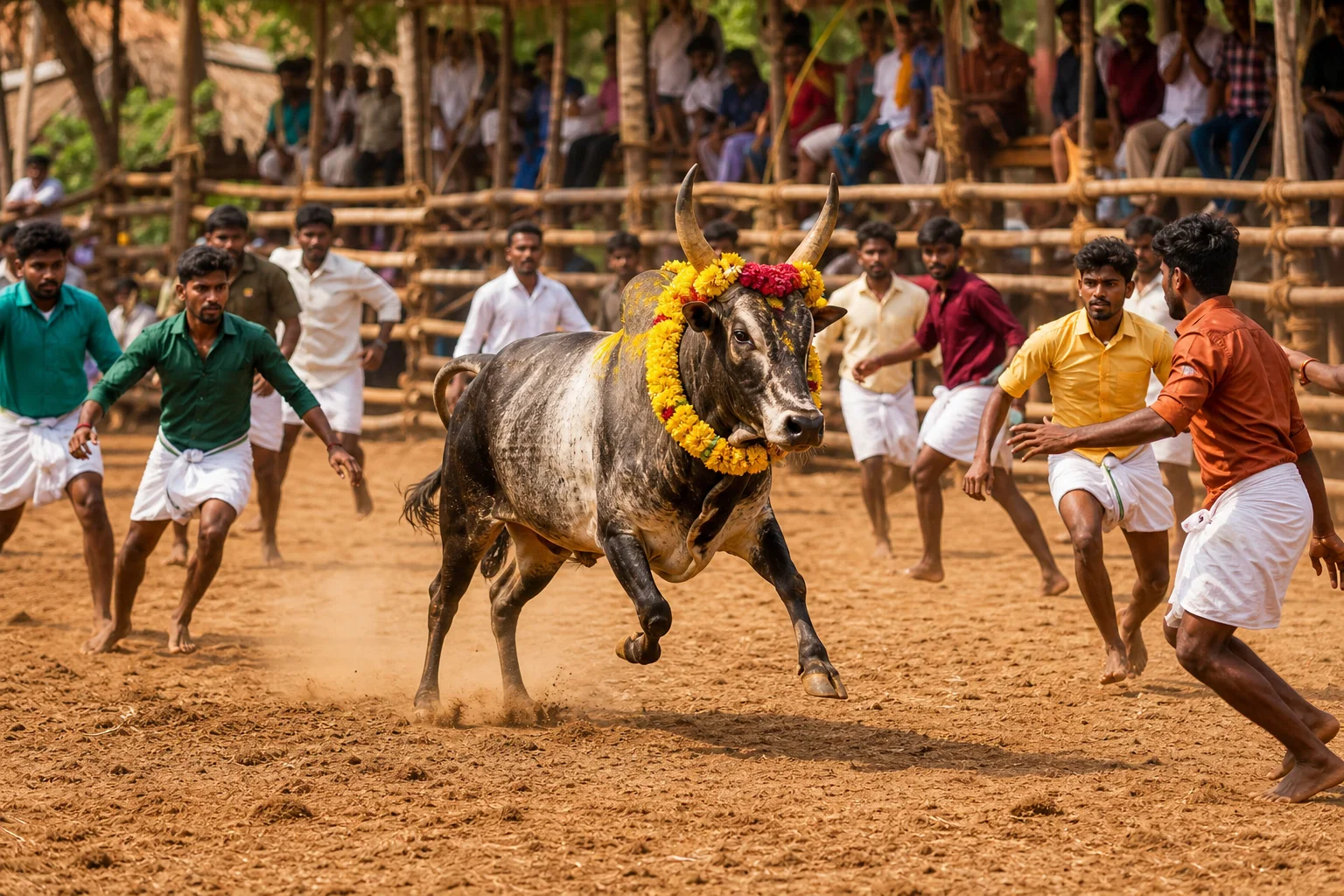
Cattle may be washed, decorated, fed or honored on Mattu Pongal in agricultural settings. Jallikattu is associated especially with parts of southern Tamil Nadu and with the Pongal season; it is not practised by every Tamil community and should not stand for Mattu Pongal as a whole. Current event rules, locations and access must be checked from responsible authorities.[2]
RELIGIOUS SIGNIFICANCE
Thanksgiving, kinship and more than one meaning
Many accounts describe gratitude to the sun, land, cattle and forces that sustain cultivation. Specific prayers and deities differ. Some households frame the day through Hindu worship; some foreground family, farming and Tamil identity; others participate socially without the same ritual interpretation. The page does not collapse these meanings into one theology.
Kaanum Pongal can place relationships and visiting at the center. Public outings and riverbank or coastal gatherings are common in some places, but crowd controls and environmental restrictions change. A cultural description cannot substitute for current municipal, police, transport or weather information.
DOCUMENTED HISTORY
How to speak about age and continuity
Harvest thanksgiving has deep roots, but a present four-day sequence should not be assigned an exact ancient foundation date without sources that document that form. Literary references, inscriptions, agricultural calendars and later ethnography may illuminate parts of the history while leaving gaps between earlier practices and today's named observances.
The strongest account of continuity is layered: older seasonal and agrarian ideas, regionally transmitted household customs, modern public institutions, school calendars, media and diaspora celebration all contribute. This avoids both extremes of claiming an unchanged ancient festival and treating Pongal as a recent invention.
Editorial method
How to read a living culture carefully
These principles keep practice, history, memory and modern representation in proportion.
A cultural practice is not a specimen sealed at one date. It is learned, repeated, adjusted, argued over and sometimes deliberately revived. Household routine, hereditary training, religious observance, public institution, classroom, stage, market and social media can all sustain the same named tradition in different ways. This guide therefore identifies the setting behind a claim instead of treating one version as the Tamil version.
Documented history and community memory answer different questions. An archive can date an organization or law; a repertoire can preserve techniques not fully explained in writing; an oral account can reveal how practitioners understand continuity. The page labels these forms of evidence so a meaningful tradition is not dismissed for lacking an inscription, and a compelling story is not quietly converted into a settled historical fact.
Terms used in English often flatten distinctions. Classical, folk, ritual, domestic, sacred, secular, traditional and modern are useful only when the page explains who is using the label and why. A practice may move between these categories over time. It can also carry unequal histories involving caste, gender, patronage, labor and access, even when a present performance is celebratory.
Variation is not an exception to be corrected. District, language register, religion, community, occupation, age, migration and family history all influence practice. This page describes patterns supported by the cited institutions while leaving room for people whose experience differs. Phrases such as 'many households' or 'in some performance lineages' are intentional evidence controls, not vagueness.
Responsible participation begins with context and consent. Observe before entering a working space; ask before photographing a person, ceremony, lesson or design; pay clearly for instruction or craft; follow venue and household rules; and avoid asking a practitioner to stage sacred or private activity as entertainment. Cultural respect is practical behavior, not a decorative disclaimer.
Archives have their own silences. Court, temple and government records often preserve patrons, rules and institutions more readily than the voices of performers, artisans and household practitioners. Photographs may be staged or captioned by outsiders. A catalogue can identify an object while omitting who prepared its materials or taught the technique. Reading against these gaps is necessary, but a gap cannot be filled with an attractive invention.
Transmission is rarely a clean line from an ancient text to a present learner. People learn by watching, correcting, repeating, listening, memorizing, improvising and discussing. Printed manuals, recordings and online demonstrations can widen access while leaving tacit skills difficult to capture. When a page says a tradition is transmitted, it should ask what is transmitted, by whom, in which setting and under what conditions.
Language matters because technical terms do not always map neatly into English. A translation may clarify a first encounter while losing social register, poetic resonance or several possible meanings. This guide keeps essential Tamil or specialist words where they help and explains them in context. It avoids treating an English gloss as the complete definition of a term used differently by practitioners.
Institutions preserve and reshape culture at the same time. An academy can stabilize a curriculum, a museum can conserve material, a government inventory can make a practice visible and a festival can create paid stages. Each also selects what counts as representative. Institutional recognition is therefore evidence of recognition and activity, not proof that one approved version exhausts a tradition.
Migration and digital circulation create new cultural geographies. A practice learned in Madurai may be taught in Singapore, Toronto or Dubai; a pattern posted online may return to Tamil Nadu in altered form. Diaspora continuity is not a lesser copy, yet its setting differs from a temple, agrarian household or Chennai concert hall. Place remains important without becoming a purity test.
Cultural continuity includes disagreement. Practitioners may debate costume, repertoire, religious meaning, ownership, caste history, innovation or commercial use. Reporting that debate does not weaken the tradition. It shows that people care enough to contest its future. The editorial task is to identify positions and evidence fairly rather than manufacture a unanimous community voice.
Time words require care. Ancient, classical, medieval, traditional and modern are not interchangeable compliments. An old text can describe a concept without proving that today's full practice existed in the same form; a modern institution can preserve older material while changing presentation. Whenever chronology matters, a page should name the evidence and the particular feature being dated instead of assigning one age to the whole tradition.
Religious significance is also situated. A movement, pattern, song, object or festival action may be an offering in one setting, an artistic study in another and a marker of family identity elsewhere. Sacred meaning should be reported through practitioners and responsible institutions. It should neither be dismissed as folklore nor converted into a universal instruction for every reader.
The visitor's presence changes a cultural setting. Cameras alter attention, applause can interrupt ritual timing, and requests for explanation can add unpaid work. A responsible encounter accepts that some knowledge is private, specialist or learned slowly. The aim is not to collect every symbol in one visit, but to leave with a more accurate sense of people, place, skill and uncertainty.
Material details deserve the same care as celebrated meanings. Powder, thread, instrument wood, costume stitching, floor surface, fuel and storage all influence what can be made. Substitution may respond to price, regulation, ecology or access. Documenting those choices helps explain how practice continues without judging every new material as decline or every old material as inherently superior.
Finally, evidence should remain traceable. A reader ought to be able to distinguish a government inventory from a practitioner's account, a peer-reviewed argument from institutional history and a current programme from a permanent fact. The numbered sources on this page are a starting set rather than a claim to final authority. Future revision should add practitioner-led and Tamil-language scholarship wherever rights and reliable access permit.
Practical participation
Experience This Culture
Approach Pongal as an invited participant or respectful observer, not as a staged attraction.
Start with context
Learn which day and practice your host or community is observing.
Ask before recording
Cooking, prayer, cattle care and family gathering may be private.
Keep air and animal safety in view
Do not promote burning or crowding as cultural obligations.
Follow annual notices
Public events, traffic and weather are live information.
Regional orientation
Geographic context
This is place-name context, not a claim that a cultural boundary can be drawn as a precise modern polygon.
Observed across varied rural, urban and diaspora settings
Google Maps is provided only as an orientation fallback. It does not verify cultural boundaries, opening hours, businesses, events or access.
Visual guide
Images with explicit provenance
All images are original project-created editorial representations. They are not documentary records of a named person, maker, performance, meal, business or historical event.
Questions
Frequently asked questions
Does everyone in Tamil Nadu practise this tradition?
No. Participation and meaning vary by region, community, religion, household, profession and generation.
Is the practice unchanged from ancient times?
No living practice is unchanged. This guide separates older textual or material evidence from later institutions and present-day practice.
Can visitors photograph it?
Permission depends on the person, household, venue and ritual setting. Ask first and follow local rules.
Are generated images documentary evidence?
No. Project-created visuals are labelled editorial and should not be used as evidence for a person, place or event.
How were claims reviewed?
Institutional, government and academic sources were checked, and uncertain or contested claims remain labelled as such.
Is Jallikattu part of every Pongal celebration?
No. It is a regional public tradition associated especially with parts of southern Tamil Nadu.
When will Pongal occur next year?
This page intentionally does not predict future dates. Verify the annual calendar and official notices close to the event.
Editorial trust
Sources and further reading
Claims are cited inline. Source type, author or institution, publication information and review date are visible here.
- 1Pongal FestivalMinistry of Tourism, Government of IndiaCurrent institutional overview · Official festival record · Reviewed 9 August 2026
- 2Jallikattu (Bull Taming)Ministry of Tourism, Government of IndiaCurrent institutional overview · Official festival record · Reviewed 9 August 2026
- 3Kolam: Ritualistic Threshold Drawings and Designs of Tamil NaduIndira Gandhi National Centre for the ArtsIntangible Cultural Heritage inventory · Government cultural inventory · Reviewed 9 August 2026
- 4From the IGNCA Archives: Martha Strawn Kolam CollectionIndira Gandhi National Centre for the ArtsArchive note · Government cultural archive · Reviewed 9 August 2026
Fact and sensitivity review: Documented history, living tradition, oral tradition, religious significance and modern practice were checked as separate claim types on 9 August 2026. Food pages were also reviewed for unsupported origin, GI, health, restaurant, price and availability claims.