
Theatre, dance, storytelling and community performance
Tamil Folk Arts
A careful orientation to varied performance worlds whose music, movement, narrative and ritual meanings depend on region, community, venue and living practitioners.
Orientation
Quick overview
Tamil folk arts are not one genre. The broad label gathers dance, theatre, musical storytelling, percussion, puppetry and forms tied to worship, seasonal gatherings, public festivals or modern stages. Therukoothu, villupattu, karagattam, oyilattam, devarattam, poikkal kuthirai, kavadi-related performance, parai traditions and bommalattam each require their own social and performance context.
Tamil Virtual Academy describes folklore as oral, traditional, anonymous and existing in multiple versions. Those ideas help explain variation, but they must not erase named performers, teachers and communities whose labour keeps a repertoire alive. A government or academy label records recognition; it does not make one staged version the definitive form.[1][4]
This guide avoids invented antiquity. A literary reference, community memory or long-standing festival association may support continuity without proving that today's costume, ensemble and choreography existed unchanged at the earliest claimed date. Living arts move between local grounds, temple surroundings, political stages, television, tourism programmes and classrooms.
ORIENTATION
Dance, theatre, storytelling, music and ritual
A dance-centred form organizes movement and rhythm; theatre sustains character, dialogue and dramatic sequence; storytelling foregrounds narration and song; percussion may function as music, communication and movement practice. Many forms combine these elements. A convenient English category should not override the practitioner's name for the work.
Ritual performance is not simply a show with sacred decoration. Its timing, permission, audience and obligations may belong to a community or temple setting. The same artists can also present an adapted stage version. Visitors should not assume that watching one version grants access to private preparation, worship or restricted space.
CCRT's cultural packages include Therukoothu within traditional theatre and emphasize features such as audience interaction and improvisation. Educational summaries are useful entry points, but a full understanding needs the specific troupe, story, music, locality and event context.[3]
FOLK THEATRE
Therukoothu and performance through the night
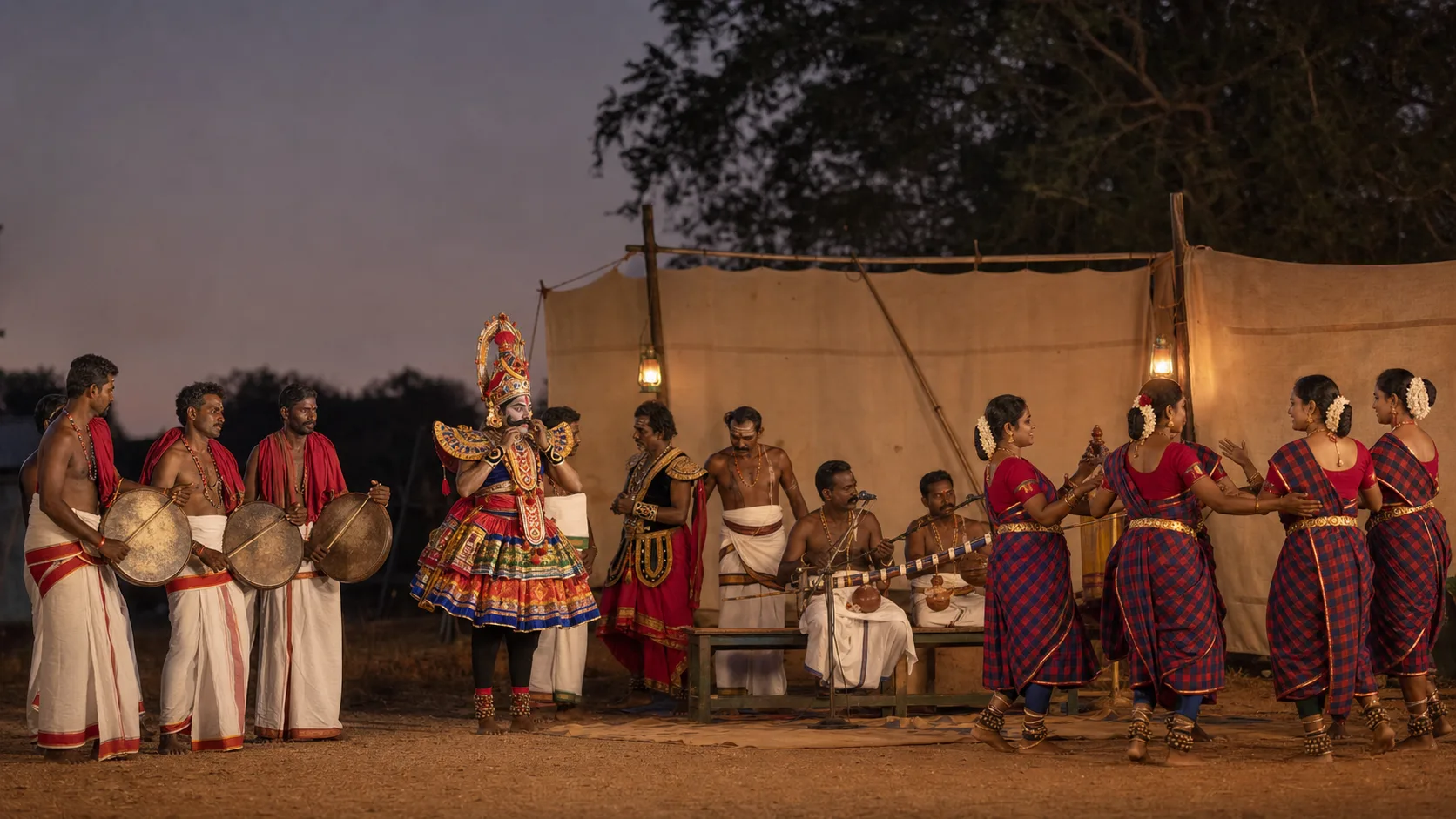
Therukoothu is a Tamil theatre tradition associated especially with parts of northern Tamil Nadu. It can combine singing, dialogue, dance, elaborate costuming, percussion, narration and direct exchange with an audience. Story cycles may draw on epic and local traditions, while exact repertoire and staging differ by troupe and occasion.[2][3]
The word koothu has wider histories and uses, so not every performance called koothu is the same as Therukoothu. Modern shortened demonstrations also differ from a long local presentation. Programme notes should name the troupe, lead artists, story and adaptation rather than advertising a generic ancient village dance.
Performance labour includes rehearsal, vocal stamina, costume preparation, makeup, transport, musicianship and teaching. Photographs often centre spectacular costume while leaving accompanists and makers out of frame. Ethical documentation records the full team and follows instructions about backstage access.
MUSICAL NARRATIVE
Villupattu, song and the work of telling
Villupattu, often translated as bow-song, is a musical storytelling form associated particularly with southern Tamil regions. A lead narration can be supported by chorus, rhythmic response and a bow-shaped instrument used percussively. Story, language, humour and audience interaction matter as much as the visually distinctive instrument.
Tamil Virtual Academy's folklore material shows that Tamil story-song categories have many regional names and settings. That makes it risky to force every narrative performance into one standardized sequence. A troupe may adapt religious, historical, social or public-information subjects while preserving characteristic musical and dialogic methods.[1]
Translation should preserve the difference between narrator, character voice, refrain and commentary. Recording a whole performance may involve repertoire rights and community expectations, not merely venue permission. Ask the artists how they want names and titles written.
DANCE AND PROCESSION
Karagattam, Oyilattam, Devarattam and related forms
Karagattam is associated with balancing a decorated pot while dancing, with ritual and staged contexts that should be distinguished. Oyilattam commonly uses coordinated group movement and cloth or hand-held elements, while devarattam has specific community and regional associations in the south. Poikkal kuthirai uses a constructed dummy-horse costume to create an equestrian visual effect.
Kavadi-related movement belongs first to Murugan devotional and pilgrimage settings, though stage adaptations also circulate. Calling every colourful kavadi performance folk entertainment can erase sacred intention. Current temple rules, procession routes and festival arrangements must be checked with responsible authorities.
These descriptions are orientation, not choreography instructions. Balance, costume weight, heat, road surfaces and crowd movement can create real risk. Visitors should watch from designated space and never imitate a physical feat without a qualified teacher and suitable conditions.
RHYTHM AND IDENTITY
Parai and the politics of hearing
Parai refers to a frame drum and to performance traditions with varied ceremonial, communicative and stage contexts. Its history is inseparable from caste, labour, stigma, assertion and contemporary cultural movements. Reducing it to an energetic photo opportunity can repeat the very hierarchy that practitioners challenge.
Present-day ensembles may teach rhythmic technique, perform at civic or political events, work in theatre and reclaim public visibility. There is no single practitioner position on ritual, identity or commercialization. Editorial work should use the artists' chosen terminology, credit teachers and avoid assigning a caste identity to an individual from instrument or costume alone.
This subject requires continuing human editorial review because community histories and present claims can be sensitive. The responsible approach is not silence; it is specific sourcing, practitioner voice, transparent uncertainty and refusal of stereotype.
OBJECT PERFORMANCE
Bommalattam and puppet stages
Bommalattam is a broad Tamil term for puppet performance. Troupes may use string, rod, glove or shadow techniques, and regional repertoires differ. Puppets bring together carving, textile, painting, voice, music and manipulation. A museum object shows material craft but cannot reproduce the timing and audience relationship of live performance.
Sangeet Natak Akademi's intangible-cultural-heritage programme includes traditional theatre and puppetry within a national preservation framework. Institutional listing can support visibility, documentation and training, but it should lead readers back to the specific tradition and artists rather than become a generic authenticity seal.[4]
When attending, sit where instructed, avoid flash and do not touch puppets or instruments without invitation. For school or festival bookings, ask who performs, how long the complete form normally runs and whether the proposed presentation has been adapted for the venue.
CONTINUITY AND CHANGE
Patronage, preservation and contemporary stages
Folk arts continue through local patronage, religious and civic events, artist families, troupes, cultural organizations, universities and government programmes. Preservation does not mean freezing costume or story. Artists adapt duration, amplification, language and subject because audiences, income and venues change.
Documentation can help when it records repertoire, technique, biography and context with informed consent. It can harm when it extracts a clip, removes credit or exposes private knowledge. Archives should preserve names, dates, places, rights and the difference between rehearsal, ritual and public performance.
A visitor's best route is an institution-led demonstration, credited public programme or locally authorized event where the full ensemble is named. Schedules are live information. Verify them with the presenter and do not rely on an evergreen guide for tonight's performance.[4][3]
Editorial method
How to read a living culture carefully
These principles keep practice, history, memory and modern representation in proportion.
A cultural practice is not a specimen sealed at one date. It is learned, repeated, adjusted, argued over and sometimes deliberately revived. Household routine, hereditary training, religious observance, public institution, classroom, stage, market and social media can all sustain the same named tradition in different ways. This guide therefore identifies the setting behind a claim instead of treating one version as the Tamil version.
Documented history and community memory answer different questions. An archive can date an organization or law; a repertoire can preserve techniques not fully explained in writing; an oral account can reveal how practitioners understand continuity. The page labels these forms of evidence so a meaningful tradition is not dismissed for lacking an inscription, and a compelling story is not quietly converted into a settled historical fact.
Terms used in English often flatten distinctions. Classical, folk, ritual, domestic, sacred, secular, traditional and modern are useful only when the page explains who is using the label and why. A practice may move between these categories over time. It can also carry unequal histories involving caste, gender, patronage, labor and access, even when a present performance is celebratory.
Variation is not an exception to be corrected. District, language register, religion, community, occupation, age, migration and family history all influence practice. This page describes patterns supported by the cited institutions while leaving room for people whose experience differs. Phrases such as 'many households' or 'in some performance lineages' are intentional evidence controls, not vagueness.
Responsible participation begins with context and consent. Observe before entering a working space; ask before photographing a person, ceremony, lesson or design; pay clearly for instruction or craft; follow venue and household rules; and avoid asking a practitioner to stage sacred or private activity as entertainment. Cultural respect is practical behavior, not a decorative disclaimer.
Archives have their own silences. Court, temple and government records often preserve patrons, rules and institutions more readily than the voices of performers, artisans and household practitioners. Photographs may be staged or captioned by outsiders. A catalogue can identify an object while omitting who prepared its materials or taught the technique. Reading against these gaps is necessary, but a gap cannot be filled with an attractive invention.
Transmission is rarely a clean line from an ancient text to a present learner. People learn by watching, correcting, repeating, listening, memorizing, improvising and discussing. Printed manuals, recordings and online demonstrations can widen access while leaving tacit skills difficult to capture. When a page says a tradition is transmitted, it should ask what is transmitted, by whom, in which setting and under what conditions.
Language matters because technical terms do not always map neatly into English. A translation may clarify a first encounter while losing social register, poetic resonance or several possible meanings. This guide keeps essential Tamil or specialist words where they help and explains them in context. It avoids treating an English gloss as the complete definition of a term used differently by practitioners.
Institutions preserve and reshape culture at the same time. An academy can stabilize a curriculum, a museum can conserve material, a government inventory can make a practice visible and a festival can create paid stages. Each also selects what counts as representative. Institutional recognition is therefore evidence of recognition and activity, not proof that one approved version exhausts a tradition.
Migration and digital circulation create new cultural geographies. A practice learned in Madurai may be taught in Singapore, Toronto or Dubai; a pattern posted online may return to Tamil Nadu in altered form. Diaspora continuity is not a lesser copy, yet its setting differs from a temple, agrarian household or Chennai concert hall. Place remains important without becoming a purity test.
Cultural continuity includes disagreement. Practitioners may debate costume, repertoire, religious meaning, ownership, caste history, innovation or commercial use. Reporting that debate does not weaken the tradition. It shows that people care enough to contest its future. The editorial task is to identify positions and evidence fairly rather than manufacture a unanimous community voice.
Time words require care. Ancient, classical, medieval, traditional and modern are not interchangeable compliments. An old text can describe a concept without proving that today's full practice existed in the same form; a modern institution can preserve older material while changing presentation. Whenever chronology matters, a page should name the evidence and the particular feature being dated instead of assigning one age to the whole tradition.
Religious significance is also situated. A movement, pattern, song, object or festival action may be an offering in one setting, an artistic study in another and a marker of family identity elsewhere. Sacred meaning should be reported through practitioners and responsible institutions. It should neither be dismissed as folklore nor converted into a universal instruction for every reader.
The visitor's presence changes a cultural setting. Cameras alter attention, applause can interrupt ritual timing, and requests for explanation can add unpaid work. A responsible encounter accepts that some knowledge is private, specialist or learned slowly. The aim is not to collect every symbol in one visit, but to leave with a more accurate sense of people, place, skill and uncertainty.
Material details deserve the same care as celebrated meanings. Powder, thread, instrument wood, costume stitching, floor surface, fuel and storage all influence what can be made. Substitution may respond to price, regulation, ecology or access. Documenting those choices helps explain how practice continues without judging every new material as decline or every old material as inherently superior.
Finally, evidence should remain traceable. A reader ought to be able to distinguish a government inventory from a practitioner's account, a peer-reviewed argument from institutional history and a current programme from a permanent fact. The numbered sources on this page are a starting set rather than a claim to final authority. Future revision should add practitioner-led and Tamil-language scholarship wherever rights and reliable access permit.
Practical participation
Experience Folk Arts Responsibly
Approach a performance as skilled work embedded in a particular community and venue.
Name the form
Use the troupe's and practitioner's terminology instead of a generic folk-dance label.
Credit the ensemble
Include narrators, musicians, makers, teachers and stage workers where known.
Ask before recording
Performance tickets do not automatically grant recording or backstage permission.
Pay for expertise
Book through responsible presenters and agree clearly on fees, travel, duration and adaptation.
Regional orientation
Geographic context
This is place-name context, not a claim that a cultural boundary can be drawn as a precise modern polygon.
Forms, names and performance settings vary by district, community and troupe
Google Maps is provided only as an orientation fallback. It does not verify cultural boundaries, opening hours, businesses, events or access.
Visual guide
Images with explicit provenance
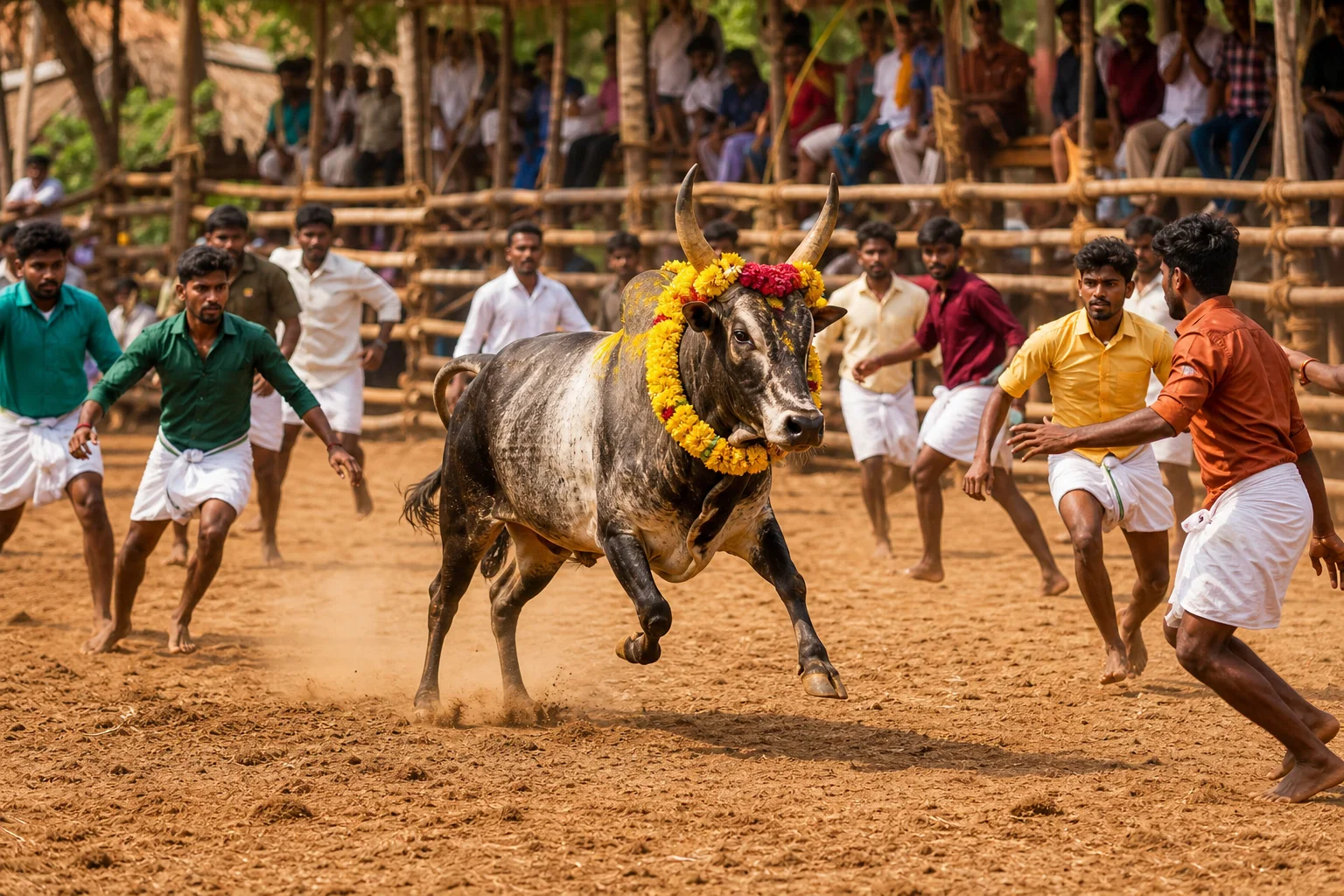
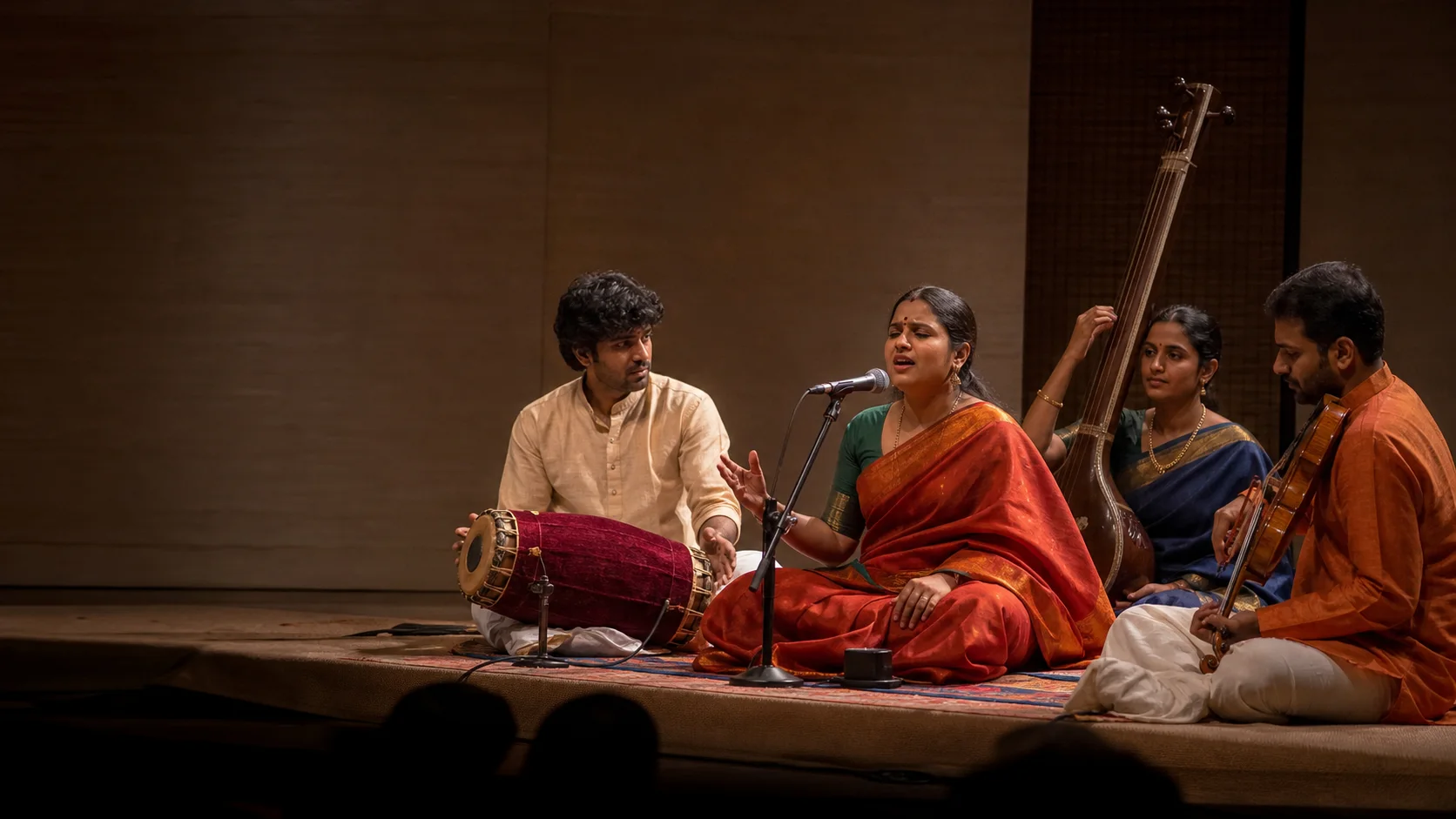
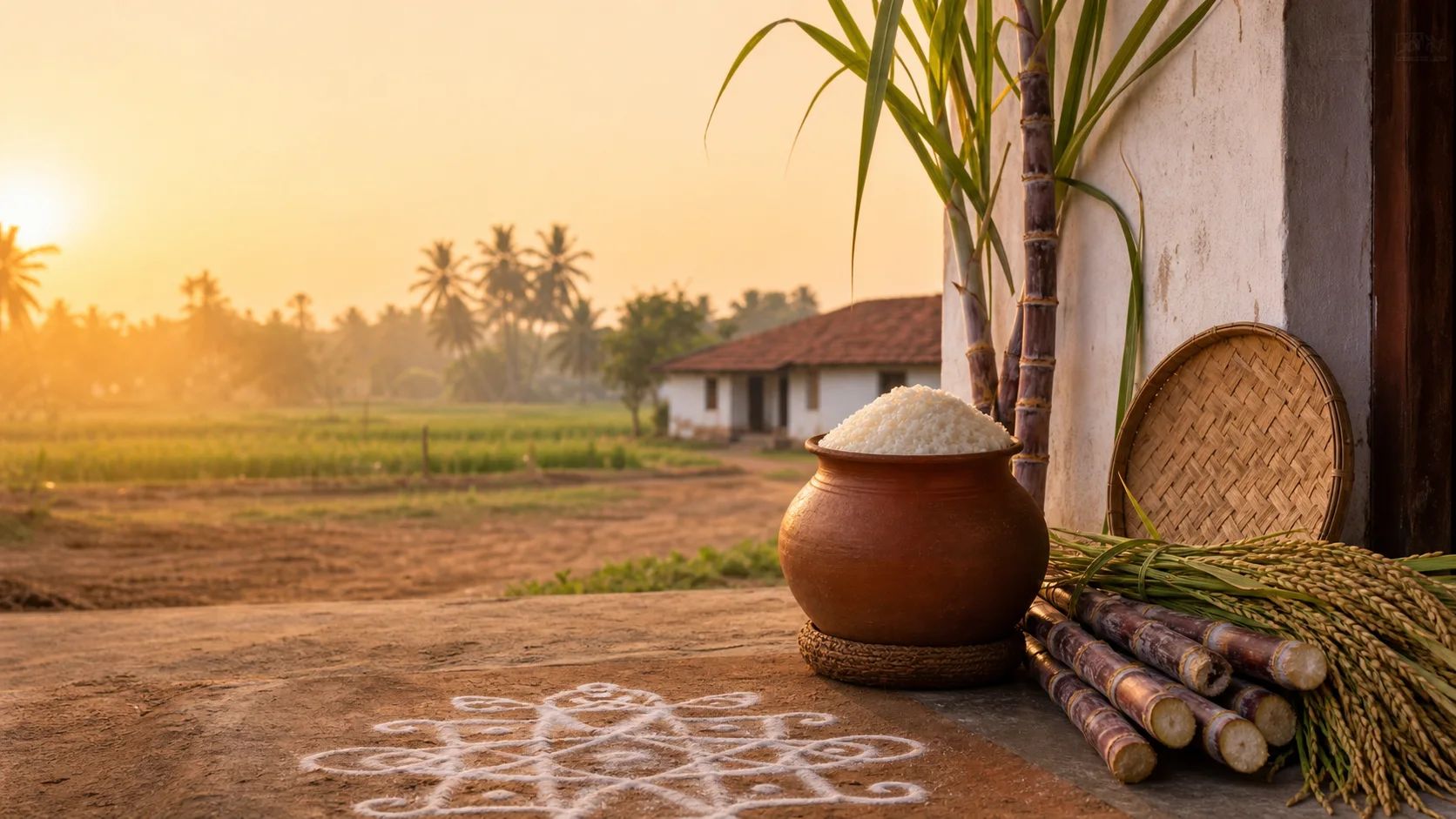
All images are original project-created editorial representations. They are not documentary records of a named person, maker, performance, meal, business or historical event.
Questions
Frequently asked questions
Does every community in Tamil Nadu share the same practice?
No. Language, repertoire, rules, participation and meaning vary by region, community, institution, household and generation.
Is the practice unchanged from ancient times?
No. The guide separates early evidence from later transmission, institutional change and present-day practice.
Can visitors photograph people or materials?
Ask the person, institution or event organizer first. Archives, performances, lessons and private homes may restrict photography or recording.
Are the page images documentary evidence?
No. They are clearly labelled project-created editorial representations and do not depict a named artifact, practitioner or event.
How were claims checked?
Government, university, archive and scholarly-institution sources were reviewed. Uncertain dates, origin stories and universal claims remain qualified.
Are all Tamil folk arts village dances?
No. The field includes theatre, storytelling, percussion, puppetry, ritual and stage adaptations as well as dance.
Is Therukoothu practised throughout Tamil Nadu in one form?
No. It has strong northern regional associations, and repertoire, duration and staging vary by troupe and event.
Can I book a ritual performance as entertainment?
Do not assume so. Ask responsible practitioners whether a form has a suitable public-stage version and follow their conditions.
Editorial trust
Sources and further reading
Claims are cited inline. Source type, author or institution, publication information and review date are visible here.
- 1Folklore: An IntroductionTamil Virtual AcademyCurrent learning resource · Government of Tamil Nadu educational source · Reviewed 13 August 2026
- 2Folk Plays: TherukoothuTamil Virtual AcademyCurrent learning resource · Government of Tamil Nadu educational source · Reviewed 13 August 2026
- 3Cultural PackagesCentre for Cultural Resources and TrainingCurrent educational catalogue · Ministry of Culture educational source · Reviewed 13 August 2026
- 4Intangible Cultural HeritageSangeet Natak AkademiCurrent institutional programme · National performing-arts institution · Reviewed 13 August 2026
Fact and sensitivity review: Documented history, living tradition, oral tradition, religious significance and modern practice were checked as separate claim types on 13 August 2026. Food pages were also reviewed for unsupported origin, GI, health, restaurant, price and availability claims.