
Filter coffee, milk and a name with several explanations
Kumbakonam Degree Coffee
A place-associated style of South Indian filter coffee whose brass service is recognizable, while the meaning and origin of 'degree' remain debated.
Orientation
Quick overview
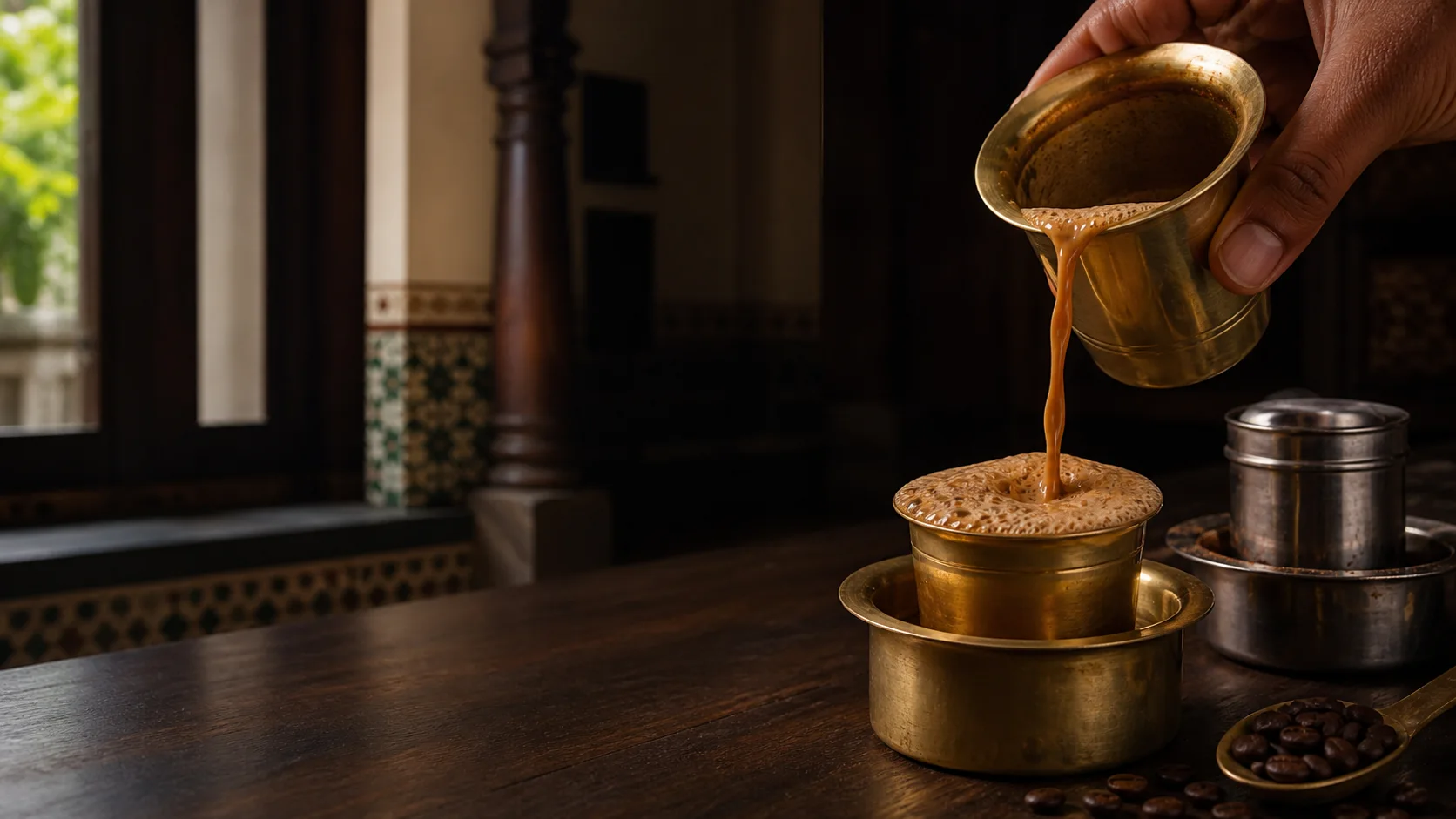
Kumbakonam degree coffee is a place-associated expression of South Indian filter coffee, commonly imagined as a strong decoction combined with hot milk and sugar, then aerated between a metal tumbler and davara. Bean blend, roast, chicory, decoction strength, milk and sweetness vary, so the name does not specify one formula.
Historian A. R. Venkatachalapathy documents how coffee drinking became part of colonial Tamil middle-class culture, challenging the idea that it has always occupied the same place in Tamil life. Coffee Board material places Tamil Nadu within India's traditional southern coffee-growing and consuming region while showing that filter coffee now shares the market with instant forms.[1][2][3]
Several explanations of 'degree' circulate: the quality or purity of milk, a lactometer reading, the strength or first extraction of decoction, or later commercial storytelling. The evidence reviewed does not support selecting one as settled. The page treats the term as cultural language with a debated etymology.
DRINK PRACTICE
Filter, decoction, milk and foam
A South Indian metal filter typically holds ground coffee in an upper chamber while hot water passes slowly into a lower chamber, producing decoction. A measured amount is mixed with hot milk and sugar. Pouring between tumbler and davara can cool, combine and aerate the drink.
The visible high pour is not mandatory and should be done safely. Foam does not prove bean quality, and brass does not guarantee a Kumbakonam origin. Vessel, method and ingredient claims should be described separately.
PANTRY
Coffee, chicory and the question of strength
Indian filter blends may combine arabica, robusta and chicory in varied proportions, while some drinkers prefer coffee without chicory. Roast and grind affect extraction. 'Strong' can mean more decoction, darker roast, more robusta, less milk or simply a familiar sensory expectation.
The Coffee Board identifies Tamil Nadu as one of India's traditional coffee-growing states, though a cup served in Kumbakonam is not necessarily made from beans grown nearby. Supply networks connect the delta with plantations and roasters elsewhere.[2]
DOCUMENTED HISTORY
Coffee in colonial Tamil society
Coffee cultivation and coffee drinking have different histories. Venkatachalapathy's cultural history traces the beverage's rise in colonial Tamil society through print, domestic routine, status and debate. This record complicates claims that today's filter-coffee ritual is timeless.[1]
Domestic preparation involved labor, fuel, milk supply and equipment, often gendered and divided by household hierarchy. Public coffee houses and later branded stalls created other social spaces. Nostalgia can preserve sensory detail while smoothing over these inequalities.
ORAL TRADITION
What might 'degree' mean?
One explanation links degree to high-quality or undiluted milk, sometimes through a lactometer. Another links it to decoction strength or the first extraction. Some accounts hear a transformed English word or a commercial quality mark. These explanations are repeated more often than they are documented.
A careful guide therefore says 'degree coffee' is a culturally established name associated with Kumbakonam, while its etymology is disputed. A memorable story may still matter to a family or business; it should be labelled as that source's account rather than universal history.
LIVING TRADITION
Kumbakonam, delta hospitality and brand expansion
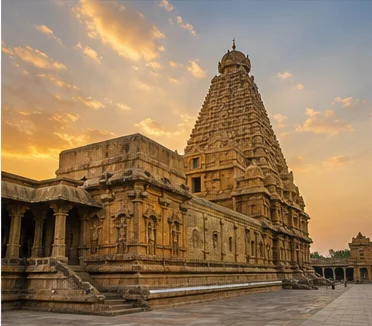
Kumbakonam's temple-town and Kaveri-delta identity gives the drink a powerful setting. Hospitality, railway and road travel, pilgrimage and urban stalls have helped the name circulate. The city association is culturally real even though a branded outlet elsewhere may use a different blend or method.
The phrase is now widely commercialized. This page does not endorse a chain or establish who can use the name. Trademark, GI and cultural reputation are different. No registered Kumbakonam Degree Coffee GI claim is made.[4]
MODERN PRACTICE
A changing filter-coffee culture
Coffee Board research reports a national shift toward instant coffee while ground and filter coffee remain significant, especially in home consumption. Equipment, pre-ground blends, ready decoction and cafe service change the routine without erasing the older filter method.[3]
Taste can be explored by adjusting one variable at a time: decoction, milk, sugar or blend. No caffeine or health claim is made. People who need dietary or medical guidance should rely on qualified advice and current product labels.
Editorial method
How to read a regional cuisine carefully
These principles keep a place-associated food from becoming a single recipe or marketing story.
Regional cuisine is an archive of land, water, labor, trade, household economy, religion, migration and taste. A restaurant menu records one commercial version; it cannot define every kitchen in a region. This guide uses named dishes as points of entry and keeps vegetarian, non-vegetarian, everyday, festive, community-specific and commercial settings distinct.
Dish names travel. The same name may refer to different textures or ingredients, while closely related preparations may have several names. Ingredients also shift with season, cost, dietary practice and availability. The page describes common associations rather than issuing an authenticity test based on one recipe. It intentionally does not reproduce a full recipe or claim that a modern plated version is ancient.
Origin stories need stronger evidence than popularity. Family memory, trade history, local pride and business publicity may preserve valuable clues, but they do not always agree. Where several accounts circulate, this guide names the disagreement and avoids selecting an 'original' shop, inventor or date without documentary support.
Heat is not a complete description of Tamil food. Chilli, black pepper, souring agents, aromatics, roasted pulses, coconut, sesame, curry leaves, grains, greens and cooking technique create different balances. Some preparations are assertive; others are mild, sweet, fermented, steamed or gently seasoned. Individual kitchens tune them differently.
Food experiences also involve people and working conditions. Ask before photographing cooks or vendors, avoid blocking a counter, disclose allergies without assuming a shared kitchen can eliminate cross-contact, and judge hygiene from current conditions rather than reputation. This page does not rank businesses, publish hours or promise that a dish will be available on a particular day.
Agricultural evidence and culinary evidence should not be confused. A crop report can show that turmeric, millet or coconut is grown in a zone; it does not prove how every household used it or when a named dish emerged. Cookbooks, oral histories, menus, account books, utensils and market records answer other questions. Strong food history combines several evidence types and keeps their limits visible.
Season and preservation help organize kitchens. Fresh greens, mango, tubers, fish, milk and festival ingredients have different calendars, while drying, fermenting, pickling, roasting and storing extend availability. Refrigeration, transport and supermarkets change those relationships. Calling an ingredient seasonal should therefore identify the place and period rather than assume an unchanging annual menu.
Labor belongs inside the story of taste. Washing, grinding, fuel management, repeated stirring, leaf preparation, service and cleanup can take more time than a dish's final appearance suggests. Large ceremonial meals depend on coordination and often on specialists. Crediting only a host, chef or brand can hide women, assistants, farmers, vendors and craftspeople whose work makes the meal possible.
Geographic names can describe reputation, style, production or marketing, and these are not identical. A dish sold far from its associated town may still carry a recognizable method, or it may use the name loosely. Legal GI status is a narrower question checked through the official registry. This guide never infers registration from fame, packaging or a repeated tourism slogan.
A tasting note is an observation, not a verdict on identity. Texture, aroma, heat and sweetness depend on temperature, freshness, portion and the taster's experience. Describing those qualities precisely is more useful than declaring a dish best, pure or original. Regional significance does not depend on winning a ranking.
Practical participation
Taste This Region
Treat the cup as a method and social ritual, not proof of one origin legend.
Ask about the blend
Coffee species, chicory and roast all shape flavor.
Watch the filter
Decoction strength matters more than theatrical pouring.
Choose milk and sugar
There is no single mandatory ratio.
Keep the name story open
Several explanations of 'degree' circulate.
Regional orientation
Geographic context
This is place-name context, not a claim that a cultural boundary can be drawn as a precise modern polygon.
A place-associated name now used far beyond the town
Google Maps is provided only as an orientation fallback. It does not verify cultural boundaries, opening hours, businesses, events or access.
Visual guide
Images with explicit provenance
All images are original project-created editorial representations. They are not documentary records of a named person, maker, performance, meal, business or historical event.

Questions
Frequently asked questions
Is this the only authentic version?
No. Recipes and meal structures vary across households, communities, seasons and cooks.
Does the guide recommend a restaurant?
No. Restaurant quality, hours, prices and hygiene are current information requiring a separate review process.
Are full recipes included?
No. The page explains ingredients, techniques and cultural context without presenting a standardized recipe.
Is every dish very spicy?
No. Tamil regional cuisines balance heat with sourness, aromatics, grains, pulses, coconut, sweetness and technique in different ways.
Can dietary safety be guaranteed?
No. Ask the person preparing the food about ingredients and cross-contact; names alone do not establish allergen or dietary status.
How were origin claims handled?
Documented history is separated from oral tradition, family memory and commercial claims. Unsettled stories remain unsettled.
What does 'degree' mean?
Several explanations circulate, including milk quality and decoction strength; this guide found no basis to select one as settled.
Must degree coffee contain chicory?
No single blend is universal. Coffee-only and coffee-chicory blends both occur.
Does it have a GI registration?
No registered GI claim is published here because one was not verified in the official registry during review.
Editorial trust
Sources and further reading
Claims are cited inline. Source type, author or institution, publication information and review date are visible here.
- 1'In Those Days There Was No Coffee': Coffee-drinking and Middle-class Culture in Colonial TamilnaduA. R. Venkatachalapathy, Indian Economic & Social History Review2002 · Peer-reviewed cultural history · Reviewed 9 August 2026
- 2Coffee Regions of IndiaCoffee Board of IndiaCurrent official resource · Government commodity board · Reviewed 9 August 2026
- 3Coffee Consumption Trends in India, 2023Coffee Board of India2024 · Government market study · Reviewed 9 August 2026
- 4All GI ApplicationsGeographical Indications Registry, Intellectual Property IndiaCurrent registry · Official legal registry · Reviewed 9 August 2026
Fact and sensitivity review: Documented history, living tradition, oral tradition, religious significance and modern practice were checked as separate claim types on 9 August 2026. Food pages were also reviewed for unsupported origin, GI, health, restaurant, price and availability claims.