
Speech, script and a living classical tradition
Tamil Language
A guide to Tamil as speech, writing, literature and public culture, with careful distinctions between early evidence, classical recognition and the many forms used today.
Orientation
Quick overview
Tamil is a Dravidian language used in everyday conversation, education, administration, media, worship, literature and digital communication. It is closely identified with Tamil Nadu, yet its speakers and literary networks extend across India and global communities. A state guide should therefore explain Tamil's strong regional place without turning political boundaries into linguistic boundaries.
The language has an extensive written record and a celebrated classical corpus. Those facts do not justify the popular claim that Tamil is simply the world's oldest language or that it has remained unchanged for thousands of years. Languages change continuously. Linguists, epigraphists and literary scholars date particular inscriptions, scripts, grammatical descriptions and works; they do not assign one uncontested birthday to an entire living language.[1][4]
Modern Tamil includes formal prose, public speech, regional and social varieties, specialist vocabularies, literary styles and rapidly changing online usage. The Central Institute of Indian Languages even lists a study devoted to formal and informal Tamil, a useful reminder that learning a textbook register is not the same as understanding every conversation.[7]
LINGUISTIC CONTEXT
Tamil within the Dravidian language family
Tamil belongs to the Dravidian family alongside Malayalam, Kannada, Telugu and many other languages. Family classification concerns historically related language structures; it is not a ranking of cultural worth. Tamil and Malayalam are especially close, but each has its own literary, political and social histories. Contact with Sanskrit, Prakrit, Persian, Arabic, Portuguese, English and neighbouring languages has also shaped vocabulary and usage over long periods.
Words borrowed through trade, government, religion, technology or popular culture become part of real language use. Efforts to promote Tamil vocabulary and debates about linguistic purity belong to modern cultural history, but no speaker's everyday mixture should be treated as evidence of deficient identity. Context decides whether a classical term, colloquial expression, technical coinage or borrowed word is useful.
Official mother-tongue data must be dated. Census 2011 provides tables by state, district, urban or rural residence and sex; it does not describe every multilingual person's proficiency or how language choices have changed since 2011. The table is evidence for that census moment, not a live speaker counter.[8]
EPIGRAPHY
Tamil-Brahmi and the evidence of inscriptions
Early Tamil writing is studied through inscriptions on caves, pottery, coins and other material contexts. Scholars commonly use the label Tamil-Brahmi for an adapted Brahmi script used to write early Tamil. Reading an inscription requires attention to letter forms, archaeological context, language, damage, later copying and the history of publication. A photograph by itself is not a secure translation.
The Pavendhar Library catalogue describes Iravatham Mahadevan's study of Tamil-Brahmi and early Vatteluttu cave inscriptions extending to the sixth century CE. That work is a major reference, while individual readings and dates remain subjects for specialist epigraphy. This guide does not turn one inscription into proof that modern speech or script already existed in its present form.[4]
Inscriptions are especially valuable because they record names, gifts, institutions, titles and language in material settings. Their survival is uneven. Stone lasts differently from palm leaf, and discovery patterns favour some places and activities. Absence from the surviving inscriptional record is therefore not proof that a word, group or practice did not exist.
WRITING SYSTEM
From early scripts to modern Tamil type
Tamil has been written through changing scripts and letter forms. Tamil-Brahmi belongs to an early inscriptional context; Vatteluttu and other regional practices appear in later records; Grantha characters were used in particular settings, especially for Sanskrit material; and modern Tamil print forms emerged through manuscript, scribal, printing and educational histories. These developments overlap rather than forming a perfectly neat replacement chart.
The modern script combines independent vowel signs, consonants and dependent vowel marks, with the pulli distinguishing a consonant without an inherent vowel. Learners benefit from understanding sound-letter relationships, but handwriting, typeface design and digital fonts can make the same character look different. Transliteration is a study aid, not a substitute for the script.
Printing standardized some choices while creating new debates about spelling, punctuation and type. Unicode and digital input systems now allow Tamil across websites, messages, archives and publishing tools. Digital access still depends on accurate encoding, usable keyboards, readable fonts and preservation. Tamil University's computing projects, including electronic catalogues and language resources, show how language scholarship now connects archives with technology.[10]
CLASSICAL STATUS
What classical recognition means
The Government of India recognized Tamil as a classical language on 12 October 2004. The Central Institute of Classical Tamil is an autonomous institution under the Ministry of Education devoted to research, documentation, editions, translation and teaching connected with the classical phase. This is a formal policy and research status, not a claim that only classical Tamil is authentic.[1]
CICT organizes a programme around forty-one ancient grammatical and literary works through the period it defines up to 600 CE. The list includes different genres and textual histories. A modern reader should not imagine that all works were composed at the same date, by the same social world or in the same form in which later manuscripts preserve them.[2][3]
Classical study and living language use support different questions. A critical edition compares manuscripts and commentaries; a conversation follows contemporary pronunciation and social register. Students can value both without asking present speech to imitate an early poem or treating colloquial Tamil as decay.
LIVING LANGUAGE
Spoken, written, regional and social variation
Tamil often displays a marked difference between formal written styles and everyday spoken forms, sometimes discussed through the linguistic idea of diglossia. News reading, an official letter, a novel's dialogue, a lecture, a film scene and a family conversation may choose grammar and vocabulary differently. No single pair of 'high' and 'low' forms captures every situation.[7]
Speech varies across Chennai, the Kaveri delta, western districts, the far south and other regions, while caste, religion, occupation, age, education, migration and media also matter. Regional labels are broad tendencies, not scripts for how a person must sound. Mimicking an accent for comedy can reproduce status prejudice, especially when the speaker's own account is ignored.
Multilingualism is ordinary. A Tamil speaker may also use Telugu, Urdu, Malayalam, Kannada, English or another language at home, school or work. Census categories simplify this complexity. Responsible discovery asks which language a person prefers in that setting instead of assuming identity from place, name or appearance.[8]
MODERN USAGE
Education, media, institutions and digital Tamil
Tamil appears across state public life, but the exact language of a school, court filing, service or examination depends on current law and institutional rules. This evergreen guide does not promise a particular service language. Visitors needing an official form should check the responsible department's current portal.
Newspapers, radio, cinema, television, publishing and social media continually extend Tamil's vocabulary and stylistic range. Subtitling, speech technology, optical character recognition and digital archives can broaden access while introducing errors. A digitized page remains an image until its metadata, transcription and rights are handled carefully.
CICT's Pavendhar Library and digital programmes support access to classical works, commentaries, translations and research. Tamil University's palm-leaf and computing departments preserve and catalogue other materials. These institutions are starting points for discovery; catalogue availability, reading-room access and reproduction permission must be confirmed directly.[5][6][9][10]
LEARNING PATH
How to begin learning and listening
Start with the script and sounds, then pair a structured course with real listening. Learn how respect, familiarity, age and setting affect address. A phrase that is grammatically possible may still feel too formal, abrupt or intimate. Teachers and trusted speakers can explain those social choices better than a word list.
Read across formats: a short news item, children's text, caption, poem in translation and conversation transcript reveal different registers. For early literature or inscriptions, use an edition that names its editor, manuscript basis or epigraphic source. Anonymous quote graphics and claims of perfect translation should be treated cautiously.
The most respectful learning goal is communication, not performance of purity. Expect correction, variation and words you do not know. Ask whether a speaker is comfortable helping, credit translators, and avoid using sacred, political or identity-laden phrases as decorative content without understanding their setting.
Editorial method
How to read a living culture carefully
These principles keep practice, history, memory and modern representation in proportion.
A cultural practice is not a specimen sealed at one date. It is learned, repeated, adjusted, argued over and sometimes deliberately revived. Household routine, hereditary training, religious observance, public institution, classroom, stage, market and social media can all sustain the same named tradition in different ways. This guide therefore identifies the setting behind a claim instead of treating one version as the Tamil version.
Documented history and community memory answer different questions. An archive can date an organization or law; a repertoire can preserve techniques not fully explained in writing; an oral account can reveal how practitioners understand continuity. The page labels these forms of evidence so a meaningful tradition is not dismissed for lacking an inscription, and a compelling story is not quietly converted into a settled historical fact.
Terms used in English often flatten distinctions. Classical, folk, ritual, domestic, sacred, secular, traditional and modern are useful only when the page explains who is using the label and why. A practice may move between these categories over time. It can also carry unequal histories involving caste, gender, patronage, labor and access, even when a present performance is celebratory.
Variation is not an exception to be corrected. District, language register, religion, community, occupation, age, migration and family history all influence practice. This page describes patterns supported by the cited institutions while leaving room for people whose experience differs. Phrases such as 'many households' or 'in some performance lineages' are intentional evidence controls, not vagueness.
Responsible participation begins with context and consent. Observe before entering a working space; ask before photographing a person, ceremony, lesson or design; pay clearly for instruction or craft; follow venue and household rules; and avoid asking a practitioner to stage sacred or private activity as entertainment. Cultural respect is practical behavior, not a decorative disclaimer.
Archives have their own silences. Court, temple and government records often preserve patrons, rules and institutions more readily than the voices of performers, artisans and household practitioners. Photographs may be staged or captioned by outsiders. A catalogue can identify an object while omitting who prepared its materials or taught the technique. Reading against these gaps is necessary, but a gap cannot be filled with an attractive invention.
Transmission is rarely a clean line from an ancient text to a present learner. People learn by watching, correcting, repeating, listening, memorizing, improvising and discussing. Printed manuals, recordings and online demonstrations can widen access while leaving tacit skills difficult to capture. When a page says a tradition is transmitted, it should ask what is transmitted, by whom, in which setting and under what conditions.
Language matters because technical terms do not always map neatly into English. A translation may clarify a first encounter while losing social register, poetic resonance or several possible meanings. This guide keeps essential Tamil or specialist words where they help and explains them in context. It avoids treating an English gloss as the complete definition of a term used differently by practitioners.
Institutions preserve and reshape culture at the same time. An academy can stabilize a curriculum, a museum can conserve material, a government inventory can make a practice visible and a festival can create paid stages. Each also selects what counts as representative. Institutional recognition is therefore evidence of recognition and activity, not proof that one approved version exhausts a tradition.
Migration and digital circulation create new cultural geographies. A practice learned in Madurai may be taught in Singapore, Toronto or Dubai; a pattern posted online may return to Tamil Nadu in altered form. Diaspora continuity is not a lesser copy, yet its setting differs from a temple, agrarian household or Chennai concert hall. Place remains important without becoming a purity test.
Cultural continuity includes disagreement. Practitioners may debate costume, repertoire, religious meaning, ownership, caste history, innovation or commercial use. Reporting that debate does not weaken the tradition. It shows that people care enough to contest its future. The editorial task is to identify positions and evidence fairly rather than manufacture a unanimous community voice.
Time words require care. Ancient, classical, medieval, traditional and modern are not interchangeable compliments. An old text can describe a concept without proving that today's full practice existed in the same form; a modern institution can preserve older material while changing presentation. Whenever chronology matters, a page should name the evidence and the particular feature being dated instead of assigning one age to the whole tradition.
Religious significance is also situated. A movement, pattern, song, object or festival action may be an offering in one setting, an artistic study in another and a marker of family identity elsewhere. Sacred meaning should be reported through practitioners and responsible institutions. It should neither be dismissed as folklore nor converted into a universal instruction for every reader.
The visitor's presence changes a cultural setting. Cameras alter attention, applause can interrupt ritual timing, and requests for explanation can add unpaid work. A responsible encounter accepts that some knowledge is private, specialist or learned slowly. The aim is not to collect every symbol in one visit, but to leave with a more accurate sense of people, place, skill and uncertainty.
Material details deserve the same care as celebrated meanings. Powder, thread, instrument wood, costume stitching, floor surface, fuel and storage all influence what can be made. Substitution may respond to price, regulation, ecology or access. Documenting those choices helps explain how practice continues without judging every new material as decline or every old material as inherently superior.
Finally, evidence should remain traceable. A reader ought to be able to distinguish a government inventory from a practitioner's account, a peer-reviewed argument from institutional history and a current programme from a permanent fact. The numbered sources on this page are a starting set rather than a claim to final authority. Future revision should add practitioner-led and Tamil-language scholarship wherever rights and reliable access permit.
Practical participation
Explore Tamil Responsibly
Combine listening, reliable learning materials and traceable archives without reducing a living language to slogans.
Learn the script
Use transliteration as a bridge, then practise Tamil letters and sound patterns.
Notice the register
Compare formal writing with conversation without ranking either as more real.
Date the evidence
A census table, inscription and social-media post answer different historical questions.
Credit language work
Name translators, editors, teachers and speakers when their work supports your understanding.
Regional orientation
Geographic context
This is place-name context, not a claim that a cultural boundary can be drawn as a precise modern polygon.
A living language whose speech, script and institutions extend beyond one modern boundary
Google Maps is provided only as an orientation fallback. It does not verify cultural boundaries, opening hours, businesses, events or access.
Visual guide
Images with explicit provenance
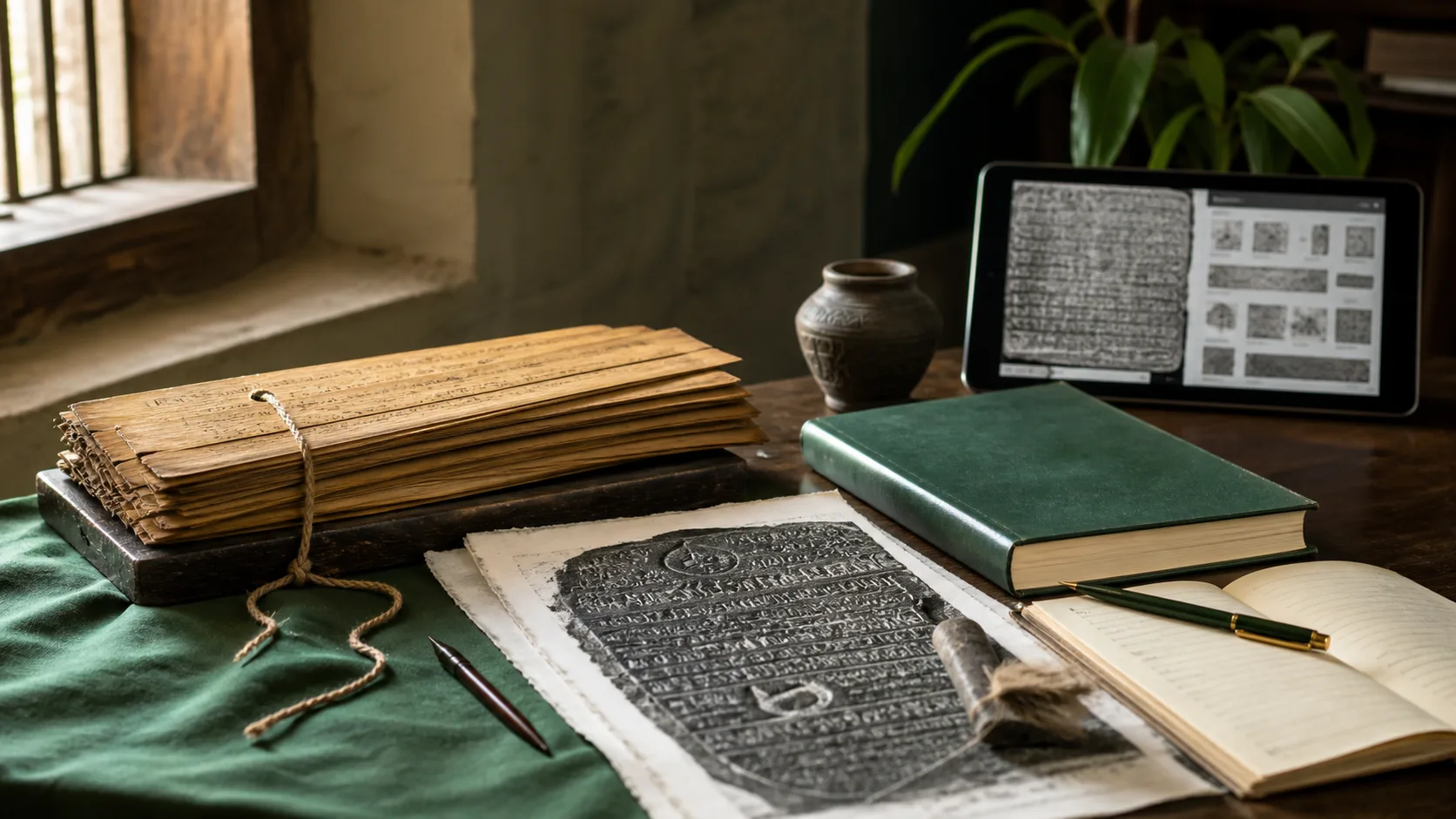
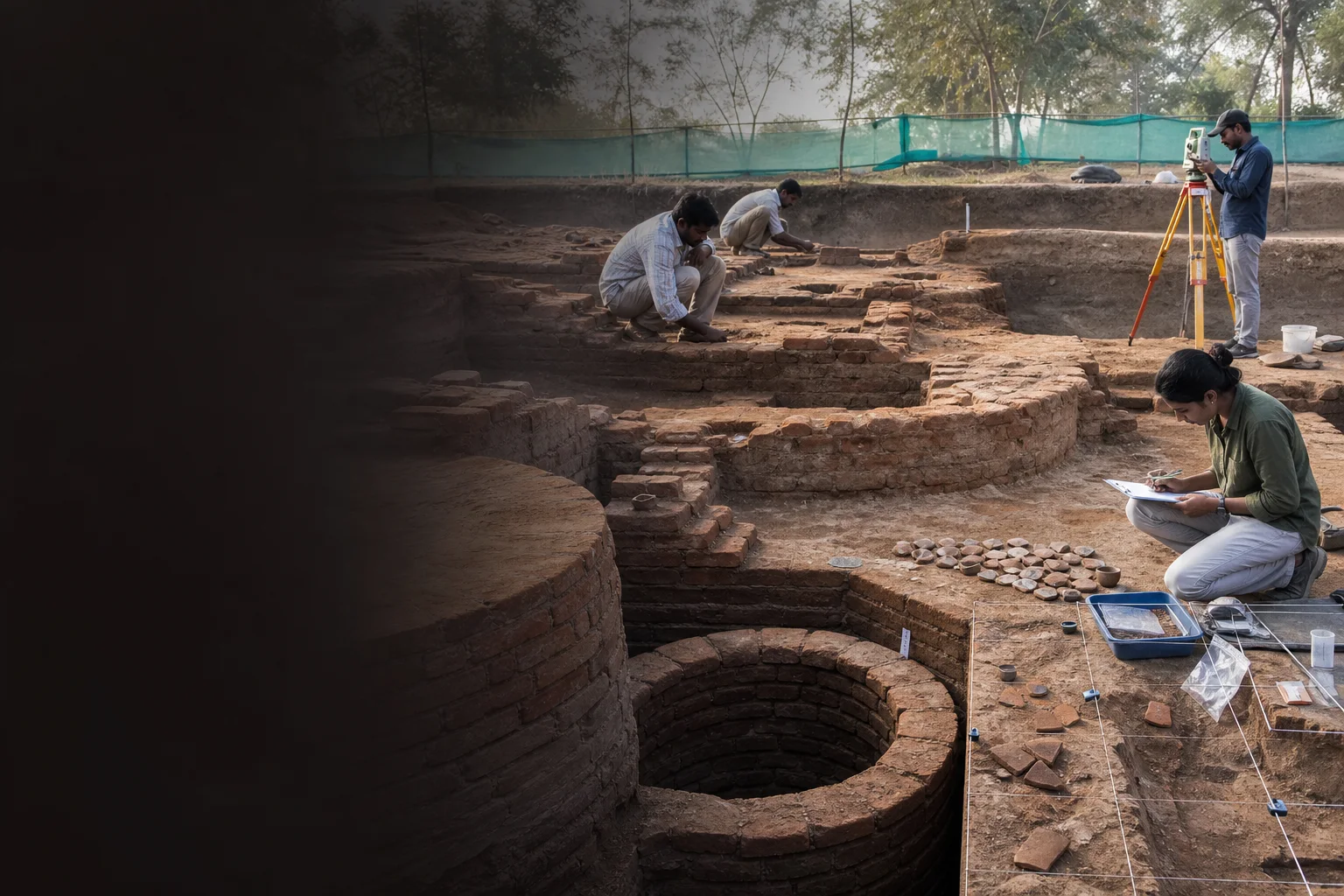
All images are original project-created editorial representations. They are not documentary records of a named person, maker, performance, meal, business or historical event.
Questions
Frequently asked questions
Does every community in Tamil Nadu share the same practice?
No. Language, repertoire, rules, participation and meaning vary by region, community, institution, household and generation.
Is the practice unchanged from ancient times?
No. The guide separates early evidence from later transmission, institutional change and present-day practice.
Can visitors photograph people or materials?
Ask the person, institution or event organizer first. Archives, performances, lessons and private homes may restrict photography or recording.
Are the page images documentary evidence?
No. They are clearly labelled project-created editorial representations and do not depict a named artifact, practitioner or event.
How were claims checked?
Government, university, archive and scholarly-institution sources were reviewed. Uncertain dates, origin stories and universal claims remain qualified.
Is Tamil the world's oldest language?
That superlative is not a sound linguistic claim. Tamil has a long written record and living classical tradition, but languages change and do not have one uncontested birthday.
Is spoken Tamil the same as written Tamil?
Not always. Register varies by speech, formal prose, literature, media, region and social setting.
Where can I study early Tamil texts?
Begin with CICT, Tamil University and editions that identify editors, manuscripts or inscriptions. Confirm current access directly with each institution.
Editorial trust
Sources and further reading
Claims are cited inline. Source type, author or institution, publication information and review date are visible here.
- 1About the Central Institute of Classical TamilCentral Institute of Classical TamilCurrent institutional overview · Government research institution · Reviewed 13 August 2026
- 2Research Works on 41 ClassicsCentral Institute of Classical TamilCurrent research programme · Government research institution · Reviewed 13 August 2026
- 3Major ProjectsCentral Institute of Classical TamilCurrent research programme · Government research institution · Reviewed 13 August 2026
- 4Early Tamil EpigraphyPavendhar Library, Central Institute of Classical Tamil2023 edition record · Government research-library catalogue · Reviewed 13 August 2026
- 5Pavendhar LibraryPavendhar Library, Central Institute of Classical TamilCurrent institutional overview · Government research library · Reviewed 13 August 2026
- 6Digital LibraryPavendhar Library, Central Institute of Classical TamilCurrent institutional overview · Government digital-library programme · Reviewed 13 August 2026
- 7Southern Regional Language Centre: Tamil PublicationsCentral Institute of Indian LanguagesCurrent catalogue · Government linguistic institute · Reviewed 13 August 2026
- 8C-16: Population by Mother Tongue, Tamil Nadu, 2011Office of the Registrar General & Census Commissioner, India2011 census table · Official statistical dataset · Reviewed 13 August 2026
- 9Department of Palmleaf ManuscriptologyTamil UniversityCurrent institutional overview · State university archive · Reviewed 13 August 2026
- 10Department of Computer ScienceTamil UniversityCurrent institutional overview · State university source · Reviewed 13 August 2026
Fact and sensitivity review: Documented history, living tradition, oral tradition, religious significance and modern practice were checked as separate claim types on 13 August 2026. Food pages were also reviewed for unsupported origin, GI, health, restaurant, price and availability claims.