Poets & Writers · Freedom Fighters · Reformers
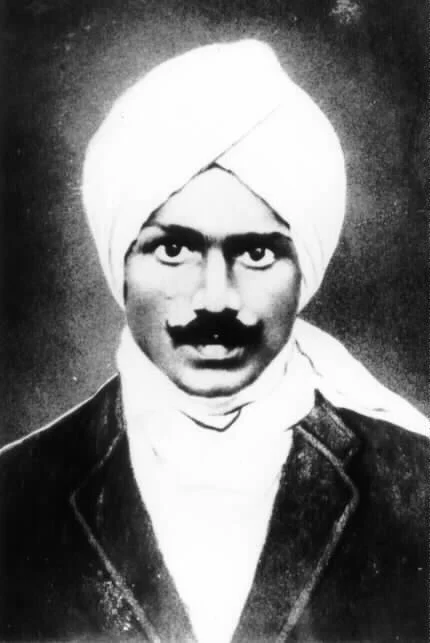
Subramania Bharati
சுப்பிரமணிய பாரதி
11 December 1882 – 11 September 1921
Subramania Bharati brought poetry, journalism, political argument, and social criticism into a charged early twentieth-century Tamil public sphere. His years in Ettayapuram, Chennai, and French-ruled Pondicherry shaped a body of work whose literary energy cannot be reduced to patriotic songs alone.
Editorial status: Published · Reviewed 10 August 2026- Field
- Poetry, prose, translation, and journalism
- Languages
- Primarily Tamil; also worked across multilingual contexts
- Political context
- Swadeshi and Indian nationalist movements
- Associated places
- Ettayapuram, Chennai, and Pondicherry
- Major themes
- Freedom, equality, women, caste, devotion, and nature
- Life
- 1882–1921 [1]
Life and context
Who Subramania Bharati Was
Subramania Bharati was a Tamil poet, prose writer, journalist, translator, and nationalist public intellectual born at Ettayapuram on 11 December 1882. He is often addressed as Bharathiyar or Mahakavi Bharati in public memory. This profile uses Subramania Bharati as the primary English name and records meaningful variants for search without multiplying canonical identities. [1][5]
His writing joined literary experiment to the politics of the early twentieth century. Poems and essays addressed national freedom, social equality, women, caste, labor, education, devotion, nature, and international events. These concerns did not form one fixed manifesto; they changed across genres, publications, and moments of political pressure. [2][4]
Bharati's importance to Tamil modernity lies partly in the intensity and accessibility of his language, but simple claims that he single-handedly modernized Tamil erase earlier writers, contemporaries, publishers, readers, and performance traditions. His distinctive contribution can be explained through specific writing and editorial work without declaring him the greatest poet.
Life and context
Ettayapuram, Education, and Literary Formation
Bharati's early life was connected with Ettayapuram, now in Thoothukudi District. Courtly literary culture and Tamil learning formed part of this environment. The title Bharati is associated with recognition of his poetic ability, but later ceremonial accounts should not be made to supply unsupported exact details. [1]
Time spent in north India exposed him to languages, religious debate, and a wider political geography. Biographies often present this as a single awakening; intellectual formation is better understood as cumulative. Tamil classical and devotional literature, Sanskritic traditions, journalism, translation, public speech, and contemporary nationalist thought all entered his work in different ways.
Marriage, household obligations, employment, and economic insecurity belonged to the same life as literary ambition. Treating the poet only as inspired genius makes the practical conditions of print culture disappear: editors needed presses, paper, subscriptions, contributors, distributors, and readers, all under legal and financial constraints.
Life and context
Journalism and the New Public Sphere
In Chennai, Bharati worked in Tamil journalism and participated in a rapidly changing print public. Newspapers and journals carried news, political commentary, translation, satire, cartoons, poems, and debate. The periodical page allowed language to respond quickly to events in a way that a later collected volume can conceal. [2][3]
His association with publications including Swadesamitran and India connected literary style to nationalist argument. Editorial work was collaborative: proprietors, printers, artists, fellow writers, correspondents, and readers shaped what circulated. Colonial surveillance and press law also influenced where and how political material could be published. [2]
Bharati's use of political cartoons and visual satire belongs to this journalistic setting. An official commemorative record identifies cartoons in India, but claims about being the first in all Tamil journalism require a broader periodical survey and are not repeated here as settled fact. [3]
Life and context
The Pondicherry Years
Bharati moved to French-ruled Pondicherry in 1908 as colonial pressure intensified in British India. Pondicherry, now Puducherry, is a Union Territory and not a district of Tamil Nadu. Its different colonial jurisdiction gave Indian nationalists and publishers a space that was connected to, but not free from, surveillance and political risk. [2]
There he interacted with political and intellectual circles while continuing poetry, prose, translation, and periodical work. The years are associated with important compositions and with economic hardship. A place of refuge should not be romanticized as an uninterrupted creative retreat; borders, policing, publishing finance, and family life shaped the experience. [2]
When discussing Pondicherry, this site keeps current geography explicit. The profile links to Tamil Nadu's Culture and Freedom Movement guides because of Bharati's influence and activity, but it does not fabricate a Puducherry destination route inside a Tamil Nadu district architecture.
Life and context
Poetry, Form, and Literary Modernity
Bharati wrote across patriotic, devotional, philosophical, social, romantic, and nature poetry. Titles and clusters such as Kannan Pattu, Kuyil Pattu, and Panchali Sabatham indicate the range of voice and form, but a title does not summarize the full work. This page discusses themes and does not reproduce complete poems or lengthy translations. [4]
His writing could combine classical reference with direct rhythm, song-like movement, colloquial force, and new political vocabulary. Publication history matters because texts appeared in periodicals, pamphlets, manuscripts, and later editions. A familiar modern version may reflect editorial arrangement after his death, so claims about exact wording or chronology should follow textual scholarship.
Translation has helped Bharati reach readers beyond Tamil. Sahitya Akademi records its cooperation with UNESCO in publishing an English selection translated by Prema Nandakumar. A translation is an authored interpretation with its own copyright and editorial history; it should not be treated as transparent access to every nuance of the Tamil original. [4]
Life and context
Return, Later Life, and Death
Bharati returned from Pondicherry to British Indian territory in 1918 and was detained before release under conditions described in biographical accounts. The final years included renewed work in Chennai, continued writing, financial difficulty, and fragile health. Popular anecdotes about every encounter in this period are not included unless tied to reliable evidence. [1]
He died in Chennai on 11 September 1921 at the age of thirty-eight. Later accounts connect declining health with an incident involving the temple elephant at Parthasarathy Temple, but exact causal retellings often exceed the evidence available in short institutional summaries. This page records the verified death date without turning the incident into dramatic certainty. [1]
Much of Bharati's later status emerged through posthumous editing, publication, performance, education, cinema, political commemoration, and translation. That history explains why a writer with a short life came to occupy a large public presence. It also means readers should ask which edition, arrangement, or musical setting they are encountering.
Life and context
Places Associated With Subramania Bharati
Ettayapuram, in current Thoothukudi District, is associated with Bharati's birth and early literary life. Chennai is associated with journalism, political networks, and his final years. Both places are inside current Tamil Nadu, though the administrative settings and urban geographies of his lifetime differed from today's. [1]
Pondicherry was central to his publishing and nationalist period from 1908. It is now Puducherry, a separate Union Territory outside Tamil Nadu. Describing it as a Tamil cultural setting does not make it administratively part of Tamil Nadu. [2]
Bharati's work also reflects wider Indian and global reference points reached through travel, reading, translation, and journalism. A literary association is not the same as residence. This profile limits its place links to current, published My Tamil Nadu guides with a direct contextual value.
Life and context
Publication, Performance, and Legacy
Bharati's poems circulate through books, classrooms, public meetings, recordings, concerts, theatre, and film. Performance keeps the work alive but can detach a song from its original publication and political context. Readers benefit from hearing the music and also returning to reliable Tamil editions and source history.
His legacy spans literature and nationalism, but neither label is complete. Journalism shows the speed of his political thinking; poetry shows formal experiment and voice; essays show argument; translation shows intellectual exchange. Social criticism connects these genres without making them identical. [5][4]
A restrained assessment avoids both worship and dismissal. Bharati was a consequential modern Tamil writer whose language continues to animate debates about freedom and equality. The best way to understand that influence is through specific texts, editions, institutions, and historical contexts rather than unsupported superlatives.
Images with explicit provenance
Places and historical context
Chronology
Timeline
- 11 December 1882
Subramania Bharati was born at Ettayapuram, now in Thoothukudi District. [1]
- Early 1900s
Bharati entered Chennai journalism and nationalist public debate. [2]
- 1908
He moved to French-ruled Pondicherry as political pressure intensified in British India. [2]
- 1908–1918
The Pondicherry period included major poetic, journalistic, and political work under difficult conditions. [2]
- 1918
Bharati returned to British Indian territory and was detained before release. [1]
- 11 September 1921
He died in Chennai. [1]
Keep exploring
Places, periods, and connected guides
Related history
Associated places
Literature and culture
Questions
Frequently asked questions
Who was Subramania Bharati?
He was a Tamil poet, journalist, prose writer, translator, and nationalist public intellectual who lived from 1882 to 1921. [1]
Why is Bharati important to Tamil literature?
His work combined literary experiment, direct public language, journalism, song, and themes of freedom and social equality across several genres.
Why did Bharati live in Pondicherry?
French-ruled Pondicherry offered a different jurisdiction during colonial pressure in British India, enabling continued political and publishing work while remaining subject to surveillance and hardship. [2]
What did Bharati write about?
His subjects included nationalism, women, caste, labor, devotion, nature, love, philosophy, and international affairs.
Is Bharathiyar a different person?
No. Bharathiyar is a respectful and widely used form for Subramania Bharati; it is an alias for search, not a separate route.
Does this page reproduce Bharati's poems?
No. It names and explains works without reproducing full poems or lengthy translations; readers should use reliable editions.
Editorial trust
Sources & further reading
- Subramania BharatiMinistry of Culture, Government of India · Official biographical recordAccessed 10 August 2026
- Subramania Bharati and the Freedom Movement in PuducherryMinistry of Culture, Government of India · Official historical recordAccessed 10 August 2026
- Political Cartoons of Subramania BharatiMinistry of Culture, Government of India · Official periodical-history recordAccessed 10 August 2026
- Cooperation with UNESCO: Poems of Subramania BharatiSahitya Akademi · Prema Nandakumar, translator · 1982 revised edition · National literary institution recordAccessed 10 August 2026
- Subramania Bharati archival publicationTamil Nadu Archives and Historical Research · Government archival publicationAccessed 10 August 2026
Life and context
Freedom, Equality, Women, and Caste
Bharati's nationalist writing imagined political freedom together with social transformation. He wrote about women's education and agency, challenged caste hierarchy, and addressed labor and poverty. His language could be radical within his setting, yet a historical reader should examine each text and context rather than convert selected lines into a complete present-day policy program. [2][5]
The relationship between nationalism and social equality was contested across the period. Bharati's contribution lies in refusing to make freedom only a transfer of political authority. At the same time, his work should be read critically for shifts, tensions, and the assumptions of his era. Admiration does not require treating every statement as timeless or internally consistent.
Devotional and universalist language often operates beside political critique. Those modes are not necessarily contradictions, but neither should they be flattened into a single slogan. Genre, speaker, metaphor, and publication occasion help determine what a poem or essay is doing.