
Material evidence and method
Archaeology of Tamil Nadu
Learn how archaeologists build histories from landscapes, layers, objects, inscriptions, scientific samples, and documented uncertainty across Tamil Nadu.
Orientation
Overview
Prehistory to the recent past
Archaeology studies people through material remains and their contexts. In Tamil Nadu, those remains include stone tools, habitation deposits, rock art, burials, ceramics, beads, metal production, coins, inscriptions, ports, brick structures, temples, forts, industrial sites, and colonial landscapes. The field is not limited to finding rare objects. Its central work is recording relationships among soil layers, features, samples, objects, buildings, and landscapes.[1][3]
The State Department of Archaeology and the Archaeological Survey of India have conducted excavations at sites including Adichanallur, Keezhadi, Korkai, Kodumanal, Poompuhar, and many others. Universities, museums, laboratories, and independent scholars also contribute surveys, epigraphy, conservation, and analysis. Each project has a defined research question, permit, season, method, and publication history.[1][2][9]
Public discussion often jumps from one spectacular find to a sweeping claim about the oldest city, language, religion, kingdom, or civilization. Archaeology moves more slowly. A sample date belongs to a sample and context; a potsherd inscription belongs to a vessel fragment and layer; a brick wall belongs to a sequence of construction and reuse. Strong interpretation explains those steps.[10][9][4]
Archaeology also has ethical obligations. Excavation is destructive because a layer cannot be put back after removal. Teams therefore document plans, sections, coordinates, photographs, samples, and field observations. Conservation and publication are part of the work. Visitors protect the record by staying out of trenches, obeying barriers, and leaving every object where it lies.
Chronology
A careful timeline
Dates identify documented phases and broad ranges. They do not imply uninterrupted rule or certainty where the evidence remains debated.
Stone tools and changing landscapes
Survey and excavation trace long histories before writing; dates depend on site and method.[3]
Burials, iron and settlement
Urns, cairns, cists, pottery, iron objects, and habitation evidence vary across regions.[9][1]
Writing, craft and exchange
Tamil-Brahmi, settlements, ports, coins, and production sites broaden the record.[4][6][7]
Temples, towns and inscriptions
Buildings and inscriptions document institutions while settlement archaeology recovers wider life.[5]
Forts, factories and urban layers
Archaeology can test archives and recover spaces omitted from official narratives.[12]
Conservation and new analysis
Scientific methods and renewed publication continue to refine interpretations.[2]
Historical reading
From research question to excavation report
Archaeological work often begins with a question: how did a settlement develop, where did raw materials move, how was a burial ground organized, or how did a coastline change? Researchers review earlier reports, maps, inscriptions, oral knowledge, remote sensing, geology, and surface finds before choosing whether excavation is necessary.
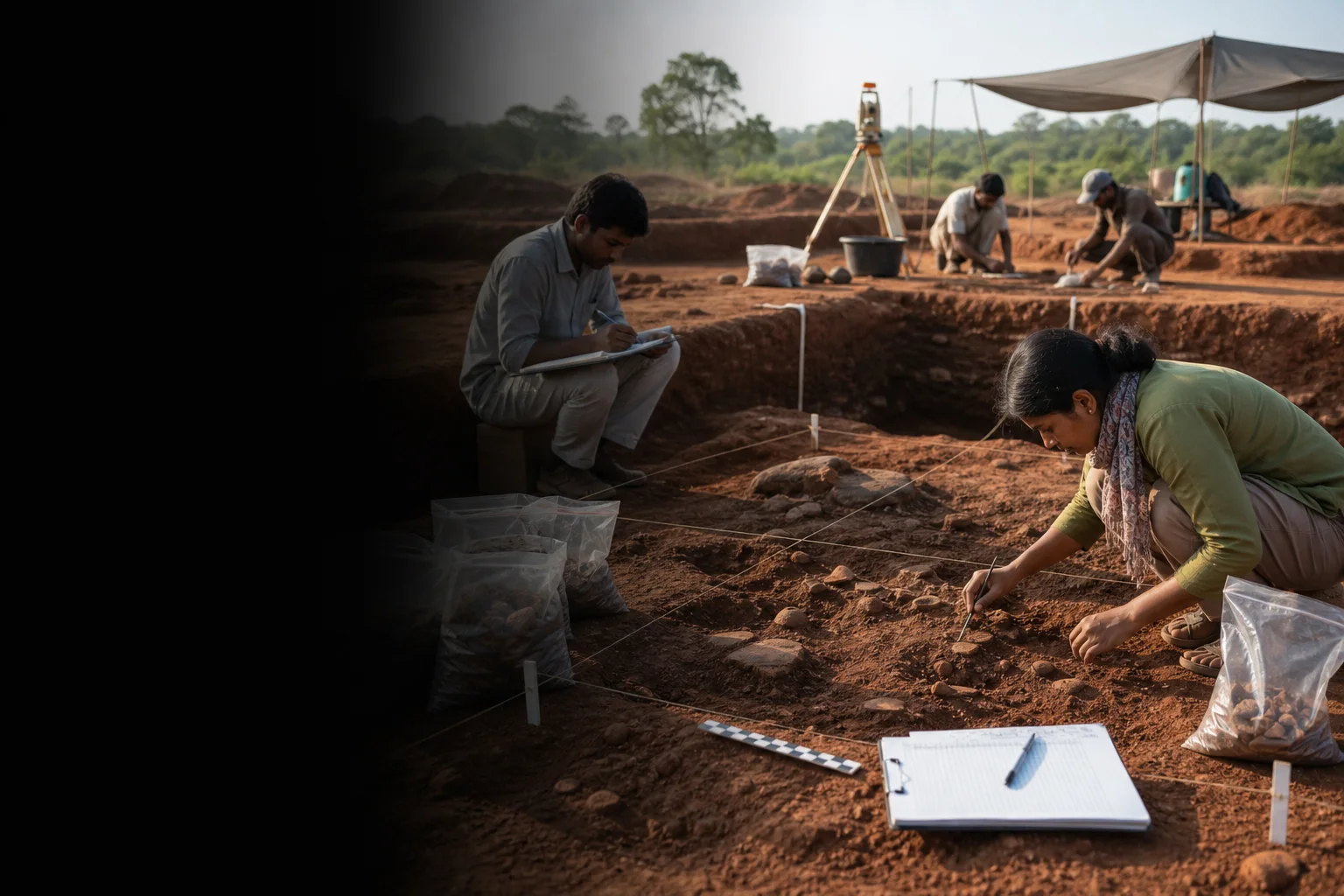
Survey records features without opening large areas. Excavation proceeds by controlled units and layers, using measured grids, drawings, photographs, registers, and sample numbers. A wall, pit, floor, burial, or hearth is a feature; its relationship to other layers is the stratigraphy. Removing an object without that record destroys much of its information.
After fieldwork, specialists study ceramics, animal bone, plant remains, charcoal, sediments, metals, beads, human remains where ethically and legally appropriate, and inscriptions. Reports should state methods, contexts, catalogues, drawings, scientific results, and limitations. A press release is not a substitute for that publication.[2][11]
Historical reading
How archaeological dating works
Relative dating establishes sequence: a lower undisturbed layer generally formed before one above it, while a pit can cut earlier layers. Pottery forms, scripts, coins, and artifact styles can be compared with better-dated sequences. These methods produce ordered relationships and estimated ranges rather than an automatic calendar year.
Radiocarbon dating measures carbon-bearing material and yields a probability distribution after calibration. The archaeological question depends on association. Charcoal in a secure floor context may date activity near that floor; old wood, residual material, intrusive roots, or uncertain collection can weaken the link. Laboratories report ranges and statistical confidence, not a single magical number.
Thermoluminescence and optically stimulated luminescence estimate events related to heating or light exposure in suitable materials. Archaeomagnetism, dendrochronology, numismatics, palaeography, and other techniques answer different questions. Agreement among independent methods is more persuasive than a dramatic isolated result.[9][4]
Public summaries commonly attach the earliest date from one sample to an entire site or cultural identity. This page avoids that shortcut. Sites can contain centuries of occupation, erosion, digging, rebuilding, and later contamination. Every date should identify what was measured and where it came from.
Historical reading
Pottery, beads, metal and food remains
Pottery is abundant because fired clay survives. Archaeologists examine fabric, inclusions, surface treatment, form, firing, soot, residue, repair, and distribution. Labels such as Black-and-Red Ware or rouletted ware are analytical categories with regional and chronological variation. A pottery type should not be equated automatically with one people.
Beads reveal raw materials and skilled production. Carnelian, quartz, glass, shell, and other materials can be traced through manufacturing debris, unfinished pieces, tools, and compositional analysis. Kodumanal is important because production evidence helps distinguish a workshop from a place where finished beads were merely consumed.[6]
Iron, copper alloys, gold, and other metals preserve different stages of production and use. Slag, furnace remains, crucibles, molds, and failed castings can be more informative about technology than a finished prestige object. Corrosion and soil chemistry complicate identification and demand conservation.
Animal bones, charred seeds, phytoliths, pollen, shell, and residues contribute to histories of diet, farming, herding, environment, and craft. These materials require sampling strategies and specialist comparison. Absence may reflect preservation or recovery method rather than actual non-use.[11]
Historical reading
Inscriptions, scripts and portable marks
Tamil-Brahmi inscriptions occur in rock shelters and on portable objects. They provide direct evidence for names, donations, marking, and writing practices during the early historic period. Their interpretation requires secure reading, palaeographic comparison, linguistic knowledge, and context.[4]
Later Tamil, Vatteluttu, Grantha, and other scripts appear in stone and copper-plate records. Epigraphists document location, dimensions, script, language, damage, formula, and translation. A photograph circulating online may omit the line that changes a reading, while recutting or paint can permanently harm the surface.[5][13][14]
Graffiti marks are not automatically writing, and writing is not automatically a literary text. Scholars compare repeated signs, placement, direction, sequence, and language. Claims that a mark proves a sweeping ethnic or civilizational conclusion require published demonstration.
Inscriptions were social acts. A cave-bed label, temple endowment, hero stone, boundary record, or royal eulogy addressed different audiences. Their content and silence reflect those purposes.
Historical reading
A connected site network
Adichanallur is central to Iron Age urn-burial research in the Tamiraparani region. Its burial evidence should not be treated as a complete settlement history or assigned automatically to a later dynasty. Keezhadi addresses settlement and production in the Vaigai region. The contrast shows why one site cannot answer every question.[9][10]
Korkai contributes to coastal and estuarine history, while Kodumanal contributes craft, route, burial, and settlement evidence. Poompuhar and underwater work raise questions about ports and coastal change. These places belong to a network of research questions, not a ranking contest for the single oldest or greatest site.[7][6][8]
Museums preserve and interpret excavated collections, but storage, conservation, documentation, and access vary. A display case contains selected objects detached from most of their field context. The catalogue and report restore some of those relationships.[3][2]
Historical reading
Burials, human remains and respect
Burials can reveal mortuary practice, health, diet, mobility, kinship, and social difference, but human remains are not props. Excavation and study require legal authority, trained specialists, documentation, conservation, and ethical decisions about storage, analysis, display, and community interests.
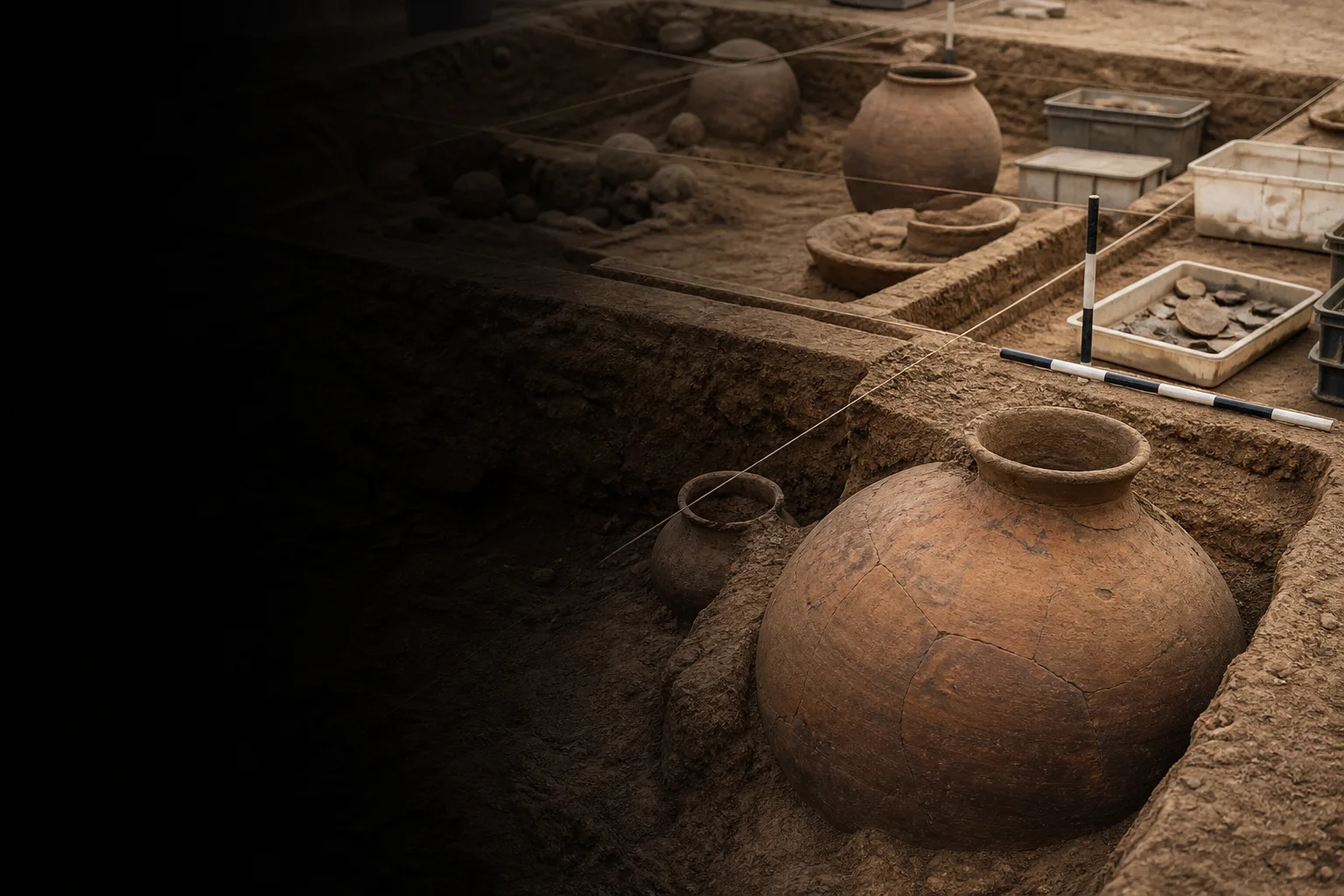
An urn may contain primary or secondary deposition, complete or fragmentary remains, associated vessels, iron objects, ornaments, organic traces, or later disturbance. The position and relationship of these elements matter. Emptying an urn for a photograph would erase the sequence.[9]
Burial form does not translate directly into ethnicity, language, or dynasty. Similar practices can cross political regions, and one community can use more than one mortuary form. Interpretation should compare settlement, chronology, biology, objects, and landscape.
Historical reading
Trade without the Roman-object shortcut
Imported amphorae, ceramics, glass, and coins are evidence for wider exchange, but the adjective Roman can conceal complexity. Objects may have been made in different Mediterranean regions, moved through Red Sea and Indian Ocean ports, transferred by many merchants, and reused locally.
Tamil products likewise traveled through chains of producers and intermediaries. Pepper, pearls, textiles, beads, gemstones, ivory, and other goods appear in texts and material records, but quantities and routes change by period. Political authorities could tax or protect trade without directly operating it.
Coin finds must be evaluated by provenance and context. A hoard, grave offering, single settlement coin, and later collection are different evidence. Museum typologies are a starting point, not a license to infer permanent political control from circulation alone.[15]
Historical reading
Conservation, ownership and public responsibility
Archaeological sites and antiquities are protected by law and public stewardship. Buying an object without lawful provenance encourages looting and destroys contextual knowledge. A beautiful sherd is still evidence where it lies. Photograph it without moving it and report a concerning find to the relevant archaeology authority.
Visitors should not climb fragile walls, enter active trenches, touch skeletal material, make rubbings, apply chalk, or post precise locations of vulnerable discoveries. Drone use and photography may require permission. Museums and active sites can change access for conservation or research.
Responsible public archaeology explains uncertainty and publishes evidence in accessible forms. It also listens to communities living around sites, whose land, labor, memory, and access are affected by excavation and heritage management. Expertise and public participation strengthen one another when roles and evidence remain clear.
Historical reading
A field guide to evidence claims
Historical knowledge is assembled from sources that answer different questions. Excavated objects and soil layers reveal production, food, settlement, exchange, burial, and technology, but only when their archaeological context is recorded. Inscriptions can name donors, rulers, institutions, taxes, places, and religious gifts, yet they are selective public acts rather than neutral surveys. Coins establish circulation and political imagery more readily than they establish precise borders. Literary works preserve language, ethics, emotion, landscape conventions, and political ideals; they cannot be treated as transcripts of daily life.[1][5][15]
Dates on this site use BCE and CE. A date attached to charcoal, grain, pottery, a script style, a monument, or a ruler does not always date every object or activity at the same place. Radiocarbon dates describe measured samples and probability ranges. Palaeographic dates compare letter forms. Regnal dates may depend on inscriptions and later synchronisms. When these methods disagree or the published evidence is incomplete, the uncertainty belongs in the account rather than being smoothed away.[4][2]
Literary tradition, religious tradition, local memory, and legend can be historically important even when they are not independently verified descriptions of an event. This guide labels them as traditions and asks what they meant to the communities that preserved them. It does not use them to manufacture exact battles, genealogies, city plans, or territorial maps. New excavations and new readings of inscriptions can change interpretation, so the sources and review date are part of the article, not an afterthought.[16][5]
Historical reading
What future research can change
New excavation is only one path to new knowledge. Reanalysis of stored collections can use improved dating, residue, isotope, metallurgical, botanical, or imaging methods. Digitized inscriptions and archival maps can reveal patterns without disturbing another site.
Regional survey can connect celebrated sites to villages, fields, quarries, workshops, routes, and water systems. This broader scale is essential because political and economic life rarely fits inside an excavation trench.
Uncertainty is productive when clearly stated. It identifies the next sample, comparison, publication, or conservation step. Archaeology becomes less reliable, not more exciting, when uncertainty is replaced by certainty for publicity.
Human scale
People and institutions
Named rulers are only one part of the history. These groups and individuals help show how evidence and social life connect.
Field archaeologists
Plan research, excavate, record contexts, and coordinate specialist analysis.
Epigraphists
Document and interpret scripts, languages, formulae, and historical settings.
Conservators
Stabilize objects and structures from the moment of discovery through storage and display.
Scientific specialists
Study dates, plants, animals, sediments, metals, residues, and human remains.
Local communities
Residents and land users whose knowledge and rights are part of ethical heritage work.
Historical geography
Connected places
Places are linked only when a substantive My Tamil Nadu guide already exists. Other entries remain non-clickable research context.
Visual reading
Images with explicit provenance
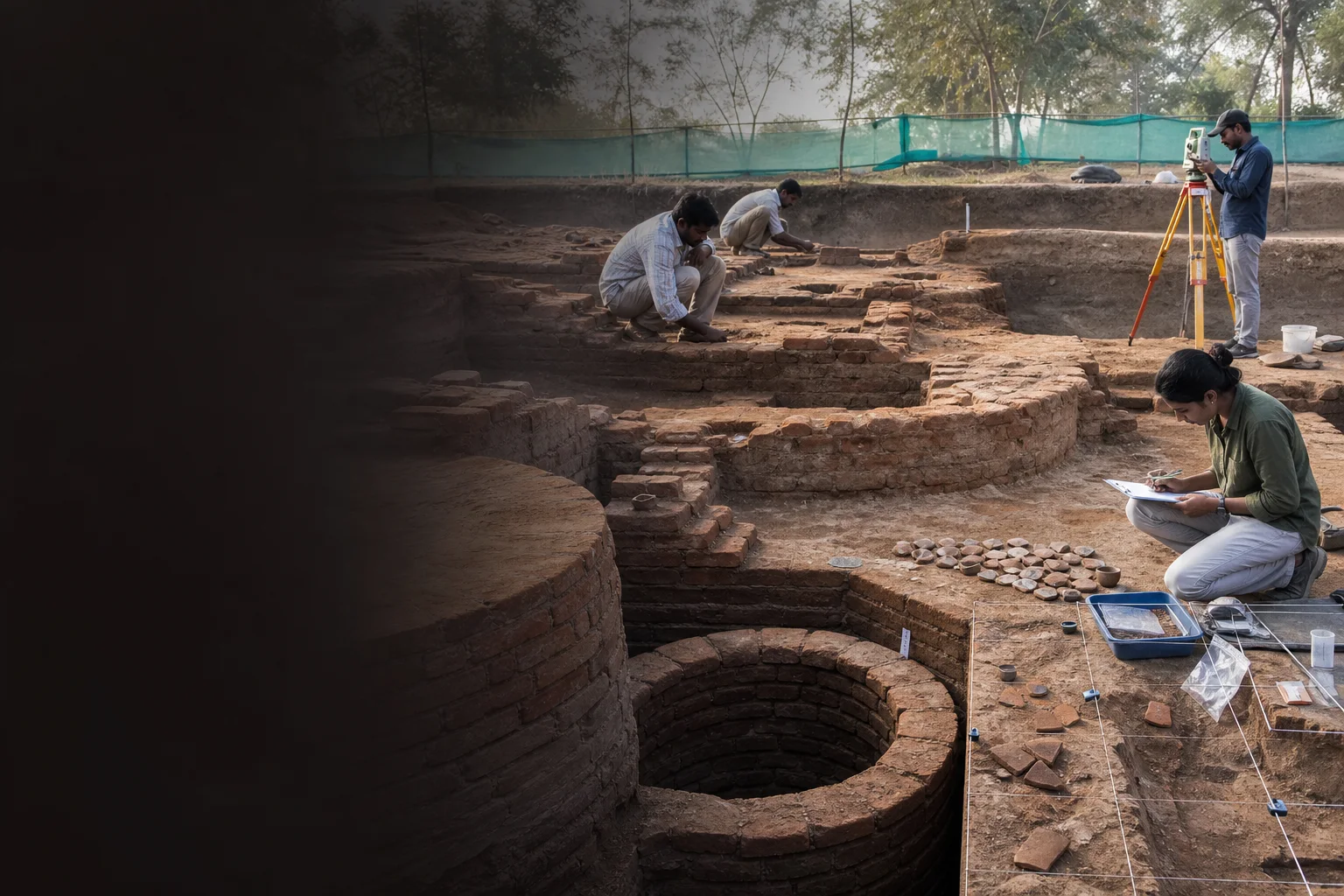
These project-created visuals support orientation. They are not presented as photographs of an excavation, monument, person, or event.
Questions
Frequently asked questions
Why do some dates appear as ranges?
Different dating methods and incomplete records rarely support a single exact year. Ranges communicate what the evidence can sustain.
Does an inscription prove every detail in a royal claim?
No. Inscriptions are primary evidence, but they were produced for particular purposes and must be read with archaeology, other inscriptions, language, and context.
Are literary traditions treated as facts?
They are treated as important historical sources and traditions. The article distinguishes their cultural testimony from independently verified events.
Can this history change?
Yes. Excavation reports, scientific analyses, newly documented inscriptions, and scholarly debate can revise chronology and interpretation.
How were sources selected?
Priority goes to excavation reports, official archaeology and museum records, archives, UNESCO documentation, university resources, and established scholarship.
Can I visit every place named here?
No. Some are living religious sites, protected monuments, working excavations, archives, or places without visitor facilities. Check the responsible institution before travelling.
Editorial trust
Sources and further reading
Citations in the article point to this full list. Source type and review date are shown so readers can evaluate the evidence.
- 1Archaeological excavations in Tamil NaduTamil Nadu State Department of ArchaeologyOfficial excavation register · Reviewed 9 August 2026
- 2Department e-publicationsTamil Nadu State Department of ArchaeologyOfficial publication catalogue · Reviewed 9 August 2026
- 3Archaeology sectionGovernment Museum ChennaiOfficial museum collection guide · Reviewed 9 August 2026
- 4Tamil-Brahmi scriptTamil Nadu State Department of ArchaeologyOfficial epigraphy overview · Reviewed 9 August 2026
- 5EpigraphyTamil Nadu State Department of ArchaeologyOfficial subject overview · Reviewed 9 August 2026
- 6Kodumanal excavationTamil Nadu State Department of ArchaeologyOfficial site report · Reviewed 9 August 2026
- 7Korkai excavationTamil Nadu State Department of ArchaeologyOfficial site report · Reviewed 9 August 2026
- 8Underwater archaeologyTamil Nadu State Department of ArchaeologyOfficial programme overview · Reviewed 9 August 2026
- 9Adichchanallur excavation report, 2004-05Archaeological Survey of IndiaPrimary excavation report · Reviewed 9 August 2026
- 10Keeladi excavationTamil Nadu State Department of ArchaeologyOfficial site report · Reviewed 9 August 2026
- 11Rajya Sabha answer on Keeladi excavations and scientific studiesParliament of IndiaOfficial parliamentary record · Reviewed 9 August 2026
- 12Record holdingsTamil Nadu Archives and Historical ResearchOfficial archive catalogue · Reviewed 9 August 2026
- 13Inscriptions in Tamil scriptTamil Nadu State Department of ArchaeologyOfficial epigraphy overview · Reviewed 9 August 2026
- 14Inscriptions in Grantha scriptTamil Nadu State Department of ArchaeologyOfficial epigraphy overview · Reviewed 9 August 2026
- 15Coins of Tamil NaduGovernment Museum ChennaiOfficial museum collection guide · Reviewed 9 August 2026
- 16Polity in the Sangam AgeUGC e-PG Pathshala / INFLIBNETUniversity teaching module · Reviewed 9 August 2026
Editorial review: Factual claims were checked against the linked primary and institutional sources on 9 August 2026. Where the sources support only a range or interpretation, the article keeps that limitation visible.