
Archaeological site guide
Keezhadi
What has been excavated, what scientific dates actually date, what remains under study, and why Keezhadi matters without turning a complex site into a slogan.
Orientation
Overview
Multi-season excavation of an early historic settlement in the Vaigai region
Keezhadi is a settlement site in the Vaigai region that has become one of Tamil Nadu's most closely watched archaeological projects. The Archaeological Survey of India conducted the first seasons, followed by the Tamil Nadu State Department of Archaeology. Excavations have documented brick structures, ring wells, floors or working surfaces, drains or channels described in reports, pottery, beads, spindle whorls, gaming pieces, animal remains, and marked or inscribed sherds.[2][1]
The site matters because habitation archaeology can reveal how people organized space, craft, water, consumption, and waste. Much early historic public attention had focused on monuments, burials, and literary texts. Keezhadi places settlement deposits and ordinary objects at the center of the discussion.[2]
Scientific dating is crucial and frequently misunderstood. The Tamil Nadu department reports an AMS radiocarbon result associated with a sample dating to the 6th century BCE. The archaeological significance depends on the sample's layer and association. It does not by itself date every brick, potsherd mark, or urban feature to that century. Parliament records confirm multiple scientific studies and samples, while publication and review establish how the results fit the full sequence.[2][3]
In July 2025, the Ministry of Culture announced publication of the ASI report covering the first two excavation seasons after scientific vetting. This is an important change in the source base. Later Tamil Nadu excavation reports remain necessary because different seasons opened different areas and produced their own contexts.[1][4]
Chronology
A careful timeline
Dates identify documented phases and broad ranges. They do not imply uninterrupted rule or certainty where the evidence remains debated.
ASI first season
Initial excavation began documenting the settlement sequence and material assemblage.[1]
ASI second season
Additional trenches expanded the evidence later included in the published ASI report.[1]
ASI third season
Fieldwork continued before the state department took up subsequent excavation.[5]
Tamil Nadu excavations
State-led seasons expanded trenches, analyses, public reporting, and related Vaigai-region research.[2][5]
State report and scientific results
The department published an English report presenting excavation and analytical findings.[4][2]
ASI report released
The Ministry of Culture announced publication of the vetted report for the first two seasons.[1]
Historical reading
A settlement in the Vaigai region
Keezhadi lies within a wider archaeological landscape rather than as an isolated city. The Vaigai river, agricultural land, routes, nearby settlements, production zones, and burial sites all matter to interpretation. Regional survey and comparison with sites such as Konthagai and Agaram help ask how habitation, burial, and craft were distributed.[5][2]
A settlement can contain several phases of construction, resurfacing, dumping, cutting, abandonment, and reuse. Brick alignments become rooms or industrial features only after archaeologists document plans, bonds, associated floors, drains, artifacts, and sequence. Public photographs show exposed remains but rarely convey the full stratigraphy.
The term urban is used in public discussion to describe planned structures, craft specialization, writing, and material density. Urbanism is an analytical question, not a trophy label. Researchers must compare scale, permanence, public infrastructure, economic specialization, and regional relationships before defining the settlement.
Historical reading
Structures, ring wells and everyday objects
Brick structural remains demonstrate built spaces and repeated investment. Their function is not always obvious from surviving wall lines. Roofs, upper walls, doors, furniture, and organic materials are usually missing, so room labels should remain provisional unless use-wear, installations, residues, or associated finds support them.[2]
Ring wells are assembled from stacked ceramic rings and are known at several early historic South Asian sites. At Keezhadi they contribute to discussion of water management and sanitation. A ring well's date depends on the layer, construction cut, fill, and associated material, not on the form alone.
Pottery, beads, spindle whorls, iron objects, terracotta pieces, gaming objects, animal bone, and other finds reveal production and daily practice. Their quantity and distribution matter. A single attractive artifact can draw attention, while a large assemblage of ordinary sherds often carries more reliable evidence about chronology and activity.[2][3]
Historical reading
Marked and inscribed pottery
Some Keezhadi sherds carry graffiti marks and some are reported with Tamil-Brahmi letters. These categories must be distinguished. A mark can indicate ownership, production, count, ritual, or another practice without forming language. A letter sequence requires epigraphic reading and documentation.[2][6]
An inscribed sherd is dated by the layer and associated materials in which it was recovered, by the vessel's typology, and by palaeography. If a sherd is residual in a later layer or lacks secure provenance, its chronological value changes. The date of nearby charcoal is not automatically the date when writing was incised.
Keezhadi contributes to the history of writing because portable inscriptions place written marking in settlement life. It does not alone establish the origin date of the Tamil language, which has a linguistic history broader than the survival of writing. Language, script, and a particular inscription are related but not identical questions.[6][7]
Historical reading
Radiocarbon and specialist studies
The Department of Archaeology reports radiocarbon results from carbon samples and presents one calibrated result reaching the 6th century BCE. Readers should consult the report for laboratory identification, measured age, calibration, probability, trench, depth, layer, and association. A popular summary that gives only the earliest endpoint omits most of the scientific statement.[2][4]
Parliamentary records describe studies involving faunal remains, phytoliths, pollen, soil, and carbon samples. These methods can address diet, plants, environment, activity, and chronology. Results are strongest when sampling strategies and specialist reports are published so that other researchers can evaluate them.[3]
Scientific analysis does not replace excavation interpretation. A laboratory can date a submitted sample; archaeologists must explain why that sample relates to a floor, structure, or occupation phase. Replication and multiple secure samples can clarify a long-lived site.
Historical reading
Excavation seasons and publication
Different agencies and seasons opened different trenches. An interpretation based only on the first season or on a later state report is incomplete. The ASI publication announced in 2025 adds vetted documentation for the first two seasons, while state publications document subsequent work.[1][4]
A full excavation report usually contains trench descriptions, stratigraphy, drawings, photographs, artifact catalogues, specialist studies, and conclusions. Those components allow readers to separate observation from interpretation. News coverage is valuable for public awareness but cannot replace the report.
Publication does not end debate. Scholars may question associations, terminology, calibration, comparanda, or sampling and then propose alternatives. Constructive disagreement is part of archaeological method when it cites evidence and can be evaluated.
Historical reading
Civilization claims and political debate
Keezhadi has become connected to public claims about the antiquity of Tamil civilization and urban life. The interest reflects the site's genuine importance and the desire to connect literature, language, and material history. Problems arise when one result is made to prove an entire identity or when caution is misrepresented as hostility.
The word civilization can carry assumptions about cities, writing, state power, and cultural superiority. Archaeologists can study settlement complexity without ranking peoples. A date for one context should not be used to declare that all features of later Tamil society already existed in the same form.
Institutional disagreement over reports and chronology should be documented through dated publications and official statements. This page does not infer motives from silence or delay. The strongest public case for Keezhadi is transparent release of contexts, methods, datasets, and specialist analyses.[1][3]
Historical reading
Keezhadi, literature and neighboring sites
The settlement lies in a region central to later Madurai and Pandya history, inviting comparison with Sangam literature. Similarity between a find and a poetic image can be suggestive, but the text and layer must each be dated independently. Archaeology should not be forced to illustrate a poem line by line.[8]
Konthagai's burial evidence and work at other nearby sites can help connect the living and the dead, production and residence, local routes and the river landscape. These connections require compatible chronology rather than proximity alone.[5]
Comparisons with Kodumanal, Korkai, Arikamedu, Uraiyur, and other early historic sites can test pottery sequences, craft, writing, and exchange. No single site should be treated as the capital of an entire archaeological culture without direct evidence.[9][10]
Historical reading
Visiting and protecting the record
Museum and site access can change with excavation, conservation, weather, and government arrangements. This article does not publish static timings or ticket claims. Check the Tamil Nadu Department of Archaeology before travel and follow all barriers and staff guidance.[2]
Do not enter trenches, collect sherds, touch features, or photograph restricted work. A loose piece on the surface still has spatial information. Report a possible find to the responsible authority rather than posting a precise vulnerable location online.
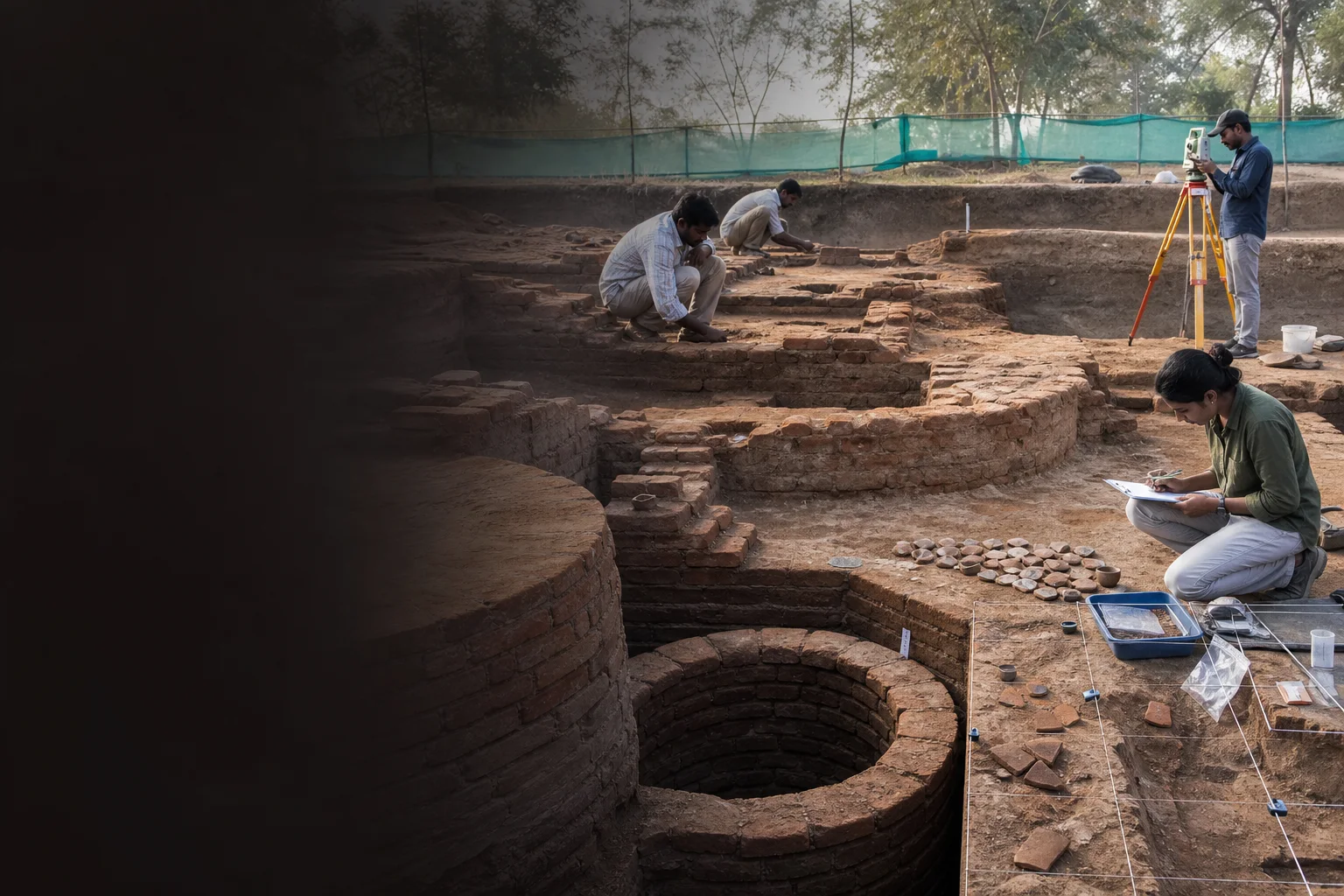
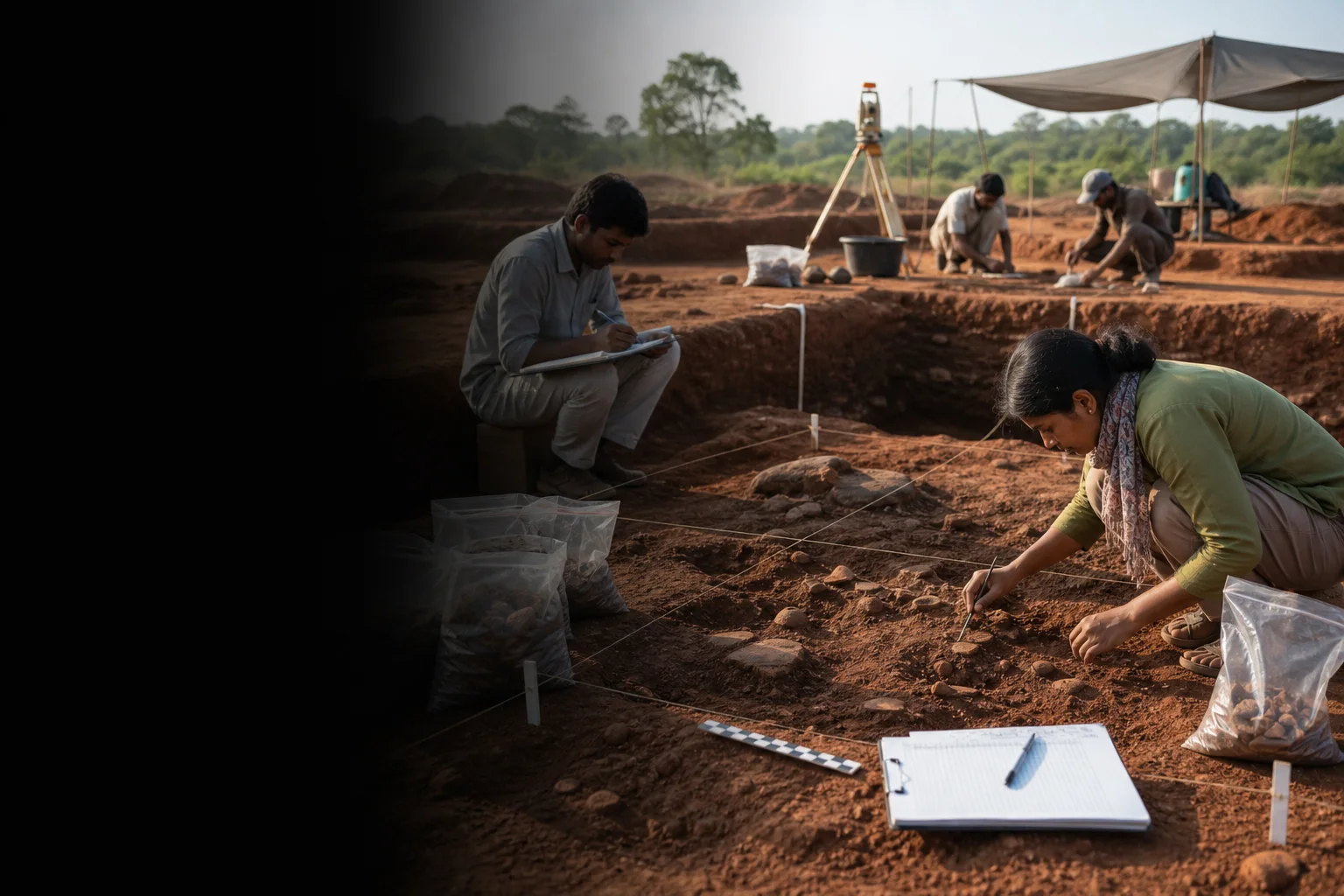
The project-generated images on this page are editorial representations, not photographs of Keezhadi. Captions identify that status. For documentary evidence, use the excavation reports and official image collections linked in the sources.
Historical reading
How to read the evidence
Historical knowledge is assembled from sources that answer different questions. Excavated objects and soil layers reveal production, food, settlement, exchange, burial, and technology, but only when their archaeological context is recorded. Inscriptions can name donors, rulers, institutions, taxes, places, and religious gifts, yet they are selective public acts rather than neutral surveys. Coins establish circulation and political imagery more readily than they establish precise borders. Literary works preserve language, ethics, emotion, landscape conventions, and political ideals; they cannot be treated as transcripts of daily life.[5][11][12]
Dates on this site use BCE and CE. A date attached to charcoal, grain, pottery, a script style, a monument, or a ruler does not always date every object or activity at the same place. Radiocarbon dates describe measured samples and probability ranges. Palaeographic dates compare letter forms. Regnal dates may depend on inscriptions and later synchronisms. When these methods disagree or the published evidence is incomplete, the uncertainty belongs in the account rather than being smoothed away.[6][4]
Literary tradition, religious tradition, local memory, and legend can be historically important even when they are not independently verified descriptions of an event. This guide labels them as traditions and asks what they meant to the communities that preserved them. It does not use them to manufacture exact battles, genealogies, city plans, or territorial maps. New excavations and new readings of inscriptions can change interpretation, so the sources and review date are part of the article, not an afterthought.[8][11]
Human scale
People and institutions
Named rulers are only one part of the history. These groups and individuals help show how evidence and social life connect.
Excavation teams
ASI and Tamil Nadu archaeologists, field staff, conservators, and specialists across multiple seasons.
Laboratory specialists
Researchers who analyze dates, sediments, plants, animal remains, and materials.
Epigraphists
Specialists who distinguish marks from script and assess letter forms and language.
Local communities
Residents whose landscape, labor, access, and stewardship shape the site's present and future.
Historical geography
Connected places
Places are linked only when a substantive My Tamil Nadu guide already exists. Other entries remain non-clickable research context.
Visual reading
Images with explicit provenance
These project-created visuals support orientation. They are not presented as photographs of an excavation, monument, person, or event.
Questions
Frequently asked questions
Why do some dates appear as ranges?
Different dating methods and incomplete records rarely support a single exact year. Ranges communicate what the evidence can sustain.
Does an inscription prove every detail in a royal claim?
No. Inscriptions are primary evidence, but they were produced for particular purposes and must be read with archaeology, other inscriptions, language, and context.
Are literary traditions treated as facts?
They are treated as important historical sources and traditions. The article distinguishes their cultural testimony from independently verified events.
Can this history change?
Yes. Excavation reports, scientific analyses, newly documented inscriptions, and scholarly debate can revise chronology and interpretation.
How were sources selected?
Priority goes to excavation reports, official archaeology and museum records, archives, UNESCO documentation, university resources, and established scholarship.
Can I visit every place named here?
No. Some are living religious sites, protected monuments, working excavations, archives, or places without visitor facilities. Check the responsible institution before travelling.
Editorial trust
Sources and further reading
Citations in the article point to this full list. Source type and review date are shown so readers can evaluate the evidence.
- 1ASI publishes Keezhadi excavation report in line with scientific protocolsMinistry of Culture, Government of IndiaOfficial release · Reviewed 9 August 2026
- 2Keeladi excavationTamil Nadu State Department of ArchaeologyOfficial site report · Reviewed 9 August 2026
- 3Rajya Sabha answer on Keeladi excavations and scientific studiesParliament of IndiaOfficial parliamentary record · Reviewed 9 August 2026
- 4Department e-publicationsTamil Nadu State Department of ArchaeologyOfficial publication catalogue · Reviewed 9 August 2026
- 5Archaeological excavations in Tamil NaduTamil Nadu State Department of ArchaeologyOfficial excavation register · Reviewed 9 August 2026
- 6Tamil-Brahmi scriptTamil Nadu State Department of ArchaeologyOfficial epigraphy overview · Reviewed 9 August 2026
- 7Evolution of South Indian scripts from BrahmiUGC e-PG Pathshala / INFLIBNETUniversity teaching module · Reviewed 9 August 2026
- 8Polity in the Sangam AgeUGC e-PG Pathshala / INFLIBNETUniversity teaching module · Reviewed 9 August 2026
- 9Kodumanal excavationTamil Nadu State Department of ArchaeologyOfficial site report · Reviewed 9 August 2026
- 10Korkai excavationTamil Nadu State Department of ArchaeologyOfficial site report · Reviewed 9 August 2026
- 11EpigraphyTamil Nadu State Department of ArchaeologyOfficial subject overview · Reviewed 9 August 2026
- 12Coins of Tamil NaduGovernment Museum ChennaiOfficial museum collection guide · Reviewed 9 August 2026
Editorial review: Factual claims were checked against the linked primary and institutional sources on 9 August 2026. Where the sources support only a range or interpretation, the article keeps that limitation visible.