
Archaeological site guide
Adichanallur
Understand what the urn burials reveal, how the excavation was recorded and dated, and why language, ethnicity, and dynasty cannot be read directly from a burial vessel.
Orientation
Overview
Iron Age burial complex with a long research history
Adichanallur is one of South India's most important burial sites. Located in the Tamiraparani region, it has attracted antiquarian and archaeological attention since the 19th century and was excavated by the Archaeological Survey of India in 2004-05. The ASI report documents 178 burials in approximately 600 square meters of excavated area, demonstrating both the density of the cemetery and the limited sample represented by one season.[1]
Large urns, associated pottery, human skeletal material, iron objects, copper-alloy objects, gold ornaments in particular contexts, and other finds have made the site prominent. Their value lies in association: whether a vessel was inside or outside an urn, whether remains were complete or fragmentary, and how a burial cut related to nearby deposits. Lists of objects without context cannot explain mortuary practice.[1]
The 2004-05 report discusses scientific dating, including luminescence results with substantial uncertainty, and concludes that the excavated Iron Age urn burials broadly belong in the first millennium BCE, proposing a range around 850-650 BCE for the excavated phase. This is a published interpretation of specific samples and contexts, not a date for every burial across the whole site.[1]
Adichanallur is often drawn into claims about ancient Tamil identity, language, race, and dynastic history. Archaeology can investigate biological relationships, diet, mobility, technology, chronology, and practice. It cannot read a modern identity label directly from an urn, skull, or metal object.
Chronology
A careful timeline
Dates identify documented phases and broad ranges. They do not imply uninterrupted rule or certainty where the evidence remains debated.
Antiquarian investigation
Early collectors and researchers brought Adichanallur to wider attention, often under methods unlike modern excavation.[1]
Further excavation and museum collections
Objects entered institutional collections, though documentation standards and provenience varied.[1][4]
ASI excavation
A large burial sample was excavated with stratigraphic, skeletal, ceramic, metal, and scientific study.[1]
Context and analysis
The ASI report provides the essential primary account for the 2004-05 season.[1]
New questions and conservation
Further excavation, analysis, museums, and regional comparison continue to develop the site history.[2][3]
Historical reading
What an urn burial contains
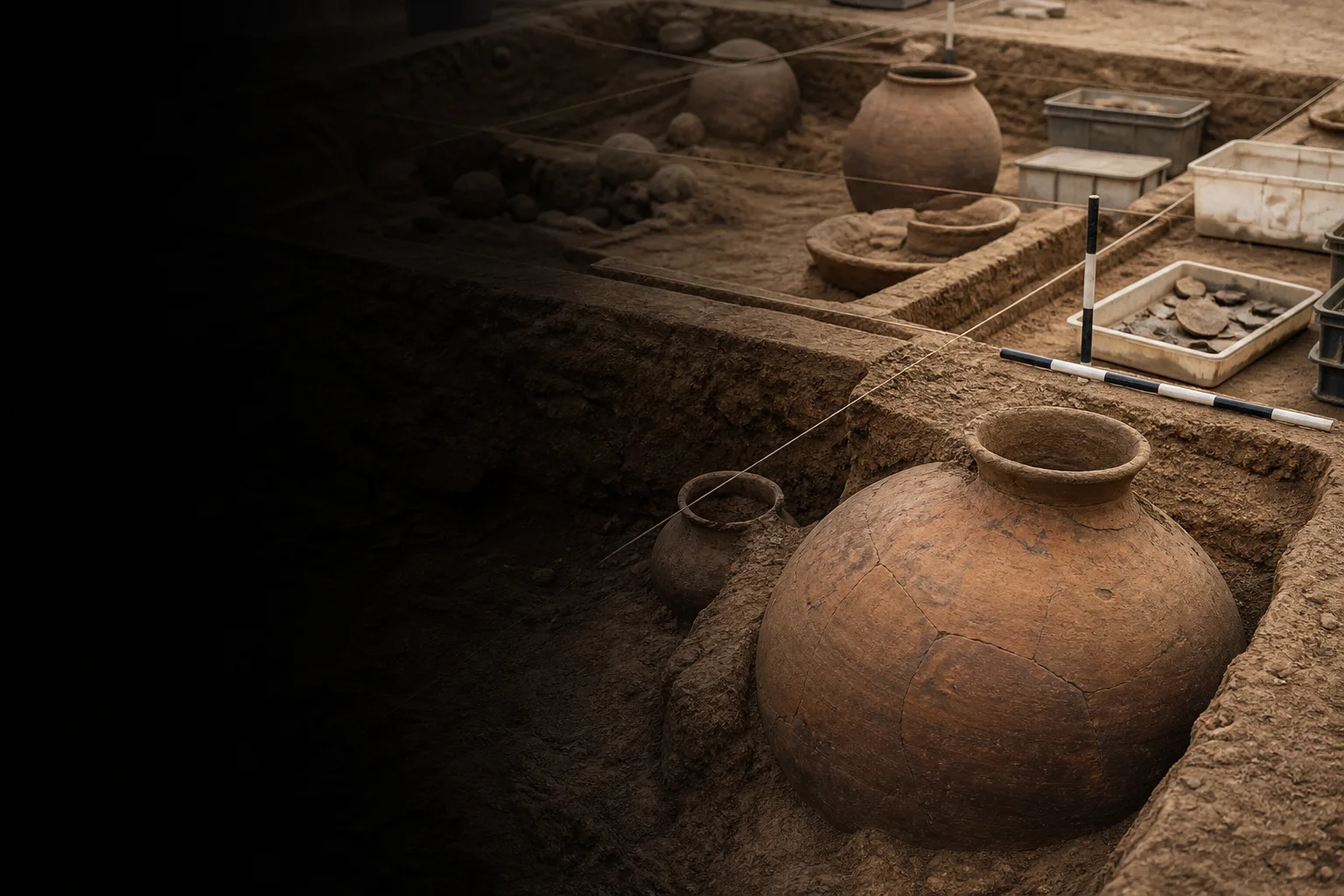
An urn burial is an archaeological context, not just a ceramic container. The vessel may hold skeletal remains, soil, small pots, metal objects, ornaments, and organic traces. Objects can also be placed around it. The sequence of digging the burial pit, placing or filling the urn, adding offerings, closing the vessel, and later disturbance is reconstructed from stratigraphy.[1]
The ASI report describes variation among burials. Variation may relate to age, ritual choice, chronology, status, preservation, or different community practices. It should not be forced into one explanation without statistical and contextual support.
Some burials are primary and others may involve selected or secondary remains. Taphonomy studies what happened between death, burial, excavation, and analysis. Soil pressure, water, roots, corrosion, animal activity, earlier digging, and excavation history can all alter what survives.
Historical reading
The 2004-05 excavation record
The ASI excavation opened a defined area within a much larger protected landscape. Recording 178 burials in about 600 square meters reveals density, not the total cemetery population. Extrapolating a total number without survey and boundary evidence would be speculation.[1]
Plans and catalogue entries in the report allow researchers to compare urn size, orientation, depth, associated vessels, skeletal preservation, and objects. The report is strongest when those observations remain linked to numbered contexts. Secondary summaries should preserve those links.
Earlier investigations recovered significant material but operated under different documentation and collecting practices. Objects now in museums may lack the fine provenience expected today. They remain valuable for technology and style, while some spatial questions can no longer be answered.[4][1]
Historical reading
Ceramics and mortuary practice
Large burial urns required skilled clay preparation, forming, drying, firing, transport, and handling. Their technical study can reveal production choices and perhaps workshop traditions. Visible size alone does not identify social rank.
Associated vessels include different forms and surface treatments. Archaeologists compare rim, body, base, fabric, firing, decoration, and use traces. Typology helps establish relative chronology but should be tested against stratigraphy and scientific dates.[1]
Symbols or marks on pottery require careful documentation. A mark is not automatically a letter, personal name, or ethnic emblem. Claims about script should provide high-quality images, context, reading, and specialist publication.[5]
Historical reading
Iron, copper alloys, gold and technology
Iron objects from burial contexts can illuminate weapons, tools, and mortuary offerings, but corrosion may obscure original form. Radiography, metallography, and conservation can reveal construction and composition without destructive cleaning.
Copper-alloy objects and vessels show metalworking knowledge and access to materials. Alloy identification requires analysis; color in a photograph cannot reliably distinguish copper, bronze, or corrosion products.
Gold objects attract disproportionate attention. Their presence in particular burials is evidence for material differentiation and symbolic practice, not proof that every burial was wealthy or royal. The archaeological question is distribution, association, manufacture, and use, not treasure value.[1]
Historical reading
Human remains, health and ethics
Skeletal remains can contribute to estimates of age, sex where preservation and method allow, health, trauma, diet, and activity. Such estimates have uncertainty and do not create a full biography. Population-level claims require adequate samples and transparent methods.
Ancient DNA and isotope studies can investigate biological relationship, ancestry, mobility, and diet under suitable preservation conditions. Genetic ancestry is not identical to language, caste, ethnicity, or modern community identity. Results should be reported with sampling and contamination limits.
Human remains deserve dignity in excavation, laboratory study, storage, imaging, and display. Public interest does not create an automatic right to graphic photographs. This page's original visual deliberately shows urn contexts without exposed remains.
Historical reading
Dating Adichanallur
The ASI report includes thermoluminescence and optically stimulated luminescence results and discusses their uncertainty. Luminescence techniques estimate the last heating of ceramics or last light exposure of sediments under defined conditions. Error ranges can be broad, and sample suitability matters.[1]
The report's broad placement of the excavated urn burials around 850-650 BCE should be understood as an interpretation of the available sequence and dates, not an exact start and end for the entire site. Earlier and later activity may exist elsewhere or in contexts not sampled by that excavation.[1]
Relative sequence, ceramic comparison, metals, burial relationships, and additional scientific dates should be considered together. The responsible wording is 'the excavated phase is broadly dated' rather than 'the civilization began in' a single year.
Historical reading
Language, ancestry and the limits of identity claims
Burial practice can be shared across communities and can change within a community. Archaeologists should not label every urn burial Tamil, Pandya, Dravidian, or another modern identity solely from form. Those identities involve language, politics, memory, and self-understanding that a vessel does not encode directly.
Adichanallur's location in today's Tamil Nadu and its importance to Tamil history are not in doubt. The methodological caution concerns which specific cultural claims the excavated evidence supports. Strong regional history does not need unsupported biological or racial certainty.
Later Pandya history in the Tamiraparani region provides important context but should not be projected backward automatically. Chronology matters: a first-millennium BCE burial cannot be assigned to a later medieval ruler because the places overlap.[7][6]
Historical reading
Adichanallur in the Tamiraparani landscape
The cemetery belongs within a riverine and coastal region that also includes settlement, agricultural, craft, and port histories. A burial ground does not reveal where every buried person lived. Regional survey is needed to connect cemeteries with habitation and production.
Korkai provides an important comparative coastal context, but its occupational history and Adichanallur's burial phases must be dated independently. Shared geography can suggest networks without proving that the two sites functioned simultaneously in every phase.[6]
River movement, floodplain processes, agriculture, quarrying, roads, and modern settlement affect preservation. Heritage management must protect the archaeological landscape, not only a display area around selected urns.
Historical reading
Collections, conservation and public access
Excavated ceramics and metals change after leaving the soil. Drying, salts, corrosion, movement, and old restoration can damage them. Conservators stabilize objects while preserving evidence of manufacture and deposition.
A site museum can reconnect finds with local geography and make reports accessible. Displays should identify excavation season, trench, burial, material, date range, and uncertainty. Replicas and reconstructions need clear labels so that visitors do not confuse them with excavated originals.
Current opening hours, galleries, and site access can change. Verify with ASI or the responsible state institution before travelling. Do not enter protected areas or collect surface material.[1][4]
Historical reading
How to read the evidence
Historical knowledge is assembled from sources that answer different questions. Excavated objects and soil layers reveal production, food, settlement, exchange, burial, and technology, but only when their archaeological context is recorded. Inscriptions can name donors, rulers, institutions, taxes, places, and religious gifts, yet they are selective public acts rather than neutral surveys. Coins establish circulation and political imagery more readily than they establish precise borders. Literary works preserve language, ethics, emotion, landscape conventions, and political ideals; they cannot be treated as transcripts of daily life.[2][8][9]
Dates on this site use BCE and CE. A date attached to charcoal, grain, pottery, a script style, a monument, or a ruler does not always date every object or activity at the same place. Radiocarbon dates describe measured samples and probability ranges. Palaeographic dates compare letter forms. Regnal dates may depend on inscriptions and later synchronisms. When these methods disagree or the published evidence is incomplete, the uncertainty belongs in the account rather than being smoothed away.[5][3]
Literary tradition, religious tradition, local memory, and legend can be historically important even when they are not independently verified descriptions of an event. This guide labels them as traditions and asks what they meant to the communities that preserved them. It does not use them to manufacture exact battles, genealogies, city plans, or territorial maps. New excavations and new readings of inscriptions can change interpretation, so the sources and review date are part of the article, not an afterthought.[7][8]
Human scale
People and institutions
Named rulers are only one part of the history. These groups and individuals help show how evidence and social life connect.
Buried communities
People known through mortuary contexts whose individual identities are only partly recoverable.
Early investigators
Researchers whose collections established significance while often leaving limited provenience.
ASI excavation team
The archaeologists and specialists responsible for the 2004-05 report and analysis.
Conservators and bioarchaeologists
Specialists who protect objects and study human remains with methodological and ethical care.
Local communities
Residents connected to the landscape and its long-term stewardship.
Historical geography
Connected places
Places are linked only when a substantive My Tamil Nadu guide already exists. Other entries remain non-clickable research context.
Visual reading
Images with explicit provenance
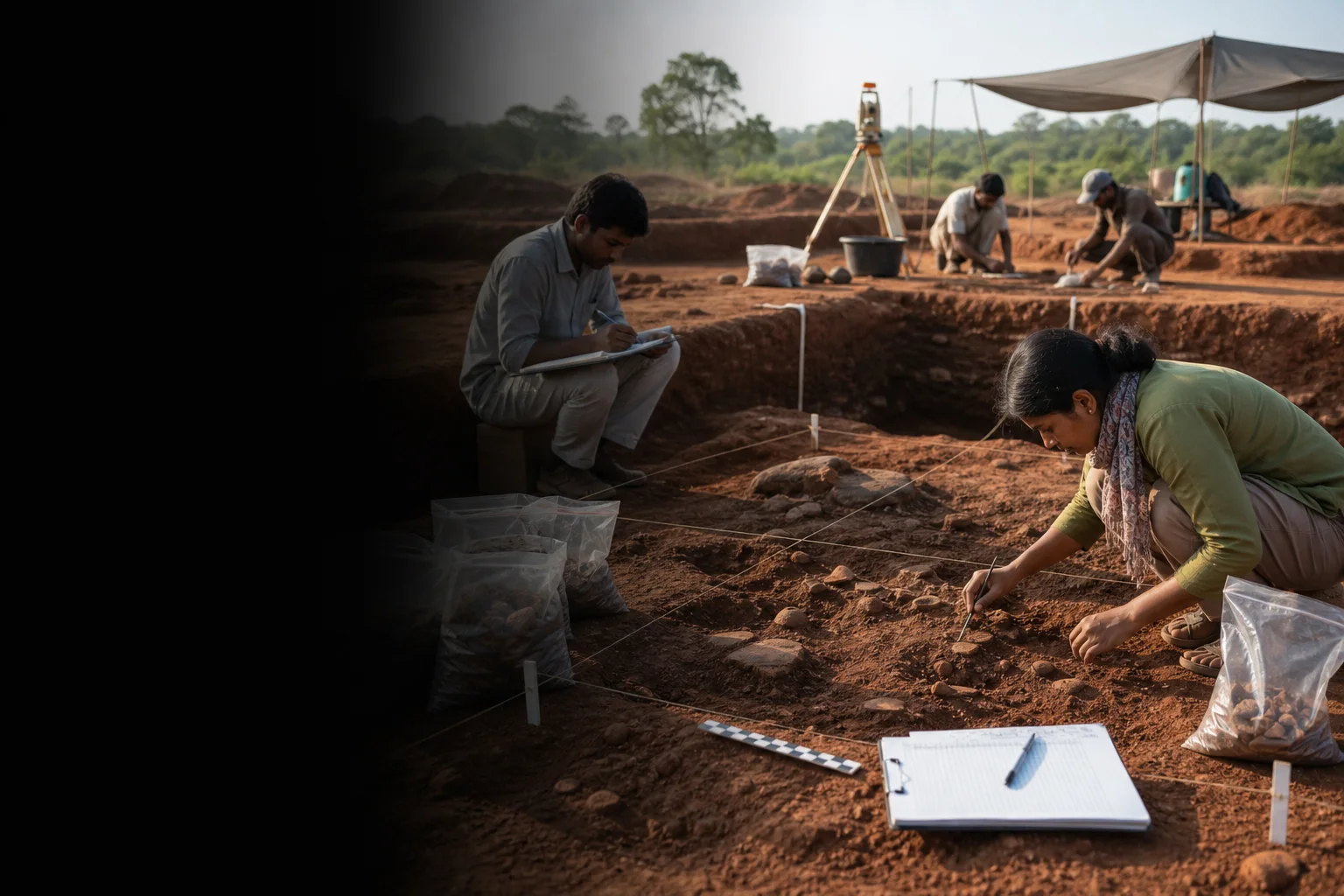
These project-created visuals support orientation. They are not presented as photographs of an excavation, monument, person, or event.
Questions
Frequently asked questions
Why do some dates appear as ranges?
Different dating methods and incomplete records rarely support a single exact year. Ranges communicate what the evidence can sustain.
Does an inscription prove every detail in a royal claim?
No. Inscriptions are primary evidence, but they were produced for particular purposes and must be read with archaeology, other inscriptions, language, and context.
Are literary traditions treated as facts?
They are treated as important historical sources and traditions. The article distinguishes their cultural testimony from independently verified events.
Can this history change?
Yes. Excavation reports, scientific analyses, newly documented inscriptions, and scholarly debate can revise chronology and interpretation.
How were sources selected?
Priority goes to excavation reports, official archaeology and museum records, archives, UNESCO documentation, university resources, and established scholarship.
Can I visit every place named here?
No. Some are living religious sites, protected monuments, working excavations, archives, or places without visitor facilities. Check the responsible institution before travelling.
Editorial trust
Sources and further reading
Citations in the article point to this full list. Source type and review date are shown so readers can evaluate the evidence.
- 1Adichchanallur excavation report, 2004-05Archaeological Survey of IndiaPrimary excavation report · Reviewed 9 August 2026
- 2Archaeological excavations in Tamil NaduTamil Nadu State Department of ArchaeologyOfficial excavation register · Reviewed 9 August 2026
- 3Department e-publicationsTamil Nadu State Department of ArchaeologyOfficial publication catalogue · Reviewed 9 August 2026
- 4Archaeology sectionGovernment Museum ChennaiOfficial museum collection guide · Reviewed 9 August 2026
- 5Tamil-Brahmi scriptTamil Nadu State Department of ArchaeologyOfficial epigraphy overview · Reviewed 9 August 2026
- 6Korkai excavationTamil Nadu State Department of ArchaeologyOfficial site report · Reviewed 9 August 2026
- 7Polity in the Sangam AgeUGC e-PG Pathshala / INFLIBNETUniversity teaching module · Reviewed 9 August 2026
- 8EpigraphyTamil Nadu State Department of ArchaeologyOfficial subject overview · Reviewed 9 August 2026
- 9Coins of Tamil NaduGovernment Museum ChennaiOfficial museum collection guide · Reviewed 9 August 2026
Editorial review: Factual claims were checked against the linked primary and institutional sources on 9 August 2026. Where the sources support only a range or interpretation, the article keeps that limitation visible.