Early Tamil history
The Sangam Age
Read early Tamil society through poetry, inscriptions, coins, settlements, burials, and exchange without turning literary convention into a literal map of the past.
Orientation
Overview
Broadly the early historic period; chronology remains debated
The term Sangam Age is a convenient modern label for an important but difficult period in the history of the Tamil-speaking region. It is closely associated with early Tamil poetic anthologies and long poems, with traditions about assemblies of poets, and with remembered Chera, Chola, and Pandya rulers. It should not be imagined as a neatly bounded century or a single political system. The surviving texts were composed, transmitted, organized, and commented upon across time, and scholars continue to discuss the chronology of individual works and layers.[1]
Archaeology gives this literary world material depth. Settlements, craft sites, burial grounds, ceramics, beads, metal objects, imported goods, and inscribed sherds show communities participating in agriculture, pastoral life, production, and long-distance exchange. Sites such as Kodumanal, Korkai, Karur, and Keezhadi illuminate different parts of that history; none is a physical illustration of the whole poetic corpus.[2][5][6][9]
A responsible account therefore works by comparison. Poems can show valued landscapes, social relationships, warfare, generosity, love, grief, trade, and performance. Material remains show what people made, used, discarded, buried, or built. Inscriptions show writing in specific contexts. Coins show symbols and circulation. Where the sources converge, interpretation becomes stronger; where they do not, the gap remains visible.[3][4]
Chronology
A careful timeline
Dates identify documented phases and broad ranges. They do not imply uninterrupted rule or certainty where the evidence remains debated.
Tamil-Brahmi
Inscriptions in caves and on objects provide direct written evidence; individual examples require their own dates and contexts.[3]
Settlements and exchange
Craft and trade evidence appears across inland, riverine, and coastal sites rather than in one political center.[2][5]
Poetic corpora
The anthologies preserve early material but their composition and compilation cannot be reduced to one exact date.[1]
Transmission and commentary
Manuscripts, commentary, print, and scholarship shaped how the corpus reached modern readers.[8]
Historical reading
What the literature can tell us
Early Tamil poems organize experience through highly developed conventions. Akam poetry concerns interior themes such as love and separation; puram poetry concerns public themes such as war, generosity, death, and fame. Landscape categories connect ecology, time, mood, occupation, and poetic situation. These are literary systems, not census tables, but their vocabulary gives historians unusually rich access to remembered environments and social values.[1]
Named rulers, poets, bards, warriors, patrons, women, traders, cultivators, and pastoral communities appear in the poems. Praise poetry can preserve names and relationships while also magnifying patrons. Laments can communicate the human cost of war but do not provide neutral campaign records. References to ports and imported goods matter most when read alongside finds from archaeological sites.[1][2]
The traditional story of three Sangams has deep cultural importance. It belongs to the history of how Tamil literary antiquity was imagined and remembered. The available evidence does not support treating every detail of that later tradition as a literal institutional chronology. Calling it a tradition protects its meaning while keeping the historical claim proportionate.
Historical reading
Landscapes, work and social relations
The poetic landscapes place human work within mountains, forests and pasture, cultivated river plains, coast, and arid conditions. Hunting, herding, farming, fishing, salt making, craft, exchange, and martial service appear in different settings. The system is poetic and ethical as well as ecological; real communities could move, trade, and occupy mixed environments.
Status appears through kinship, patronage, occupation, wealth, gender, martial reputation, and access to resources. The poems do not describe an equal society, and later social categories should not be projected backward without evidence. Archaeology may reveal differences in burial, diet, craft access, or settlement, but these patterns require site-specific study before they can be connected to named groups.
Women appear as poetic voices, performers, mothers, partners, patrons, and figures in public memory. Their presence does not mean the sources reveal every woman's experience. Genre, authorship, transmission, and elite patronage all shape who becomes visible. A social history must attend both to striking voices and to the many workers whom texts mention only indirectly.
Historical reading
Chiefs, kings and the three crowned lineages
Chera, Chola, and Pandya names appear alongside many smaller chiefs and local powers. Authority was relational: rulers sought tribute, loyalty, military support, prestige, and control over productive places and routes. Poetry often portrays generosity as the moral test of a ruler because bards and gifts were part of political communication.[1]
The phrase three crowned kings is useful for a remembered political triad, but it should not erase the many Velir chiefs and other powers in the corpus. Nor should a praise poem be converted into a modern administrative map. Influence could be intermittent, and political centers were connected to specific landscapes and routes.
Genealogies assembled from poems are inherently uncertain. Similar names and titles may refer to different people, and later traditions can connect figures in ways that are difficult to verify. This guide uses named rulers only where the source context matters and avoids exact reign dates that the evidence cannot securely establish.
Historical reading
Ports, craft and wider exchange
The early historic Tamil region participated in networks extending across the peninsula and the Indian Ocean. Imported ceramics, amphora fragments, coins, beads, and other materials can indicate contact and circulation. They do not automatically identify the ethnicity of every trader or prove direct travel between every pair of places.[2][4]
Kodumanal is especially important for understanding inland production and movement. Excavation records describe beads, pottery, iron-related activity, inscriptions or graffiti on sherds, and burial evidence. Its position helps historians connect western routes, inland craft, and eastern destinations without assuming one centrally planned trade system.[5]
Korkai and Puhar occupy important places in literary memory and archaeological research. Coastal change, sediment, erosion, and later settlement complicate their study. Underwater archaeology may contribute evidence, but evocative stories of lost cities must be separated from documented finds and geological interpretation.[6][7]
Historical reading
Writing, coins and named people
Tamil-Brahmi inscriptions are among the most direct records of early writing in the region. Cave inscriptions and marks on portable objects differ in purpose and context. A personal name on a potsherd can demonstrate literacy or marking practices in one setting; it does not by itself prove a universal literacy rate or the date of an entire settlement.[3]
Coins associated with early Chera, Chola, and Pandya polities use symbols, legends, metals, and weight practices that specialists compare with find contexts. Museum collections make this evidence visible, but coins detached from secure archaeological provenance have limits. A symbol is not a map, and circulation can extend beyond the issuing authority's direct power.[4]
Epigraphy changes the scale of history by preserving short acts: a donation, a name, an affiliation, or a place. Careful reading requires script knowledge, language, documentation, and comparison. Popular photographs often lack scale and context, which is why this guide points readers to institutional corpora rather than offering speculative translations.[10]
Historical reading
How to read the evidence
Historical knowledge is assembled from sources that answer different questions. Excavated objects and soil layers reveal production, food, settlement, exchange, burial, and technology, but only when their archaeological context is recorded. Inscriptions can name donors, rulers, institutions, taxes, places, and religious gifts, yet they are selective public acts rather than neutral surveys. Coins establish circulation and political imagery more readily than they establish precise borders. Literary works preserve language, ethics, emotion, landscape conventions, and political ideals; they cannot be treated as transcripts of daily life.[2][10][4]
Dates on this site use BCE and CE. A date attached to charcoal, grain, pottery, a script style, a monument, or a ruler does not always date every object or activity at the same place. Radiocarbon dates describe measured samples and probability ranges. Palaeographic dates compare letter forms. Regnal dates may depend on inscriptions and later synchronisms. When these methods disagree or the published evidence is incomplete, the uncertainty belongs in the account rather than being smoothed away.[3][8]
Literary tradition, religious tradition, local memory, and legend can be historically important even when they are not independently verified descriptions of an event. This guide labels them as traditions and asks what they meant to the communities that preserved them. It does not use them to manufacture exact battles, genealogies, city plans, or territorial maps. New excavations and new readings of inscriptions can change interpretation, so the sources and review date are part of the article, not an afterthought.[1][10]
Historical reading
Legacy without a golden-age shortcut
Sangam literature is foundational to Tamil literary history and modern cultural life. Its poems continue to be translated, performed, taught, and debated. That afterlife is part of the subject: each period has selected different themes, heroes, landscapes, and political meanings from the corpus.
Calling the period a golden age can express admiration, but it can flatten conflict, labor, inequality, and uncertainty. The poems themselves contain hunger, grief, warfare, separation, and precarious dependence alongside courage, love, generosity, and beauty. Historical respect does not require removing those tensions.
The strongest legacy claim is not that every modern practice descends unchanged from a poem. It is that an early body of Tamil expression, together with archaeology and epigraphy, gives unusually complex evidence for language, landscape, society, and memory. That evidence deserves close reading rather than slogans.
Study desk
Research notes for careful readers
Use these questions to move from an overview of The Sangam Age to evidence-led historical study.
Build chronology from anchors
Begin with evidence that carries its own recoverable context: a dated inscription, an excavated layer, a documented coin hoard, a building phase, a letter, or an administrative file. Then place less certain material around those anchors. A royal genealogy, literary allusion, stylistic comparison, or later tradition may be highly informative without supporting an exact year. Writing the evidence type beside every date prevents a reconstructed sequence from looking more certain than its foundations.[1]
Watch for gaps and overlaps. Dynastic names can disappear from one kind of record and return in another; two rulers may claim authority at the same time; a monument can be begun, enlarged, repaired, and reinterpreted under different patrons. Period labels are tools for organizing change, not walls between communities. A timeline should therefore identify phases and transitions instead of pretending that one court handed a complete territory to the next on a single day.[2]
Read maps as arguments
Historical maps are reconstructions. An inscription naming a victory, a poem praising a ruler, a coin found in circulation, and a grant made in a village describe different relationships to place. None by itself proves a permanently administered frontier. Useful maps distinguish core areas, attested sites, campaign claims, routes, tributary relationships, and uncertain zones. They also use the coastline, river course, and place names appropriate to the period being discussed.[3]
Modern Tamil Nadu remains the geographic focus of this site, but historical networks crossed its present boundary. Ports connected to Sri Lanka and the wider Indian Ocean; inland routes crossed the Ghats; religious and merchant institutions operated across several political regions; the Madras Presidency extended far beyond today's state. A regional history becomes clearer when present-day borders orient the reader without containing the past.
Account for survival and silence
Stone temples, copper plates, official files, and elite literary collections survive for particular reasons. Durable material and institutional custody make some voices much louder than others. Workers may appear only through wages or duties, women through gifts or prosecutions, rural communities through tax demands, and defeated groups through an opponent's praise. Silence can indicate loss, exclusion, or the source's purpose; it cannot safely be converted into proof that a person or practice was absent.[4]
Translation adds another layer. Titles, offices, social terms, ritual vocabulary, and place names do not always have one modern equivalent. A smooth English phrase can hide alternatives in the original language. Where an interpretation depends on one word, consult the transcription, translation notes, and more than one scholarly reading. Quotations should come from a checked edition rather than from unsourced graphics or repeated web summaries.
Compare at the right scale
Comparison is strongest when the units truly match. A burial site should not be measured against a capital city as though they served the same function. One king's regnal inscription should not be compared directly with a literary anthology compiled over time. Instead compare burial with burial, workshop with workshop, grant formula with grant formula, and securely dated architectural phase with another documented phase. Regional synthesis comes after those controlled comparisons.
Public history adds valuable questions but can also reward superlatives. Claims about the oldest, greatest, first, largest, or most advanced require a clearly defined comparison set and published evidence. Historical significance does not depend on winning such a ranking. A site or tradition can matter because it changes an interpretation, preserves an unusual archive, or connects people and landscapes in a way that no simple contest can express.
Preserve the evidence you came to see
Historical study continues at living temples, museums, archives, archaeological sites, streets, water systems, and working landscapes. Follow access rules, never touch or enhance inscriptions, do not remove surface finds, ask before photographing people or rituals, and treat conservation closures as part of responsible care. Record the institution, gallery, accession number, monument, or report behind an observation so that it can be checked later.
The best next question is often narrower than the first: which phase of this building, which version of this text, which sample from which layer, which office produced this file, or which community preserved this memory? Narrow questions are not a retreat from big history. They are how large claims become reliable enough to connect.
Human scale
People and institutions
Named rulers are only one part of the history. These groups and individuals help show how evidence and social life connect.
Poets and performers
Named and unnamed creators whose works moved through patronage, performance, compilation, and commentary.
Chera, Chola and Pandya rulers
Political figures remembered in praise, conflict, genealogy, coins, and later tradition; exact chronologies vary.
Velir and local chiefs
A reminder that early polity was more crowded than a three-dynasty summary suggests.
Craft and exchange communities
Bead makers, metalworkers, potters, merchants, carriers, fishers, and cultivators visible unevenly in texts and finds.
Historical geography
Connected places
Places are linked only when a substantive My Tamil Nadu guide already exists. Other entries remain non-clickable research context.
Visual reading
Images with explicit provenance
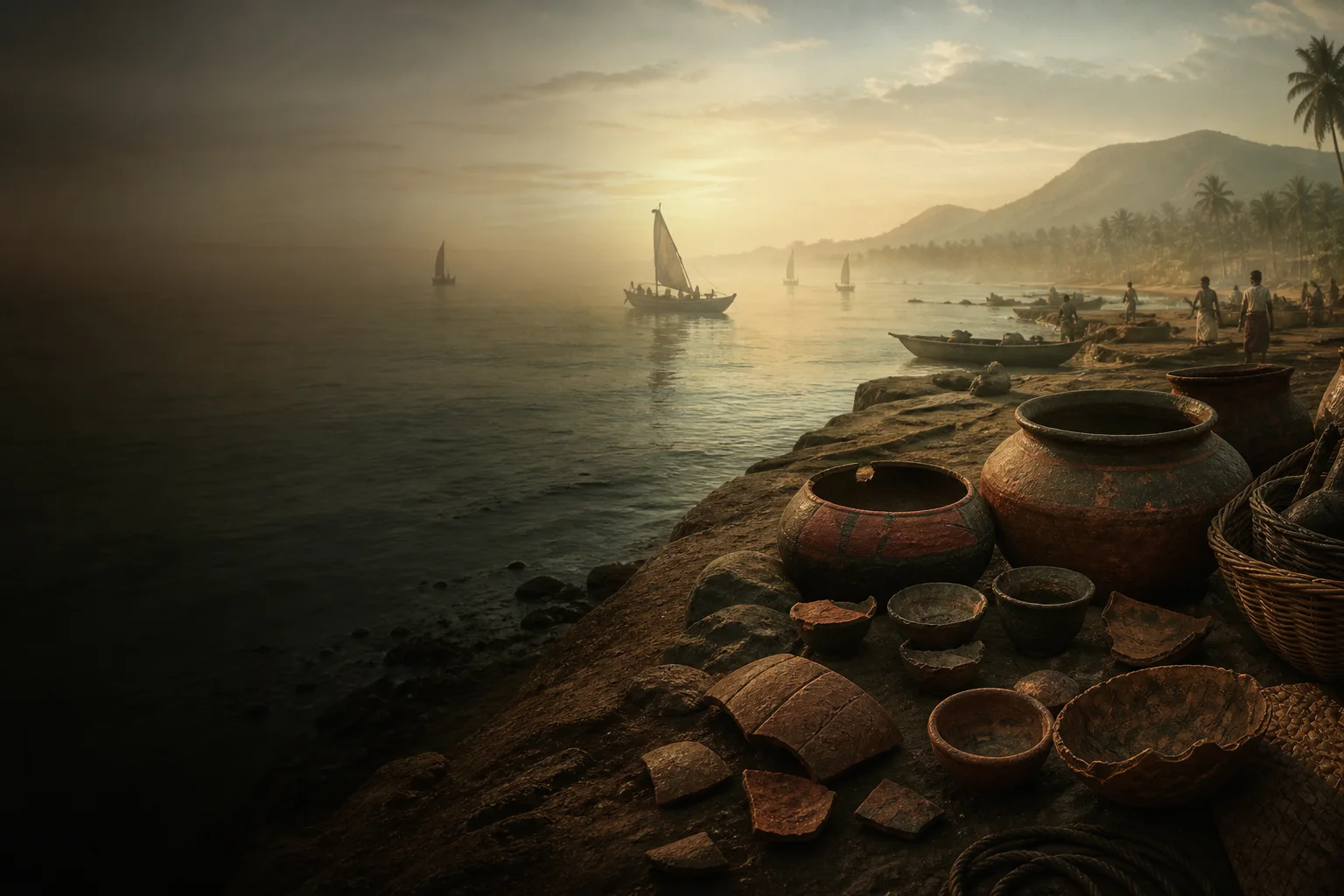
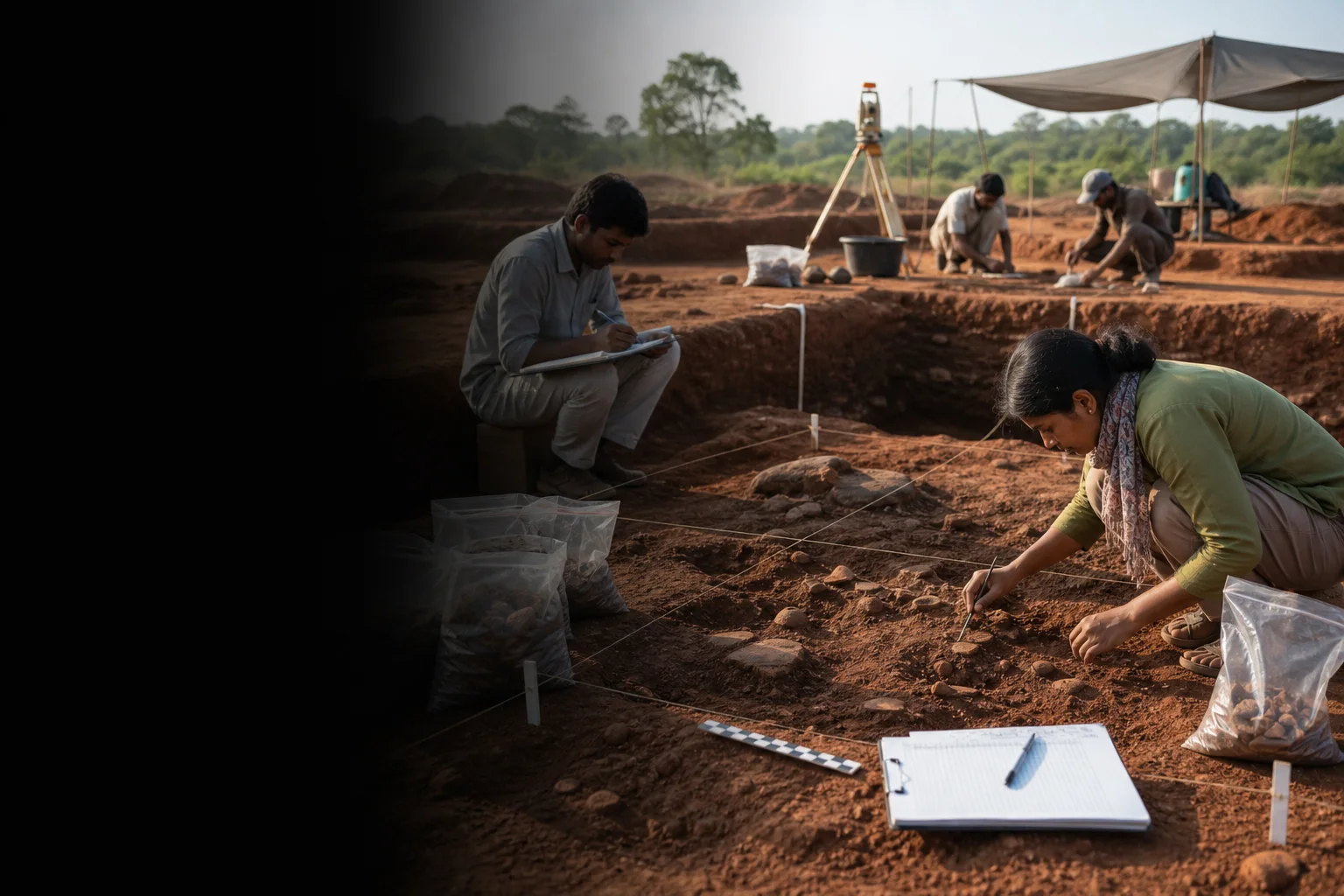
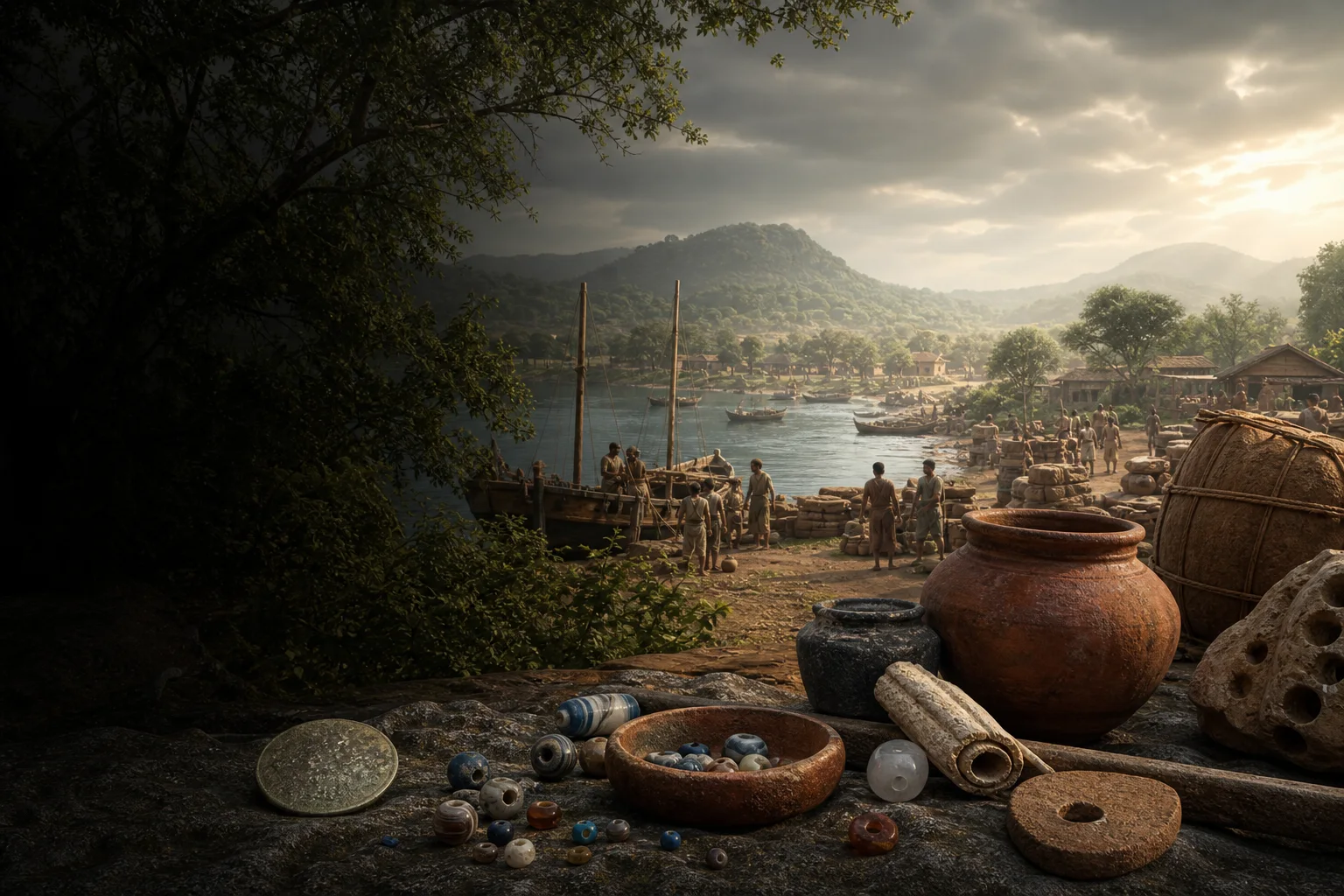
These project-created visuals support orientation. They are not presented as photographs of an excavation, monument, person, or event.
Questions
Frequently asked questions
Why do some dates appear as ranges?
Different dating methods and incomplete records rarely support a single exact year. Ranges communicate what the evidence can sustain.
Does an inscription prove every detail in a royal claim?
No. Inscriptions are primary evidence, but they were produced for particular purposes and must be read with archaeology, other inscriptions, language, and context.
Are literary traditions treated as facts?
They are treated as important historical sources and traditions. The article distinguishes their cultural testimony from independently verified events.
Can this history change?
Yes. Excavation reports, scientific analyses, newly documented inscriptions, and scholarly debate can revise chronology and interpretation.
How were sources selected?
Priority goes to excavation reports, official archaeology and museum records, archives, UNESCO documentation, university resources, and established scholarship.
Can I visit every place named here?
No. Some are living religious sites, protected monuments, working excavations, archives, or places without visitor facilities. Check the responsible institution before travelling.
Editorial trust
Sources and further reading
Citations in the article point to this full list. Source type and review date are shown so readers can evaluate the evidence.
- 1Polity in the Sangam AgeUGC e-PG Pathshala / INFLIBNETUniversity teaching module · Reviewed 9 August 2026
- 2Archaeological excavations in Tamil NaduTamil Nadu State Department of ArchaeologyOfficial excavation register · Reviewed 9 August 2026
- 3Tamil-Brahmi scriptTamil Nadu State Department of ArchaeologyOfficial epigraphy overview · Reviewed 9 August 2026
- 4Coins of Tamil NaduGovernment Museum ChennaiOfficial museum collection guide · Reviewed 9 August 2026
- 5Kodumanal excavationTamil Nadu State Department of ArchaeologyOfficial site report · Reviewed 9 August 2026
- 6Korkai excavationTamil Nadu State Department of ArchaeologyOfficial site report · Reviewed 9 August 2026
- 7Underwater archaeologyTamil Nadu State Department of ArchaeologyOfficial programme overview · Reviewed 9 August 2026
- 8Department e-publicationsTamil Nadu State Department of ArchaeologyOfficial publication catalogue · Reviewed 9 August 2026
- 9Keeladi excavationTamil Nadu State Department of ArchaeologyOfficial site report · Reviewed 9 August 2026
- 10EpigraphyTamil Nadu State Department of ArchaeologyOfficial subject overview · Reviewed 9 August 2026
Editorial review: Factual claims were checked against the linked primary and institutional sources on 9 August 2026. Where the sources support only a range or interpretation, the article keeps that limitation visible.