Dynasties of Tamil Nadu
The Chola Dynasty
Beyond conquest lists: read Chola history through inscriptions, temples, bronzes, land and water institutions, maritime connections, labor, and later memory.
Orientation
Overview
Early references; major imperial phase from the 9th to 13th centuries CE
The Cholas are documented in early Tamil literature and again, much more extensively, in inscriptions and monuments from the medieval imperial period. These two histories share a dynastic name but are separated by major chronological gaps. The later Cholas created a powerful state centered in the Kaveri basin, extended military influence across parts of South India and Sri Lanka, and participated in wider Bay of Bengal networks. Their history is unusually visible because thousands of inscriptions record gifts, taxes, offices, land, water, assemblies, and temple institutions.[3][2]
Rajaraja I's Brihadisvara Temple at Thanjavur and Rajendra I's temple at Gangaikondacholapuram, together with the later Airavatesvara Temple at Darasuram, form UNESCO's Great Living Chola Temples property. These monuments demonstrate architectural and artistic achievement while remaining living sacred places. They should not stand in for the whole society that funded, built, staffed, supplied, and later preserved them.[1]
Chola bronzes have become global icons, but their historical meaning lies in ritual movement, patronage, metallurgy, inscription, temple economy, and community. Museum display changes the object's setting. The same caution applies to inscriptions: they preserve a vast administrative record, yet formula, royal perspective, survival, and later copying shape the archive.[6][3]
This page uses the label empire for the scale and ambition of later Chola power, while avoiding the idea of a uniform modern territorial state. Control varied by region, campaign, alliance, tribute, and local institution. Naval and overseas claims are discussed through specific evidence, not through inflated maps or unsupported accounts of permanent colonization.
Chronology
A careful timeline
Dates identify documented phases and broad ranges. They do not imply uninterrupted rule or certainty where the evidence remains debated.
Early Chola memory
Poetry and coins preserve Chola names and symbols; exact genealogical continuity remains uncertain.[7][8]
Medieval expansion
A Chola line consolidated power in the Kaveri region; inscriptional evidence becomes increasingly abundant.[3]
Brihadisvara at Thanjavur
The great temple associated with Rajaraja I became a monumental religious and political institution.[1]
Gangaikondacholapuram
Rajendra I founded a new imperial center and temple after major campaigns.[1]
Airavatesvara at Darasuram
The later Chola temple demonstrates continuity and change in architecture and sculpture.[1]
End of Chola sovereignty
Pandya expansion and other regional powers reshaped the political order; Chola institutions and monuments continued.
Historical reading
From early Cholas to the medieval state
Early Cholas appear in Sangam literature, with Uraiyur and Kaveripattinam connected to their memory. Later medieval inscriptions construct lineages that reach into an ancient past. Such genealogies were political resources. They demonstrate what later courts wished to claim, not an independently complete chain across every intervening century.[7][3]
The medieval line rose in the Kaveri basin amid competition with Pallavas, Pandyas, Muttaraiyars, and other powers. Historians reconstruct the sequence from dated and regnal inscriptions, temple foundations, grants, and references in neighboring records. Even a well-attested chronology has local uncertainty because kings could rule with heirs, issue records under titles, and campaign without permanently administering every place named.
Rajaraja I and Rajendra I occupy a central place because their reigns left major monuments and extensive inscriptions. A ruler-centered narrative, however, can obscure long institutional development before and after them. Later Chola rulers maintained and altered political, temple, and regional networks for generations.
Historical reading
Administration, assemblies and records
Chola administration operated through nested regions, officers, revenue assignments, local bodies, temples, and corporate groups. Inscriptions mention ur assemblies in non-brahmadeya villages, sabhas in Brahmana settlements, nagarams associated with merchants, and nattar at a wider local level. These bodies differed by place and were not democratic municipalities in the modern universal-suffrage sense.[2]
The celebrated Uttiramerur inscriptions describe procedures within a particular Brahmadeya context, including qualifications and committee selection. They are important evidence for structured local government, but they should not be generalized to every village or presented as a direct copy of modern elections. Eligibility was socially restricted, and the records belong to specific institutional circumstances.[2]
Inscriptions also preserve taxes, remissions, measurements, boundaries, endowments, maintenance duties, and disputes. The density of records reflects both administrative activity and the survival of stone temples where texts endured. Perishable records and the practices of less monumental communities are far less visible.[3][4]
Historical reading
Land, water and the Kaveri landscape
The Kaveri basin supported intensive cultivation through river branches, channels, tanks, wells, embankments, and local maintenance. Chola rulers and elites invested in hydraulic works, but no single dynasty created the entire delta system. Farmers, local assemblies, laborers, engineers, donors, and later regimes built and repaired it across centuries.
Land grants changed revenue relationships and could create Brahmadeya or temple-centered settlements. Inscriptions name plots, water rights, dues, and obligations with precision in their local context. They also reveal unequal access to land and labor. A grant celebrated as piety by a donor could reorganize resources for cultivators and service communities.
The landscape made surplus and monumental patronage possible, while floods, silt, rainfall variability, and maintenance shaped risk. Historical discussion should not romanticize the delta as naturally abundant. It was a worked environment whose productivity depended on continuous social coordination.
Historical reading
Temples, architecture and institutional life
The Great Living Chola Temples combine scale, engineering, sculpture, painting, inscription, ritual, and urban presence. Brihadisvara's axial composition and towering vimana differ from the sculptural rhythms of Darasuram. UNESCO groups them for their Chola achievement and continued living traditions, not because the three complexes are identical.[1]
Temples received land, lamps, livestock, gold, vessels, and services. They employed or coordinated priests, musicians, dancers, accountants, guards, gardeners, artisans, and suppliers. Their records illuminate economy and culture while also reflecting hierarchy and control over resources. The institution cannot be reduced either to a devotional monument or to a treasury.
Structures accumulated later additions and repairs. Vijayanagara, Nayak, Maratha, colonial, and modern interventions can coexist in a site commonly called Chola. Architectural history should identify the date and patron of individual components where possible instead of assigning the entire visible complex to one reign.[1][3]
Historical reading
Bronzes, sculpture and skilled production
Chola-period metal images are associated with the lost-wax process, in which a model and mold produce a unique casting. The technical sequence required specialized knowledge and organized access to metal, fuel, modeling materials, finishing, and iconographic rules. Attributing every South Indian bronze with a similar appearance to the Chola court would be unsafe.[6]
Many bronzes were made for worship and procession. Their movement through streets connected deity, temple, patron, and community. Museum lighting highlights form, but it removes the image from sound, scent, clothing, ornament, ritual time, and sacred agency. Captions should acknowledge both art history and living religious meaning.[6]
Stone sculpture and inscriptions were also skilled products of workshops. Differences in style can help establish sequence, but stylistic dating remains interpretive. A signed or inscribed work offers stronger attribution than resemblance alone.
Historical reading
War, maritime connections and scale
Chola armies campaigned across southern India and Sri Lanka, and inscriptions celebrate victories farther afield. Campaign records are political texts. They can establish ambition and movement while leaving the duration and local texture of control uncertain. Accounts of violence and extraction must sit beside accounts of monumental patronage.
Rajendra I's overseas expedition toward Southeast Asia is a major episode in Bay of Bengal history. It is evidence of naval capacity and intervention in maritime networks, not proof that the Cholas permanently ruled all the places named in celebratory records. Commercial, diplomatic, religious, and political connections continued through many actors.
Merchant groups appear in inscriptions across South and Southeast Asia, but they were not simply departments of the Chola state. Traders could use political protection, temple networks, kinship, and corporate organization while pursuing their own interests. Maritime history becomes clearer when royal records are compared with inscriptions and archaeology outside Tamil Nadu.
Historical reading
Society, labor and unequal visibility
Chola inscriptions name many occupations and status groups, but the archive privileges donors, officials, institutions, and transactions that required durable record. Agricultural and service labor underpinned the state and temple economy. Some communities appear through duties or payments rather than through self-authored accounts.
Caste, landholding, religious status, gender, and occupation shaped access to assemblies and resources. Temple women and performers appear in records, including those associated with music and dance. Their roles changed across time, and modern labels can distort medieval institutions. They should be studied as historical people rather than romantic symbols.
Religious life included Shaiva, Vaishnava, Jain, Buddhist, local, and courtly traditions in changing relationships. Royal support for one institution did not make society religiously uniform. Material and textual evidence from Nagapattinam and other places complicates any single-faith picture of the Chola world.
Historical reading
How to read Chola evidence
Historical knowledge is assembled from sources that answer different questions. Excavated objects and soil layers reveal production, food, settlement, exchange, burial, and technology, but only when their archaeological context is recorded. Inscriptions can name donors, rulers, institutions, taxes, places, and religious gifts, yet they are selective public acts rather than neutral surveys. Coins establish circulation and political imagery more readily than they establish precise borders. Literary works preserve language, ethics, emotion, landscape conventions, and political ideals; they cannot be treated as transcripts of daily life.[10][3][8]
Dates on this site use BCE and CE. A date attached to charcoal, grain, pottery, a script style, a monument, or a ruler does not always date every object or activity at the same place. Radiocarbon dates describe measured samples and probability ranges. Palaeographic dates compare letter forms. Regnal dates may depend on inscriptions and later synchronisms. When these methods disagree or the published evidence is incomplete, the uncertainty belongs in the account rather than being smoothed away.[11][9]
Literary tradition, religious tradition, local memory, and legend can be historically important even when they are not independently verified descriptions of an event. This guide labels them as traditions and asks what they meant to the communities that preserved them. It does not use them to manufacture exact battles, genealogies, city plans, or territorial maps. New excavations and new readings of inscriptions can change interpretation, so the sources and review date are part of the article, not an afterthought.[7][3]
Historical reading
Legacy, preservation and debate
A dynasty is not a single person stretched across centuries. Courts changed location, alliances shifted, branches competed, and later rulers reused earlier names. The people living under those regimes included cultivators, pastoralists, artisans, merchants, soldiers, religious specialists, administrators, performers, and many others whose experiences are unevenly visible in surviving records.
Modern pride in Tamil history can encourage preservation and study, but it can also tempt writers to turn partial evidence into certainty. This article treats monumental achievements seriously while also asking who supplied labor, land, revenue, knowledge, and materials. It avoids projecting present-day state borders onto historical polities whose influence was layered and changeable.
The most durable legacy is often not a list of conquests. It can be a changed settlement pattern, a water system, a script practice, a temple institution, a route of exchange, a body of literature, or an archive of inscriptions. Those traces survived because later communities maintained, adapted, contested, or rediscovered them.
Study desk
Research notes for careful readers
Use these questions to move from an overview of The Chola Dynasty to evidence-led historical study.
Build chronology from anchors
Begin with evidence that carries its own recoverable context: a dated inscription, an excavated layer, a documented coin hoard, a building phase, a letter, or an administrative file. Then place less certain material around those anchors. A royal genealogy, literary allusion, stylistic comparison, or later tradition may be highly informative without supporting an exact year. Writing the evidence type beside every date prevents a reconstructed sequence from looking more certain than its foundations.[1]
Watch for gaps and overlaps. Dynastic names can disappear from one kind of record and return in another; two rulers may claim authority at the same time; a monument can be begun, enlarged, repaired, and reinterpreted under different patrons. Period labels are tools for organizing change, not walls between communities. A timeline should therefore identify phases and transitions instead of pretending that one court handed a complete territory to the next on a single day.[2]
Read maps as arguments
Historical maps are reconstructions. An inscription naming a victory, a poem praising a ruler, a coin found in circulation, and a grant made in a village describe different relationships to place. None by itself proves a permanently administered frontier. Useful maps distinguish core areas, attested sites, campaign claims, routes, tributary relationships, and uncertain zones. They also use the coastline, river course, and place names appropriate to the period being discussed.[3]
Modern Tamil Nadu remains the geographic focus of this site, but historical networks crossed its present boundary. Ports connected to Sri Lanka and the wider Indian Ocean; inland routes crossed the Ghats; religious and merchant institutions operated across several political regions; the Madras Presidency extended far beyond today's state. A regional history becomes clearer when present-day borders orient the reader without containing the past.
Account for survival and silence
Stone temples, copper plates, official files, and elite literary collections survive for particular reasons. Durable material and institutional custody make some voices much louder than others. Workers may appear only through wages or duties, women through gifts or prosecutions, rural communities through tax demands, and defeated groups through an opponent's praise. Silence can indicate loss, exclusion, or the source's purpose; it cannot safely be converted into proof that a person or practice was absent.[4]
Translation adds another layer. Titles, offices, social terms, ritual vocabulary, and place names do not always have one modern equivalent. A smooth English phrase can hide alternatives in the original language. Where an interpretation depends on one word, consult the transcription, translation notes, and more than one scholarly reading. Quotations should come from a checked edition rather than from unsourced graphics or repeated web summaries.
Compare at the right scale
Comparison is strongest when the units truly match. A burial site should not be measured against a capital city as though they served the same function. One king's regnal inscription should not be compared directly with a literary anthology compiled over time. Instead compare burial with burial, workshop with workshop, grant formula with grant formula, and securely dated architectural phase with another documented phase. Regional synthesis comes after those controlled comparisons.
Public history adds valuable questions but can also reward superlatives. Claims about the oldest, greatest, first, largest, or most advanced require a clearly defined comparison set and published evidence. Historical significance does not depend on winning such a ranking. A site or tradition can matter because it changes an interpretation, preserves an unusual archive, or connects people and landscapes in a way that no simple contest can express.
Preserve the evidence you came to see
Historical study continues at living temples, museums, archives, archaeological sites, streets, water systems, and working landscapes. Follow access rules, never touch or enhance inscriptions, do not remove surface finds, ask before photographing people or rituals, and treat conservation closures as part of responsible care. Record the institution, gallery, accession number, monument, or report behind an observation so that it can be checked later.
The best next question is often narrower than the first: which phase of this building, which version of this text, which sample from which layer, which office produced this file, or which community preserved this memory? Narrow questions are not a retreat from big history. They are how large claims become reliable enough to connect.
Human scale
People and institutions
Named rulers are only one part of the history. These groups and individuals help show how evidence and social life connect.
Rajaraja I
Associated with imperial consolidation and Brihadisvara Temple; known through extensive inscriptions.
Rajendra I
Associated with Gangaikondacholapuram and far-reaching campaigns, including an overseas expedition.
Local assemblies
Ur, sabha, nagaram, and nattar institutions whose powers varied by settlement and record.
Artisans and temple workers
Specialists and service communities who made monumental and ritual systems function.
Later Chola rulers
A long sequence that maintained, adapted, and contested the imperial inheritance.
Historical geography
Connected places
Places are linked only when a substantive My Tamil Nadu guide already exists. Other entries remain non-clickable research context.
Visual reading
Images with explicit provenance
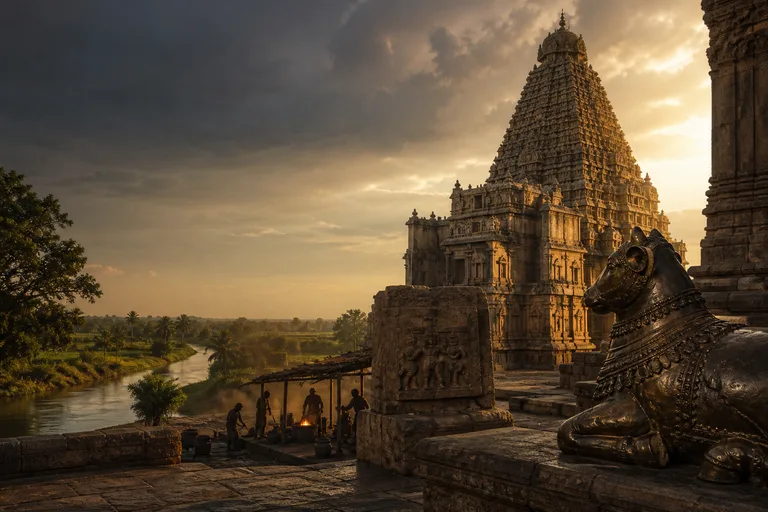
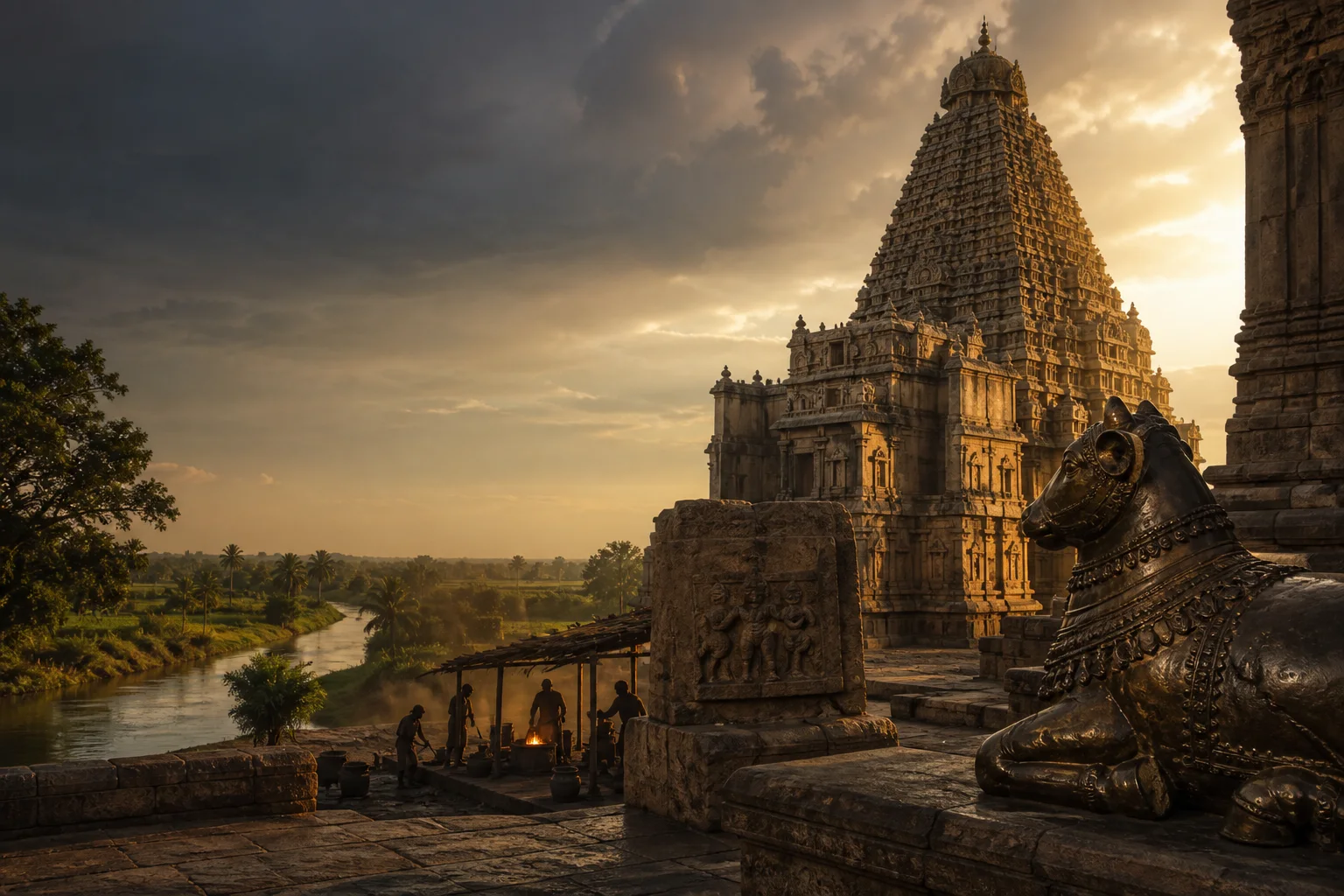
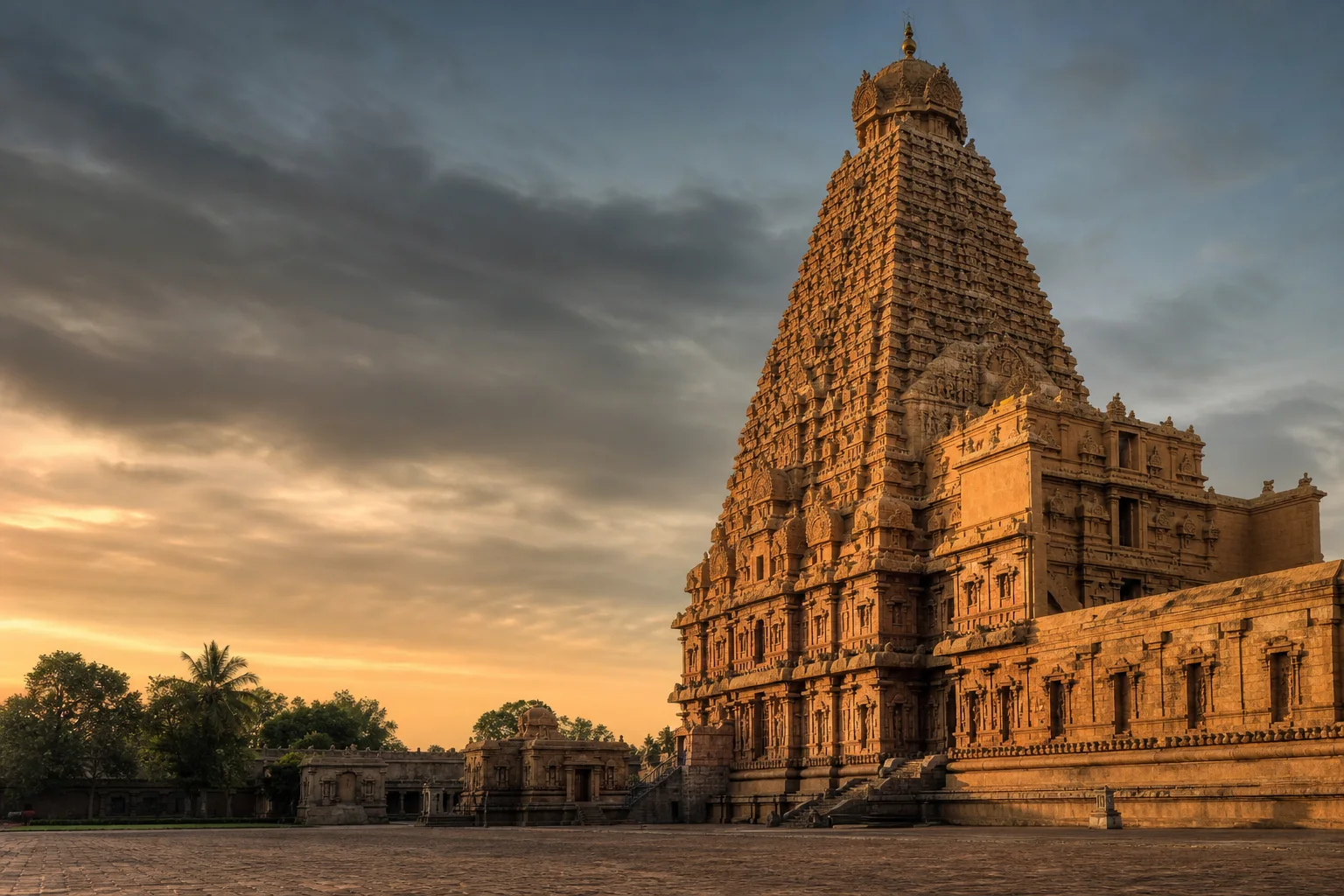
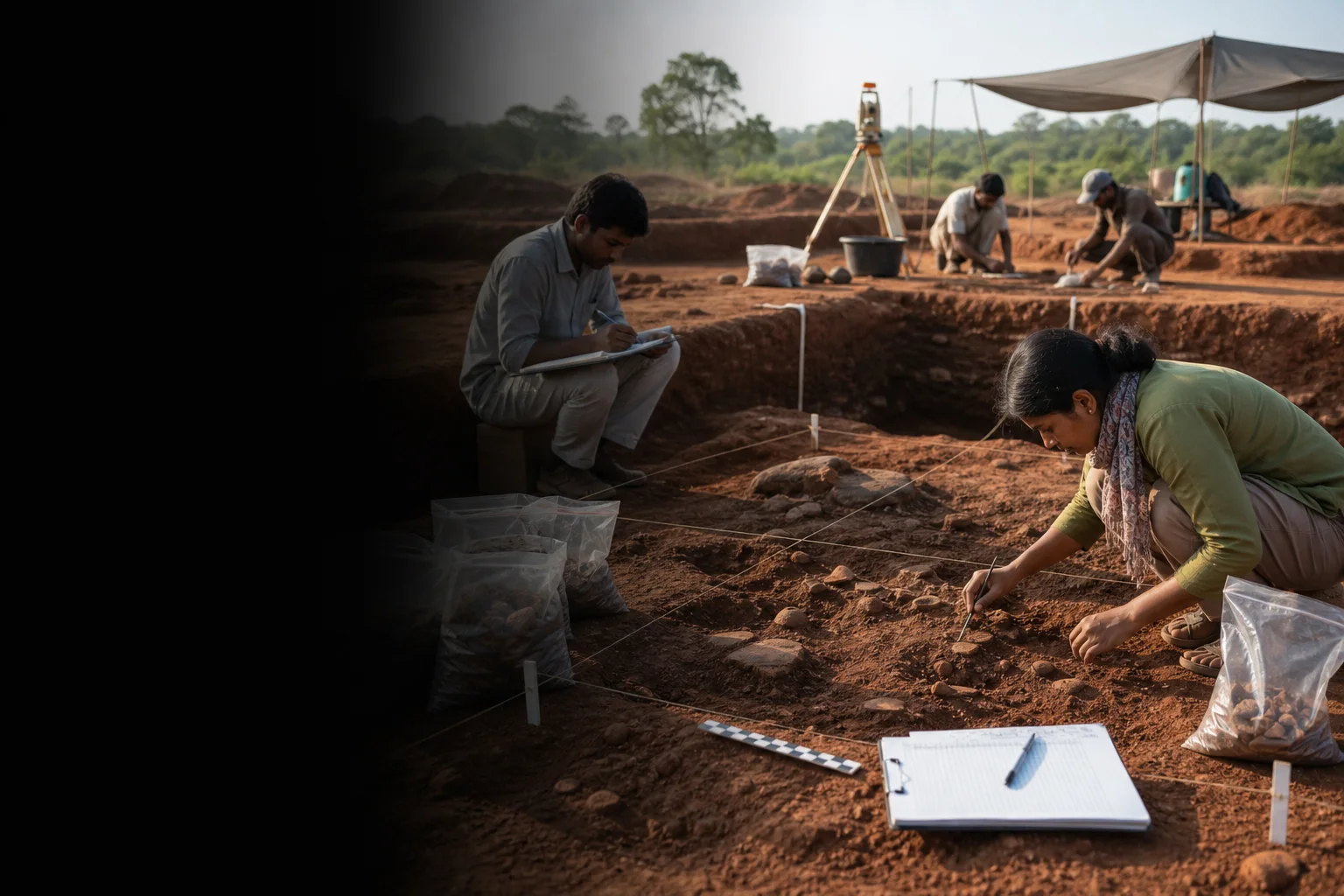
These project-created visuals support orientation. They are not presented as photographs of an excavation, monument, person, or event.
Questions
Frequently asked questions
Why do some dates appear as ranges?
Different dating methods and incomplete records rarely support a single exact year. Ranges communicate what the evidence can sustain.
Does an inscription prove every detail in a royal claim?
No. Inscriptions are primary evidence, but they were produced for particular purposes and must be read with archaeology, other inscriptions, language, and context.
Are literary traditions treated as facts?
They are treated as important historical sources and traditions. The article distinguishes their cultural testimony from independently verified events.
Can this history change?
Yes. Excavation reports, scientific analyses, newly documented inscriptions, and scholarly debate can revise chronology and interpretation.
How were sources selected?
Priority goes to excavation reports, official archaeology and museum records, archives, UNESCO documentation, university resources, and established scholarship.
Can I visit every place named here?
No. Some are living religious sites, protected monuments, working excavations, archives, or places without visitor facilities. Check the responsible institution before travelling.
Editorial trust
Sources and further reading
Citations in the article point to this full list. Source type and review date are shown so readers can evaluate the evidence.
- 1Great Living Chola TemplesUNESCO World Heritage CentreOfficial World Heritage record · Reviewed 9 August 2026
- 2Cholas: provincial and local administrationUGC e-PG Pathshala / INFLIBNETUniversity teaching module · Reviewed 9 August 2026
- 3EpigraphyTamil Nadu State Department of ArchaeologyOfficial subject overview · Reviewed 9 August 2026
- 4Inscriptions in Tamil scriptTamil Nadu State Department of ArchaeologyOfficial epigraphy overview · Reviewed 9 August 2026
- 5Copper-plate inscriptionsTamil Nadu State Department of ArchaeologyOfficial epigraphy overview · Reviewed 9 August 2026
- 6Guide to the bronze galleryGovernment Museum ChennaiOfficial museum guide · Reviewed 9 August 2026
- 7Polity in the Sangam AgeUGC e-PG Pathshala / INFLIBNETUniversity teaching module · Reviewed 9 August 2026
- 8Coins of Tamil NaduGovernment Museum ChennaiOfficial museum collection guide · Reviewed 9 August 2026
- 9Department e-publicationsTamil Nadu State Department of ArchaeologyOfficial publication catalogue · Reviewed 9 August 2026
- 10Archaeological excavations in Tamil NaduTamil Nadu State Department of ArchaeologyOfficial excavation register · Reviewed 9 August 2026
- 11Tamil-Brahmi scriptTamil Nadu State Department of ArchaeologyOfficial epigraphy overview · Reviewed 9 August 2026
Editorial review: Factual claims were checked against the linked primary and institutional sources on 9 August 2026. Where the sources support only a range or interpretation, the article keeps that limitation visible.