Early modern to colonial history
Colonial Tamil Nadu
Read the colonial period as a transformation of power, land, labor, cities, knowledge, and resistance, grounded in archives without making the colonial state the only historical actor.
Orientation
Overview
From European coastal settlements to Indian independence in 1947
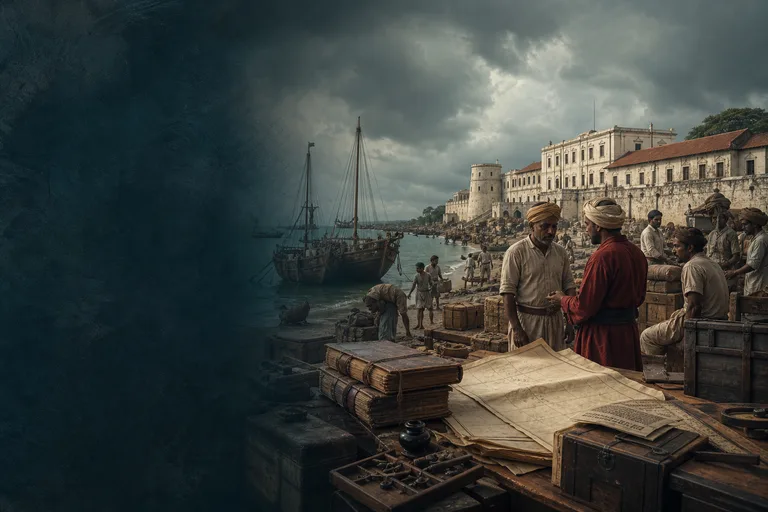
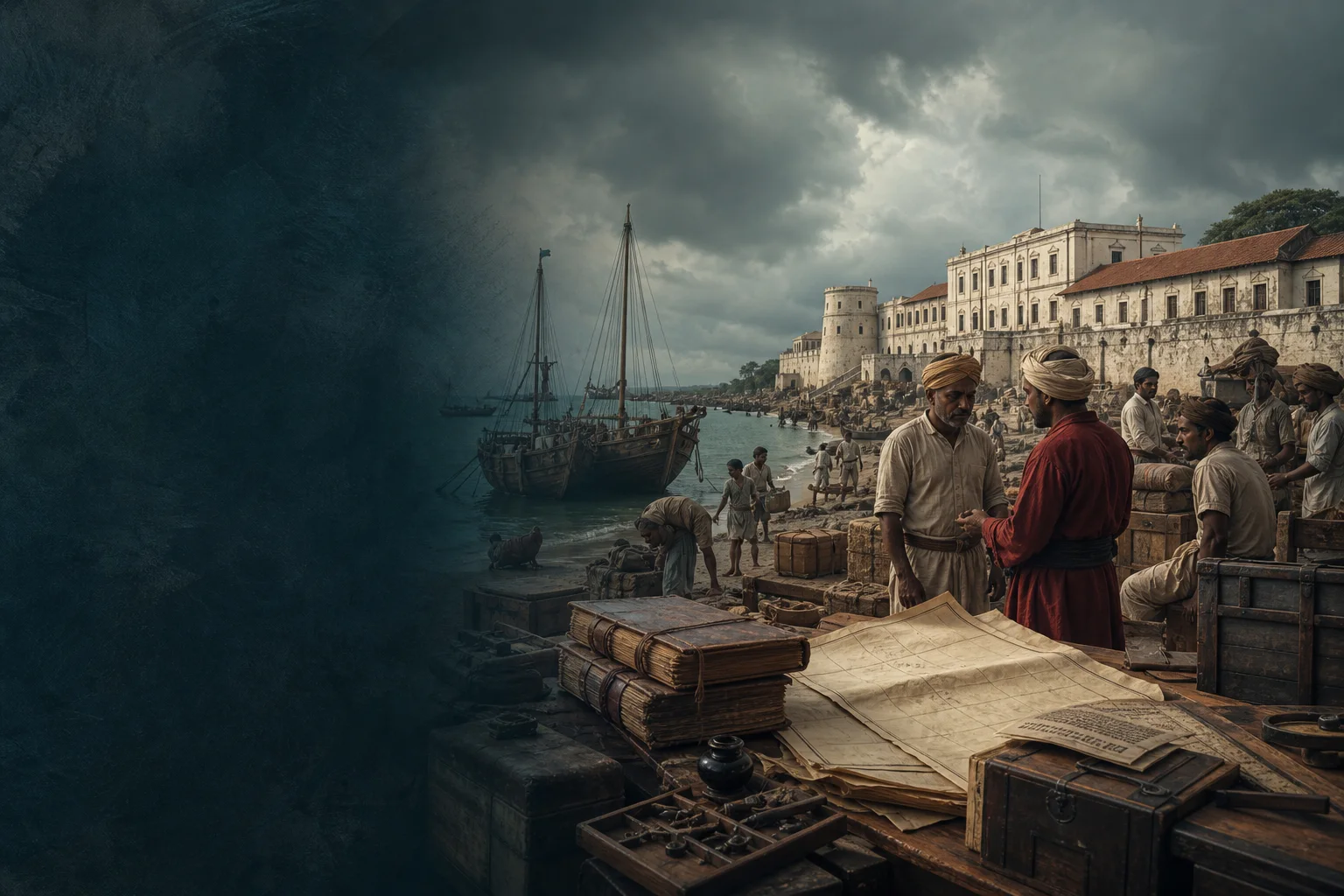
Colonial Tamil Nadu developed through several overlapping processes rather than one date of conquest. Portuguese, Dutch, Danish, French, and English companies established coastal networks and settlements. Indian merchants, brokers, weavers, financiers, rulers, soldiers, sailors, and laborers shaped those systems. The English East India Company's Fort St George settlement, established at Madras in the 17th century, became a major administrative center, but its rise depended on regional negotiation and conflict.[5][2]
Wars involving European companies, the Nawabs of Arcot, Mysore, Maratha powers, local polities, and the British changed military and revenue authority during the 18th century. The eventual Madras Presidency covered areas far beyond present Tamil Nadu. Its archive is therefore not a synonym for Tamil history, and today's state boundary should not be projected backward.[1][3]
Colonial rule reorganized land revenue, law, policing, public works, education, forests, trade, and urban government. The ryotwari system associated revenue demand directly with cultivators in much of the Madras Presidency, but practice varied and records often describe land through the state's fiscal priorities. Economic change brought new markets and infrastructure while also producing extraction, vulnerability, and unequal benefit.[4]
The period also saw print expansion, missionary institutions, new associations, caste and anti-caste movements, labor organization, women's public action, and nationalist politics. These histories cannot be reduced to a simple encounter between Britain and an undifferentiated Tamil society.
Chronology
A careful timeline
Dates identify documented phases and broad ranges. They do not imply uninterrupted rule or certainty where the evidence remains debated.
European coastal presence
Portuguese and other maritime powers entered existing Indian Ocean networks.
Madras and Fort St George
The English settlement grew through agreements, merchants, labor, and coastal commerce.[5]
War and company expansion
Regional conflict enabled the East India Company to increase military and revenue authority.[2]
Presidency rule expands
Company administration consolidated across much of the Tamil region after major wars and treaties.[2]
Crown rule
Government of India authority replaced East India Company rule after the 1857 uprising.[3]
Independence
British rule ended; colonial institutions and inequalities continued to shape the new state.
Historical reading
Companies on the Coromandel coast
European companies entered a coast already linked to Southeast Asia, Sri Lanka, the western Indian Ocean, and inland production. Textile centers and merchant networks were not created by Europeans. Companies competed to secure cloth, shipping, credit, storage, and political protection, and Indian commercial groups could bargain, adapt, relocate, or suffer coercion.
The English settlement at Madras depended on agreements with regional authorities and on Indian merchants and weavers. Archival research on early Coromandel merchants shows commercial relationships that were negotiated rather than simply imposed from the first day. Over time, fortified space, judicial authority, and military power changed that balance.[5]
Pulicat, Nagapattinam, Tranquebar, Pondicherry, and Madras had different European and Indian histories. A coast-wide narrative should preserve those differences. Danish Tranquebar and French Pondicherry, for example, cannot be folded into an English chronology even when British power later became dominant.
Historical reading
War, the Company and regional states
Eighteenth-century conflict involved European company rivalry and regional struggles around Arcot, Hyderabad, Mysore, Thanjavur, the Marathas, and local rulers. Europeans relied heavily on Indian soldiers, revenue, suppliers, and alliances. Describing the wars as European contests alone removes most of the participants.
Company military success converted commercial privileges into territorial and fiscal power. Treaties and assignments could transfer revenue claims without creating immediate administrative control on the ground. Local officials, poligars, zamindars, and village institutions mediated or resisted demands.
The Vellore uprising of 1806 involved Indian soldiers and grievances shaped by military regulations, religious concerns, and the recent history of Mysore. It preceded the larger 1857 uprising and remains important to Tamil Nadu's resistance history, but the events had their own context and should not be collapsed into a single national script.[6]
Historical reading
Land revenue, agriculture and environment
Colonial revenue administration attempted to classify land, cultivators, crops, soils, water, and entitlement. Ryotwari settlements in much of the Madras Presidency made cultivators the recorded revenue holders, but assessments, debt, intermediaries, and local power shaped actual outcomes. Official categories can appear precise while hiding negotiation and coercion.[4]
Irrigation surveys and public works altered tanks, channels, dams, and delta management. Some investments expanded capacity; others prioritized revenue and particular crops. Famines and scarcity must be studied through rainfall, food prices, wages, transport, entitlement, state policy, and public health rather than attributed to weather alone.
Forest laws redefined access to grazing, timber, fuel, shifting cultivation, and hill landscapes. Communities that had used forests through customary arrangements faced permits and criminalization. Plantation and conservation histories therefore contain both ecological change and contested rights.
Historical reading
Madras: segregated city and administrative capital
Madras grew around the fort, port, trading streets, religious institutions, military zones, and expanding suburbs. Colonial labels such as White Town and Black Town encoded racial and administrative distinctions while flattening the diversity of Indian neighborhoods. The city expanded through displacement as well as opportunity.
As presidency capital, Madras concentrated courts, colleges, hospitals, print, railway administration, and government departments. These institutions created new professions and public forums but remained shaped by race, caste, class, and gender. Education and law could support reform while serving colonial governance.
The Tamil Nadu Archives preserves records of the East India Company and later presidency administration. They are indispensable and institutionally biased: petitions, proceedings, surveys, and reports entered the archive because the state acted on them. Reading against the grain asks whose voice was summarized, translated, ignored, or absent.[1][2]
Historical reading
Print, religion, caste and public life
Missionary presses, Tamil scholars, publishers, schools, and readers expanded print culture. Palm-leaf manuscript traditions continued while dictionaries, grammars, newspapers, tracts, and new literary forms circulated. Colonial philology classified language and religion, and Tamil intellectuals adopted, challenged, and transformed those classifications.
Caste was neither invented by colonialism nor left untouched by it. Census, law, education, representation, temple access, land, and employment hardened some categories and created new arenas of dispute. Anti-caste thinkers and movements developed powerful critiques that belong centrally to modern Tamil history.
Women entered colonial records through education, labor, reform debates, property disputes, medicine, mission institutions, and political action, yet male officials and reformers often framed the archive. Recovering women's agency requires letters, periodicals, oral history, organizational records, and material culture as well as government files.
Historical reading
Work, mobility and infrastructure
Railways, roads, ports, telegraph, and municipal systems changed movement and markets. Infrastructure was not a neutral gift: routes served military and commercial priorities, construction relied on labor, and access was unequal. Communities also appropriated these networks for pilgrimage, organizing, migration, and politics.
Plantations and overseas labor migration connected Tamil districts to Ceylon, Malaya, Burma, Mauritius, and other destinations. Recruitment, debt, contract, family strategy, caste, and empire shaped mobility. Diasporic histories are part of Tamil Nadu's colonial story even when the archive is held elsewhere.
Urban workers in mills, railways, ports, printing, domestic service, and public works formed associations and participated in wider politics. Labor history broadens the freedom movement beyond speeches by prominent leaders.
Historical reading
How to read colonial archives
Colonial files can be extraordinarily detailed because states counted revenue, property, crime, disease, population, and infrastructure. Their precision should not be confused with neutrality. Categories were designed for governance, reports moved through bureaucratic editing, and statistics depended on local collection practices.[2][3]
Indian petitions and depositions can preserve voices but often survive in translation or official summary. Newspapers and memoirs offer alternatives while carrying their own audiences and politics. Comparing records from different institutions is essential.
Place names, district boundaries, and administrative units changed. A record filed under the Madras Presidency may concern a place outside modern Tamil Nadu; a Tamil-speaking community may appear in records held outside Chennai. Historical geography must be stated for the period under discussion.
Historical reading
Colonial legacies and historical responsibility
Present institutions of law, revenue, archives, municipalities, transport, and education carry colonial histories, but they were repeatedly modified by Indian officials, movements, and post-independence governments. Continuity should not be mistaken for unchanged inheritance.
Built heritage can preserve evidence while encouraging nostalgia for elite colonial spaces. Forts, clubs, courts, stations, prisons, factories, worker neighborhoods, and sites of protest belong in the same landscape. The question is not whether a building looks attractive, but what relationships it embodied.
A balanced account recognizes Indian agency without using collaboration as a blanket accusation or resistance as a universal condition. People acted within unequal structures for survival, advantage, reform, belief, and political change. Historical judgment benefits from specificity.
Study desk
Research notes for careful readers
Use these questions to move from an overview of Colonial Tamil Nadu to evidence-led historical study.
Build chronology from anchors
Begin with evidence that carries its own recoverable context: a dated inscription, an excavated layer, a documented coin hoard, a building phase, a letter, or an administrative file. Then place less certain material around those anchors. A royal genealogy, literary allusion, stylistic comparison, or later tradition may be highly informative without supporting an exact year. Writing the evidence type beside every date prevents a reconstructed sequence from looking more certain than its foundations.[1]
Watch for gaps and overlaps. Dynastic names can disappear from one kind of record and return in another; two rulers may claim authority at the same time; a monument can be begun, enlarged, repaired, and reinterpreted under different patrons. Period labels are tools for organizing change, not walls between communities. A timeline should therefore identify phases and transitions instead of pretending that one court handed a complete territory to the next on a single day.[2]
Read maps as arguments
Historical maps are reconstructions. An inscription naming a victory, a poem praising a ruler, a coin found in circulation, and a grant made in a village describe different relationships to place. None by itself proves a permanently administered frontier. Useful maps distinguish core areas, attested sites, campaign claims, routes, tributary relationships, and uncertain zones. They also use the coastline, river course, and place names appropriate to the period being discussed.[3]
Modern Tamil Nadu remains the geographic focus of this site, but historical networks crossed its present boundary. Ports connected to Sri Lanka and the wider Indian Ocean; inland routes crossed the Ghats; religious and merchant institutions operated across several political regions; the Madras Presidency extended far beyond today's state. A regional history becomes clearer when present-day borders orient the reader without containing the past.
Account for survival and silence
Stone temples, copper plates, official files, and elite literary collections survive for particular reasons. Durable material and institutional custody make some voices much louder than others. Workers may appear only through wages or duties, women through gifts or prosecutions, rural communities through tax demands, and defeated groups through an opponent's praise. Silence can indicate loss, exclusion, or the source's purpose; it cannot safely be converted into proof that a person or practice was absent.[4]
Translation adds another layer. Titles, offices, social terms, ritual vocabulary, and place names do not always have one modern equivalent. A smooth English phrase can hide alternatives in the original language. Where an interpretation depends on one word, consult the transcription, translation notes, and more than one scholarly reading. Quotations should come from a checked edition rather than from unsourced graphics or repeated web summaries.
Compare at the right scale
Comparison is strongest when the units truly match. A burial site should not be measured against a capital city as though they served the same function. One king's regnal inscription should not be compared directly with a literary anthology compiled over time. Instead compare burial with burial, workshop with workshop, grant formula with grant formula, and securely dated architectural phase with another documented phase. Regional synthesis comes after those controlled comparisons.
Public history adds valuable questions but can also reward superlatives. Claims about the oldest, greatest, first, largest, or most advanced require a clearly defined comparison set and published evidence. Historical significance does not depend on winning such a ranking. A site or tradition can matter because it changes an interpretation, preserves an unusual archive, or connects people and landscapes in a way that no simple contest can express.
Preserve the evidence you came to see
Historical study continues at living temples, museums, archives, archaeological sites, streets, water systems, and working landscapes. Follow access rules, never touch or enhance inscriptions, do not remove surface finds, ask before photographing people or rituals, and treat conservation closures as part of responsible care. Record the institution, gallery, accession number, monument, or report behind an observation so that it can be checked later.
The best next question is often narrower than the first: which phase of this building, which version of this text, which sample from which layer, which office produced this file, or which community preserved this memory? Narrow questions are not a retreat from big history. They are how large claims become reliable enough to connect.
Human scale
People and institutions
Named rulers are only one part of the history. These groups and individuals help show how evidence and social life connect.
Indian merchants and brokers
Commercial actors who negotiated with companies and connected coast to inland production.
Soldiers and local rulers
Participants in conflict, treaty, revolt, and changing revenue power.
Cultivators and workers
People who bore assessments, produced exports, built infrastructure, and organized.
Scholars, printers and reformers
Creators of new public debates in Tamil and other languages.
Colonial officials
Producers of a powerful but institutionally partial archive.
Historical geography
Connected places
Places are linked only when a substantive My Tamil Nadu guide already exists. Other entries remain non-clickable research context.
Visual reading
Images with explicit provenance
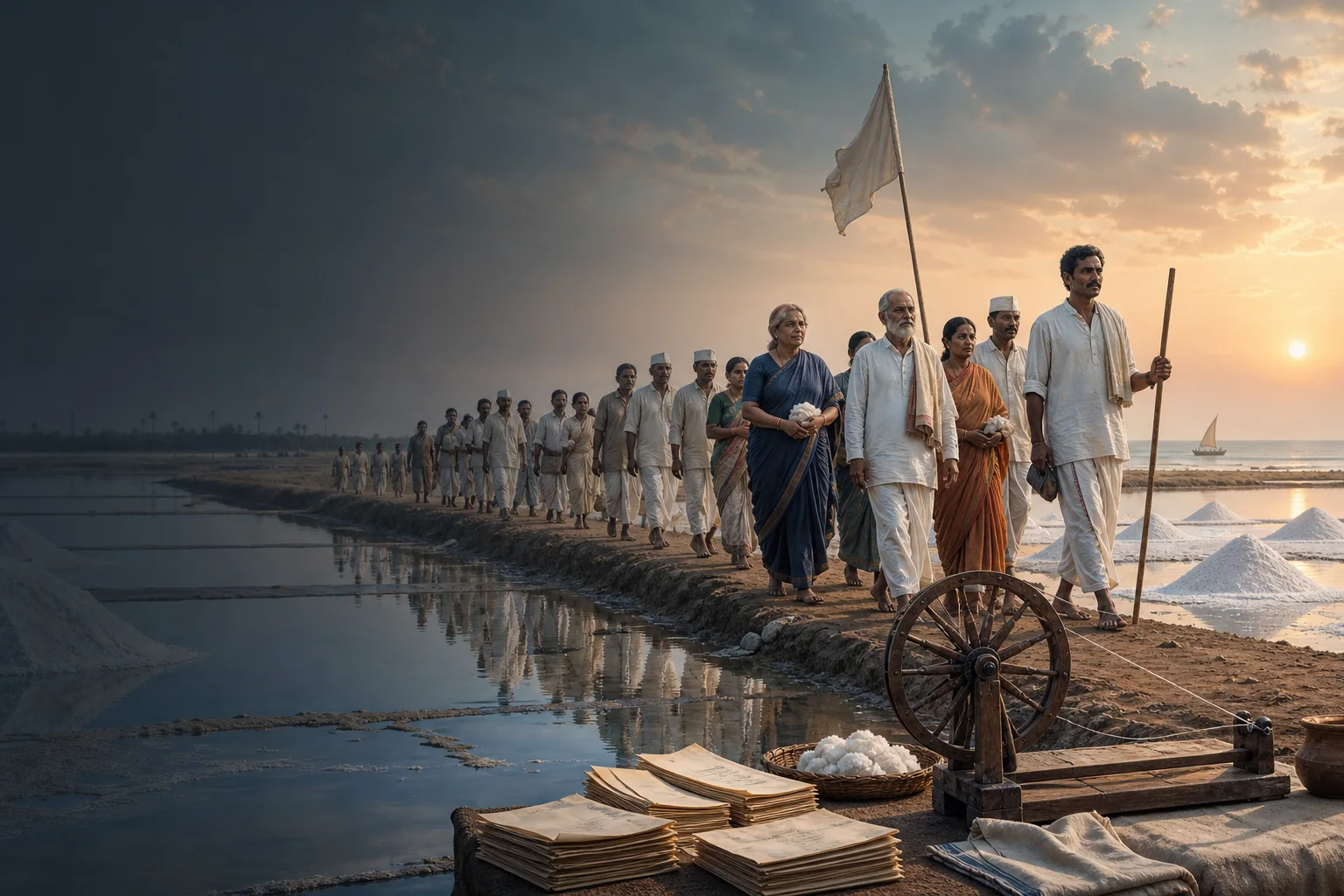
These project-created visuals support orientation. They are not presented as photographs of an excavation, monument, person, or event.

Questions
Frequently asked questions
Why do some dates appear as ranges?
Different dating methods and incomplete records rarely support a single exact year. Ranges communicate what the evidence can sustain.
Does an inscription prove every detail in a royal claim?
No. Inscriptions are primary evidence, but they were produced for particular purposes and must be read with archaeology, other inscriptions, language, and context.
Are literary traditions treated as facts?
They are treated as important historical sources and traditions. The article distinguishes their cultural testimony from independently verified events.
Can this history change?
Yes. Excavation reports, scientific analyses, newly documented inscriptions, and scholarly debate can revise chronology and interpretation.
How were sources selected?
Priority goes to excavation reports, official archaeology and museum records, archives, UNESCO documentation, university resources, and established scholarship.
Can I visit every place named here?
No. Some are living religious sites, protected monuments, working excavations, archives, or places without visitor facilities. Check the responsible institution before travelling.
Editorial trust
Sources and further reading
Citations in the article point to this full list. Source type and review date are shown so readers can evaluate the evidence.
- 1Introduction to the Tamil Nadu ArchivesTamil Nadu Archives and Historical ResearchOfficial archive guide · Reviewed 9 August 2026
- 2Record holdingsTamil Nadu Archives and Historical ResearchOfficial archive catalogue · Reviewed 9 August 2026
- 3Public records holdingsNational Archives of IndiaOfficial archive catalogue · Reviewed 9 August 2026
- 4Economic effects of British colonialismNational Institute of Open SchoolingGovernment educational resource · Reviewed 9 August 2026
- 5The Indigenous Merchants and English Company on the Coromandel Coast, 1611-1652Tamil Nadu Archives and Historical ResearchArchive research publication · Reviewed 9 August 2026
- 6Vellore MutinyMinistry of Culture, Government of IndiaOfficial historical note · Reviewed 9 August 2026
- 7Tilak Ghat, ChennaiGandhi Heritage PortalInstitutional heritage record · Reviewed 9 August 2026
Editorial review: Factual claims were checked against the linked primary and institutional sources on 9 August 2026. Where the sources support only a range or interpretation, the article keeps that limitation visible.