Resistance, nationalism and public life
Tamil Nadu and the Freedom Movement
A many-voiced history of soldiers, rulers, workers, women, writers, organizers, and ordinary participants, with early resistance distinguished from later organized nationalism.
Orientation
Overview
From early resistance to independence in 1947
Tamil Nadu's freedom-movement history includes resistance to expanding Company power, the Vellore uprising of 1806, 19th-century political associations, swadeshi campaigns, labor organizing, Home Rule, non-cooperation, civil disobedience, the Vedaranyam Salt Satyagraha, anti-caste and social-justice politics, Quit India activity, and participation in armed and overseas movements. These strands overlapped but did not share one ideology or timeline.[1][2][6]
Early conflicts involving the Marudhu brothers, Velu Nachiyar, Puli Thevar, Kattabomman, Dheeran Chinnamalai, poligar forces, and Company expansion are often folded into a national freedom story. They are essential histories of resistance, sovereignty, revenue, and regional power. Historians should preserve their 18th-century contexts rather than assume every participant used the later language of Indian nationalism.
By the late 19th and early 20th centuries, newspapers, associations, lawyers, students, merchants, workers, poets, and women activists expanded the political public. Chennai became an important center of meetings and print. Tuticorin labor and swadeshi enterprise, Madurai's Gandhian associations, and the Vedaranyam march show that national politics took distinct regional forms.[4][3][2]
Independence in 1947 did not settle every political demand. Questions of caste equality, labor rights, language, representation, gender, land, and regional autonomy continued. The freedom movement is therefore best understood as a field of argument as well as resistance to foreign rule.
Chronology
A careful timeline
Dates identify documented phases and broad ranges. They do not imply uninterrupted rule or certainty where the evidence remains debated.
Resistance to Company expansion
Regional rulers and poligar forces resisted revenue and military encroachment in distinct conflicts.
Vellore uprising
Indian soldiers rebelled at Vellore amid military and religious grievances.[1]
Associations and press
Political organizations, newspapers, public meetings, and petitions widened participation.[6]
Swadeshi and labor
Boycott, indigenous enterprise, journalism, and worker action became major forms of politics in the south.
Mass non-cooperation
Meetings, khadi, boycott, and Gandhian mobilization reached towns and districts across the region.[4][3]
Vedaranyam Salt Satyagraha
A march led by C. Rajagopalachari challenged the salt laws on the Tamil coast.[2]
Quit India and independence
Protest, repression, wartime politics, and negotiation led into independence.
Historical reading
Early resistance before organized nationalism
Company expansion altered tribute, succession, military obligation, and revenue. Resistance by regional rulers and poligar networks grew from specific political economies. Remembering these struggles matters, but calling every campaign a modern national war can erase local objectives and alliances.
Velu Nachiyar's history is associated with Sivaganga resistance and alliance-building in the late 18th century. The Marudhu brothers later became central to resistance and proclamations against Company authority. Popular narratives sometimes add precise speeches or sensational details without documented sources; this guide does not reproduce them.
Puli Thevar, Kattabomman, and Dheeran Chinnamalai belonged to different places and moments of resistance. Their later commemoration helped create a regional pantheon of freedom. Commemoration itself is historical evidence, but monuments and films should be checked against contemporary records before supplying exact episodes.
Historical reading
The Vellore uprising of 1806
At Vellore Fort, Indian soldiers rebelled in July 1806. Changes to military dress and fears about religious interference were among the grievances, alongside the wider political aftermath of Mysore's defeat and the presence of Tipu Sultan's family. The uprising was violently suppressed.[1]
Vellore is sometimes called a precursor to 1857. Comparison can be useful, but it should not make the two events identical. The scale, networks, immediate triggers, and political contexts differed. The official Ministry of Culture account offers a starting chronology; military and archival records require critical reading.[1][6]
Soldiers enter the record through court-martial and official reports written by the power they challenged. Recovering motive requires caution about confession, translation, rumor, and retrospective explanation. The archive records repression more fully than private thought.
Historical reading
Press, swadeshi and a new political public
Late 19th-century Madras supported political associations, newspapers, debating societies, lawyers, educators, and public meetings. English and Tamil print linked regional grievances to all-India questions while generating disagreements over strategy, representation, and social reform.
Swadeshi politics after the partition of Bengal encouraged boycott, indigenous enterprise, political speech, and new symbols. In Tuticorin, V.O. Chidambaram Pillai's shipping venture challenged commercial power, while worker mobilization showed that economic and political demands could reinforce one another. Any heroic biography should also include collaborators and laboring participants.
Subramania Bharati's poetry and journalism became central to nationalist memory, combining freedom, social reform, women's emancipation, and a transformed public voice. Literary influence cannot be reduced to one event, and later canonization should not erase the risks and material difficulties of print politics.
Historical reading
Gandhian mobilization in Tamil Nadu
Gandhi addressed meetings at Chennai's Tilak Ghat and traveled through the Tamil region. The Gandhi Heritage Portal documents these locations and dates from institutional records. Such visits mattered because local organizers translated national calls into fundraising, khadi work, protest, and district networks.[4]
At Madurai in September 1921, Gandhi adopted the loincloth that became central to his public image, explaining the change through poverty and the boycott of foreign cloth. The event is well documented, but its meaning should be discussed alongside the people whose everyday clothing and labor became a political symbol.[3]
Non-cooperation brought students, lawyers, merchants, women, religious leaders, and volunteers into politics in different ways. Participation was neither universal nor uncontested. Justice Party politics, non-Brahmin movements, and debates over council entry show that opposition to colonial rule coexisted with arguments about social power and political method.
Historical reading
Salt, civil disobedience and Vedaranyam
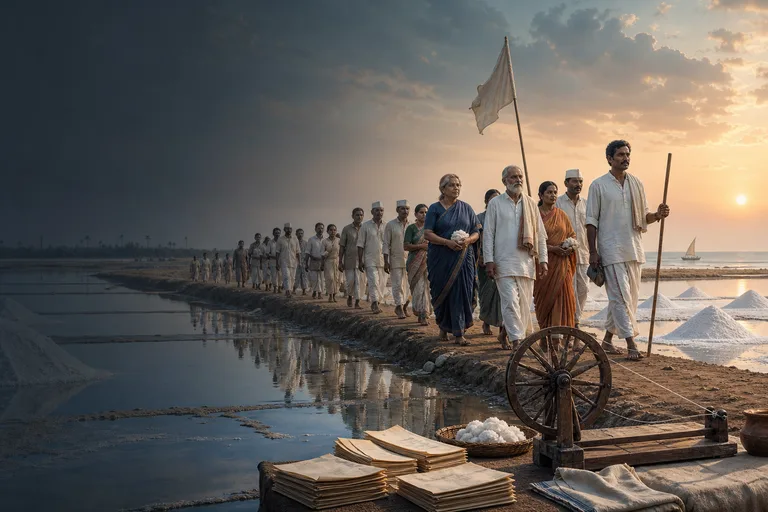
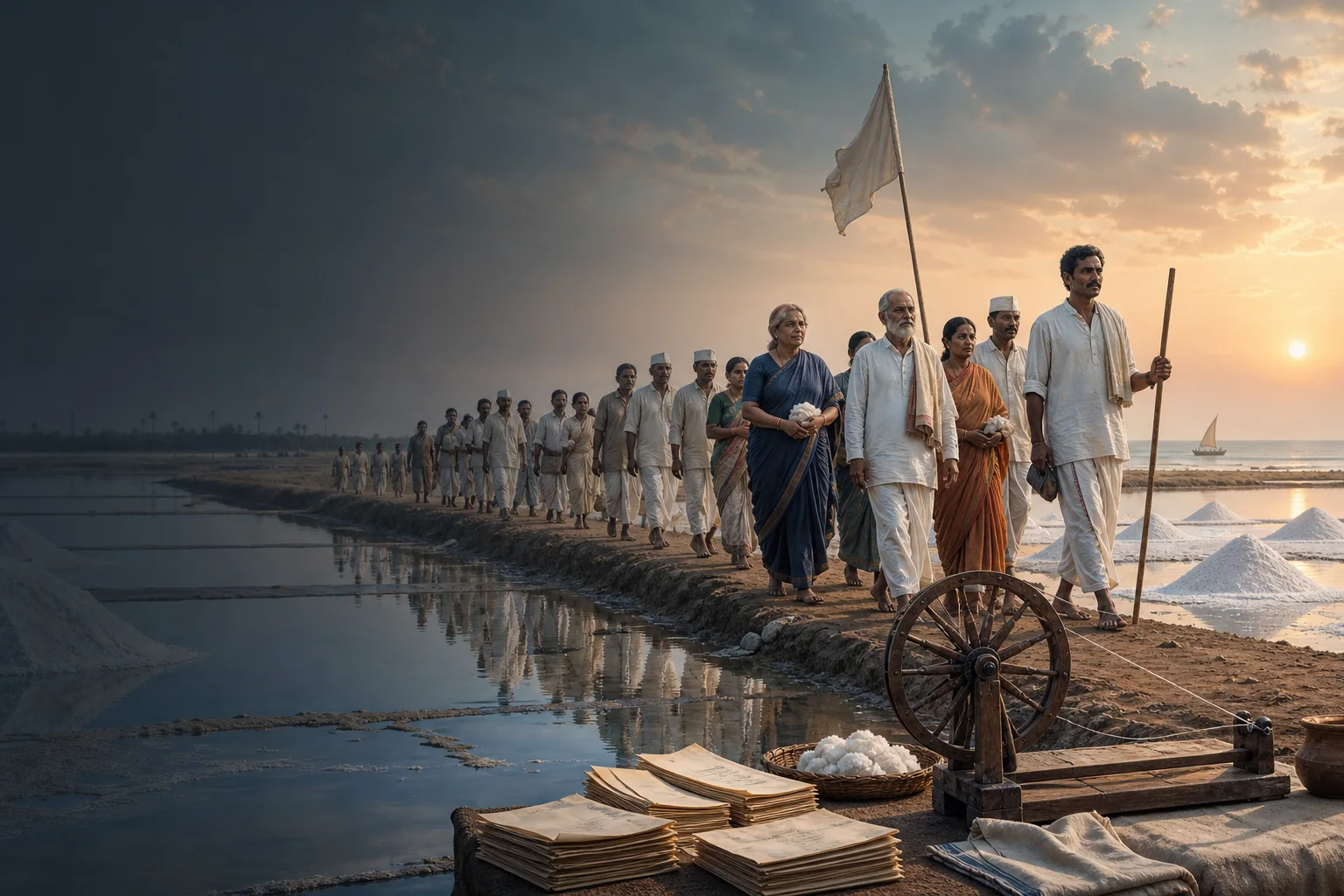
In 1930, C. Rajagopalachari led a march from Tiruchirappalli to Vedaranyam as part of the wider Civil Disobedience Movement. The route and salt-law challenge connected a national strategy to Tamil geography and local organizing. The Ministry of Culture record provides an official outline.[2]
A march is more than its leader. Hosts, cooks, local committees, speakers, women activists, fundraisers, and crowds sustained the action, while police surveillance and arrests shaped its course. Local archives and newspapers can recover participation beyond the best-known names.
Salt was politically effective because it connected state monopoly to everyday need. Coastal production also had its own labor and ecological history. Commemoration should not turn salt workers into scenery for a famous procession.
Historical reading
Workers, women and social movements
Labor organization in Madras, Tuticorin, plantations, railways, and other workplaces linked wages and conditions to wider politics. National leaders did not always control worker action, and workers could pursue immediate demands alongside anti-colonial goals.
Women participated through picketing, marches, underground work, fundraising, khadi, writing, and organizations. Elite women are more visible in published records, while working-class, rural, and Dalit women's participation is often dispersed across police files and local memory. A representative history must state that imbalance.
Anti-caste and self-respect movements challenged social hierarchies that a purely nationalist story could leave intact. Their relationship to Congress nationalism ranged from collaboration to critique. Freedom was contested as a social concept: political independence, dignity, representation, education, and access were not interchangeable goals.
Historical reading
War years, Quit India and other paths
The Second World War changed prices, employment, military recruitment, censorship, and political strategy. Quit India protests in 1942 were met with arrests and repression. The surviving record varies by district and should not be replaced by invented local incidents.
Some Tamil participants joined Subhas Chandra Bose's Indian National Army or supported overseas networks in Southeast Asia. Their histories intersect with Tamil migration and wartime empire. Service records, oral histories, and trial documents require careful provenance.
Negotiated constitutional politics, electoral work, mass protest, revolutionary action, labor struggle, social reform, and wartime mobilization all contributed to the conditions of independence. A single-method triumphal story cannot contain that diversity.
Historical reading
Memory, archives and disputed credit
Freedom fighters often entered official records because they were watched, arrested, prosecuted, or denied benefits. Those files are valuable but shaped by policing. Memoirs may restore motive while compressing chronology or centering the author's network. Newspapers reflect editorial politics and censorship.
Later recognition schemes, statues, schoolbooks, family memory, and films determine who becomes publicly known. Absence from commemoration is not proof of absence from the movement. Claims about a first, greatest, or only participant require especially strong comparative evidence.
This page separates early armed resistance from later organized nationalism while showing how later generations connected them. That distinction respects original contexts without denying the power of shared remembrance.
Historical reading
Independence and unfinished freedoms
Independence ended British sovereignty but inherited economic inequality, caste exclusion, communal tensions, and colonial institutions. Political freedom created new constitutional possibilities; it did not automatically complete social transformation.
Sites such as Vellore Fort, Tilak Ghat, Gandhi Museum Madurai, Tuticorin's harbor landscape, and the Vedaranyam coast are places of memory rather than self-explanatory evidence. Good interpretation connects them to documents, people, and the changing physical landscape.
The most responsible commemoration makes room for disagreement. Participants held different visions of India and Tamil society. Recovering that debate makes the movement larger, not weaker.
Study desk
Research notes for careful readers
Use these questions to move from an overview of Tamil Nadu and the Freedom Movement to evidence-led historical study.
Build chronology from anchors
Begin with evidence that carries its own recoverable context: a dated inscription, an excavated layer, a documented coin hoard, a building phase, a letter, or an administrative file. Then place less certain material around those anchors. A royal genealogy, literary allusion, stylistic comparison, or later tradition may be highly informative without supporting an exact year. Writing the evidence type beside every date prevents a reconstructed sequence from looking more certain than its foundations.[1]
Watch for gaps and overlaps. Dynastic names can disappear from one kind of record and return in another; two rulers may claim authority at the same time; a monument can be begun, enlarged, repaired, and reinterpreted under different patrons. Period labels are tools for organizing change, not walls between communities. A timeline should therefore identify phases and transitions instead of pretending that one court handed a complete territory to the next on a single day.[2]
Read maps as arguments
Historical maps are reconstructions. An inscription naming a victory, a poem praising a ruler, a coin found in circulation, and a grant made in a village describe different relationships to place. None by itself proves a permanently administered frontier. Useful maps distinguish core areas, attested sites, campaign claims, routes, tributary relationships, and uncertain zones. They also use the coastline, river course, and place names appropriate to the period being discussed.[3]
Modern Tamil Nadu remains the geographic focus of this site, but historical networks crossed its present boundary. Ports connected to Sri Lanka and the wider Indian Ocean; inland routes crossed the Ghats; religious and merchant institutions operated across several political regions; the Madras Presidency extended far beyond today's state. A regional history becomes clearer when present-day borders orient the reader without containing the past.
Account for survival and silence
Stone temples, copper plates, official files, and elite literary collections survive for particular reasons. Durable material and institutional custody make some voices much louder than others. Workers may appear only through wages or duties, women through gifts or prosecutions, rural communities through tax demands, and defeated groups through an opponent's praise. Silence can indicate loss, exclusion, or the source's purpose; it cannot safely be converted into proof that a person or practice was absent.[4]
Translation adds another layer. Titles, offices, social terms, ritual vocabulary, and place names do not always have one modern equivalent. A smooth English phrase can hide alternatives in the original language. Where an interpretation depends on one word, consult the transcription, translation notes, and more than one scholarly reading. Quotations should come from a checked edition rather than from unsourced graphics or repeated web summaries.
Compare at the right scale
Comparison is strongest when the units truly match. A burial site should not be measured against a capital city as though they served the same function. One king's regnal inscription should not be compared directly with a literary anthology compiled over time. Instead compare burial with burial, workshop with workshop, grant formula with grant formula, and securely dated architectural phase with another documented phase. Regional synthesis comes after those controlled comparisons.
Public history adds valuable questions but can also reward superlatives. Claims about the oldest, greatest, first, largest, or most advanced require a clearly defined comparison set and published evidence. Historical significance does not depend on winning such a ranking. A site or tradition can matter because it changes an interpretation, preserves an unusual archive, or connects people and landscapes in a way that no simple contest can express.
Preserve the evidence you came to see
Historical study continues at living temples, museums, archives, archaeological sites, streets, water systems, and working landscapes. Follow access rules, never touch or enhance inscriptions, do not remove surface finds, ask before photographing people or rituals, and treat conservation closures as part of responsible care. Record the institution, gallery, accession number, monument, or report behind an observation so that it can be checked later.
The best next question is often narrower than the first: which phase of this building, which version of this text, which sample from which layer, which office produced this file, or which community preserved this memory? Narrow questions are not a retreat from big history. They are how large claims become reliable enough to connect.
Human scale
People and institutions
Named rulers are only one part of the history. These groups and individuals help show how evidence and social life connect.
Velu Nachiyar and the Marudhu brothers
Figures in late 18th-century resistance whose histories require separation from later nationalism.
V.O. Chidambaram Pillai
Swadeshi entrepreneur and political organizer linked to Tuticorin and labor history.
Subramania Bharati
Poet and journalist whose nationalist writing also addressed social change.
C. Rajagopalachari
Leader of the Vedaranyam Salt Satyagraha and a major, debated political figure.
Women, workers and local organizers
Participants whose names are less consistently preserved in national narratives.
Historical geography
Connected places
Places are linked only when a substantive My Tamil Nadu guide already exists. Other entries remain non-clickable research context.
Visual reading
Images with explicit provenance
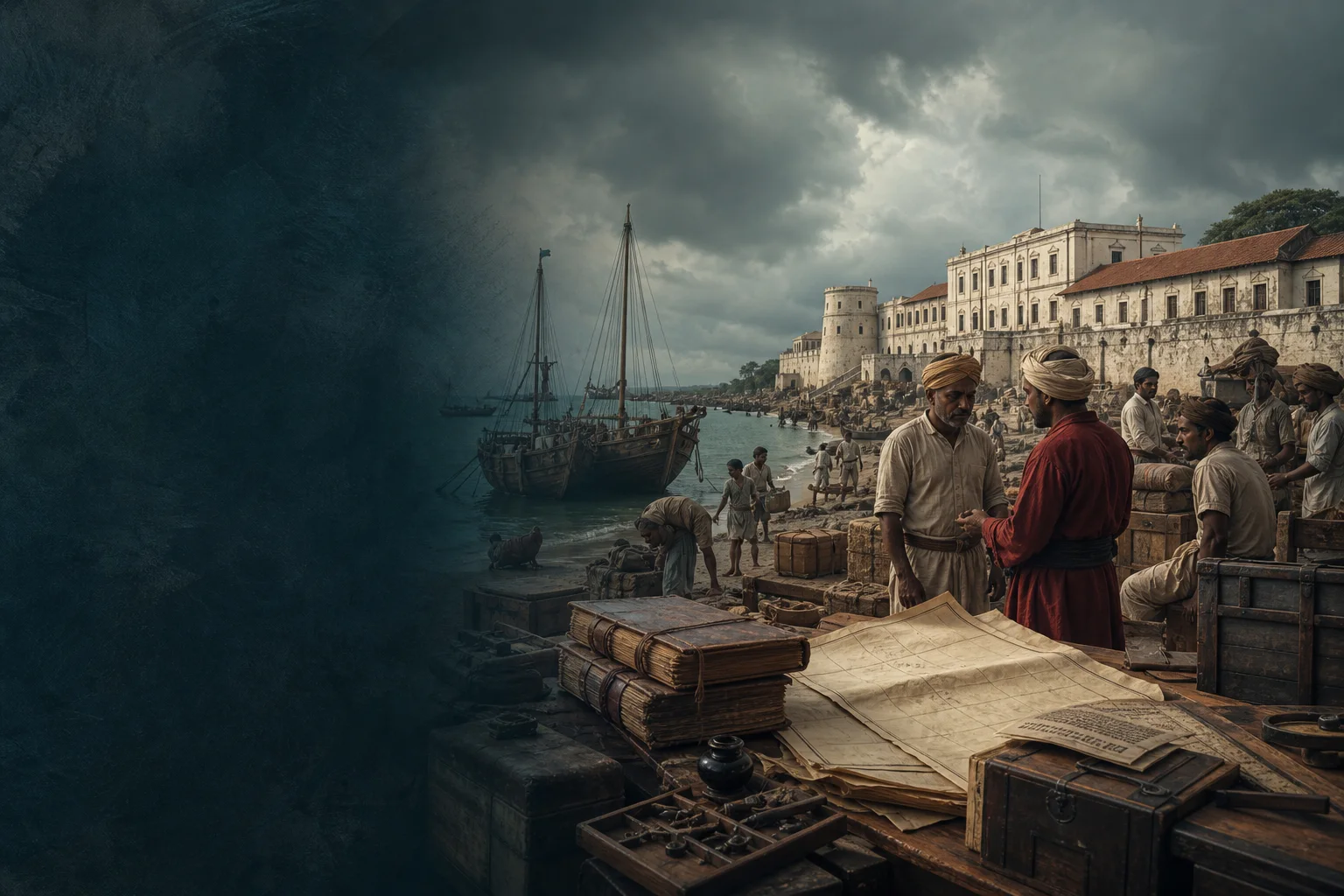
These project-created visuals support orientation. They are not presented as photographs of an excavation, monument, person, or event.

Questions
Frequently asked questions
Why do some dates appear as ranges?
Different dating methods and incomplete records rarely support a single exact year. Ranges communicate what the evidence can sustain.
Does an inscription prove every detail in a royal claim?
No. Inscriptions are primary evidence, but they were produced for particular purposes and must be read with archaeology, other inscriptions, language, and context.
Are literary traditions treated as facts?
They are treated as important historical sources and traditions. The article distinguishes their cultural testimony from independently verified events.
Can this history change?
Yes. Excavation reports, scientific analyses, newly documented inscriptions, and scholarly debate can revise chronology and interpretation.
How were sources selected?
Priority goes to excavation reports, official archaeology and museum records, archives, UNESCO documentation, university resources, and established scholarship.
Can I visit every place named here?
No. Some are living religious sites, protected monuments, working excavations, archives, or places without visitor facilities. Check the responsible institution before travelling.
Editorial trust
Sources and further reading
Citations in the article point to this full list. Source type and review date are shown so readers can evaluate the evidence.
- 1Vellore MutinyMinistry of Culture, Government of IndiaOfficial historical note · Reviewed 9 August 2026
- 2Vedaranyam Salt SatyagrahaMinistry of Culture, Government of IndiaOfficial historical note · Reviewed 9 August 2026
- 3Gandhi Memorial Museum, MaduraiGandhi Heritage PortalInstitutional heritage record · Reviewed 9 August 2026
- 4Tilak Ghat, ChennaiGandhi Heritage PortalInstitutional heritage record · Reviewed 9 August 2026
- 5Introduction to the Tamil Nadu ArchivesTamil Nadu Archives and Historical ResearchOfficial archive guide · Reviewed 9 August 2026
- 6Record holdingsTamil Nadu Archives and Historical ResearchOfficial archive catalogue · Reviewed 9 August 2026
- 7Public records holdingsNational Archives of IndiaOfficial archive catalogue · Reviewed 9 August 2026
Editorial review: Factual claims were checked against the linked primary and institutional sources on 9 August 2026. Where the sources support only a range or interpretation, the article keeps that limitation visible.