
Before the Sangam Age
Attirampakkam and Palaeolithic Tamil Nadu
An open-air site in northern Tamil Nadu has changed the chronology of South Asian prehistory. Its importance lies in the relationship between stone tools, sediment and careful scientific dating.
Orientation
Overview
Early and Middle Pleistocene evidence; dates belong to particular excavated levels
A stone tool can fit in a hand while opening a timescale difficult to imagine. At Attirampakkam, the question is not simply how old an unusual object might be. Archaeologists have investigated successive deposits, the tools within them and the processes that brought both together. That combination makes the site an important reference point for Palaeolithic research in southern India. The argument rests on recorded relationships in the ground, rather than the appearance of one especially striking handaxe.
Attirampakkam lies in the Kortallaiyar river basin, north-west of Chennai. The excavation team’s early account describes an open-air site, with tools eroding into gullies as well as artefacts preserved below the surface. It records Foote’s discovery in 1863 and a renewed excavation programme beginning in 1999. This is therefore both an ancient place of activity and a place with a long history of archaeological investigation.[3]
Palaeolithic means Old Stone Age. In this guide, it describes archaeological evidence for very early toolmaking and ways of using a landscape. It does not mean the beginning of Tamil literature, the founding of a city or a dated kingdom. Those belong to much later kinds of evidence. Keeping the distinction clear allows Attirampakkam to matter on its own terms, without making it carry claims its excavations were never designed to test.
Chronology
A careful timeline
Dates refer to particular sites, samples or research events. Phases overlap and are not a uniform regional calendar.
An archaeological discovery
Robert Bruce Foote identified the site during the early development of Indian prehistoric research.[3]
Renewed field research
Excavation combined the study of tools with environmental and chronological questions.[6]
An Early Pleistocene chronology
The earliest dated Acheulian levels were reported as no younger than 1.07 million years, with a pooled average of 1.51 ± 0.07 million years.[1]
An early technological transition
The published Middle Palaeolithic sequence extends from about 385 ± 64 to 172 ± 41 thousand years ago.[2]
Historical reading
From Pallavaram to a different kind of history
The wider story of discovery begins at Pallavaram. The Government Museum Chennai identifies 30 May 1863 as the date Robert Bruce Foote recovered a Palaeolithic handaxe there. His geological work helped establish that deliberately worked stones could be evidence of a human past far older than written records. Pallavaram and Attirampakkam should nevertheless remain distinct entries on the map: the date of a discovery at one place is not a scientific age for every tool found in the region.[8]
An early collection and a modern excavation answer different questions. A collected object may preserve its form, material and find locality. An excavated object can also be tied to a layer, neighbouring finds, sediment samples and a measured position. Neither becomes unimportant because the other exists. Together they explain why a site known for generations can still produce a major revision: new work changes the quality of the questions that can be asked.
Older reports deserve to be read as stages in that investigation. The 2003 excavation account described Lower, Middle and Upper Palaeolithic deposits and work toward a chronology. Its provisional age discussion predates the better-known 2011 and 2018 dating papers. Quoting an early estimate as if it were the final result would conceal the research process rather than respect it.[3]
Historical reading
What Acheulian tools reveal
Acheulian is a name for a technological tradition associated especially with handaxes and other large cutting tools. It is not the name of a dynasty or a known spoken language. The Smithsonian’s overview treats stone tools as evidence of technical abilities and innovation. Their shapes help researchers compare assemblages, but the objects also preserve choices: where to strike a stone, which edge to work and how much material to remove.[9]
A handaxe is the conspicuous survivor of a longer sequence. Hammerstones, cores and detached flakes can illuminate stages of manufacture that a finished tool hides. A core is the piece from which flakes were struck; the flakes themselves may have useful sharp edges. Thinking through that relationship changes a museum case from a row of isolated specimens into evidence of actions. The smallest pieces can matter as much as the carefully shaped object beside them.[10]
Akhilesh and Pappu’s study of waste products at Attirampakkam combines excavated material with experimental toolmaking. It argues for transport of large flakes and partly worked pieces from raw-material areas, followed by further shaping at the site. The authors also discuss reuse of suitable flakes, skill and mistakes. These are interpretations of an assemblage, not eyewitness descriptions of a particular day. They suggest planning across a landscape without letting us count a household or name a teacher.[4]
Historical reading
Two published chronologies, two different questions
The 2011 Science paper reports that the earliest Acheulian levels studied were no younger than 1.07 million years, with a pooled average burial age of 1.51 ± 0.07 million years. It combines palaeomagnetic evidence with aluminium-26/beryllium-10 burial dating. Those results place the material in the Early Pleistocene and give the site significance well beyond Tamil Nadu. The familiar shorthand “1.5 million years old” is useful only when the underlying range and sampled context remain visible.[1]
The 2018 Nature study concerns a later part of the sequence. It reports the emergence of Middle Palaeolithic technology at approximately 385 ± 64 thousand years ago, continuing to about 172 ± 41 thousand years ago. These are luminescence-based estimates, not radiocarbon dates for the stone tools. They must not be combined with the older Acheulian result to invent a single uninterrupted occupation lasting from one headline number to the other.[2]
Dating works through a relationship between the measured material and the archaeological event. Historic England’s guidance emphasises the importance of demonstrating that relationship and describes the special sampling requirements of luminescence methods, including protecting suitable sediment from light. An impressive laboratory number does not remove the need for field interpretation. Readers should ask what was sampled, where it lay and which event the measurement can reasonably date.[11]
Historical reading
Reading technological change without inventing a migration
The Middle Palaeolithic study identifies reduced use of bifaces alongside more small tools and distinctive strategies for preparing cores and removing flakes or points. It also records a blade component. The authors argue that the early chronology requires reconsideration of models tying the Indian transition only to modern-human dispersal after roughly 125,000 years ago. This is a contribution to a debate about behaviour and population history, rather than proof of a named migration into Tamil Nadu.[2]
Similarity between toolkits does not settle every question about the people who made them. Ideas can be learned, techniques can change locally, and comparable practical problems can invite comparable solutions. An artefact’s form cannot by itself choose between those possibilities. The responsible question is which explanation best fits the whole evidence, including chronology, technological sequence and regional comparisons. That leaves room for a strong archaeological finding without pretending that the makers have supplied their own biography.
Experiments are useful here, but they too require care. Moore and Perston tested what kinds of shapes can arise under controlled flaking conditions and showed why apparently organised forms should not automatically be treated as transparent measures of intention. Their study is not an Attirampakkam excavation report. It provides a methodological caution: archaeologists need to examine the sequence of manufacture, not simply admire a finished outline and assign it a modern psychological meaning.[12]
Historical reading
An open-air site within a changing landscape
Attirampakkam is one part of a larger prehistoric landscape. Regional research places quartzite resources in the Allikulli and Satyavedu hills and examines sites across foothill, river and coastal settings. The distribution of raw material helps explain why movement matters to the archaeological question. A tool found away from its stone source can preserve a connection between places, even where the route itself has vanished.[7]
The environmental record is less visually dramatic than a handaxe but no less important. Warrier and colleagues studied magnetic properties of Attirampakkam sediments as indicators of past environmental conditions, noting the limited animal and plant remains available for reconstruction. Such work uses indirect evidence: a measured property is interpreted through its relationship to soil formation and climate. It should not be turned into a detailed scene of particular animals, vegetation and weather that the surviving evidence cannot supply.[5]
Imagine comparing two excavation squares. One contains more tools, but that alone does not prove more people lived there. Sediment may have accumulated at different rates; material may have moved; a particular activity may have generated more waste. This is why a site plan, section drawing and geological interpretation belong beside the artefact catalogue. They make it possible to test an explanation rather than merely illustrate it.
Historical reading
Seeing the site through its records
The excavators’ TIFR lecture abstract frames their project around occupation, chronology and adaptation to environmental change. That is a useful order for approaching the evidence. Begin with what was found and its setting, then consider its age, and only then ask what behaviour it may imply. A spectacular date is one part of the explanation, not a substitute for the rest.[6]
For a public introduction, the Poondi museum and its regional collections offer a complementary starting point. The separate Poondi and Gudiyam guide explains why a museum, rock shelters and an open-air excavation should not be treated as interchangeable stops. Access arrangements can change, and an archaeological research site is not automatically a managed visitor attraction. Consult the responsible institution before making a journey; this article does not promise entry to trenches or permission to collect surface finds.
Attirampakkam belongs in a history of Tamil Nadu because it preserves a much earlier chapter of life in this landscape. It also belongs in the study of humanity across Asia. Both scales are needed. The local river basin gives the objects their archaeological setting; comparison with other regions gives the technological and chronological findings their wider significance. Neither requires attaching a later literary identity to people known here through the material traces of their activity.
Human scale
People and institutions
The people who made and used these objects are often unnamed. Research teams, museums and local communities help preserve their traces.
Robert Bruce Foote
Geologist associated with the 1863 discoveries at Pallavaram and Attirampakkam.
Shanti Pappu and Kumar Akhilesh
Researchers whose collaborative fieldwork and analyses have reshaped understanding of this sequence.
Unnamed toolmakers
Known through their material traces; their languages and individual identities are not recovered by these tools.
Historical geography
Connected places
Places are linked only when a substantive My Tamil Nadu guide already exists. Other entries remain non-clickable research context.
Visual reading
Images with explicit provenance
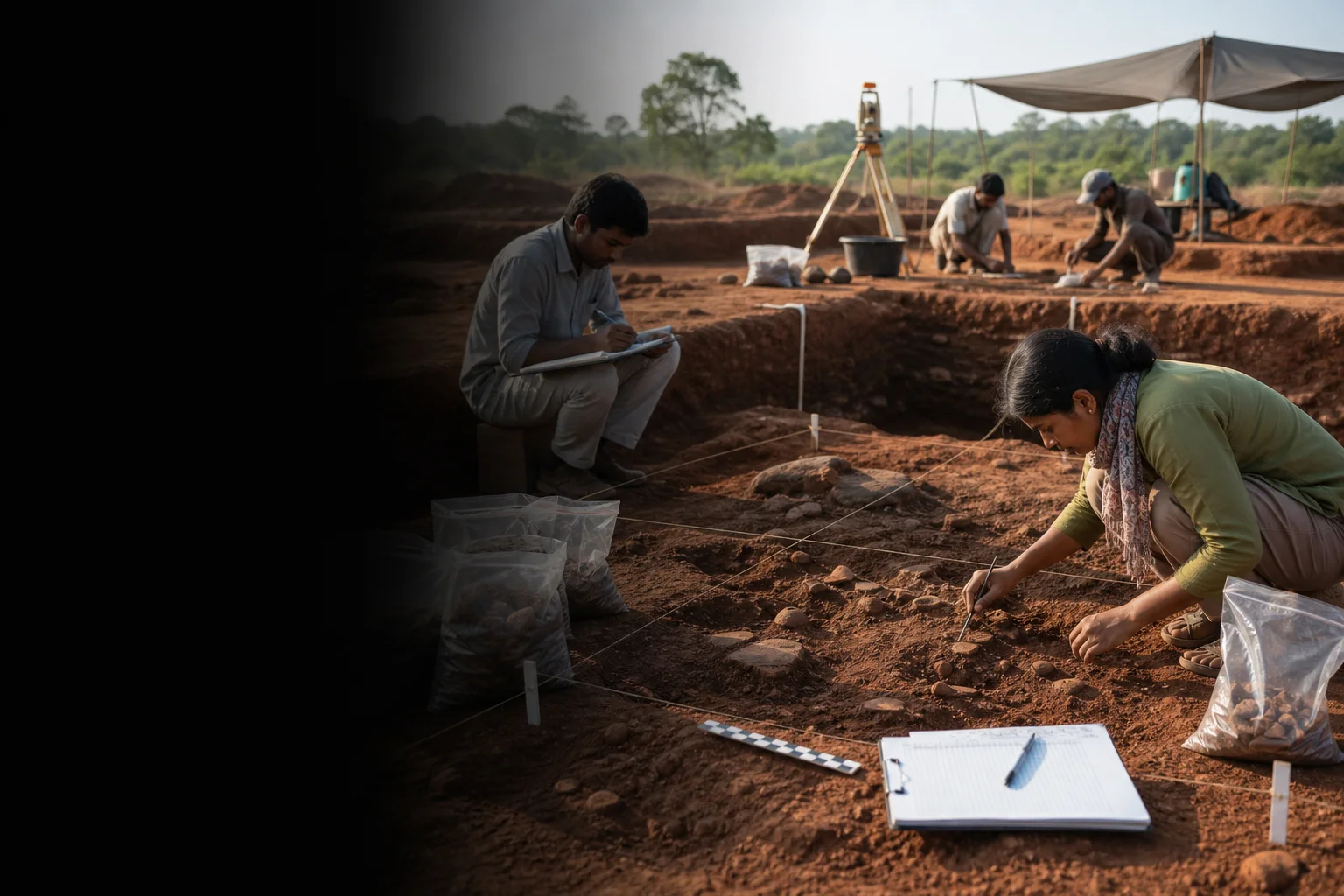
These project-created visuals support orientation. They are not presented as photographs of an excavation, monument, person, or event.
Questions
Frequently asked questions
Were these the first Tamil speakers?
Stone-tool assemblages cannot establish the language of their makers. These deposits long precede the written and literary evidence discussed in early Tamil history.
Is every Attirampakkam tool 1.5 million years old?
No. The site has multiple deposits and technological phases. The published dates apply to particular sampled contexts.
Editorial trust
Sources and further reading
Citations in the article point to this full list. Source type and review date are shown so readers can evaluate the evidence.
- 1Early Pleistocene Presence of Acheulian Hominins in South IndiaPappu et al. · Science 331 (2011), 1596–1599Peer-reviewed dating study · DOI 10.1126/science.1200183
- 2Early Middle Palaeolithic culture in India around 385–172 ka reframes Out of Africa modelsAkhilesh et al. · Nature 554 (2018), 97–101Peer-reviewed study · abstract and DOI record
- 3Excavations at the Palaeolithic site of Attirampakkam, South IndiaPappu et al. · Antiquity Project Gallery (2003)Excavators’ preliminary account; dating subsequently revised
- 4Bits and pieces: Lithic waste products as indicators of Acheulean behaviour at Attirampakkam, IndiaAkhilesh and Pappu · Journal of Archaeological Science: Reports 4 (2015), 226–241Peer-reviewed technological study · abstract
- 5A rock magnetic record of Pleistocene rainfall variations at the Palaeolithic site of Attirampakkam, Southeastern IndiaWarrier et al. · Journal of Archaeological Science 38 (2011), 3681–3693Peer-reviewed environmental study · abstract
- 6Tools, Time and Trenches: Excavating the Prehistoric Site of AttirampakkamTata Institute of Fundamental Research · Pappu and Akhilesh (2011)Institutional lecture abstract by the excavators
- 7Research and management of Palaeolithic resources in Tamil Nadu, South IndiaPappu et al. · Antiquity Project Gallery (2010)Researchers’ regional survey and conservation account
- 8Certain Choice Exhibits of Anthropology at the Government Museum ChennaiGovernment Museum ChennaiOfficial museum publication
- 9Stone ToolsSmithsonian Institution · Human Origins ProgramInstitutional overview of stone-tool evidence
- 10The early human tool kitSmithsonian Institution · Human Origins ProgramInstitutional explanation of cores, flakes and hammerstones
- 11Scientific Dating of Pleistocene Sites: Scientific Dating MethodsHistoric EnglandInstitutional technical guidance
- 12Experimental Insights into the Cognitive Significance of Early Stone ToolsMoore and Perston · PLOS ONE (2016)Peer-reviewed experimental archaeology
Editorial review: Factual claims were checked against the linked primary and institutional sources on 15 November 2026. Where the sources support only a range or interpretation, the article keeps that limitation visible.