
Before the Sangam Age
Poondi and Gudiyam: Reading a Prehistoric Landscape
The museum at Poondi, the shelters at Gudiyam and the surrounding hills offer different ways into northern Tamil Nadu’s deep past. Their value grows when they are read together, without giving every place the same date.
Orientation
Overview
Palaeolithic archaeology, later museum collections and the history of research
It is tempting to imagine prehistory as a cave, a fire and a few tools arranged around it. The Poondi–Gudiyam region invites a wider view. A shelter is one setting in which material can survive; river deposits, slopes and open ground are others. A museum brings selected objects together again, but under a different organising principle. Keeping those settings separate is the first step toward understanding why this small part of northern Tamil Nadu matters.
The Tamil Nadu Department of Archaeology’s museum guide connects Poondi with the discoveries that followed Foote’s work at Pallavaram and identifies Gudiyam nearby in Tiruvallur district. It dates the museum’s establishment to 1985. The collection includes material from around Poondi and elsewhere in Tamil Nadu, so the museum is an introduction to a region and its longer sequence, rather than the contents of a single cave placed indoors.[1]
Chronology
A careful timeline
Dates refer to particular sites, samples or research events. Phases overlap and are not a uniform regional calendar.
The wider discovery story
Foote’s Pallavaram handaxe helped establish prehistoric archaeology in the region.[9]
Gudiyam excavations
These ASI field seasons are recorded in the parliamentary excavation list.[4]
Poondi excavation
The official register lists Poondi separately from Gudiyam and Attirampakkam.[4]
A public collection
The Department of Archaeology records the establishment of its prehistoric museum at Poondi.[1]
Historical reading
A museum, a shelter and a landscape
Poondi is not simply another name for Gudiyam. The first is associated with a museum and an archaeological locality; the second with rock shelters in the nearby hills. Attirampakkam, discussed in its own guide, is an open-air site with an independently studied sequence. A map can put them close together, but archaeological proximity is not proof of identical occupation, age or function.
The ASI lists Gudiyam, Attirampakkam, Poondi, Neyveli and Vada Madurai among the Tamil Nadu sites investigated by its Prehistory Branch. That list is useful because it places the famous names within a research network. It is not an itinerary or a statement that all the places are currently open to visitors. Nor does the shared label prehistoric remove the need to examine the record of each excavation.[2]
Read the region by asking how evidence changes between settings. A shelter deposit may preserve repeated visits to a restricted space. An open-air scatter can cover a broader area, with different possibilities for erosion and movement. A museum case selects and groups objects for public explanation. None provides a complete, untouched picture of daily life; each makes some relationships easier to see and others harder.
Historical reading
Gudiyam: what can be said securely
The National Mission on Monuments and Antiquities locates Gudiyam in the Allikulli hills and describes its rock as coarse Satyavedu-formation boulder conglomerate. The same inventory cites ASI excavation seasons and subsequent investigations. Its short date field, however, conflicts with its prehistoric classification. This guide therefore uses the record for location and research history, not for a supposed medieval date of the prehistoric occupation.[3]
The university teaching chapter by Kunneriath and Korisettar identifies a stratified Middle Palaeolithic horizon at Gudiyam. It places the site among a broader range of regional contexts, including hillslopes and stream settings. That supports discussing Gudiyam as archaeological evidence, not merely as an impressive natural formation. The chapter’s older regional chronology should not be substituted for the later scientific studies at Attirampakkam, or treated as a new direct date for Gudiyam itself.[5]
The distinction between the age of rock and the age of occupation is essential here. People can use a cavity in a much older formation, leave it, and return after a long interval. The surface visible today need not be the surface they used. A shelter’s dimensions cannot establish how many people occupied it, and its capacity to hold a crowd says nothing secure about a prehistoric group. Such claims would require evidence beyond the appearance of the place.
Historical reading
The excavation record and its limits
A 2004 Rajya Sabha answer records Gudiyam excavations in 1962–63 and 1963–64, followed by a separate Poondi entry for 1965–66. These are dates of fieldwork, not dates of prehistoric activity. They also help distinguish Gudiyam from Attirampakkam, which appears independently in the same register. Administrative sources are particularly useful for identifying who investigated a place and when; they offer much less detail about what an individual layer contained.[4]
The Government Museum Chennai’s excavation-history publication also lists these sites as Palaeolithic. Its overview situates them within a long history of research by different institutions. Read it alongside excavation reports rather than expecting its summary tables to answer every question about tool types, sample selection or stratigraphy. A brief catalogue entry is a doorway into the documentation, not the whole documentation.[6]
Publication history can be uneven. A 2013 CAG audit annexure records that the Gudiyam report had been submitted in August 2008. Submission is not the same as confirming that a complete report is readily available online today. This article does not claim to have inspected that final report, and it does not build detailed claims about occupation density or a complete cultural sequence from references to its existence.[7]
Historical reading
Reading the Poondi collection
The Department of Archaeology lists Palaeolithic implements, Neolithic celts, megalithic vessels, sarcophagi, iron tools, fossil material and terracotta tuyères among the museum’s holdings. The variety is useful precisely because it spans different subjects and periods. An iron implement beside a stone tool is a curatorial comparison, not evidence that both came from one prehistoric floor. Fossilised material introduces another timescale again.[1]
A productive way to look is to begin with the label. Note the place name, object type and any stated period before comparing shapes. If a find spot or excavation context is missing, keep that limitation in mind. Ask whether the display is teaching a regional sequence, illustrating a technology or presenting a particular excavated group. Those are different tasks, and a case may do more than one.
Then consider what the label cannot show. A clean, isolated object has lost the visual company of soil, fragments and neighbouring finds. A section drawing or excavation photograph, when supplied, can restore some of that relationship. Without one, resist supplying an imagined scene of manufacture or burial. The museum still offers a valuable encounter with material evidence, even when the complete history of an object cannot be reconstructed in front of the case.
Historical reading
Why the ground between sites matters
The regional survey published by Pappu and colleagues describes a foothill belt between the Eastern Ghats and the coast, with river environments and sources of stone suitable for toolmaking. Its maps and field investigations treat prehistoric evidence as a distribution across terrain. The authors also identify destruction of sites as a reason to include heritage management in the research. A landscape approach therefore concerns both ancient movement and what survives for future study.[8]
For a reader, that approach changes the meaning of an apparently empty stretch between marked sites. It may contain no known archaeological evidence; it may be poorly surveyed; or deposits may be buried, eroded or altered. A blank area on a visitor map is not a demonstrated boundary of prehistoric activity. The marked points are places where evidence has been recognised and recorded, not necessarily the limits of where people went.
Comparison with Attirampakkam is useful because its published sequence gives regional research a strong chronological reference. Comparison still needs a stated basis. Similar stone, nearby geography or a broadly comparable tool form cannot transfer a laboratory date from one site to another. The question is what can actually be correlated: a technological pattern, a geological deposit or a demonstrably contemporary phase.
Historical reading
Approaching the place with useful expectations
Begin with the museum if your aim is to understand the objects, and use the separate Attirampakkam guide for scientific dating and technological change. Treat any journey to Gudiyam as a visit to a particular landscape, not an opportunity to inspect an excavated prehistoric household. Confirm current arrangements with the responsible authorities. No opening hours, trail permissions, transport timings or promises of access are asserted here.
Leave stones and fragments where they are. Removing an object separates it from the location that could make it useful to a researcher; arranging pieces for a photograph can also change that record. If something appears significant, record the observation without disturbing it and seek guidance from the archaeology department. Interest in the past is most useful when it helps preserve the evidence that remains.
The reward is a more precise view of familiar ground. Poondi makes collections accessible; Gudiyam introduces shelter settings; the surrounding terrain connects archaeological questions to water, stone and movement. They do not need a shared sensational age to belong in the same story. Their differences are what allow the region to explain more than a single find could.
Human scale
People and institutions
The people who made and used these objects are often unnamed. Research teams, museums and local communities help preserve their traces.
ASI Prehistory Branch
Institution responsible for the documented Gudiyam and Poondi excavation seasons.
Tamil Nadu Department of Archaeology
Custodian of the Poondi prehistoric museum.
Regional survey researchers
Investigators who connect artefact distributions with geology, chronology and conservation.
Historical geography
Connected places
Places are linked only when a substantive My Tamil Nadu guide already exists. Other entries remain non-clickable research context.
Visual reading
Images with explicit provenance
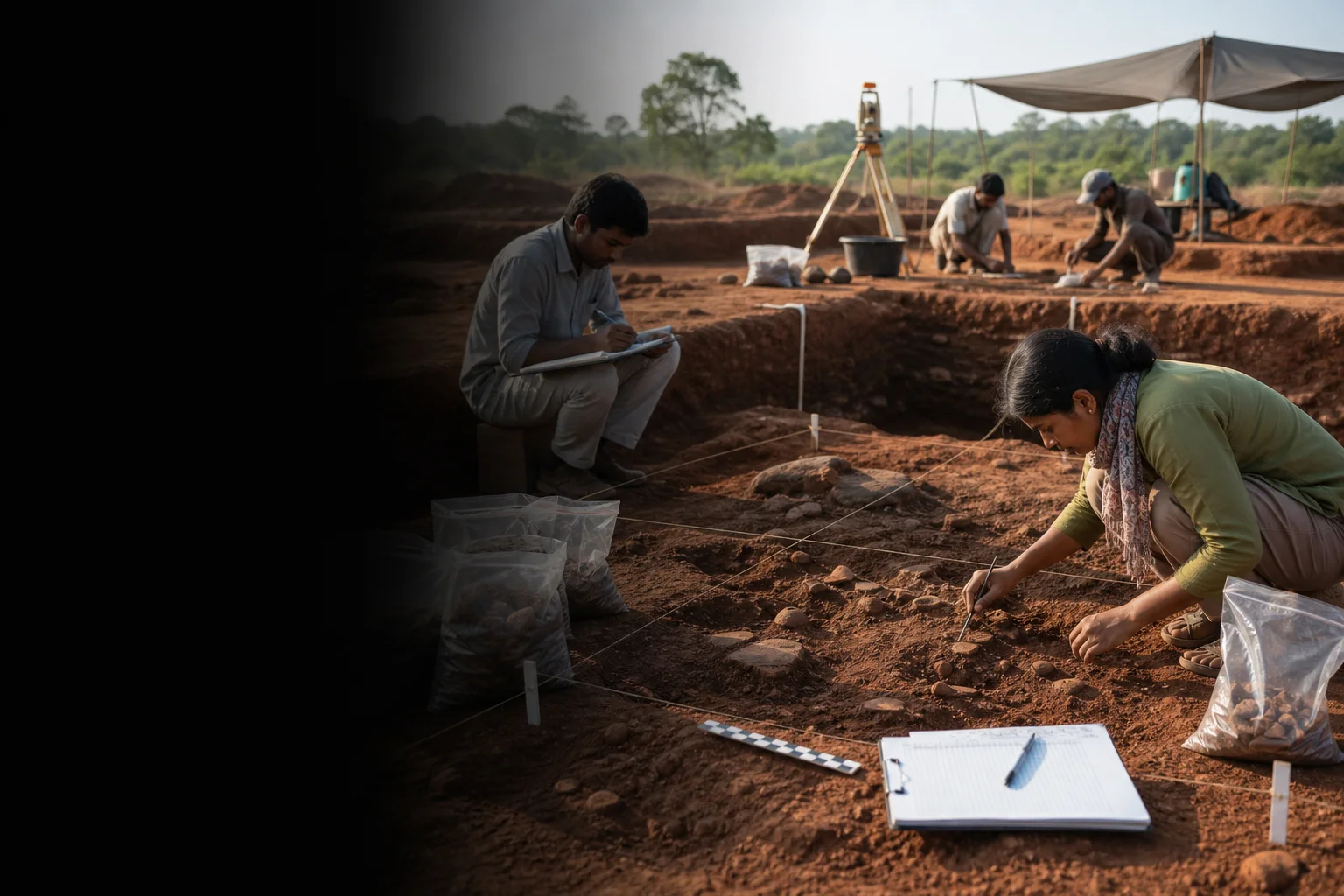
These project-created visuals support orientation. They are not presented as photographs of an excavation, monument, person, or event.
Questions
Frequently asked questions
Are Poondi and Gudiyam the same site?
No. This guide connects a museum and archaeological locality with a nearby shelter landscape while keeping their evidence separate.
Can Attirampakkam’s dates be used for Gudiyam?
Not automatically. A dated context at one site cannot directly date a different site merely because it is nearby.
Editorial trust
Sources and further reading
Citations in the article point to this full list. Source type and review date are shown so readers can evaluate the evidence.
- 1Pre-Historic Site Museum – TiruvallurTamil Nadu Department of ArchaeologyOfficial museum collection guide
- 2Prehistory Branch, NagpurArchaeological Survey of IndiaOfficial research programme overview
- 3Gudiyam cave · inventory TN01001407National Mission on Monuments and Antiquities · ASIOfficial inventory; contradictory date field excluded
- 4Details of excavations carried out by the Archaeological Survey of India in Tamil NaduRajya Sabha · Government of India (23 August 2004)Parliamentary excavation-season register
- 5Middle Palaeolithic CultureMadhavi Kunneriath and Ravi Korisettar · INFLIBNETUniversity teaching chapter; regional chronology predates newer studies
- 6Excavations in Tamil Nadu: An Archaeological ReportGovernment Museum ChennaiInstitutional excavation-history synthesis
- 7Performance audit of preservation and conservation of monuments and antiquities: annexuresComptroller and Auditor General of India · Report 18 of 2013Official administrative record of excavation reporting
- 8Research and management of Palaeolithic resources in Tamil Nadu, South IndiaPappu et al. · Antiquity Project Gallery (2010)Researchers’ regional survey and conservation account
- 9Certain Choice Exhibits of Anthropology at the Government Museum ChennaiGovernment Museum ChennaiOfficial museum publication
Editorial review: Factual claims were checked against the linked primary and institutional sources on 15 November 2026. Where the sources support only a range or interpretation, the article keeps that limitation visible.