
Before the Sangam Age
Prehistory of Tamil Nadu
Before inscriptions and named rulers, there were people selecting stone, moving through river valleys, tending animals and returning to places that mattered. Their traces make a history of their own.
Orientation
Overview
Site-specific sequences; dates do not define a single regional boundary
Prehistory begins here with material left behind, rather than a list of kings. A shaped stone, a dark patch of soil or a few charred seeds may look modest beside a temple inscription. Each can nevertheless preserve an action: choosing a raw material, lighting a fire, processing food or repairing a tool. The challenge is to recover those actions without supplying conversations, beliefs and identities that the evidence cannot tell us.
Tamil Nadu is the modern geographic frame of this guide. It was not a prehistoric political unit, and people did not organize their movements around its present borders. Northern stone-tool landscapes belong in a broader South Asian discussion, while Neolithic settlements in the northwest connect with research across the southern Deccan. The region contains several histories whose rhythms do not fit a single uninterrupted ladder of progress.[7]
Chronology
A careful timeline
Dates refer to particular sites, samples or research events. Phases overlap and are not a uniform regional calendar.
Long histories of stone-working
Attirampakkam provides dated evidence extending into the Early Pleistocene. Its dates should not be assigned to every nearby find.[2]
Changing food and settlement practices
Ground stone, pottery and settlement evidence are interpreted together; regional sequences differ.[8]
Metalworking and mortuary landscapes
Technological and burial labels overlap, but neither supplies one universal start date.[9]
Additional written evidence
Tamil-Brahmi inscriptions add names and language to an already extensive material record.[11]
Historical reading
Pallavaram: a discovery that changed the questions
On 30 May 1863, Robert Bruce Foote, an officer of the Geological Survey of India, recognized a stone handaxe at Pallavaram near Madras, now Chennai. The Government Museum Chennai records this discovery and the cleaver recovered at Attirampakkam with William King later that year. These objects became landmarks in the scientific study of Indian prehistory. Their importance lies in the recognition that deliberately worked stone could be evidence for a past far older than written records.[1]
The year 1863 dates the discovery, not the making of the tool. That distinction is easy to lose when a museum label compresses two histories into a few lines. The object has a prehistoric life, including manufacture, use and deposition, and a modern life of collection and interpretation. Neither the date of its recovery nor its resemblance to another handaxe gives it an exact age. Pallavaram is therefore a strong starting point for the history of research, but it cannot by itself establish continuous occupation from deep prehistory to the modern suburb.
Historical reading
Attirampakkam and the depth of the stone-tool record
Attirampakkam matters because excavated tools can be studied within a substantial sediment sequence. In 2011, Pappu and colleagues reported that its earliest Acheulian levels were no younger than 1.07 million years, with a pooled average age of 1.51 ± 0.07 million years. Handaxes and cleavers form part of this technological record. These are estimates tied to a particular archaeological sequence and methods, rather than a birthday for Tamil culture or language.[2]
A later study by Akhilesh and colleagues placed the emergence of Middle Palaeolithic technologies at the site around 385 ± 64 thousand years ago, with the sequence continuing to about 172 ± 41 thousand years ago. Changes in how stone cores were prepared and flakes removed are central to that argument. A technological category describes learned ways of making things; it does not identify a language, ethnic community or human species on its own.[3]
The larger question is how people learned, adapted and passed on practical knowledge. Even a familiar-looking cutting edge can be the end of a complicated sequence of decisions. The dedicated Attirampakkam guide follows those decisions and explains why the excavated arrangement is more informative than an isolated attractive specimen.
Historical reading
Poondi, Gudiyam and the landscape between sites
The Poondi museum places stone tools within a wider prehistoric collection that also includes Neolithic celts, burial vessels and iron-related objects. The department connects its museum with discoveries around Poondi and the Gudiyam shelters in Tiruvallur district. Seeing these materials together can establish the breadth of the regional record, provided that visitors keep their separate dates and findspots in view. A museum case is a modern arrangement, not a prehistoric room.[4]
A river valley is useful to archaeology for more than its proximity to water. Sediments can bury, expose or move objects, and an eroding bank may place material of different ages close together. A tool lying on the surface offers different information from one documented within an intact excavated layer. The Poondi and Gudiyam landscape guide explains how terrain and collection history shape what survives, without treating every shelter as a permanently inhabited home.
Historical reading
What grew around the toolmakers?
Stone does not preserve a complete environment. Researchers at Attirampakkam have also studied phytoliths, the microscopic silica bodies produced by plants. A published study identifies changes in woody vegetation and grasses through the sequence and reports wild rice indicators in particular layers. Wild rice in a prehistoric environment is not evidence of rice cultivation. The distinction is especially important when a plant name familiar from modern farming appears in a much older context.[5]
Environmental reconstruction asks which kinds of evidence agree. A plant trace, an animal bone and a sediment description do not all measure the same thing or the same interval. For a reader, the practical question is whether an account has reconstructed a local setting from dated samples or simply pictured the present landscape with fewer buildings. Rivers change course; surfaces erode; a familiar place-name can conceal a very different earlier terrain.
Historical reading
Settling, cultivating and herding
The Neolithic is often introduced as the arrival of farming, but the regional story is more varied. Research on the Southern Neolithic treats cultivation, pastoral movement and more sustained settlement as interacting practices. Local developments and connections beyond the region both matter. A community could invest labour in a place while continuing seasonal movement, exchange or the collection of wild foods. Settlement and mobility are not mutually exclusive ways of living.[6]
Paiyampalli is a key comparison in northern Tamil Nadu. Excavations identified a Neolithic period followed by a megalithic period, with evidence for dwellings and a range of stone and ceramic objects. The sequence gives substance to a transition that a general timeline can otherwise make look instantaneous. The separate Neolithic guide uses Paiyampalli alongside Mayiladumparai to ask how households, tools and food practices can be reconstructed.[8]
A polished axe is an important clue, but one object cannot establish the economy of an entire village. Food remains, storage, house floors, grinding equipment and the distribution of refuse make the case stronger when they belong together. Evidence for repeated activity is particularly valuable: a repaired surface or rebuilt feature may reveal investment in a place that no spectacular object could show.
Historical reading
Mayiladumparai: several kinds of past in one place
Mayiladumparai in Krishnagiri district brings together evidence assigned to different periods. The Department of Archaeology’s 2025 iron report describes microlithic tools, Neolithic celts and polishing grooves, rock paintings, Iron Age graves and later written material. This range makes the locality important for examining change. It also demands care: neighbouring features need not have been made at the same time.[9]
Its place in discussions of early iron should not swallow its Neolithic significance. The question of when iron appears in a dated excavated context is separate from the question of how earlier people used stone, lived in the locality and obtained food. A date associated with iron-bearing deposits cannot simply be copied onto a polishing groove or a painting nearby. Our Mayiladumparai guide keeps these questions separate and sets out the limits of the published dating information.
Historical reading
Iron Age and megalithic landscapes
Iron Age is a technological and chronological label. Megalithic describes a range of monumental practices, especially graves marked or constructed with large stones; regional discussion also includes associated burial traditions that do not present a prominent stone monument. The terms often occur together in South Indian archaeology, but they are not interchangeable descriptions of every find. A grave, a settlement and a place where metal was worked provide different samples of life.[10]
Adichanallur, Sivagalai and Kilnamandi belong to this wider conversation, yet they should not be lined up as identical stops on a single route. Their excavation histories, burial forms and dating evidence differ. Our Iron Age guide examines those distinctions; the combined Sivagalai and Kilnamandi page follows the evidence at each site. A long chronology becomes more useful when it explains what is being compared rather than collecting the oldest reported numbers.
Historical reading
Approaching the early historic world
Written evidence changes what can be asked of the past. Tamil-Brahmi appears on rock surfaces and portable objects, including pottery, and the department’s overview places its early and late forms broadly between the third century BCE and third century CE. Individual examples still require their own context and dating. A written name can make a person visible in a way that an anonymous tool cannot, but it does not describe the whole population.[11]
The Sangam poems offer another kind of testimony, shaped by composition, performance and transmission. Archaeological pottery, a burial and a literary landscape should therefore be brought into conversation rather than made to illustrate one another automatically. Keezhadi is especially useful for continuing into settlement archaeology, while Adichanallur sustains attention to the mortuary record. There is no need to make all these sources agree on every point for them to be historically valuable.
Historical reading
What the different clocks measure
Radiocarbon results require calibration because the amount of radiocarbon in the atmosphere has changed through time. Oxford’s laboratory explanation shows how independently dated material, including tree rings, connects measurements with calendar time. A published result expressed in radiocarbon years should therefore not be read as if it were already a calendar year. Nor should a probability range be replaced with a sharply defined historical event simply because a timeline has little room.[12]
Luminescence approaches a different clock. Minerals can retain a signal accumulated through exposure to natural radiation; sufficient light or heat can reset it. Measuring that signal helps estimate the interval since an appropriate resetting event, such as sediment exposure to daylight before burial. The Wadia Institute’s method guide explains why sampling must protect the material from light and why the surrounding radiation environment matters. A sediment date is useful for archaeology through the recorded relationship between that deposit and the objects it contains.[13]
For readers moving between the Palaeolithic and later prehistory, the consequence is practical: compare dates only after identifying their units, methods and archaeological targets. The age of a sediment, the age of charcoal and the manufacture of an object are not interchangeable measurements. Agreement between independent lines of evidence can strengthen a sequence, while disagreement may reveal disturbance, an unsuitable sample or a question that needs more work. The aim is to reconstruct the order and duration of activities, not merely to select the oldest available result.
Historical reading
Reading a prehistoric place without losing its context
When looking at an object, begin with three questions: where was it found, what lay around it, and how was its date established? A display may answer only one. A publication may supply a trench, layer and laboratory reference that let the argument be checked. Those details are not decorative technicalities; they connect a striking thing to a recoverable history. An object removed without recording loses part of that connection even if it remains physically intact.
The uncertainty is productive. It identifies the next worthwhile investigation: a better sequence, more samples, closer study of a tool edge or a comparison between neighbouring localities. New discoveries need not erase every earlier interpretation, and an old museum collection can still yield new questions. For visitors, careful observation and respect for protected places are contributions in their own right. Leave material where it is, follow site restrictions and use the linked institutional sources when planning access.
Human scale
People and institutions
The people who made and used these objects are often unnamed. Research teams, museums and local communities help preserve their traces.
Robert Bruce Foote and William King
Their nineteenth-century finds helped establish the study of stone tools in the region.
Excavators and laboratory specialists
Field records and scientific measurements are combined; neither is sufficient alone.
Historical geography
Connected places
Places are linked only when a substantive My Tamil Nadu guide already exists. Other entries remain non-clickable research context.
Visual reading
Images with explicit provenance
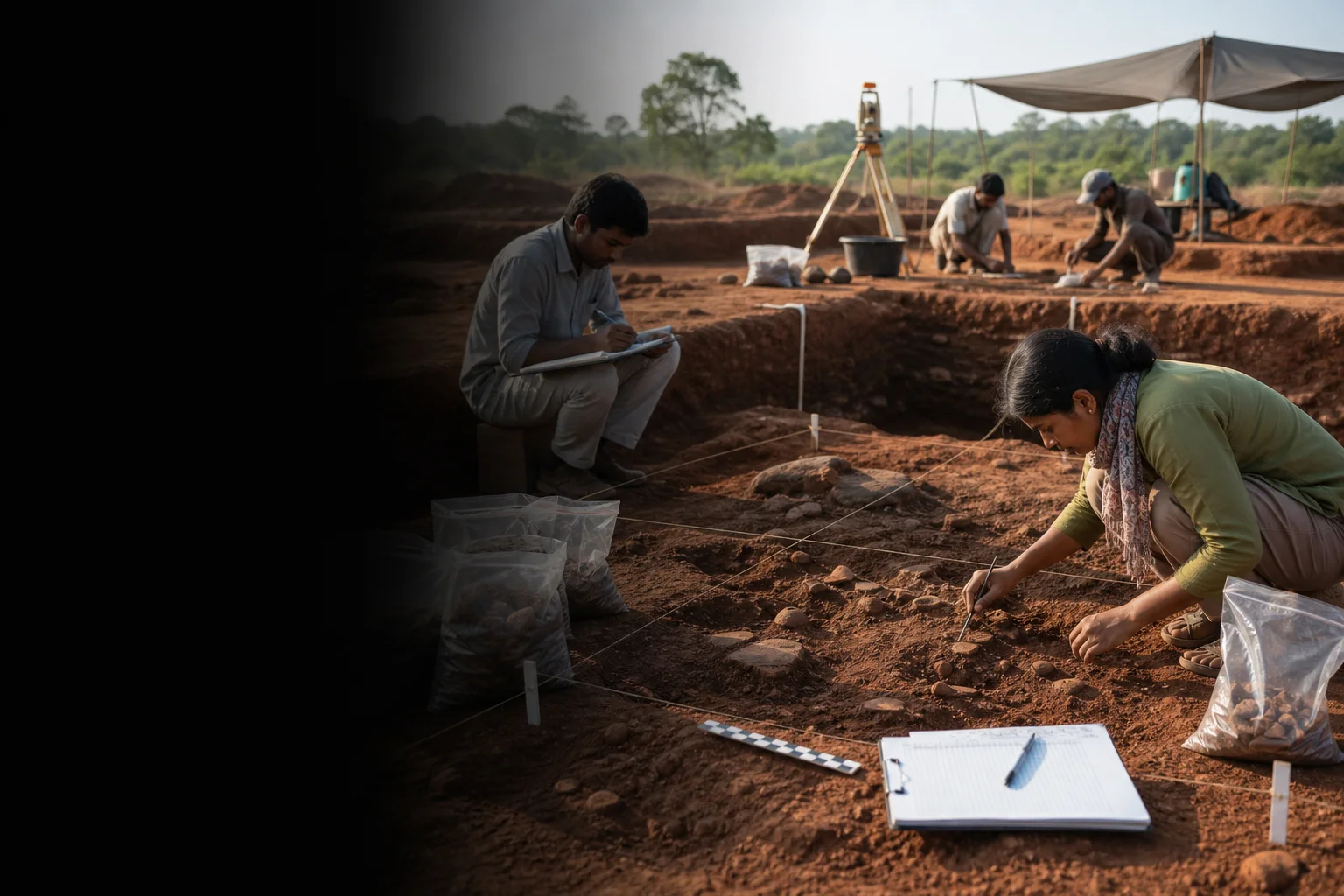
These project-created visuals support orientation. They are not presented as photographs of an excavation, monument, person, or event.
Questions
Frequently asked questions
Does prehistoric mean before people spoke?
No. It refers to the evidence available for historical study, especially the absence of a readable contemporary written record. Stone tools cannot establish the date of a language.
Did every part of Tamil Nadu pass through these periods together?
No. Period names organize evidence; changes in settlement, technology and burial practice occurred at different times and scales.
Editorial trust
Sources and further reading
Citations in the article point to this full list. Source type and review date are shown so readers can evaluate the evidence.
- 1Certain choice exhibits of anthropology: first palaeoliths of South IndiaGovernment Museum ChennaiOfficial museum collection publication
- 2Early Pleistocene Presence of Acheulian Hominins in South IndiaPappu et al., Science (2011)Peer-reviewed research; university-hosted paper
- 3Early Middle Palaeolithic culture in India around 385–172 ka reframes Out of Africa modelsAkhilesh et al., Nature (2018)Peer-reviewed research abstract
- 4Pre-Historic Site Museum – TiruvallurTamil Nadu State Department of ArchaeologyOfficial museum overview
- 5Phytoliths as indicators of Quaternary vegetation at the Paleolithic site of Attirampakkam, IndiaPremathilake et al., Journal of Archaeological Science: Reports (2017)Peer-reviewed palaeoenvironmental study
- 6First Farmers in South IndiaBoivin, Fuller, Korisettar and Petraglia, PragdharaAcademic author manuscript
- 7Dating the Neolithic of South IndiaFuller, Boivin and Korisettar, Antiquity (2007)Peer-reviewed research; author manuscript
- 8South Indian Archaeology: Neolithic sites and PaiyampalliArchaeological Survey of India; institutional archive at IGNCAInstitutional archaeological synthesis
- 9Antiquity of Iron: Recent radiometric dates from Tamil NaduK. Rajan and R. Sivanantham, Tamil Nadu Department of Archaeology (2025)Official report; chronology interpreted with qualifications
- 10Social distinctions during the south Indian Neolithic: changing mortuary practices at MaskiAntiquity (2023)Peer-reviewed regional comparison; Maski is outside Tamil Nadu
- 11Tamil-Brahmi scriptTamil Nadu State Department of ArchaeologyOfficial epigraphy overview
- 12Radiocarbon calibrationOxford Radiocarbon Accelerator UnitUniversity laboratory explanation
- 13Thermoluminescence and optically stimulated luminescenceWadia Institute of Himalayan GeologyInstitutional laboratory method guide
Editorial review: Factual claims were checked against the linked primary and institutional sources on 15 November 2026. Where the sources support only a range or interpretation, the article keeps that limitation visible.