
Temple and sacred hill
Arunachaleswarar Temple, Tiruvannamalai
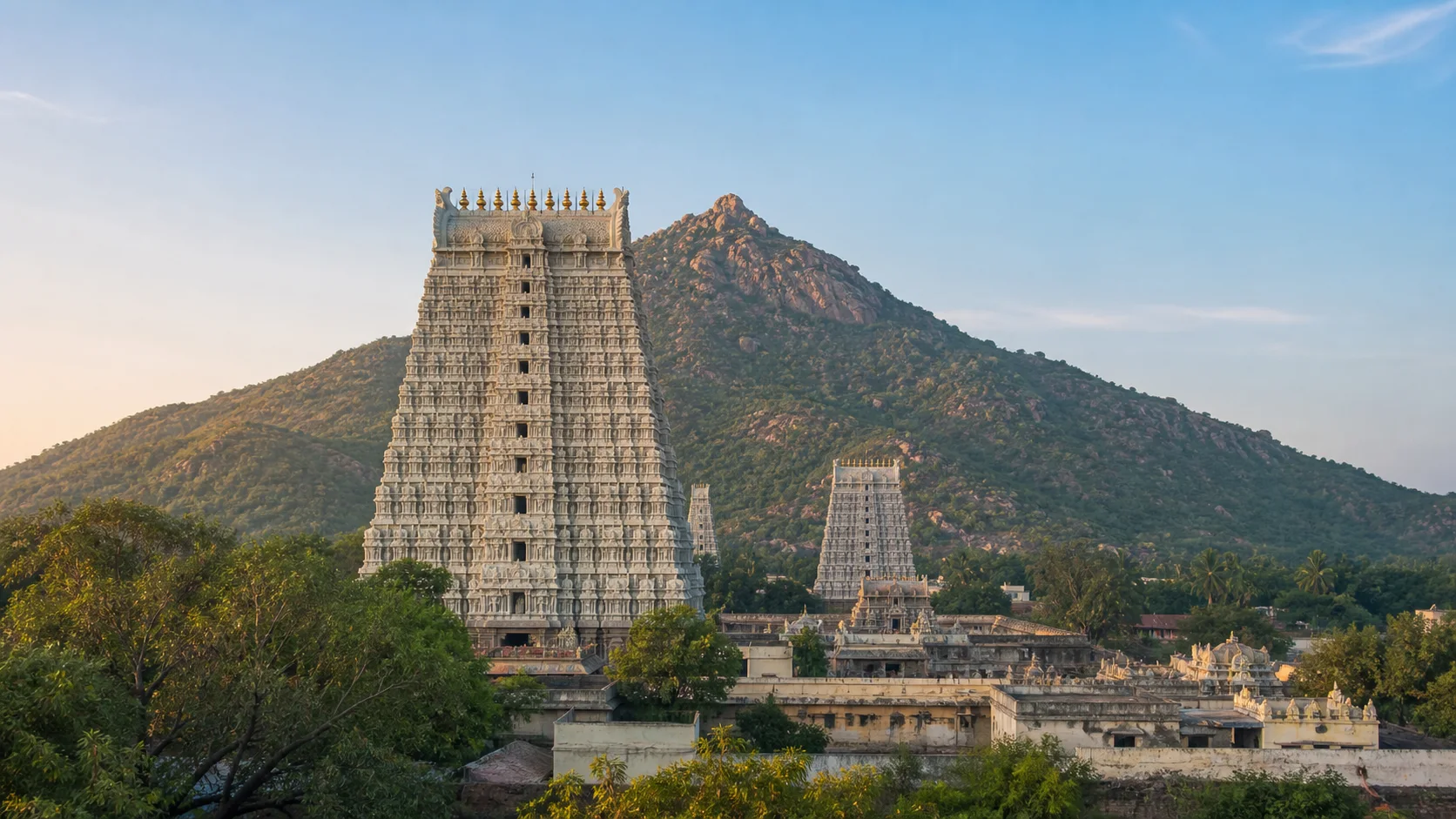
Arunachaleswarar Temple stands at the foot of Arunachala hill, joining monumental gateways and enclosures to a sacred landscape whose devotional meaning extends beyond the walls. The temple's built history, the hill's religious identity, girivalam practice, and Karthigai Deepam must be understood together but not collapsed into one kind of evidence.[1][2]
Significance
Why this temple matters
The site is a major Shaiva centre where temple, town, hill, procession, circumambulation, and festival infrastructure form a connected sacred geography.[1]
Its large gopurams and enclosures reflect several phases of patronage. No single dynasty label explains everything visible today.
Religious tradition
Sacred meaning and living practice
This section reports tradition as tradition; it does not substitute devotional chronology for material history.
Shaiva tradition understands Arunachala as a manifestation of fire and the temple as one of the elemental sacred places. Girivalam around the hill and the Karthigai Deepam beacon are central living practices.[1]
These statements describe religious tradition. Dates for structures, towers, inscriptions, and patronage require separate historical evidence.
Documented history
Patronage, construction and change
The complex accumulated through medieval and early modern patronage, with Chola, later Pandya, Vijayanagara, Nayaka, local, and institutional phases requiring element-specific study.
Inscriptions can document grants, repairs, officers, and ritual support, but a count or isolated royal name does not date the entire enclosure.[3]
Modern crowd management and conservation are especially consequential during full-moon circumambulation and Karthigai Deepam; current rules belong to official administration.[2]
Chronology
A phase-based timeline
Entries describe documented or carefully qualified phases, not an uninterrupted biography of the site.
Documented temple growth
Inscriptions and surviving fabric indicate multiple patronage phases rather than one foundation date.[3]
Monumental enlargement
Major gateways and halls belong within later expansion of the complex.
Hill circumambulation
Girivalam links temple and sacred landscape in active practice.[1]
Festival and visitor management
Official notices govern schedules, entry and festival arrangements.[2]
Architecture and art
Reading form, movement and surface
Tall gateway towers lead through broad enclosures toward the principal shrines, tanks, halls, and ritual spaces. The hill remains a visual and sacred reference even when not visible from every inner court.
The correct reading is layered: masonry joints, inscriptions, sculptural style, tower form, and enclosure sequence may belong to different phases.
Material record
Inscriptions, archaeology and conservation
Temple administration documents living practice; inscriptions and architecture support historical claims; sacred texts and oral teaching preserve religious meaning. Each source must be asked the question it can answer.
Girivalam is a public route with changing traffic, crowd, health, and weather conditions. This page does not certify a route, distance, or night-time safety plan.
On-site focus
What to notice
Relationship between temple and Arunachala hill
Multiple monumental gopurams
Large nested enclosures and temple tank
Girivalam circumambulation tradition
Karthigai Deepam sacred landscape
Festivals and sacred calendar
Karthigai Deepam is the best-known annual festival context, while full-moon days can also change movement and access.
Use current district and HR&CE notices for dates, routes, transport, crowd controls, and darshan arrangements.
Evidence guide
How to read this temple carefully
Temple history becomes clearer when different kinds of evidence are allowed to do different work.
Begin with the fabric
A temple complex is rarely the product of one moment. Sanctum, tower, gateway, hall, enclosure, tank, sculpture, painting, subsidiary shrine, street, and service building may belong to different phases. Materials, joints, reused blocks, blocked openings, changes in moulding, and differences in iconographic style can indicate sequence. Those clues need specialist comparison before they support an exact date. A broad period is more honest than an unsupported year.
Architecture also records use. Worn thresholds, processional axes, drainage, lamps, kitchens, storage, wells, and spaces for musicians or administrators reveal an institution in motion. At a living temple, recent repairs and operational barriers are part of the present layer. They should not be mistaken for the original plan, yet neither should they be dismissed as visual clutter.
Read inscriptions as situated records
Inscriptions can name a ruler, donor, deity, place, official, tax, measure, object, lamp, offering, land, or service. They are primary evidence, but they were created for a purpose and survive unevenly. A royal eulogy is not a neutral map; a gift record does not list everyone who worked; a modern translation may simplify a title or local term.[3]
Good historical practice records where an inscription is located, what language and script it uses, whether the text is complete, which edition supplies the reading, and where interpretation remains disputed. Visitors should never wet, chalk, trace, rub, or touch letters. Enhancing visibility can permanently damage the surface that preserves the evidence.
Keep tradition visible and correctly labelled
Sthala purana, hymn, oral account, festival performance, icon, and devotional practice can explain why a place is sacred, how worshippers understand it, and how memory travels across generations. Calling an account tradition does not diminish it. The label prevents a sacred narrative from being made to carry an archaeological claim it was not designed to prove.
The same temple can therefore have a sacred origin outside ordinary chronology and a documented building history with several datable phases. Both belong on this page, in separate sections. Where an official temple source presents a sacred account, this guide attributes it to temple tradition. Where UNESCO, ASI, an inscription, or documented architecture supports a historical claim, the citation appears with that claim.[1]
Avoid the language of unsupported superlatives
Claims such as oldest, largest, tallest, longest, richest, first, or only depend on definitions and comparison sets. A corridor can be measured in more than one way; a temple can be oldest by foundation tradition but not by surviving masonry; a tower may be compared by structural height or decorative finial. This guide uses a superlative only when the cited institution defines and supports it. Significance does not depend on winning a ranking.
Likewise, dynastic labels are useful but incomplete. A Chola core may have Pandya, Vijayanagara, Nayaka, Maratha, colonial-era, and modern layers. A Pallava monument may have later worship and repair. A pilgrimage centre can preserve ancient tradition while its current visitor systems are recent. The goal is not to force one label across the whole site but to see how different times coexist.
Observe without turning worship into display
At an active temple, worshippers are not exhibits and a queue is not an architectural inconvenience. Keep voices low, do not pose people without consent, do not step across ritual boundaries, and move when staff or worshippers need passage. Inner shrines can restrict entry, objects, or photography for religious and operational reasons. A map or ticket never overrides instructions given at the site.
Protected monuments require equal care. Do not sit on carved elements, climb for a viewpoint, lean bags against walls, move loose stones, or enter a closed area. Coastal salt, sandstone weathering, painted plaster, and polished thresholds each present different conservation risks. The most responsible photograph is sometimes the one not taken.
Build a focused route through a large complex
Before entering, choose a small number of questions. Where does the main axis begin? Which tower rises over the sanctum and which towers mark gateways? How do enclosure walls change the sound, light, crowd, and sense of distance? Where are water, kitchens, processional routes, subsidiary shrines, and institutional spaces placed? A question-led walk is more memorable than trying to photograph every surface.
Compare only elements you can identify responsibly. Two towers may look similar while serving different functions or belonging to different centuries. A polished sculpture may be old, recently conserved, repeatedly touched in worship, or a later replacement. An empty niche may reflect loss, redesign, ritual practice, or conservation. Record uncertainty in your notes instead of supplying a convenient explanation.
Continue the research after the visit
Start with the numbered sources on this page, then follow their bibliographies, monument inventories, epigraphic reports, museum catalogues, and conservation documents. Search using the official name as well as local and historical names, because catalogues may use different spellings. Note the publication date and responsible institution. Visitor pages are best for current access; UNESCO and ASI records explain protected significance; HR&CE pages document administration and living tradition; inscription publications and peer-reviewed scholarship are needed for detailed historical arguments.
Your own photograph can preserve an observation, but it does not prove a date or attribution. Caption it with the location, direction of view, visible element, and visit date. If a claim remains uncertain, phrase it as a question for further reading. That habit turns a temple visit from passive consumption into careful study while keeping both worship and heritage intact.
Plan your visit
Practical guidance without stale promises
Live information was checked at source level on 9 August 2026; fixed timings, fees and service availability are intentionally not copied.
Opening hours, worship schedules, tickets, queues, festival access, conservation closures, assisted transport and photography rules can change. Confirm them on the responsible authority's website shortly before departure and again at the entrance.
Verify with the official authorityBest time and season
No universal best month is claimed. Consider heat, rain, exposed stone, barefoot walking, hill ascent, coastal conditions, and festival crowds according to this site's setting. Check IMD forecasts and official local notices close to travel.
How to reach
Use the map search to orient yourself, then verify the entrance, road access, public transport, parking and drop-off arrangements. Place-name search is safer here than publishing unverified coordinates or travel times.
Accessibility
Historic thresholds, steps, uneven paving, crowds, footwear rules, hill approaches, and restricted routes may affect access. This page does not certify step-free access. Contact the authority for current entrances, mobility assistance and companion arrangements.
Photography
Assume that rules differ between outer architecture, interiors, worship, people, equipment and commercial work. Follow signs and staff directions; avoid flash, tripods, drones and photography of people without explicit permission.
Etiquette and responsible visiting
Dress and behavior should suit an active religious place even when the monument is also protected heritage. Footwear, bags, phones, food, offerings and security screening follow local rules. Never pressure staff for access, interrupt a ritual, touch an icon, or treat sacred water as a recreational facility. Families should agree on a meeting point because mobile use may be restricted and crowds can separate groups.
Heritage care extends beyond the walls. Use authorized vendors and facilities, carry reusable water where permitted, avoid single-use waste, and do not purchase objects represented as excavated or antique. Respect residents, processional streets, local traffic controls, and quiet areas. A slower visit usually reveals more while placing less pressure on the site.
Google Maps fallback
Tiruvannamalai
The embedded panel intentionally uses a verified place-name query rather than guessed coordinates.
Your visit
Temple visit checklist
Selections are stored only in this browser. No account or personal profile is required.
Regional context
Nearby places to research
These are planning prompts, not clickable destination pages or promises of current access.
Visual orientation
Images with explicit provenance
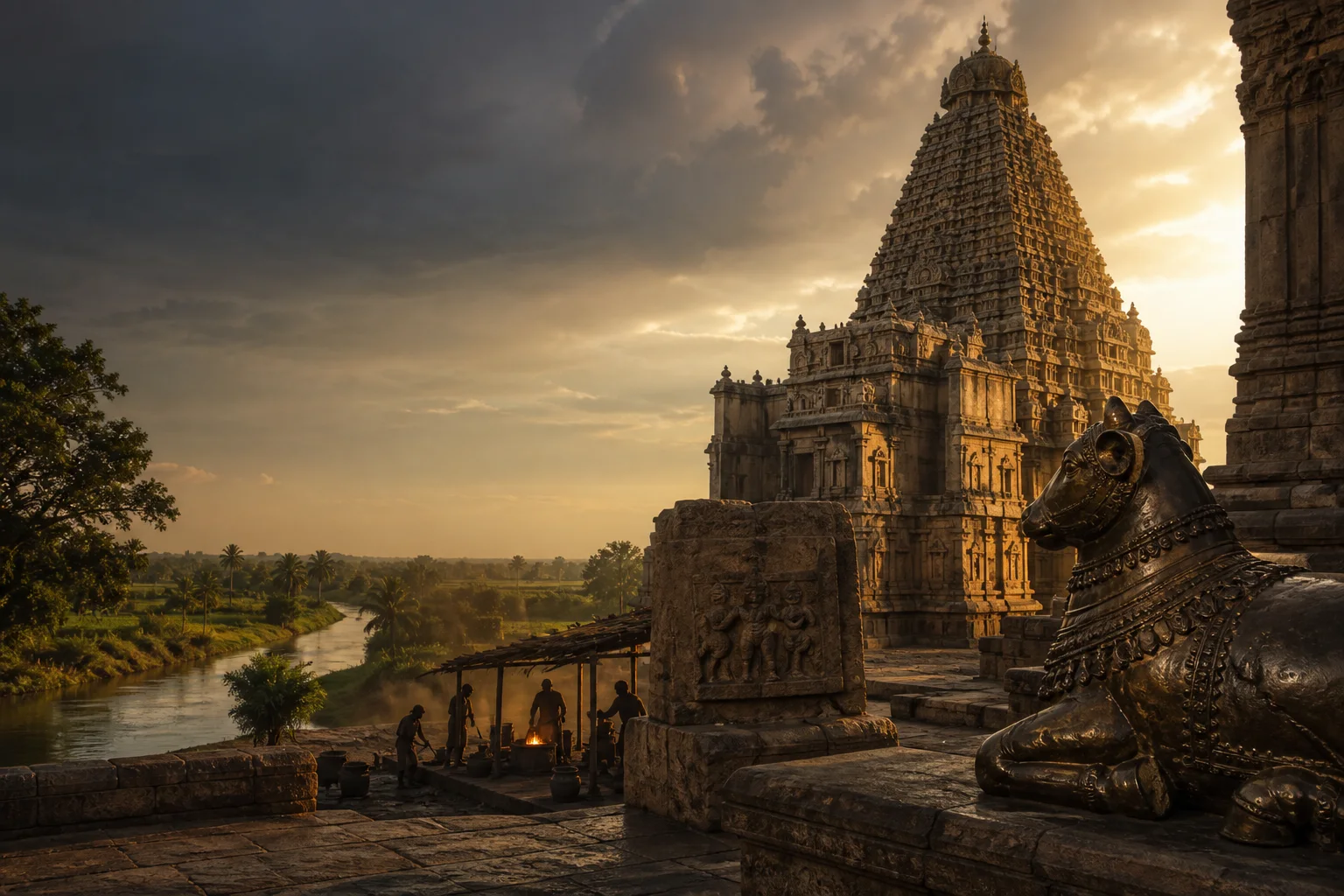
All images below are project-created editorial representations. They are not documentary photographs and should not be used to verify architectural detail.

Questions
Frequently asked questions
Is this page an official temple website?
No. My Tamil Nadu is an independent educational guide. Use the linked HR&CE, ASI, UNESCO, or district page for authoritative current instructions.
Are the opening hours shown here?
No fixed hours are reproduced. Temple and monument schedules can change; follow the official verification link before travelling.
Can every area be photographed?
Do not assume so. Photography rules can differ between outer precincts, protected fabric, worship areas, and festival periods. Ask staff on arrival.
How are legends handled?
Sthala purana and devotional accounts are identified as religious traditions. They are not presented as independently verified construction history.
Why are some dates broad?
A complex may contain several building, repair, patronage, and ritual phases. The page uses only the precision supported by its sources.
Is the map pin a guarantee of access?
No. The map opens a place-name search for orientation. It does not confirm entrances, parking, road conditions, or opening status.
Editorial trust
Sources and further reading
Historical, religious-tradition and current-information checks were completed separately. Source type and review date remain visible.
- 1Arulmigu Arunachaleswarar Temple, TiruvannamalaiTamil Nadu HR&CE DepartmentOfficial temple administration · Reviewed 9 August 2026
- 2Arulmigu Arunachaleswarar TempleTiruvannamalai District AdministrationOfficial district visitor guide · Reviewed 9 August 2026
- 3EpigraphyTamil Nadu State Department of ArchaeologyOfficial evidence guide · Reviewed 9 August 2026
- 4The Chola DynastyMy Tamil NaduReviewed historical guide · Reviewed 9 August 2026
Historical fact-check: chronology and attribution were checked against the listed heritage, archaeology, inscriptional and institutional records.
Tradition fact-check: devotional claims are attributed to temple or religious tradition and kept separate from independently documented construction history.
Current-information fact-check: the responsible authority link was reachable on 9 August 2026; changeable hours, fees and service promises were not frozen into this page.