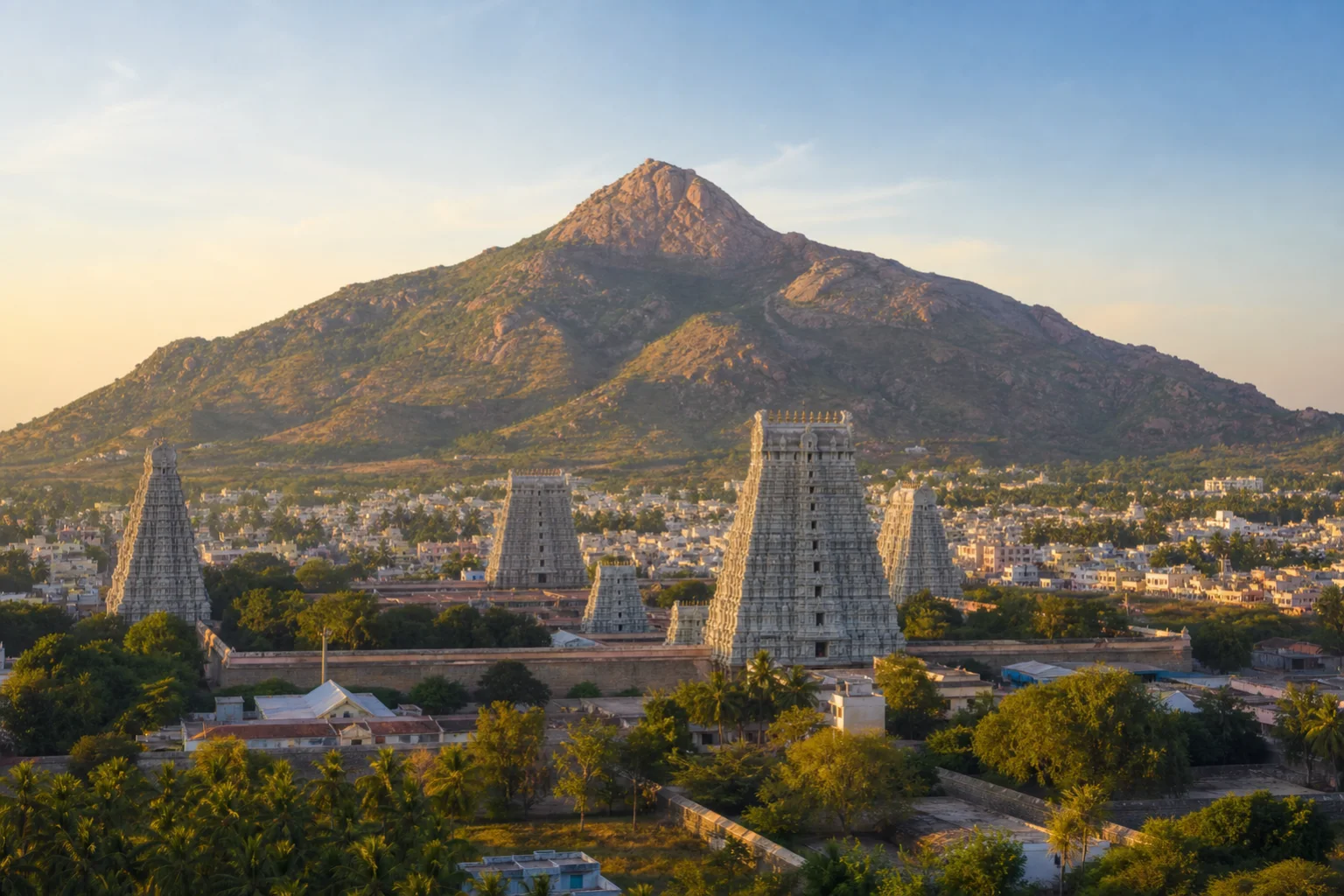
A living pilgrimage centre within a large and varied northern district
Tiruvannamalai District: Arunachala, Sacred Towns and Hills
Tiruvannamalai district is anchored in public imagination by Arunachala and Annamalaiyar Temple, yet it extends far beyond the sacred town to Arni, Cheyyar, Vandavasi, Polur, Chengam, Sathanur and Jawadhu Hills. Sacred tradition and physical geology are both meaningful, but one should never be presented as scientific proof of the other.On this page
District overview
Understanding Tiruvannamalai district
Official district material identifies Tiruvannamalai as a major sacred and administrative centre and places Jawadhu Hills, Sathanur, Arni, Cheyyar and Vandavasi within the wider district.[tiruvannamalaiAbout][tiruvannamalaiTourism]
The guide distinguishes the district, the town, the temple institution and the sacred hill rather than treating them as interchangeable.
Tiruvannamalai district is an administrative area, not a promise that every named place sits close to the headquarters. Routes should be checked by current district, taluk and place name before travel; historical sources may use boundaries that were valid only when they were written.
Why it matters
Why explore Tiruvannamalai?
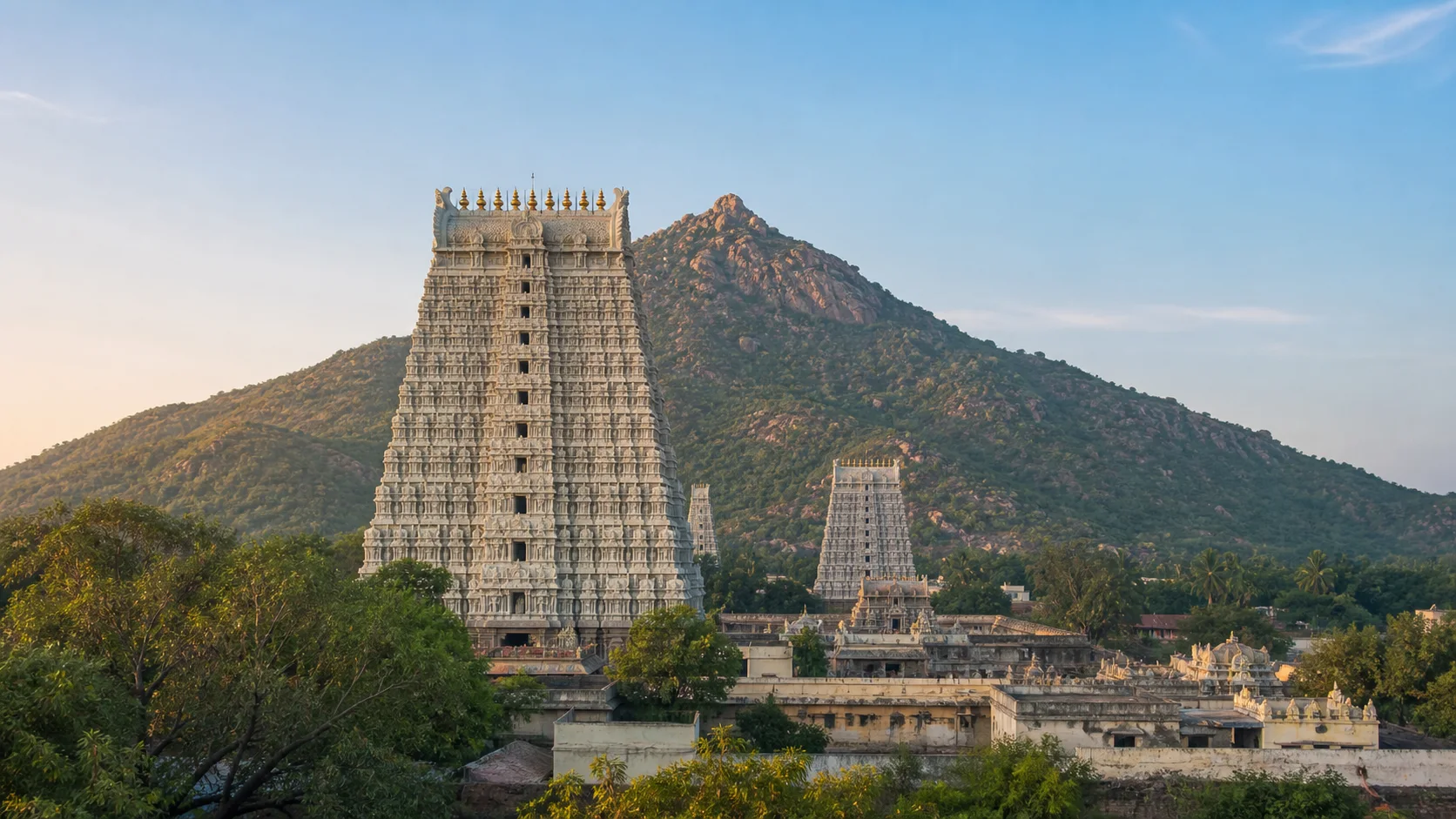
Arunachala and Annamalaiyar Temple form one of Tamil Nadu's major living Shaiva landscapes, experienced through worship, circumambulation, monastic traditions and town life.[annamalaiyar8d][tiruvannamalaiTourism]
Jawadhu Hills and Sathanur-side landscapes add forest, community, water and rural-planning contexts very different from the temple town.
Arni, Vandavasi and Cheyyar broaden the district through textile, market, political and route histories.[tiruvannamalaiAbout]
Land and water
Geography and regional identity
Rocky interior plains and isolated hills transition toward Eastern Ghats uplands in the Jawadhu region. Heat, elevation, vegetation and road conditions vary substantially.
Arunachala is a physical hill that can be described geologically. Its identity as Shiva in sacred tradition is a theological and devotional claim, not a substitute for geological method.
Sathanur reservoir and river landscapes are managed infrastructure with changing water levels and access conditions.
Landscape labels summarize a large area and never establish access. In Tiruvannamalai, public roads, protected land, worship, farms, water infrastructure and workplaces each have different rules. Place-name map searches help with orientation, while the responsible authority determines entry.
Evidence and change
Historical overview
Temple inscriptions and architecture document patronage under several dynasties and institutions, while sacred texts and oral traditions preserve other forms of memory.
Vandavasi is associated with an important eighteenth-century battle in wider Carnatic and colonial history; local places should be connected to regional actors and consequences, not only European commanders.
Arni's courtly, textile and market histories and Cheyyar's transport-industrial growth show different eastern trajectories.
The sacred town's modern expansion, pilgrimage economy, ashrams and global visitors are contemporary history as well as religious life.
A district boundary is modern administration rather than a timeless historical region. Evidence found in today's Tiruvannamalai can illuminate wider networks, but it does not prove that an ancient polity, language community or trade system followed the present border.
Continue with Tamil Nadu history →Within the district
Cities, towns and local centres
These are district contexts, not newly created destination pages.Tiruvannamalai
A major pilgrimage, administrative, education and market centre.
Arni
Silk-related commerce and regional institutions shape its identity.
Cheyyar
Road, industry, agriculture and civic growth distinguish it.
Vandavasi
A route and battle-history context requiring broad interpretation.
Polur
A market and access centre toward Jawadhu-side landscapes.
Chengam
A gateway toward Sathanur and upland routes.
Living and protected places
Temples and spiritual places
Arunachaleswarar Temple
A major living Shaiva temple; use current HR&CE and temple guidance.
Open full guideArunachala circumambulation landscape
A living sacred route through public roads and sensitive hill edges; current safety and crowd guidance applies.
Devikapuram temple context
A living temple and inscriptional landscape in the district's northern side.
Interpret carefully
Heritage and architecture
Tiruvannamalai temple town
Temple, streets, tanks, ashrams and civic life form one landscape.
Vandavasi historical context
Military history belongs inside regional political and social change.
Arni textile context
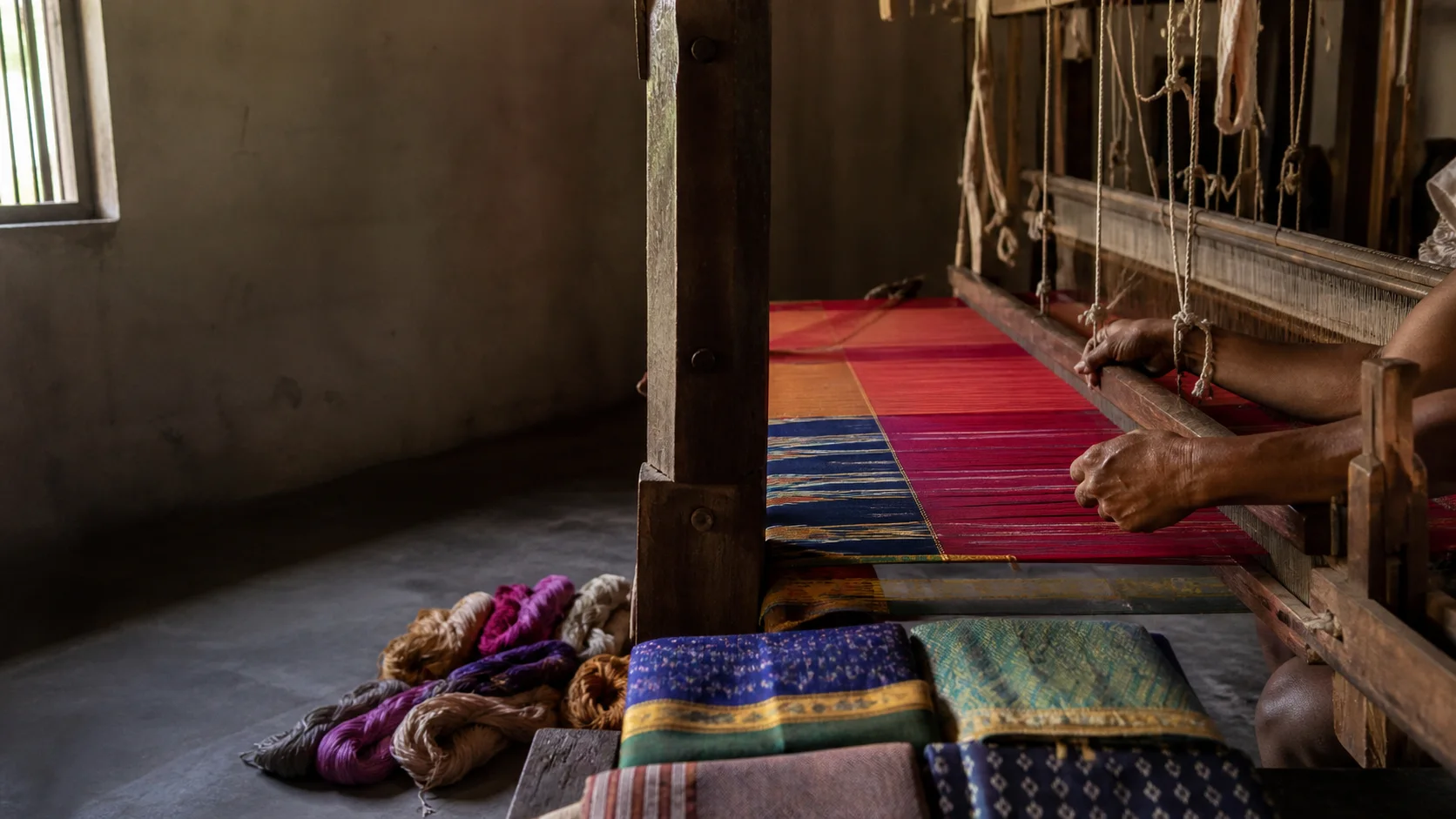
Material, loom type, labour and seller provenance should be identified.
Jawadhu cultural landscape
Living communities and forests require consent and responsible access.
Living knowledge
Culture, food and regional products
Culture and festivals
Pilgrimage, monastic institutions, temple service, markets, agriculture, textiles and hill-community life create different cultural contexts.
Circumambulation is a religious practice, not merely a walking attraction; participants should respect worship, residents, traffic and waste rules.
Large annual events affect access, but dates, routes and crowd arrangements require current official confirmation.
Food and cuisine
Pilgrimage-town food includes varied vegetarian establishments and community offerings, while the wider district has diverse rural and household foodways.
Millets, rice, pulses, groundnut, vegetables and regionally available dairy or meat appear according to season and community.
No restaurant or dish is presented as permanent, original or best.
Making and provenance
Regional products and crafts
Arni is associated with silk textiles, but handloom, powerloom, fibre, zari, production location and seller claims should be checked separately.
Agricultural and forest-linked products require identifiable and lawful provenance.
Sacred objects sold near pilgrimage places may be made elsewhere; a market location is not proof of manufacture.
District-level association does not prove that every item sold under the Tiruvannamalai name was grown, made or processed locally. Useful provenance identifies the producer, material, technique and production place without turning a broad regional reputation into a guarantee.
Landscape first
Nature and wildlife
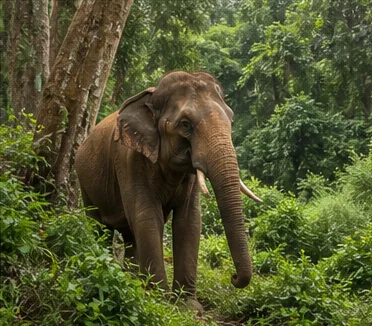
Jawadhu Hills contain forest, farms and settlements; protected-area and community rules apply and wildlife sightings are uncertain.[forest8d]
Arunachala's paths and rocky slopes can be hot, crowded or restricted. Fire risk and conservation closures must be respected.
Reservoir, stream and hill-road conditions vary with rain; use current forecasts and local advisories.[imd8d]
Work and change
Economy and livelihoods
Pilgrimage services, agriculture, textiles, manufacturing, trade, education and transport support different parts of the district.
Tourism and pilgrimage create work but also pressure water, waste, housing and roads; responsible planning acknowledges those costs.
No current crowd, textile-output or industrial ranking is asserted.
Build a coherent route
Places to explore in Tiruvannamalai
Tiruvannamalai town
Allow time for the temple, town and respectful orientation.
Arunachala route
Use current official guidance and personal capacity.
Sathanur side
Check access and combine with Chengam realistically.
Jawadhu Hills
Use authorized routes and local consent.
Arni
Ask precise provenance questions.
Vandavasi
Interpret conflict in its wider regional setting.
Choose your pace
Things to do
Separate sacred and scientific language
Honor devotional meaning without turning it into a geology claim.
Read a pilgrimage town
Connect worship with streets, water, commerce and residents.
Trace textile provenance
Distinguish handloom, powerloom and retail claims.
Build a district-scale route
Treat Jawadhu, Arni and Vandavasi as separate clusters.
Conditions, not promises
Best season and current checks
Exposed rock and plains can be very hot; hill rain, pilgrimage crowds and reservoir conditions require current checks.[imd8d]
Religious events and forest restrictions can transform access, so no fixed operating promise is given.
This evergreen guide does not publish forecasts, road or sea status, attraction hours, event dates, transport operation or other live conditions.[imd8d]
Plan by days
Suggested duration
One day
Focus on Tiruvannamalai town and the temple landscape without adding distant sites.
Two days
Use one sacred-town day and one Sathanur-Chengam or Arni-Vandavasi day.
Three or more days
Add Jawadhu Hills only with current access, daylight and return planning.
Regional access
How to reach
By rail
Tiruvannamalai and district stations serve different rail corridors; verify current trains.
By road
Roads connect Chennai-side districts, Viluppuram, Kallakurichi, Vellore, Krishnagiri and Salem regions.
By air
Confirm the practical airport and onward road or rail transfer.
Local movement
Getting around
Town movement may be walkable in selected areas, but heat, crowds and traffic matter; distant hills and eastern towns need separate transport.
The central planning check is simple: Check pilgrimage arrangements, hill and forest restrictions, reservoir access, heat, crowds and transport.
Map links are for orientation. Confirm accessibility, parking, last-mile transport and return options locally. Leave enough daylight for rural, hill, wetland or coastal return travel and keep an alternative when one place is unavailable.
Place-name links
Map of Tiruvannamalai district
No fabricated coordinates or heavy map embed are used.Map data is not embedded on this lightweight page. Open a place-name search in Google Maps for current roads, business details and directions.
Continue geographically
Nearby districts
Continue by subject
Related My Tamil Nadu guides
Practical planning
Save a district checklist
Saved only in this browser. No login or personal data is needed.
Questions
Frequently asked questions about Tiruvannamalai
Is Tiruvannamalai district the same as Tiruvannamalai town?
No. Tiruvannamalai town is the headquarters and major pilgrimage centre; the district also spans Arni, Cheyyar, Vandavasi, Polur, Chengam and Jawadhu-side landscapes.
Is Arunachala's sacred identity a geological claim?
No. Arunachala is a deeply significant sacred landscape in Shaiva tradition. Its physical hill and rocks are studied through geology; sacred meaning and geological description are distinct forms of understanding.
What is Tiruvannamalai best understood through?
The district is larger than its pilgrimage centre: Arunachala and Annamalaiyar Temple sit within a landscape of market towns, reservoirs, hill communities, farms and historically important routes.
How many days are useful for Tiruvannamalai?
Two days gives a focused introduction; use three or more when coast, hills, distant towns or heritage clusters are combined.
Are current timings, fares and schedules listed?
No. Operational details change and must be confirmed with the responsible authority.
Are the images documentary photographs?
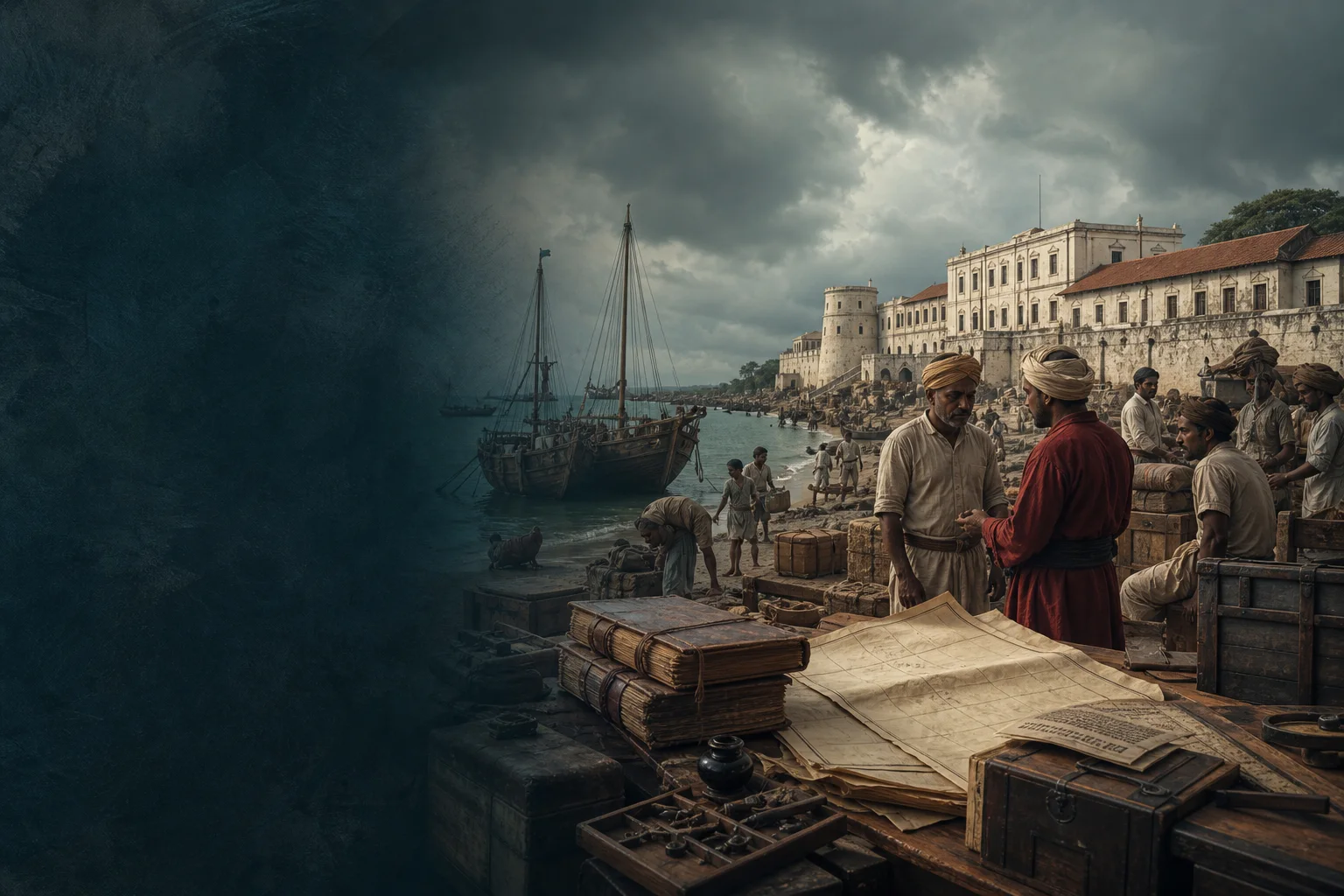
No. They are project-created editorial visuals and are explicitly labelled non-documentary.
How do the map links work?
They open place-name searches in Google Maps without guessed coordinates or a heavy embedded map.
Editorial trust
Sources and further reading
Major factual claims were checked against authoritative references. Last reviewed 9 August 2026.- About Tiruvannamalai districtTiruvannamalai District Administration · Official district profileReviewed 9 August 2026
- District tourism and heritageTiruvannamalai District Administration · Official district visitor recordReviewed 9 August 2026
- Arulmigu Arunachaleswarar TempleTamil Nadu HR&CE Department · Official temple administrationReviewed 9 August 2026
- Forests, wetlands and protected-area guidanceTamil Nadu Forest Department · State conservation authorityReviewed 9 August 2026
- Archaeological sites, excavations and museumsTamil Nadu State Department of Archaeology · State archaeology authorityReviewed 9 August 2026
- Regional Meteorological Centre ChennaiIndia Meteorological Department · Official weather authorityReviewed 9 August 2026
- National Train Enquiry SystemIndian Railways · Official transportReviewed 9 August 2026