
Before the Sangam Age
Neolithic Tamil Nadu and Mayiladumparai
A ground stone axe can open a discussion about labour, food and settlement. At Mayiladumparai, it also asks us to distinguish several periods sharing the same landscape.
Orientation
Overview
Site-specific sequences; dates do not define a single regional boundary
The Neolithic in Tamil Nadu is best approached through particular places. Some preserve habitation deposits; others are known from tools or features that are harder to connect with a complete settlement. Mayiladumparai is compelling because it brings several kinds of evidence into a small geographic setting. Paiyampalli provides a useful excavated comparison. Together they encourage a history built around people’s work and the traces of daily life, rather than a single date for the beginning of agriculture.
This guide uses Neolithic for a material and social horizon discussed by archaeologists, not a fixed identity carried by everyone living at the same time. The Southern Neolithic extends beyond modern Tamil Nadu. Comparisons with neighbouring regions help frame questions, but they cannot supply missing evidence for a particular Tamil Nadu site. An excavated seed or floor must retain its own location and context.[1]
Chronology
A careful timeline
Dates refer to particular sites, samples or research events. Phases overlap and are not a uniform regional calendar.
Cultivation, herding and settlement
Southern Deccan research places major developments in the third and second millennia BCE; local sequences require separate assessment.[1]
Neolithic followed by megalithic contexts
Excavated phases offer a local comparison rather than a date chart for all Tamil Nadu.[4]
Stone-working and later iron contexts
The 2025 departmental report associates dated samples with iron-bearing deposits, distinct from the locality’s earlier evidence.[6]
More layers of use
Later written and memorial material belongs to later histories of the landscape.[6]
Historical reading
What makes a Neolithic context?
A ground or polished stone axe often introduces the subject, but archaeologists work with associations. Pottery, dwelling traces, plant remains, animal bones and tools provide stronger grounds for describing a community than the surface discovery of one distinctive implement. Different practices can appear at different times. Pottery does not by itself demonstrate cultivation, and stone tools need not disappear as soon as metal becomes available.
Southern Neolithic research has increasingly examined the relationship between herding, cultivation and settlement. It allows room for internal development as well as connections with other regions. This matters when reading Tamil Nadu’s evidence: farming need not be imagined as a complete package arriving on one day, and communities that tended animals need not have abandoned seasonal movement. The familiar contrast between wandering hunters and settled farmers is too narrow to accommodate these combinations.[2]
Historical reading
Finding the right Mayiladumparai
The archaeological locality discussed here is in Krishnagiri district in northwestern Tamil Nadu. The Department of Archaeology’s rock-art register includes Mayiladumparai among the district’s sites. Its name can appear in slightly different spellings in publications. For practical research, the district and archaeological context are safer guides than a name alone, particularly when searching maps or older catalogues.[7]
A locality is not necessarily a single bounded settlement. A hill terrace, rock surface, burial area and later memorial can belong to different episodes of use. They may be close enough to encounter on one walk but separated by long intervals in time. A responsible account begins by identifying the feature being discussed. It then asks whether the connection to neighbouring evidence comes from excavation, a date, a shared artefact type or simply proximity.
Historical reading
Stone-working as skilled labour
Ground stone tools are the result of work, not merely stones selected for their shape. Research on South Indian axe production examines stages of manufacture and the relationship between production places and wider use. It shows why unfinished pieces and manufacturing debris can be as informative as complete polished examples. These regional studies provide useful questions for Tamil Nadu, even when their particular workshops lie elsewhere.[3]
A polishing groove can preserve repeated action on a rock surface. It cannot, by appearance alone, identify every object worked there, how many people used it or the precise date of use. Such a feature is most informative when documented alongside its geological surface, associated finds and excavated contexts. A modern viewer can recognize the physical effort involved without imagining a specific prehistoric scene that has not been demonstrated.
Tool biographies also extend beyond manufacture. A damaged cutting edge may have been repaired; a fragment may have been reused or discarded away from the working area. The most carefully finished object in a display need not be the most typical. Questions about repair, breakage and movement help restore ordinary work to a subject often represented by a few exceptional specimens.
Historical reading
Paiyampalli as an excavated comparison
Paiyampalli’s excavation sequence distinguishes a Neolithic period from a later megalithic period. Published accounts describe ground stone implements and pottery alongside traces of structures. This is a firmer basis for discussing settlement than a tool collection without documented layers. It also provides an opportunity to examine what persists through a technological transition, instead of assuming that a new period label means a wholly new population.[4]
Pondicherry University’s archaeology teaching material describes post-holes and dwelling evidence, as well as charred horse gram and green gram from the excavations. The crop identifications connect food practices to material remains. They do not establish the entire diet, the share of food obtained from cultivation or a complete agricultural calendar. Those are further questions requiring quantities, sampling information and comparison with other evidence.[5]
The value of Paiyampalli for Mayiladumparai is comparative. It shows what a more developed archaeological argument can include: layers, buildings, tools and food remains considered together. It does not license the transfer of the same house plan or crop list to another locality. Similarity should lead to a testable question, not a reconstruction copied from one settlement to the next.
Historical reading
Food, households and the evidence that survives
Food history is often less visible than tool history because survival is selective. Stone may endure where baskets, roofs and wooden handles disappear. Charred seeds can survive an accident or deliberate burning, but a collection of burnt remains is not a menu. The absence of a plant from a small sample may reflect recovery methods or preservation rather than its absence from everyday life.
Consider the difference between identifying a crop and locating its cultivation. A seed at a settlement can show that the plant reached that place. Establishing whether it was grown nearby, traded, stored or prepared there requires other observations. Similarly, grinding equipment suggests processing but does not identify its contents without further analysis. These distinctions let a readable account remain specific without making the evidence carry more than it can support.
Households can also be studied through space. A hearth, working surface and rubbish deposit may relate to one another, but a trench can cut across several episodes of rebuilding. The task is to separate contemporary features from accumulated remains. Reconstructing that sequence helps ask how long people stayed, what they maintained and which activities shared a space, even when no complete house survives.
Historical reading
Why the iron dates are a different question
The department’s 2025 Antiquity of Iron report discusses charcoal samples associated with Mayiladumparai’s iron-bearing deposits and cites an early result around 2200 BCE. This is an attributed proposal for the chronology of iron use in that context. It is not a direct date for a stone axe, polishing groove or painting, and it does not establish when farming began across Tamil Nadu.[6]
Radiocarbon analysis dates carbon-bearing material. Connecting that result to an iron object requires a secure archaeological association. The age of the sampled material, its deposition and the activity being reconstructed are related questions, not identical ones. Charcoal may have a history before it reaches its final layer, while a later disturbance can bring materials together. These are reasons to examine the recorded context, not reasons to dismiss scientific measurement.
Historic England’s scientific guidance explains the old-wood effect: carbon in an inner tree ring can be substantially older than the felling or burning of that tree. Short-lived plant material can help test such offsets when it is securely associated with the event being dated. This is a general methodological caution, not a diagnosis of the Mayiladumparai samples. Establishing whether it applies there would require sample identification and contextual information beyond a headline date. Publishing those details lets other researchers evaluate the archaeological inference separately from the laboratory measurement.[9]
Our reading keeps a further limitation visible: numerical summaries and the date table in the 2025 report are not fully consistent for Mayiladumparai. A precise regional boundary should not be built from those single-number summaries. The detailed Iron Age guide carries the wider chronology discussion; here the important point is that earlier stone-working evidence and later iron-bearing contexts retain separate evidential roles.
Historical reading
Rock paintings and the temptation to synchronize
The state’s rock-art register confirms Mayiladumparai’s place in the rock-art record, but a register is not a direct dating study. A painting near a settlement can invite an appealing story about its inhabitants. That story needs independent support before the painting can be assigned to the same period. Nor does identifying a painted animal automatically establish which animals people kept or hunted.[7]
Paint, engraving, tool-working marks and natural staining call for different observations. Conservation also matters: wetting, chalking or touching a surface can damage the evidence a visitor hopes to understand. A photograph with a responsible caption is more useful than an enhanced image that quietly changes the marks. Where an interpretation depends on uncertain shape or chronology, the caption should preserve that uncertainty.
Historical reading
A regional history without a single template
Research on mortuary practice at Maski, outside Tamil Nadu, demonstrates that the Southern Neolithic is not only a story of food and tools. Treatment of the dead and changing social distinctions also form part of the discussion. Such work broadens the questions asked of Tamil Nadu’s record, while reminding us that social arrangements must be demonstrated locally rather than inferred from a shared period name.[8]
There is no need to make Mayiladumparai stand for every Neolithic community in the state. Its importance lies in the particular combinations preserved there and in the questions they make possible. Paiyampalli offers another perspective; the wider Southern Neolithic supplies comparative methods and hypotheses. As more contexts are published, the regional picture can become more varied and more precise at the same time.
Human scale
People and institutions
The people who made and used these objects are often unnamed. Research teams, museums and local communities help preserve their traces.
Stone workers and tool users
Manufacture, maintenance and discard each leave different kinds of traces.
Cultivators and herders
Livelihoods are reconstructed from associations, not assigned from a tool alone.
Historical geography
Connected places
Places are linked only when a substantive My Tamil Nadu guide already exists. Other entries remain non-clickable research context.
Visual reading
Images with explicit provenance
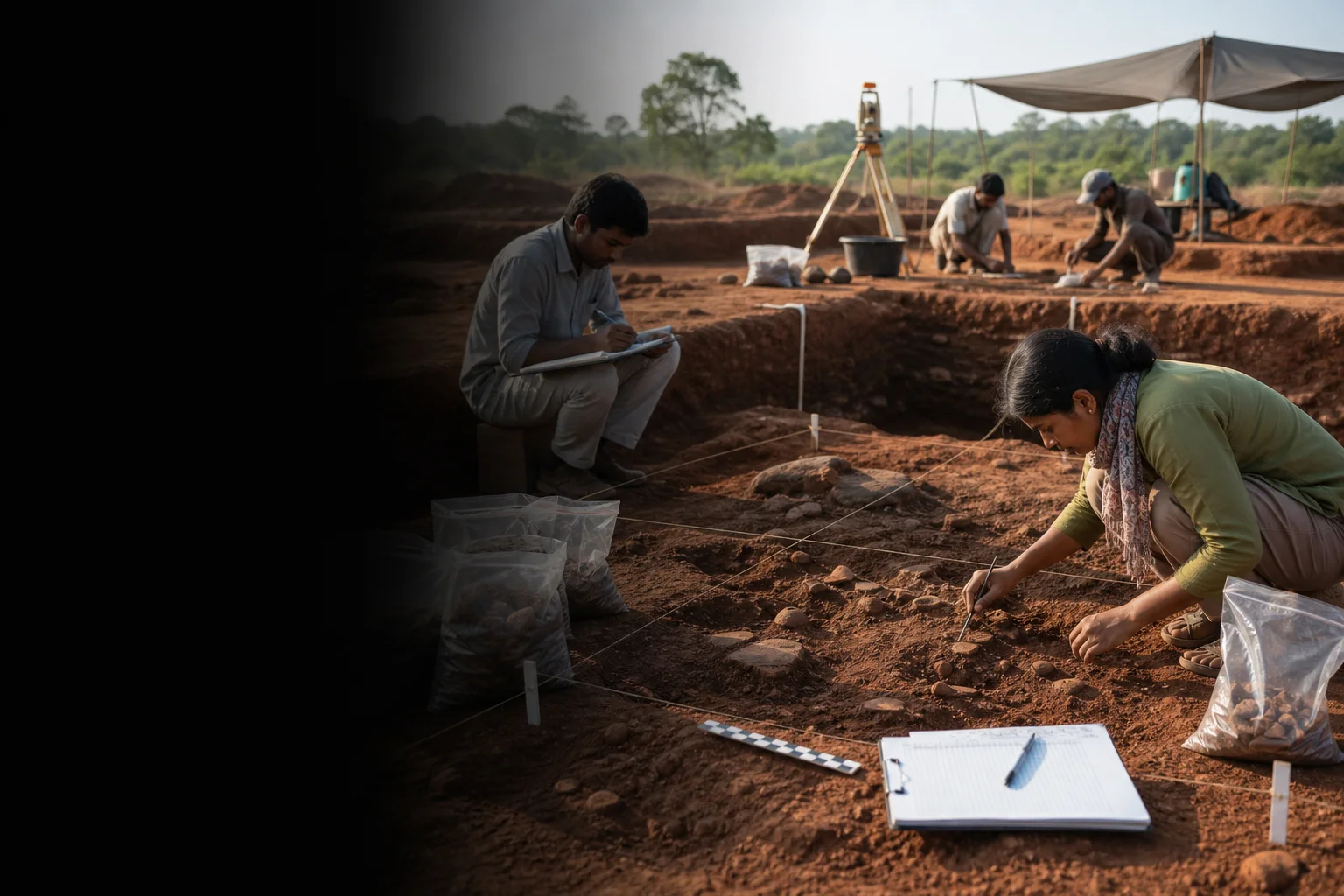
These project-created visuals support orientation. They are not presented as photographs of an excavation, monument, person, or event.
Questions
Frequently asked questions
Does the early iron date establish the age of the Neolithic?
No. It concerns samples associated with iron-bearing deposits. Earlier phases and nearby features require their own contextual and chronological assessment.
Can a polished axe prove a farming village?
Not on its own. Settlement features, food remains, other tools and secure associations are needed to build that interpretation.
Are the paintings directly dated?
The sources used here do not establish a direct date for every painting. They are not synchronized with the excavated deposits in this guide.
Editorial trust
Sources and further reading
Citations in the article point to this full list. Source type and review date are shown so readers can evaluate the evidence.
- 1Dating the Neolithic of South IndiaFuller, Boivin and Korisettar, Antiquity (2007)Peer-reviewed research; author manuscript
- 2First Farmers in South IndiaBoivin, Fuller, Korisettar and Petraglia, PragdharaAcademic author manuscript
- 3Stone Axe Technology in Neolithic South IndiaBrumm, Boivin, Korisettar et al.Academic study; Max Planck repository
- 4South Indian Archaeology: Neolithic sites and PaiyampalliArchaeological Survey of India; institutional archive at IGNCAInstitutional archaeological synthesis
- 5Introduction to the Study of Archaeology: PaiyampalliPondicherry UniversityUniversity teaching resource
- 6Antiquity of Iron: Recent radiometric dates from Tamil NaduK. Rajan and R. Sivanantham, Tamil Nadu Department of Archaeology (2025)Official report; chronology interpreted with qualifications
- 7Rock art: site registerTamil Nadu State Department of ArchaeologyOfficial site register; broad interpretations require caution
- 8Social distinctions during the south Indian Neolithic: changing mortuary practices at MaskiAntiquity (2023)Peer-reviewed regional comparison; Maski is outside Tamil Nadu
- 9Radiocarbon Dating and Chronological Modelling: The Bayesian ProcessHistoric EnglandInstitutional scientific dating guidance
Editorial review: Factual claims were checked against the linked primary and institutional sources on 15 November 2026. Where the sources support only a range or interpretation, the article keeps that limitation visible.