Begin with two kinds of traffic
Pamban Strait carries two movement systems across the same narrow geography. Trains need a continuous, accurately aligned track between the mainland and Rameswaram Island, while vessels need sufficient navigational clearance through the crossing. A movable bridge resolves that conflict by temporarily changing its shape rather than forcing one mode to disappear.
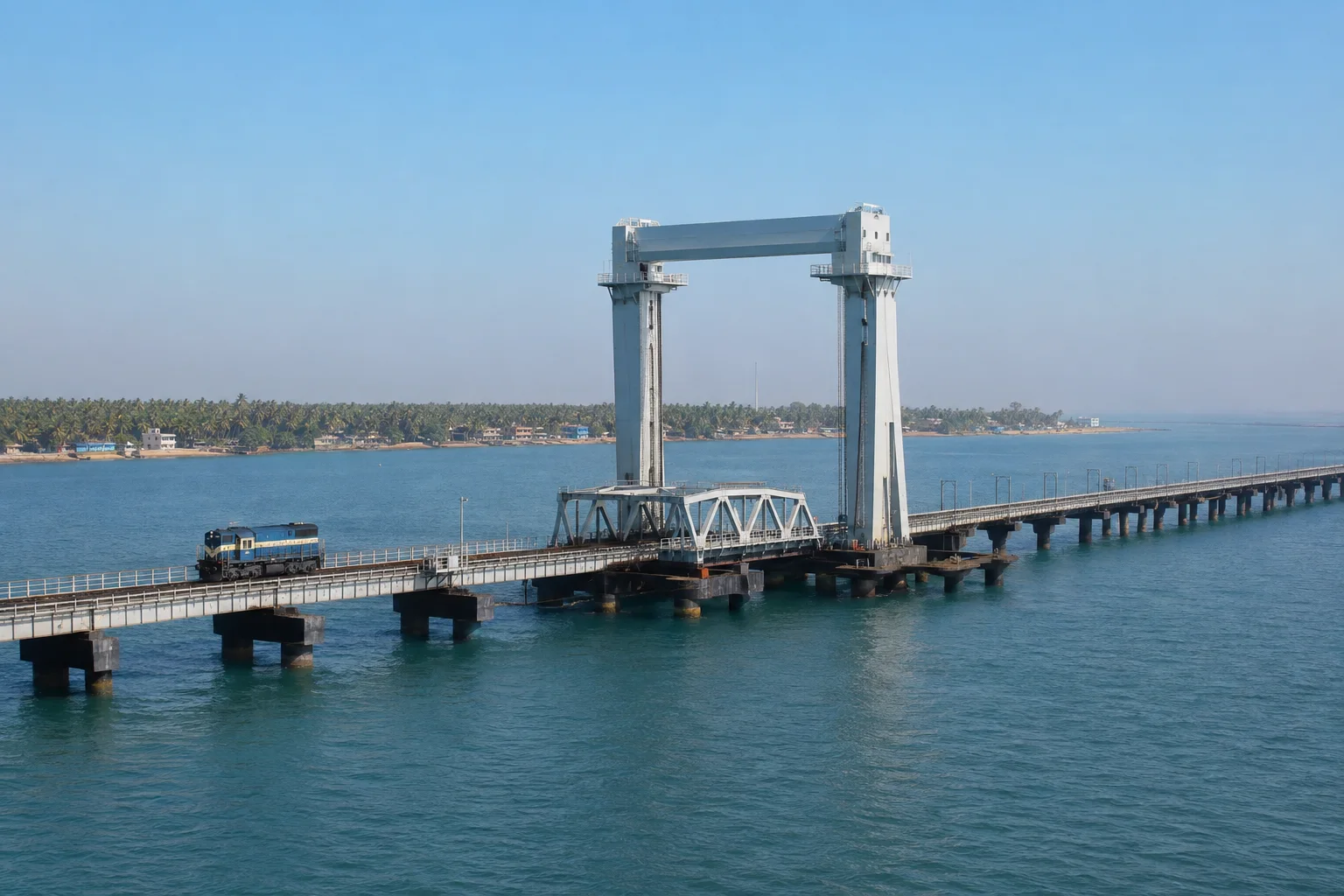
The Ministry of Railways describes the new structure as India's first vertical-lift railway sea bridge. Its central navigational span rises between towers so a vessel can pass below. That mechanism differs from an ordinary fixed bridge, and it also differs from the rolling-lift arrangement associated with the earlier Pamban rail bridge.
The lift is an operational railway and maritime process. It is not activated on demand for visitors, and a photograph of a raised span is not proof of today's schedule. Train running, vessel passage, maintenance and weather require current information from the responsible authorities rather than assumptions based on old reports.
Sources for this section: New Pamban technical brief, Bridge inauguration.
Read the vertical lift as a coordinated system
Official descriptions identify a 72.5-metre navigational span that can rise by 17 metres. The span must travel vertically while remaining controlled between its towers, then return to the precise railway position required for safe track continuity. Mechanical movement is therefore only one part of a larger system of power, control, alignment and operational checks.
A vertical lift keeps the moving deck broadly horizontal. That is useful for a railway because rails, structural members and associated systems rise together instead of rotating through an arc. The towers and overhead structure provide the height and guidance needed for that movement while the fixed approach spans continue across the strait.
Public summaries explain the concept, not every operating procedure. Avoid inventing lift duration, staffing sequence, wind limits or vessel priority from a short video. Those details belong to operating manuals and current railway or port notices, and they may vary with inspection, maintenance and marine conditions.
Sources for this section: New Pamban technical brief, Vertical-lift explainer.
Treat the sea as an engineering load
A sea bridge is exposed to salt spray, humidity, wind, waves and difficult maintenance access. Corrosion is not a cosmetic issue: it can affect structural material, fasteners, electrical equipment and moving parts. The official bridge account highlights stainless-steel reinforcement, protective coatings and fully welded joints as durability choices for that environment.
The substructure was designed with provision for two tracks, while the initial superstructure carries a single line according to the Ministry of Railways account. That distinction matters. Future-ready capacity does not mean two tracks are currently available, and a design provision should not be rewritten as a completed operating feature.
Durability claims also need time. Materials and coatings reduce risk only when paired with inspection, cleaning, repair and replacement. Visitors can understand the design intention from official documents, but they should not make their own safety assessment from visible rust, paint colour or a distant photograph.
Sources for this section: Bridge inauguration, New Pamban technical brief.
Keep the earlier and new bridges distinct
The earlier rail bridge opened in the early twentieth century and used a Scherzer rolling-lift span at its navigational channel. It became inseparable from Rameswaram's modern history, including the story of rail connection, storms, pilgrimage and island life. Its cultural prominence should not blur the engineering differences between two structures.
The new bridge runs beside that historical crossing and uses a vertical-lift arrangement. One span rolled back and upward through a particular mechanism; the other rises vertically between towers. Calling both simply the Pamban Bridge can produce confused captions, dates and technical claims, especially when an image shows both alignments.
A careful visit labels which bridge is being discussed, which date belongs to it and whether a fact concerns construction, inauguration or present operation. It also avoids declaring the older structure publicly accessible. Heritage value does not by itself authorize entry onto railway property or maintenance areas.
Sources for this section: New Pamban technical brief, Vertical-lift explainer.
Observe without entering an operating corridor
The railway bridge is operational infrastructure, not a pedestrian attraction. Do not enter tracks, service walkways, lift machinery zones or fenced approaches. A train that appears distant can close space quickly, and marine wind can make exposed structures more hazardous than they look from shore.
Use lawful public viewpoints and avoid stopping on the road bridge where signs or traffic conditions prohibit it. Do not lean over barriers, fly drones near railway or maritime infrastructure, or obstruct residents and fishing work for a photograph. Children should remain closely supervised near water and traffic.
Weather, rail operations and access controls can change. Check current railway service separately, follow police and local authority directions, and plan daylight into the return journey. This guide deliberately omits a viewing-hour promise, lift timetable and train schedule because none is safely fixed by an evergreen article.
Sources for this section: Southern Railway, Bridge inauguration.
Build a Rameswaram day around context, not a bridge spectacle
Treat the crossing as the opening chapter of an island journey. Rameswaram's temple traditions, settlement, fisheries, coastal ecology, memorial sites and Dhanushkodi landscape require different forms of attention. Packing every place around a hoped-for bridge lift produces a rushed route and can encourage unsafe roadside waiting.
A realistic plan chooses one bridge viewpoint, one substantial island destination and enough time for meals, heat and local movement. Map the road and rail alignments before arrival, but verify today's service and access through current official channels. A map can explain geography; it cannot guarantee parking, visibility or permission.
The most useful takeaway is not a record-breaking label. It is the design relationship among rail, sea, navigation and maintenance, followed by a clear distinction between the earlier and new bridges. That framework remains valuable even when timetables, regulations and viewpoints change.
Sources for this section: Ramanathapuram District, New Pamban technical brief.
Sources & Further Reading
These authoritative references support the historical, geographic, or seasonal context in this story. Current conditions and operating details still require a fresh official check.
- Bridging Progress: The Rise of the New Pamban Bridge · Press Information Bureau, Ministry of Railways
- New Pamban Rail Bridge Connecting Rameswaram to the Mainland · Press Information Bureau, Prime Minister's Office
- Waves Beneath, Trains Above: The New Pamban Bridge · Press Information Bureau
- Southern Railway Official Website · Southern Railway
- Rameswaram Tourism · Ramanathapuram District Administration
Related Stories
Rameswaram as an Island: Temple, Pamban, Dhanushkodi and the Sea
A connected reading of Rameswaram's sacred town, mainland crossing, exposed eastern coast and protected marine context rather than four unrelated stops.
Tamil Nadu's Lighthouse Trail: Read the Coast Through Navigation
A coast-spanning guide to lighthouses as working navigation infrastructure, historical evidence and responsible places of maritime learning.
Frequently asked questions
Does the New Pamban Bridge lift for tourists?
No. The span is working railway and maritime infrastructure. Its movement follows operational requirements, not a visitor timetable.
Can visitors walk onto the railway bridge?
Do not enter tracks, service walkways or restricted approaches. Use only lawful public viewpoints and follow current local directions.
Is the new bridge the same as the historic Pamban rail bridge?
No. They are separate structures with different movable-span mechanisms and dates, though they share the same crossing landscape.
Editorial attribution
Prepared and reviewed by My Tamil Nadu Editorial Desk. Modified 4 September 2026.