
Transport choices, connections and current checks
Getting Around Tamil Nadu
Choose transport by corridor, transfer burden and the complete door-to-door journey. Timetables, fares, platforms, traffic and operating details always remain with current official providers.
Orientation
Start with the decision, not a slogan
Tamil Nadu has extensive rail and bus networks, airports, metropolitan transit and road connections, but no single mode is best for every corridor. A direct train can reduce transfers; a bus may reach a town more directly; a flight can reduce line-haul distance while adding airport time; and a car can add flexibility while increasing driving, parking and hill-road demands.
Build movement around the complete door-to-door journey. Reaching the station or terminal, finding the correct entrance, waiting, handling luggage, making an interchange and reaching the final hotel or destination can matter more than the main segment. First-mile and last-mile plans should be made for both ends rather than left to assumption.
This guide makes no accessibility claim about a station, vehicle, airport or service. Assistance, step-free movement, boarding support, toilets, seating and equipment handling must be verified for every segment with the responsible operator. The unresolved detail belongs in Phase 24C rather than being inferred here.
Fares, timetables, platforms, terminal assignments, traffic and service lists change. Indian Railways, TNSTC, MTC, Chennai Metro, airports, airlines and local operators remain the sources for current operation. Keep booking records, confirm the exact boarding place and preserve enough connection margin.[1][2][3][4][7]
This is an evergreen planning guide, not a live operating feed. Forecasts, warnings, transport schedules, ticket availability, opening arrangements, access controls and prices can change after editorial review. Follow the linked official service close to departure and treat a clear unavailable state as more trustworthy than a guessed answer.[8][9]
Choose the right connection
Compare transport modes
Use this comparison to narrow the choice, then verify the exact service for the date, origin and destination.
| Mode | Best for | Useful strength | Plan around | Verify now |
|---|---|---|---|---|
| Air | Longer gateway movement when the complete ground journey still works | Can reduce the line-haul distance between regions | Airport access, check-in, baggage and onward transfer remain part of the trip | Airport and operating airline |
| Rail | Intercity corridors with useful stations at both ends | Can reduce road exposure and connect major cities and towns | Availability, boarding station and last-mile fit vary by service | Indian Railways |
| Intercity bus | Direct regional and city links where rail adds transfers | Broad reach and several corridor types | Terminal, service class and reservability must be checked | TNSTC official reservation service |
| Road / car | Dispersed places, luggage or a coherent multi-stop cluster | Flexible stopping and door-to-door movement | Driver fatigue, parking, traffic and current road conditions | Live Maps routing and relevant district notices |
| Local bus | Established city and regional movement | Useful public network where the local service fits | Routes, stops and passenger information differ by city | Local transport corporation; MTC in Chennai |
| Metro / suburban rail | Selected Chennai corridors | Can bypass parts of road congestion | A station still needs an entrance, interchange and last-mile plan | Chennai Metro and Indian Railways |
| Taxi / ride-hailing | Airport, station, hotel and attraction transfers | Direct local connection with luggage | Availability, pickup zone and price method vary | Provider and signed pickup instructions |
| Auto-rickshaw | Short local transfers where the mode is established | Flexible point-to-point urban movement | Capacity, fare basis and availability need direct confirmation | Local instructions and agreed or metered basis |
| Ferry / boat | Only an established site-specific public service or authorised activity | May provide the defined connection or experience at that site | Not a general statewide intercity network; weather and operation are volatile | Responsible local authority or operator |
Current information
Finish the check with the responsible source
My Tamil Nadu provides orientation, not live schedules, fares, bookings or operating guarantees. Continue to the relevant official provider or planning tool.
INTERCITY RAIL
Use trains for corridors, not as a statewide assumption
Rail connects many major Tamil Nadu cities and towns and can be useful on longer intercity corridors. Start with the actual origin and destination stations, not only city names. Large urban areas may have multiple stations, and the most famous station may not be the practical one for a particular service or hotel.
Check the official train schedule, running days, class, availability and PNR status for the intended date. A timetable does not guarantee a confirmed seat, punctual arrival or a convenient last-mile transfer. Keep the train number and boarding station visible on the booking record.[1]
Allow time for security, platform finding and movement with luggage. Verify station accessibility and assistance directly. If a connection is essential, avoid constructing an itinerary that fails when the first service is late.
Longer city-to-city corridors with a workable station at each end.
Train number, boarding station, date, class and live status.
Station transfer, luggage and last-mile transport.
STATE BUS NETWORK
Buses can reduce transfers when the corridor is right
Tamil Nadu's state transport system serves intercity and regional travel. Reserved long-distance services and local or regional services are not interchangeable. Use the official TNSTC system to check whether a reservable service exists for the date and corridor; do not infer availability from an old blog or screenshot.[2]
Bus terminal names and departure points matter. Chennai and other cities may use different terminals for different corridors or service types, and arrangements can change. Confirm the exact boarding point shown by the operator and leave enough time to reach it.
On hill or overnight journeys, consider motion sensitivity, rest, luggage and arrival time as well as price. An inexpensive direct bus may be simpler than several rail transfers, while a daytime journey may be more suitable for a traveler who wants visibility and easier orientation.
Check date, service class and boarding point officially.
Useful for shorter links but current information may be local.
Confirm the exact terminal rather than assuming one city has one bus stand.
CHENNAI MOVEMENT
Combine metropolitan modes instead of forcing one
Chennai travel may combine suburban rail, MTC buses, Chennai Metro, taxis, autos and walking. The right combination depends on the precise origin, destination, time, luggage and mobility requirements. A metro station near a landmark is not necessarily near its usable entrance.
Chennai Metro publishes commuter information including timetable, fares, station details and passenger facilities. MTC publishes bus information and passenger facilities. Use those services for current facts; this guide does not freeze a network map or fare table into evergreen prose.[4][3]
During peak movement or rain, preserve more margin. For airport or railway connections, use a backup mode and avoid planning a same-minute interchange. Ask the accommodation for the most practical arrival landmark when addresses are difficult to interpret.
LOCAL AND LAST-MILE MOVEMENT
Plan local buses, taxis, app rides and autos by place
Local buses, taxis, auto-rickshaws and app-based rides can connect a station, airport, terminal, hotel and attraction, but none should be assumed to operate in the same way across Tamil Nadu. Local-bus information differs by city and corporation. Ride-hailing coverage, pickup areas, pricing methods and digital connectivity vary by place and time.
Confirm the vehicle, destination and agreed or metered basis before departure. For an app ride, check the registration and driver details and do not share a one-time code until the correct vehicle is present. At a signed taxi or auto queue, follow the local system rather than creating a pickup that blocks the entrance.
For a rural, late-night or early-morning return, arrange the return leg before assuming a vehicle will appear. Save the accommodation contact and destination name in Tamil or a map pin when useful, but do not treat a pin as proof of the correct gate or passenger pickup point.
OTHER CITY GATEWAYS
Treat each city as a different local-transport question
Coimbatore, Madurai, Tiruchirappalli and Salem are important regional gateways, but this guide does not claim that every Chennai mode or passenger facility exists in each one. Begin with the exact rail station, bus terminal or airport used by the booked service, then inspect the final connection to the accommodation or destination.
A city name can conceal several arrival points. Tiruchirappalli and Trichy may appear in different interfaces; a station name may describe a suburb or junction rather than the hotel district; and a bus terminal may serve only certain corridors. Match the operator record, map and accommodation instructions instead of relying on a familiar city label.
Use city and district guides for geographic orientation. Ask the property or institution for a practical arrival landmark, but verify current service with the transport provider. No city-level section here preserves routes, fares, frequencies or universal accessibility claims.
AIR TRAVEL
A short flight still has a complete ground journey
Tamil Nadu has airport gateways serving different regions, but the nearest airport on a map is not automatically the most practical choice. Compare the operating flight, airport access, check-in, baggage, onward road or rail connection, arrival hour and schedule resilience as one journey.
Use the Airports Authority of India directory, the relevant airport page and the operating airline for current terminal, passenger-facility and flight information. Airline schedules, routes, terminals and pickup arrangements are volatile and are deliberately not reproduced here.[7]
When connecting from a flight to rail or a long-distance bus, preserve a meaningful margin. Separate tickets place more disruption risk on the traveler. A late arrival also changes what local transport, food and check-in arrangements are realistic.
ROAD AND SELF-DRIVE
Use a car when flexibility outweighs the driving burden
A car can be useful for dispersed places, family luggage or a route with limited direct public transport. It also creates responsibilities: driver fatigue, parking, tolls, fuel or charging, local traffic, road work and the need to keep attention on the road rather than the landscape.
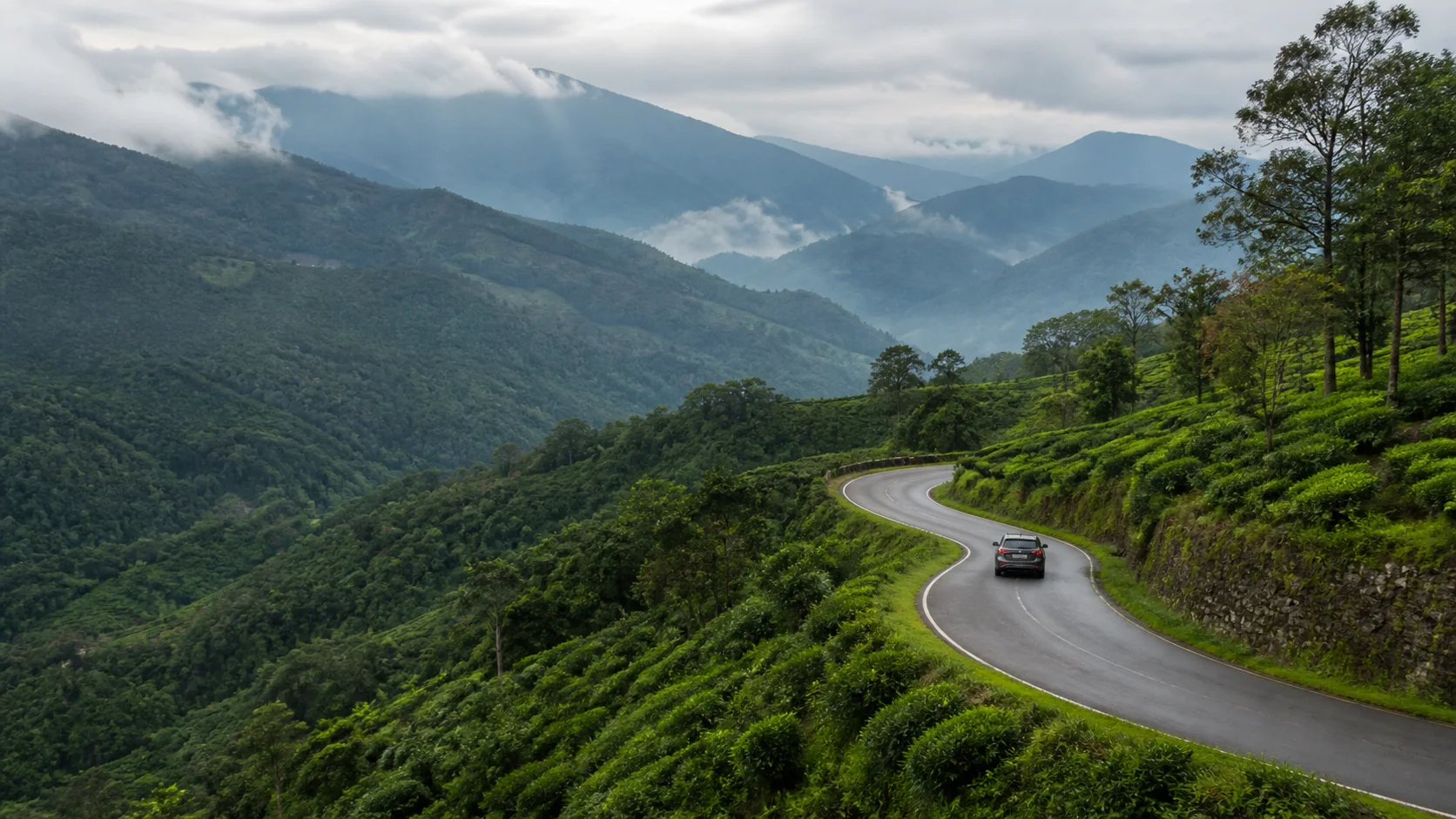
Hill routes require particular care. Weather, visibility, bends, local restrictions and motion comfort can alter the day. Do not use an optimistic map estimate as a deadline, and do not stop on a road merely because a view or animal appears.
Self-drive eligibility, licence requirements, rental terms, insurance and interstate conditions depend on the traveler and provider. Verify them directly. This site does not recommend operators, certify road condition or guarantee vehicle condition.
FERRIES AND BOATS
Treat water transport as site-specific, not a statewide network
This guide does not present ferries or boats as a general way to travel between Tamil Nadu cities. Where an established public connection, authorised tourism boat or protected-area service exists, it belongs to that exact place, operator and current operating context.
Weather, sea or water conditions, maintenance, permits and local decisions can suspend service. Never infer that a jetty, map line or earlier visitor photograph proves current operation. Confirm boarding point, operator authority, safety instructions and return arrangements directly.
Near Me may help identify nearby reviewed places, but it does not validate a water route. Maps can provide orientation, not permission or safe operating status. If the responsible authority does not clearly confirm the service, choose a land-based alternative rather than an informal boat.
ROUTE DESIGN
Reduce transfers before optimizing minutes
Choose bases that serve clusters of interests. Chennai can anchor an urban and nearby heritage visit; Madurai can support city and southern connections; Tiruchirappalli and Thanjavur can anchor central heritage routes; Coimbatore can support western movement. These are planning examples, not transport guarantees.
A short trip usually benefits from one base. A longer journey should move in one geographic direction where possible. Repeatedly returning through the same city can consume more attention than the map suggests. Use destination and district guides to understand each cluster before selecting the connection.
Use the deterministic Trip Planner to compare connected ideas, Maps for geographic and current-routing handoff, and Today for notice-provider status. Then verify each transport leg with its operator. None of these tools books tickets, certifies a road or overrides current schedules.
Saved in this browser
Before You Travel
Use this as a planning prompt, then confirm current facts with the responsible operator or authority. Nothing is sent to a server.
Visual orientation
Project-created travel perspectives
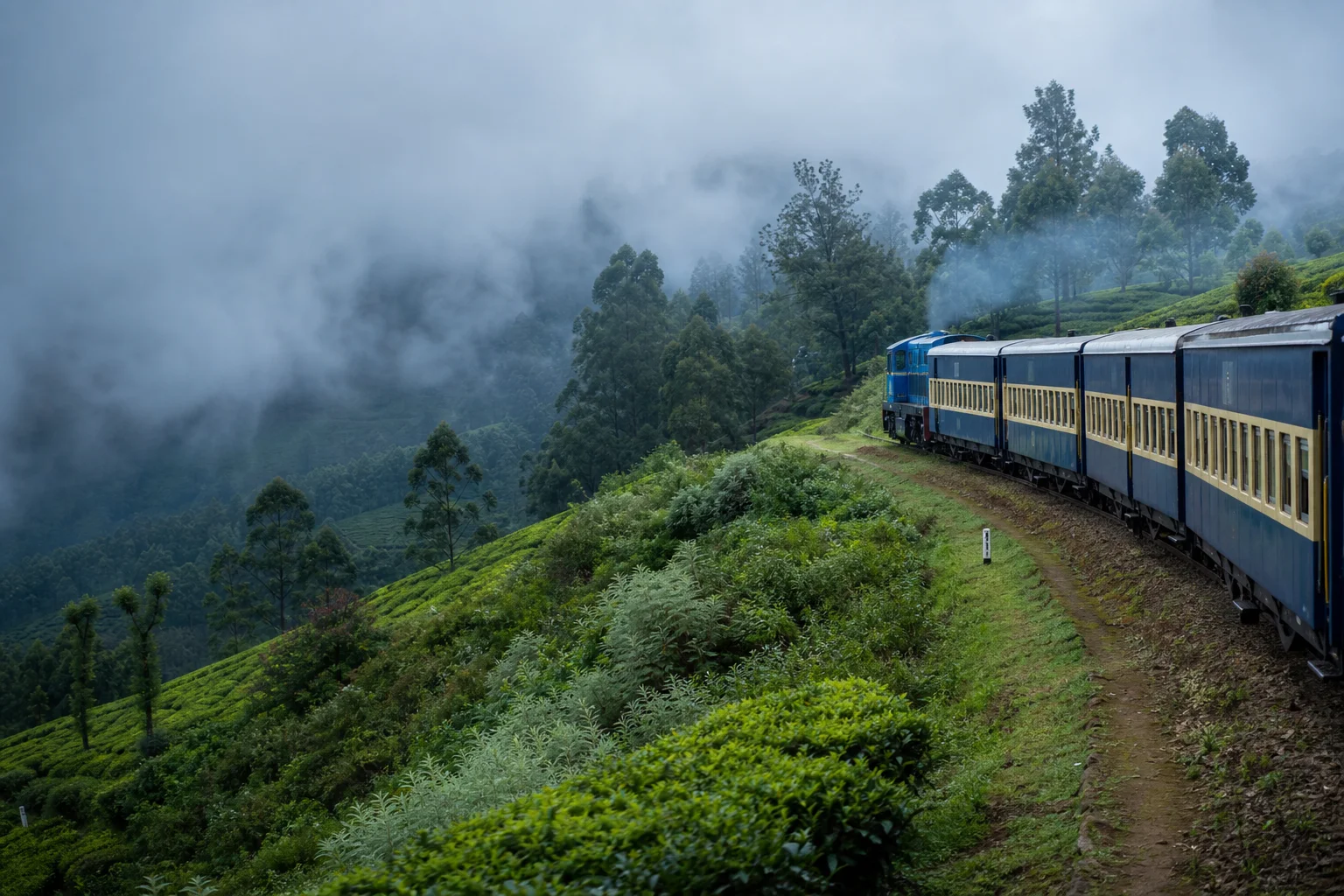
These editorial images are not evidence of current weather, access, schedules, prices, businesses or crowds.

Planning questions
Frequently asked questions
Is train the best way to travel around Tamil Nadu?
It is useful on many corridors, but the best mode depends on stations, availability, transfers and the destination.
Where should I check state-bus tickets?
Use the official TNSTC online reservation system for reservable services and current information.
Does Chennai have a metro?
Yes. Use Chennai Metro Rail's official commuter pages for the current network, timetable, fares and facilities.
Are travel times shown here?
No. Current traffic, route, stops and mode change them; use live directions and operator information.
Can I rely on app taxis everywhere?
No. Coverage, pickup rules, connectivity and availability vary. Arrange critical transfers in advance.
Is self-driving suitable for hill routes?
It depends on licence, experience, weather, road conditions and comfort. Verify current conditions and avoid fatigue.
How much transfer time should I allow?
There is no universal number. Consider separate tickets, station size, luggage, accessibility, traffic and the consequence of missing the connection.
Does the Trip Planner book transport?
No. It provides deterministic planning ideas and links; bookings remain with the operator.
Editorial trust
Sources and current-information handoffs
Major factual claims are cited inline. Operating details, warnings and availability must still be rechecked at the official source.
- 1Passenger Reservation EnquiryIndian RailwaysOfficial rail schedule, availability and PNR service · Reviewed 20 August 2026
- 2Online Ticket Reservation SystemTamil Nadu State Transport CorporationOfficial state bus booking and passenger-information service · Reviewed 20 August 2026
- 3Passenger facilitiesMetropolitan Transport Corporation (Chennai) LtdOfficial Chennai bus information · Reviewed 20 August 2026
- 4Commuters CornerChennai Metro Rail LimitedOfficial metro timetable, fare and station-information hub · Reviewed 20 August 2026
- 5Chennai AirportAirports Authority of IndiaOfficial airport information · Reviewed 20 August 2026
- 6Tamil Nadu destination overviewMinistry of Tourism, Government of IndiaOfficial tourism overview · Reviewed 20 August 2026
- 7Airports DirectoryAirports Authority of IndiaOfficial airport directory and current airport handoffs · Reviewed 20 August 2026
- 8Regional Meteorological Centre ChennaiIndia Meteorological DepartmentOfficial forecast and regional weather service · Reviewed 20 August 2026
- 9Tamil Nadu and Puducherry weather warningsIndia Meteorological DepartmentOfficial current warning service · Reviewed 20 August 2026