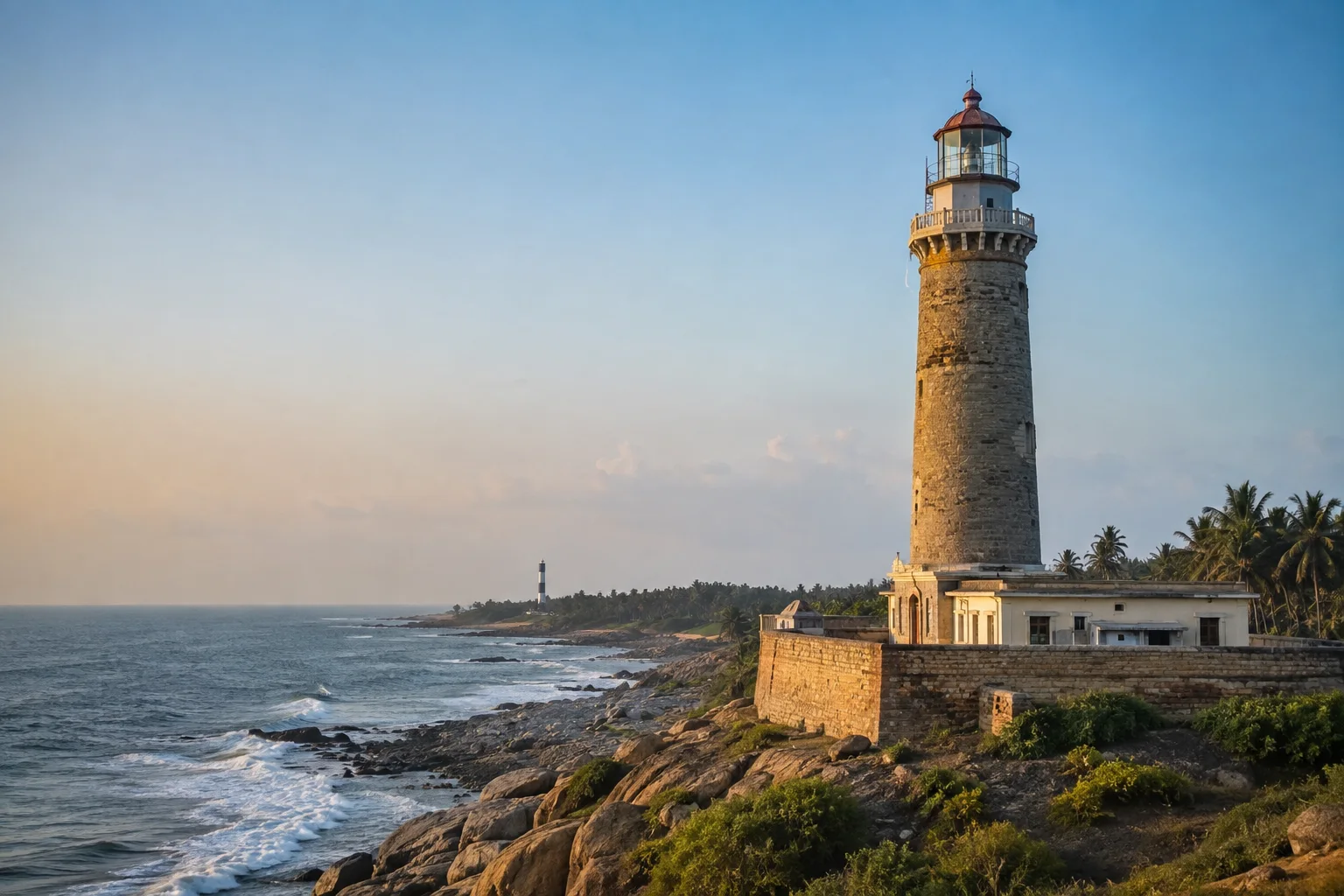
Read Chennai through four lighthouse locations
DGLL's Chennai history traces four modern lighthouse settings: Fort St George from 1796, a dedicated tower near the present High Court from 1844, the High Court dome from 1894 and the current Marina-Santhome tower from 1977. Together they show a shoreline city moving through port, surveying, architecture and electric navigation.
The sequence should not be treated as four equivalent visitor attractions. Some survive within active civic or protected settings, while others are historical locations rather than climbable towers. Use Fort St George, the High Court precinct and Marina as connected chapters, then verify access with the responsible institution.
This route also corrects a common visual shortcut: Chennai's maritime history is not confined to beach recreation. The position of lights records where administrators, mariners and engineers understood the coast, and how the city announced itself to ships before a harbour entrance became familiar.
Sources for this section: Chennai Lighthouse, DGLL introduction.
At Mamallapuram, separate beacon history from monument history
DGLL records an earlier beacon tradition on the high rock at Mamallapuram, a conventional light placed at the Olakkaneeswar temple in 1887 and the present masonry lighthouse commissioned in 1901. Those layers sit beside, but are not identical to, the Pallava monument history of the wider World Heritage property.
A careful visit distinguishes the age, authority and purpose of each structure. The Pallava monuments belong to an early medieval architectural landscape; the conventional lighthouse belongs to a later navigation system. Their proximity creates a powerful coastal reading without making the modern tower a Pallava monument.
Current admission, climbing permission, museum access and weather restrictions can change. Confirm them directly. Strong wind, wet stone and exposed steps are practical reasons to follow staff instructions, while drones and commercial photography may involve separate rules.
Sources for this section: Mahabalipuram Lighthouse, Lighthouse tourism initiative.
Use Pamban and Dhanushkodi to understand an island passage
Pamban Lighthouse belongs to a channel and port history, not simply to the bridge view. DGLL describes successive attempts to mark and maintain this passage and records the twentieth-century evolution of the light. Read it alongside rail, road, fishing and maritime movement without confusing those systems.
Farther along Pamban Island, DGLL records that Dhanushkodi Lighthouse was commissioned in 2022 between the Palk Strait and Gulf of Mannar. Its working value to local fishing activity matters as much as its visual prominence in a landscape often marketed as an endpoint.
Island conditions can change quickly through wind, heat, rain, road controls and marine weather. This article does not promise gallery access or a safe trip on a given date. Check current official notices, avoid entering operational areas and do not turn fishing work or storm memory into a backdrop without consent.
Sources for this section: Pamban Lighthouse, Dhanushkodi Lighthouse.
Build a regional route, not a tower collection
Tamil Nadu's lights are too widely distributed for one sensible checklist trip. Begin with a region: Chennai and Mamallapuram for urban and archaeological context; the central coast for port and delta histories; or Ramanathapuram and Kanniyakumari for island passages and southern headlands.
Choose two or three anchors and connect them to existing district guides. A lighthouse station may be remote from the nearest town, separated by water or reached through sensitive coast. A map pin does not establish a public road, parking area, boat service or permission to enter.
Plan around daylight, hydration and a return route. Treat online photographs as orientation rather than access evidence. If an official page gives a historical distance or facility description, verify current conditions before relying on it, especially after coastal weather or maintenance work.
Sources for this section: Chennai Directorate lights, Lighthouse tourism initiative.
Visit working maritime places with restraint
Stay outside fenced, technical and staff-only areas. Navigation equipment, power systems and communication installations are not props. Follow photography rules, keep children supervised near edges and stairs, and never assume that an open gate permits tower access.
Coastal responsibility extends beyond the compound. Carry waste out, avoid dunes and nesting areas, keep distance from fishing operations and do not climb ruins or navigation structures. At a sacred or memorial landscape, add the etiquette of that place rather than applying one generic lighthouse routine.
Record the source and date for every current claim. A good lighthouse journey leaves the reader with three things: the function of the light, the historical sequence of the site and a clear distinction between what was verified in advance and what must still be checked locally.
Sources for this section: DGLL introduction, Lighthouse tourism initiative.
Sources & Further Reading
These authoritative references support the historical, geographic, or seasonal context in this story. Current conditions and operating details still require a fresh official check.
- Lighthouse Tourism and Maritime Heritage · Press Information Bureau, Ministry of Ports, Shipping and Waterways
- Introduction and Navigation-Aid Responsibilities · Directorate General of Lighthouses and Lightships
- Lighthouses under Chennai Directorate · Directorate General of Lighthouses and Lightships
- Chennai Lighthouse History · Directorate General of Lighthouses and Lightships
- Mahabalipuram Lighthouse · Directorate General of Lighthouses and Lightships
- Pamban Lighthouse · Directorate General of Lighthouses and Lightships
- Dhanushkodi Lighthouse · Directorate General of Lighthouses and Lightships
Related Stories
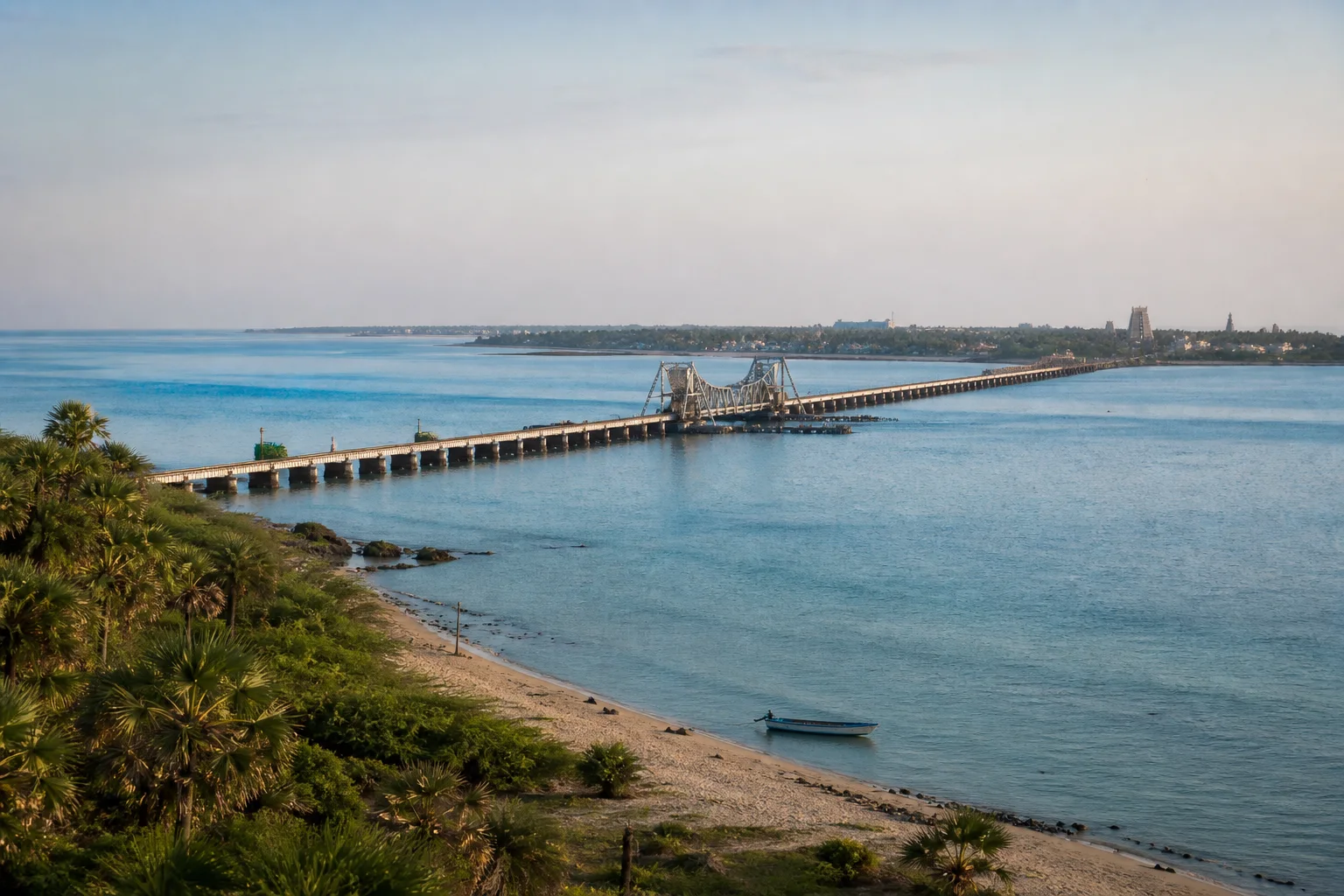
Rameswaram as an Island: Temple, Pamban, Dhanushkodi and the Sea
A connected reading of Rameswaram's sacred town, mainland crossing, exposed eastern coast and protected marine context rather than four unrelated stops.
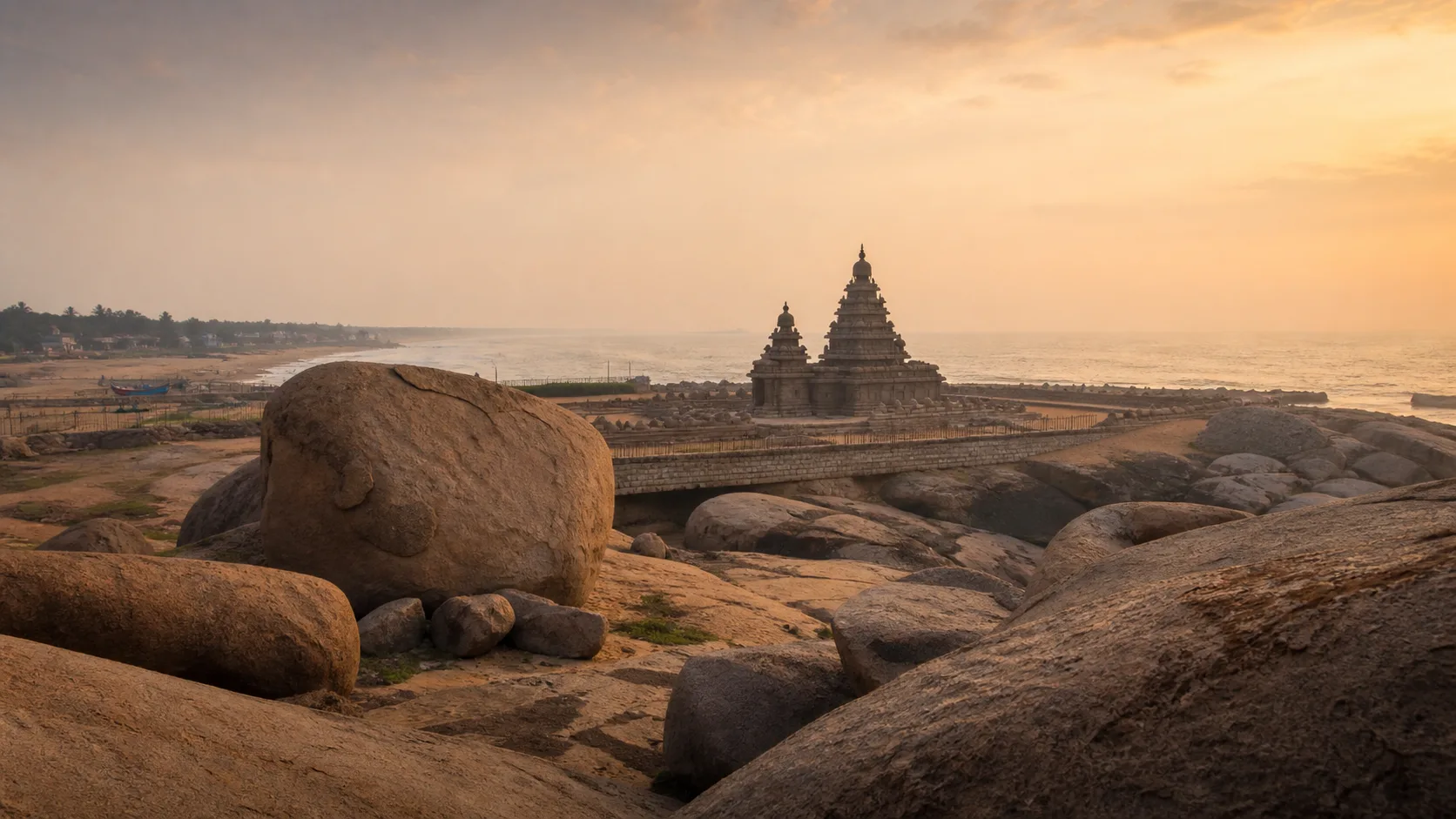
Mamallapuram: Read a Coastal World Heritage Landscape
A connected reading of Mamallapuram that moves from granite outcrops and carved caves to monolithic experiments, open-air reliefs, the Shore Temple and a living coastal town.
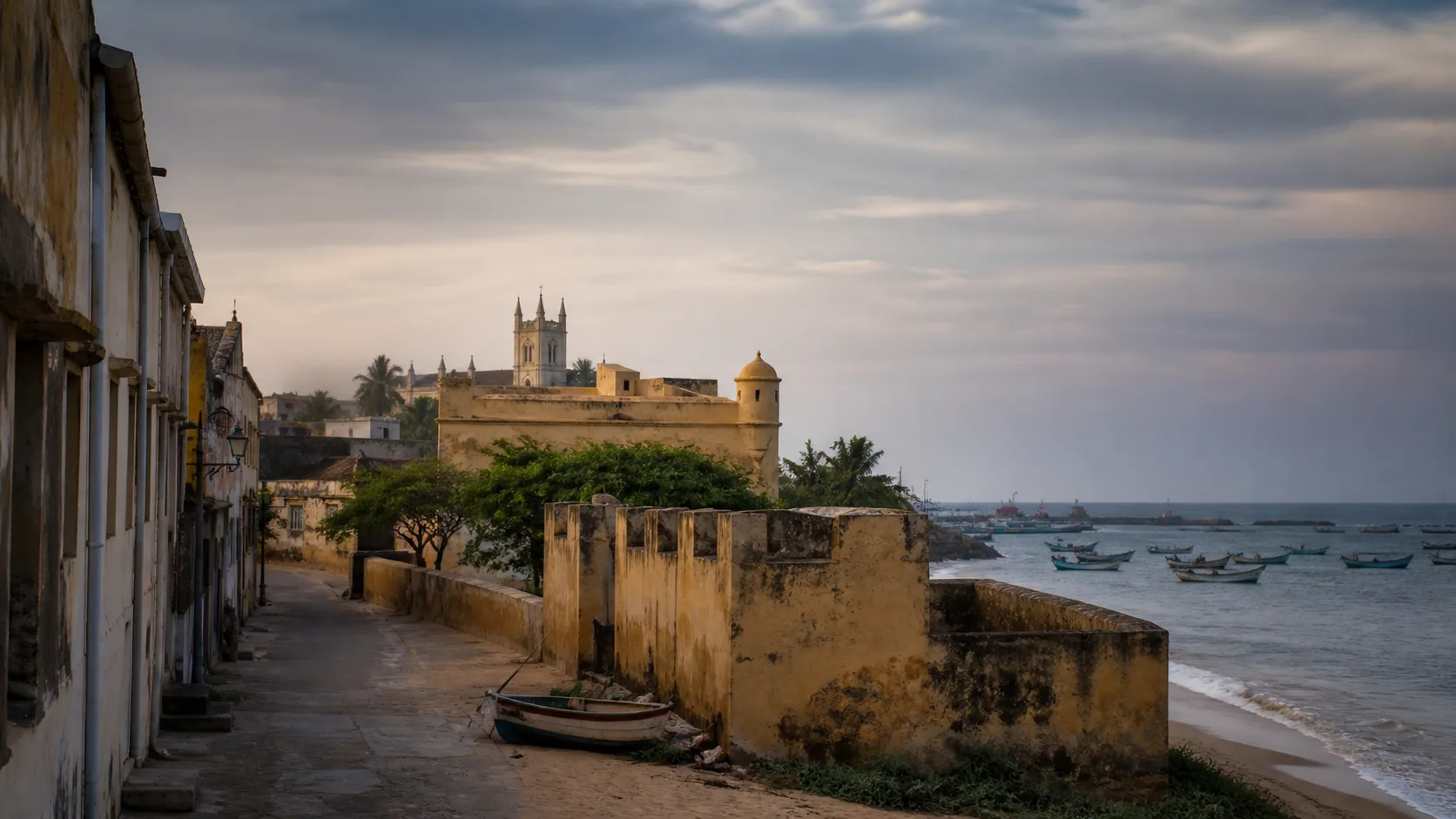
Tharangambadi: Read the Fort, Printing History and Living Coast
A layered coastal-town guide that begins before the Danish fort, follows trade and printing history, and returns heritage to a living Bay of Bengal shoreline.
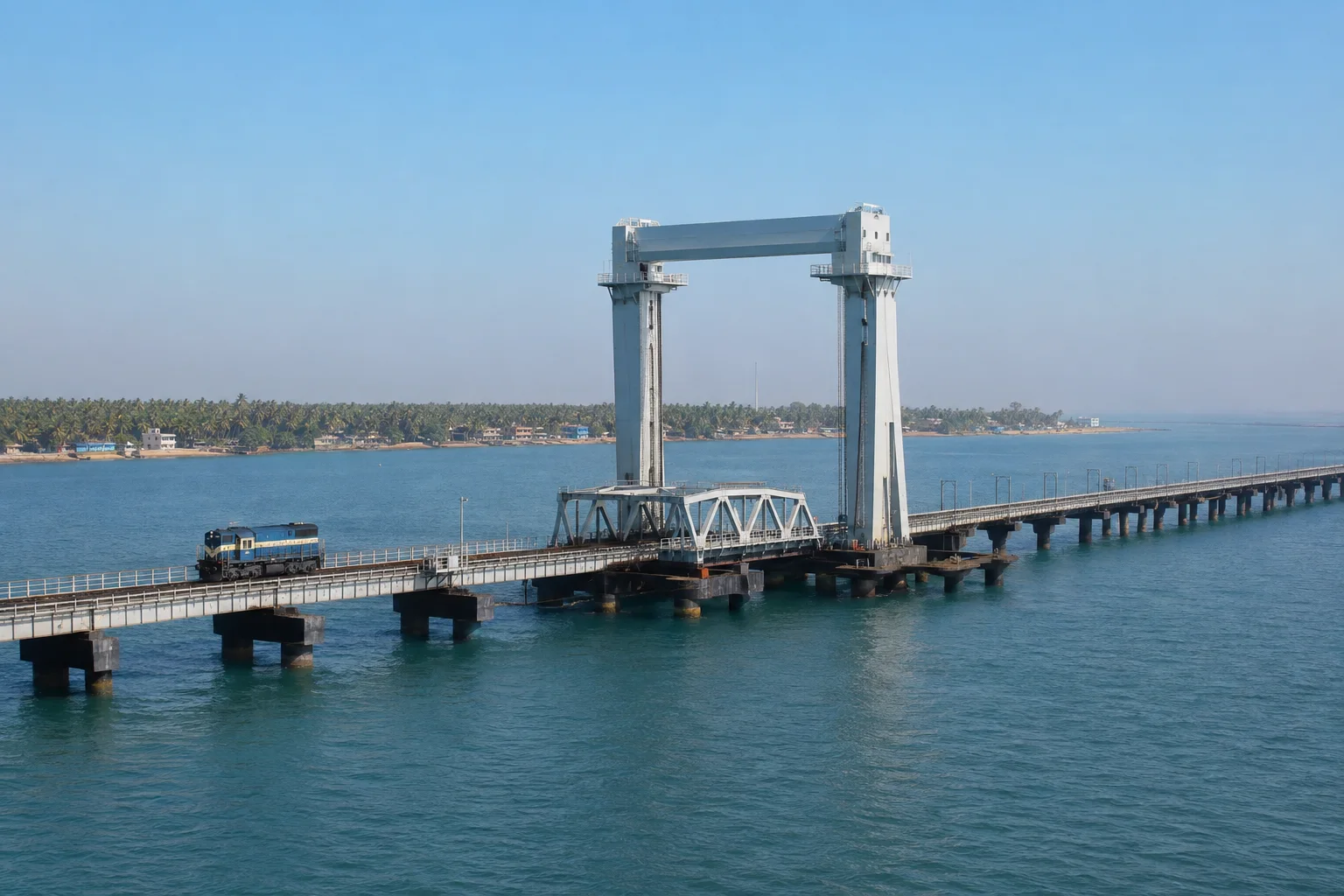
New Pamban Bridge: How a Vertical Lift Connects Rail and Sea
An engineering-first guide to the bridge that must serve trains, ships and a demanding marine environment without becoming a live timetable.
Frequently asked questions
Are all Tamil Nadu lighthouses open to visitors?
No. An official lighthouse listing does not establish current public access. Verify each station, date and restriction directly.
Can the entire lighthouse trail be covered in one trip?
A regional route is more realistic. The lights span a long coast and differ in access, context and transport.
Is the Mamallapuram lighthouse a Pallava monument?
The conventional lighthouse is later. It stands within a landscape containing much older Pallava monuments, and the layers should be described separately.
Editorial attribution
Prepared and reviewed by My Tamil Nadu Editorial Desk. Modified 4 September 2026.