
Western Tamil landscapes and household food
Kongunadu Cuisine
A western Tamil regional cuisine read through dryland and irrigated agriculture, household economy, grains, pulses, produce and both vegetarian and non-vegetarian traditions.
Orientation
Quick overview
Kongunadu refers broadly to a historical and cultural region in western Tamil Nadu. Its boundary changes according to period and source, so this guide uses Coimbatore, Erode, Tiruppur, parts of Salem, Namakkal, Karur, Dharmapuri and neighboring areas as context rather than a legal polygon.
Tamil Nadu Agricultural University documents a western-zone crop pattern that includes turmeric, rice, groundnut, pulses, cotton, sorghum, maize, sesame, coconut, banana and other crops in different irrigation and rainfall settings. That diversity helps explain a cuisine with several grain, pulse, oilseed and produce traditions rather than one staple.[2]
TNAU also identifies ragi dosa as a Kongunadu preparation and describes the region only approximately. This institutional caution is useful: food boundaries are lived through markets, marriage, migration and neighboring cuisines, not enforced at a district line.[1]
REGIONAL CONTEXT
Land, rain and more than one agricultural zone
Western Tamil Nadu includes irrigated river systems, wells, rainfed fields, coconut belts, hill edges and industrial cities. Crops change within short distances and from one season to another. Cuisine cannot be reduced to a dryland story or a prosperous irrigated story alone.
Agricultural records support the presence of turmeric, millets, pulses, oilseeds, rice, banana, coconut and sugarcane in regional systems. They do not prove that every household historically ate each crop in the same proportion. Production, market access and domestic use are related but distinct.[2]
PANTRY
Millets, pulses, coconut, turmeric and field produce
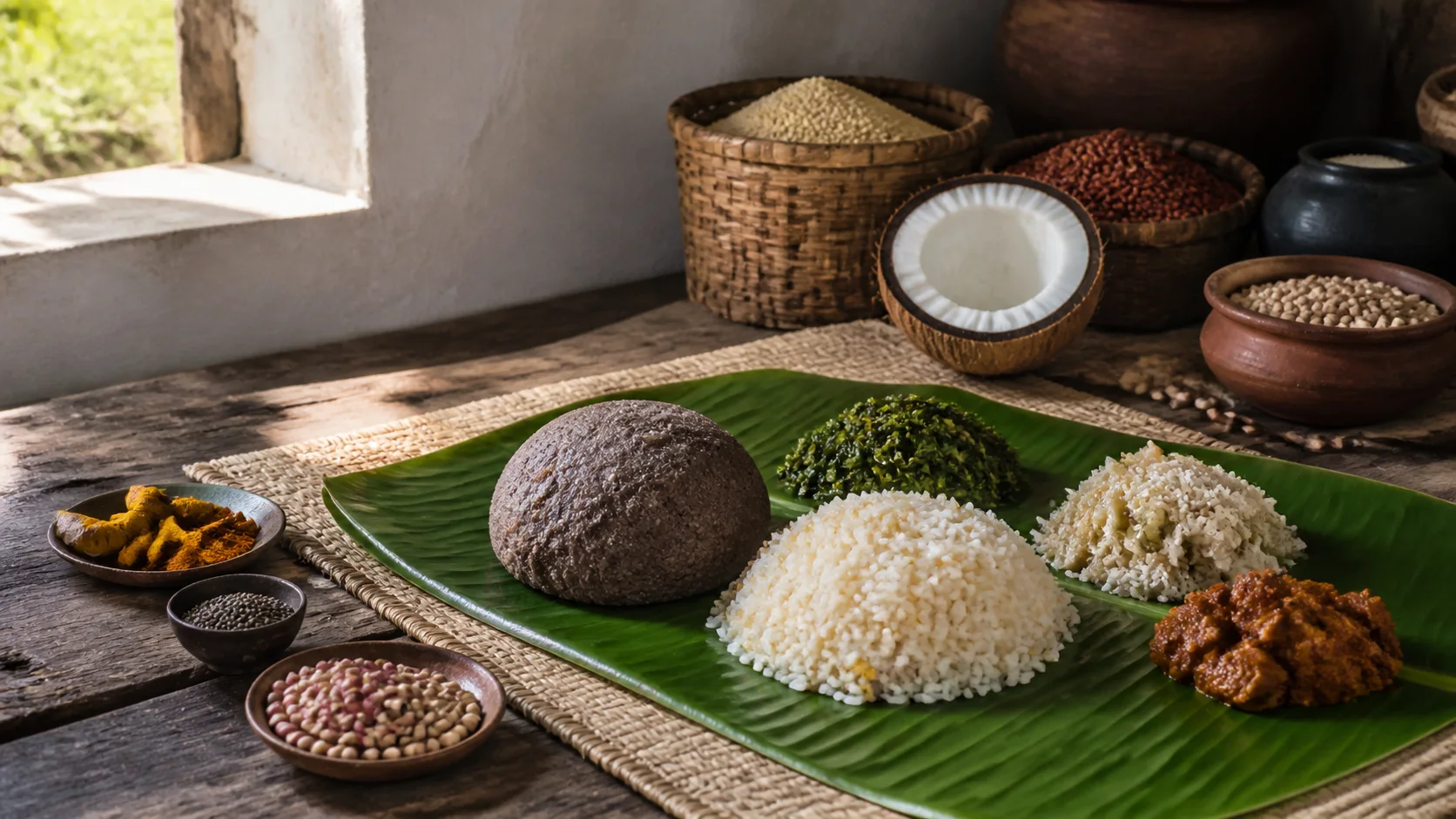
Ragi, cholam and other millets appear in preparations such as kali, dosa or porridge according to locality. Pulses and field beans can add substance to gravies and mixed rice. Coconut may be grated, ground or used as oil in some kitchens. Turmeric is both a major regional crop and a common culinary ingredient.
Groundnut, sesame, onions, curry leaves, chillies, pepper, coriander and tamarind contribute to different dishes. Listing them does not create one Kongu masala. Cooks build flavor through roasting, pounding, tempering, simmering and adjustment to the grain or vegetable at hand.
EVERYDAY FOOD
Grain, pulse and vegetable-centered meals
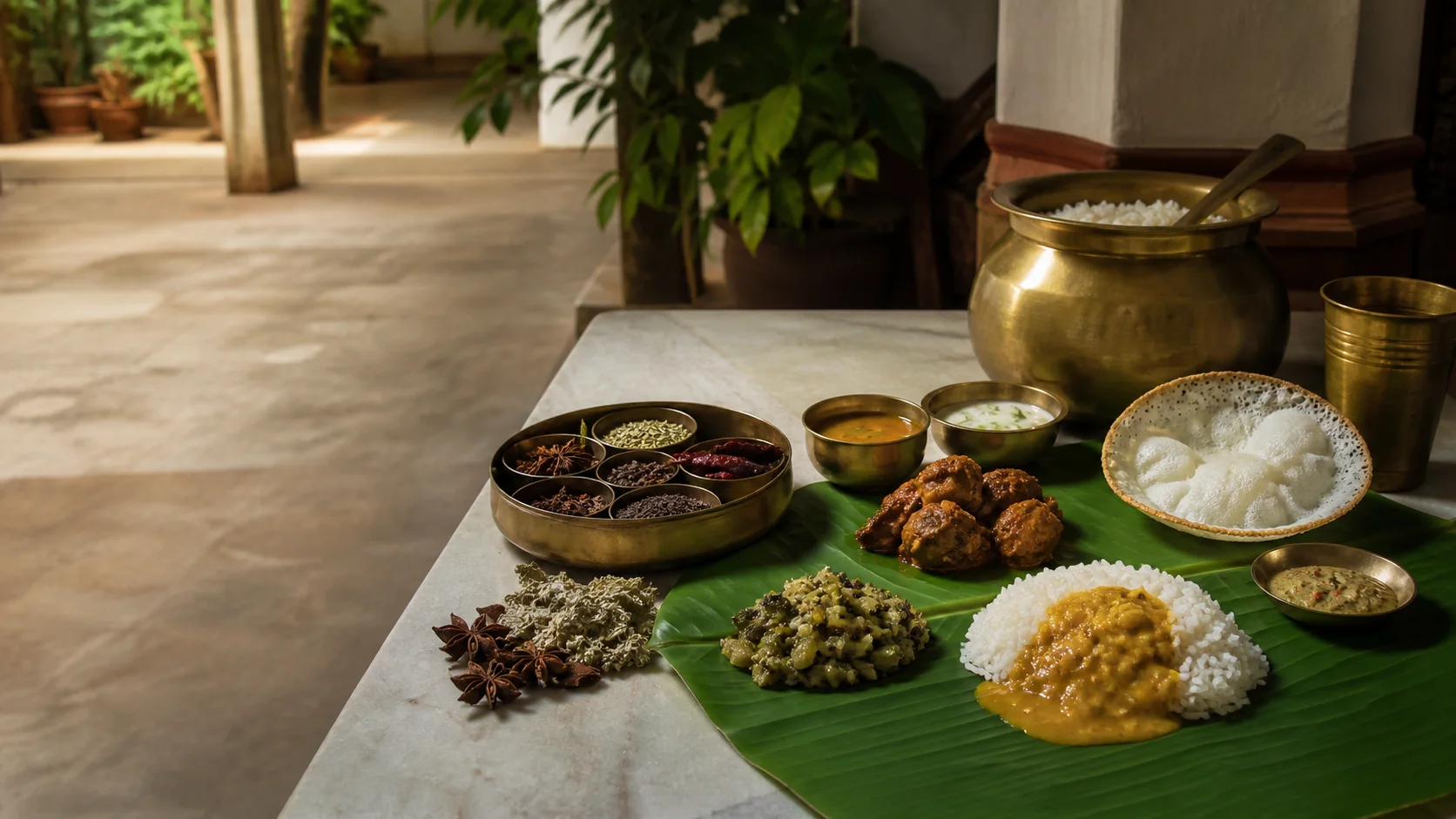
Arisi paruppu sadam, a rice-and-pulse preparation, is widely associated with Kongu home cooking. Ragi dosa and kali, greens, poriyal, kootu, buttermilk-based preparations and seasonal vegetables broaden the table. Names and accompaniments differ among homes.
A simple preparation can represent efficiency rather than poverty or nostalgia. One-pot dishes, stored grains and quick tempering fit work schedules. Urban households may use the same flavor memory with different equipment, polished grain or purchased mixes.[1]
DISH GUIDE
Non-vegetarian and festive repertoires
Chicken, mutton and freshwater fish preparations are associated with parts of the region, including peppery or dry-fried forms. Their prevalence varies by religion, community, household and budget. Kongunadu should not be described as either uniformly meat-heavy or uniformly vegetarian.
Festival and ceremonial foods may involve sweets, fried snacks, special rice dishes or meat according to occasion. A commercial menu often selects the richest items; everyday food is usually more varied and modest.
CLAIM CHECK
Why cuisine boundaries stay approximate
Foods move through Palakkad passes, hill routes, markets and marriage networks. Neighboring Tamil, Malayalam and Kannada foodways influence one another. Similarity does not erase regional identity, while one unusual ingredient does not prove foreign origin.
This guide avoids a hard map and does not link to a Coimbatore destination page because that full guide does not yet exist. Erode, Tiruppur, Namakkal and Karur also lack full destination pages in the current site, so they remain non-clickable geographic context.
MODERN PRACTICE
Industry, migration and continuity
Coimbatore and Tiruppur's industrial growth, education and migration have changed eating schedules, catering and restaurant demand. Packaged millet products and regional-cuisine branding can renew attention while simplifying local diversity.
Continuity is strongest when household knowledge, viable farming and fair food work remain connected. A dish marketed as heritage does not by itself sustain the crop or cook behind it. Ask who prepared it and what regional claim the seller is actually making.
Editorial method
How to read a regional cuisine carefully
These principles keep a place-associated food from becoming a single recipe or marketing story.
Regional cuisine is an archive of land, water, labor, trade, household economy, religion, migration and taste. A restaurant menu records one commercial version; it cannot define every kitchen in a region. This guide uses named dishes as points of entry and keeps vegetarian, non-vegetarian, everyday, festive, community-specific and commercial settings distinct.
Dish names travel. The same name may refer to different textures or ingredients, while closely related preparations may have several names. Ingredients also shift with season, cost, dietary practice and availability. The page describes common associations rather than issuing an authenticity test based on one recipe. It intentionally does not reproduce a full recipe or claim that a modern plated version is ancient.
Origin stories need stronger evidence than popularity. Family memory, trade history, local pride and business publicity may preserve valuable clues, but they do not always agree. Where several accounts circulate, this guide names the disagreement and avoids selecting an 'original' shop, inventor or date without documentary support.
Heat is not a complete description of Tamil food. Chilli, black pepper, souring agents, aromatics, roasted pulses, coconut, sesame, curry leaves, grains, greens and cooking technique create different balances. Some preparations are assertive; others are mild, sweet, fermented, steamed or gently seasoned. Individual kitchens tune them differently.
Food experiences also involve people and working conditions. Ask before photographing cooks or vendors, avoid blocking a counter, disclose allergies without assuming a shared kitchen can eliminate cross-contact, and judge hygiene from current conditions rather than reputation. This page does not rank businesses, publish hours or promise that a dish will be available on a particular day.
Agricultural evidence and culinary evidence should not be confused. A crop report can show that turmeric, millet or coconut is grown in a zone; it does not prove how every household used it or when a named dish emerged. Cookbooks, oral histories, menus, account books, utensils and market records answer other questions. Strong food history combines several evidence types and keeps their limits visible.
Season and preservation help organize kitchens. Fresh greens, mango, tubers, fish, milk and festival ingredients have different calendars, while drying, fermenting, pickling, roasting and storing extend availability. Refrigeration, transport and supermarkets change those relationships. Calling an ingredient seasonal should therefore identify the place and period rather than assume an unchanging annual menu.
Labor belongs inside the story of taste. Washing, grinding, fuel management, repeated stirring, leaf preparation, service and cleanup can take more time than a dish's final appearance suggests. Large ceremonial meals depend on coordination and often on specialists. Crediting only a host, chef or brand can hide women, assistants, farmers, vendors and craftspeople whose work makes the meal possible.
Geographic names can describe reputation, style, production or marketing, and these are not identical. A dish sold far from its associated town may still carry a recognizable method, or it may use the name loosely. Legal GI status is a narrower question checked through the official registry. This guide never infers registration from fame, packaging or a repeated tourism slogan.
A tasting note is an observation, not a verdict on identity. Texture, aroma, heat and sweetness depend on temperature, freshness, portion and the taster's experience. Describing those qualities precisely is more useful than declaring a dish best, pure or original. Regional significance does not depend on winning a ranking.
Practical participation
Taste This Region
Build a meal around grain, pulse and produce before treating one rich dish as the whole cuisine.
Start with the staple
Try a millet, rice-pulse or home-style preparation.
Notice crop context
Turmeric, coconut, pulses and oilseeds have distinct regional roles.
Expect variation
Western Tamil Nadu is not one agricultural landscape.
Avoid authenticity contests
Ask about household or local style instead.
Regional orientation
Geographic context
This is place-name context, not a claim that a cultural boundary can be drawn as a precise modern polygon.
A historical-cultural region with approximate, changing boundaries
Google Maps is provided only as an orientation fallback. It does not verify cultural boundaries, opening hours, businesses, events or access.
Visual guide
Images with explicit provenance
All images are original project-created editorial representations. They are not documentary records of a named person, maker, performance, meal, business or historical event.


Questions
Frequently asked questions
Is this the only authentic version?
No. Recipes and meal structures vary across households, communities, seasons and cooks.
Does the guide recommend a restaurant?
No. Restaurant quality, hours, prices and hygiene are current information requiring a separate review process.
Are full recipes included?
No. The page explains ingredients, techniques and cultural context without presenting a standardized recipe.
Is every dish very spicy?
No. Tamil regional cuisines balance heat with sourness, aromatics, grains, pulses, coconut, sweetness and technique in different ways.
Can dietary safety be guaranteed?
No. Ask the person preparing the food about ingredients and cross-contact; names alone do not establish allergen or dietary status.
How were origin claims handled?
Documented history is separated from oral tradition, family memory and commercial claims. Unsettled stories remain unsettled.
Where exactly is Kongunadu?
It is a historical and cultural region in western Tamil Nadu whose boundaries vary by period and source.
Is Kongunadu cuisine only millet-based?
No. Rice, pulses, vegetables, coconut, oilseeds and non-vegetarian dishes also appear in varied regional kitchens.
Editorial trust
Sources and further reading
Claims are cited inline. Source type, author or institution, publication information and review date are visible here.
- 1Ragi Dosa and Kongunadu ContextTamil Nadu Agricultural UniversityCurrent Agritech resource · University agricultural source · Reviewed 9 August 2026
- 2Cropping Pattern: Western ZoneTamil Nadu Agricultural UniversityCurrent Agritech resource · University agricultural source · Reviewed 9 August 2026
Fact and sensitivity review: Documented history, living tradition, oral tradition, religious significance and modern practice were checked as separate claim types on 9 August 2026. Food pages were also reviewed for unsupported origin, GI, health, restaurant, price and availability claims.