
Before the Sangam world
Sivagalai and Kilnamandi
Two burial landscapes, far apart within Tamil Nadu, sharpen the questions behind the Iron Age: how people buried their dead, and how those deposits can be dated.
Orientation
Overview
Site-specific chronologies; Iron Age and early historic practices overlap
Sivagalai and Kilnamandi are worth reading together because they are different. Sivagalai belongs to the Tamiraparani landscape in Thoothukudi district; Kilnamandi lies in Tiruvannamalai district. The first is closely associated with urn burial research, the second with terracotta sarcophagi. Both appear in the Department of Archaeology’s excavation programme, but neither should become a stand-in for the other. A shared Iron Age label is the beginning of a comparison, not its conclusion.[1][2]
Their recent prominence also comes from chronology. Public discussion tends to compress a sample, a measurement and a historical claim into one striking year. This guide separates those steps. First comes the recorded deposit; then the material tested; then the date estimate; finally the argument about what that estimate means. Keeping that chain visible allows the discoveries to remain significant without making every object as old as the oldest sample.
Chronology
A careful timeline
Dates refer to particular sites, samples or research events. Phases overlap and are not a uniform regional calendar.
Sivagalai programme
The departmental register lists three excavation seasons beginning in 2019–20.[1]
Kilnamandi programme
The register lists 2022–23 and 2023–24; season labels are modern fieldwork dates.[1]
Kilnamandi MEG-3 sample
The 2025 report gives this calibrated range for charcoal associated with a sarcophagus burial and iron objects.[7]
A proposed earlier iron horizon
The departmental dating report connects Sivagalai evidence with an early iron chronology; the association requires careful reading.[7]
Historical reading
Sivagalai: reading a southern urn landscape
The July 2020 departmental status report described Sivagalai as a habitation-cum-burial site, with work under way in both localities. It recorded 31 exposed urn burials at that stage. That figure belongs to an interim report, not a permanent total for the site. An excavation develops season by season, and the number of opened burials is different from the number surviving across the landscape.[3]
This distinction between burial and habitation is fundamental. A pot in a grave may have been chosen for an offering or made for the funeral. A similar pot from a house could have been used, broken and discarded in an entirely different way. Matching the forms is a useful starting point, but the deposits should not be merged into one picture of daily life. Their relationship is something to investigate.
The institutional Porunai publication describes black-and-red pottery, including white-painted examples, and reports a paddy date of 1155 BCE. The date concerns the sampled grain; it should not be read as the founding year of Sivagalai. Nor does a decorated vessel, however distinctive, establish the age of every vessel of similar colour elsewhere. Pottery comparison works best when shape, manufacture, surface treatment and context can all be checked.[2]
A buried urn is also a structure with a history. Its placement, lid, contents and surrounding fill can help distinguish deliberate deposition from later disturbance. Cracks may admit soil; the upper part can be damaged while material near the base survives. For this reason a photograph of an opened urn cannot convey everything that a plan, section drawing and context record preserve. The unglamorous recording is what makes later interpretation possible.
Historical reading
Kilnamandi: containers inside burial structures
The institutional Kilnamandi account describes a site with several archaeological localities, rather than a single isolated tomb. The wider area matters because it offers opportunities to connect mortuary evidence with other traces of occupation. A cemetery’s relationship with settlement cannot be settled merely by drawing a line to the nearest modern village. Archaeological material has to establish which places were used at the same time.[4]
The site-description passage available through the Tamil Virtual Academy library records terracotta sarcophagi, pottery, iron tools, beads and fragmentary human remains. It distinguishes material inside and outside the containers and notes pre-firing holes at their bases. These observations are more informative than a generic label such as ancient coffin. They show that the containers were designed objects whose manufacture and placement can be investigated separately.[5]
Sarcophagus is a technical term that can mislead readers familiar with stone coffins elsewhere. Here the relevant containers are fired clay. University teaching material places terracotta sarcophagi among several South Indian burial arrangements, including pits and stone chambers. The material, supports and enclosure matter more than a familiar English image of a coffin. A photograph should therefore be read alongside its description, scale and excavation context.[6]
When several containers occur in a burial complex, it is tempting to imagine a family group or a single funeral. Such possibilities require evidence about deposition, skeletal relationships and the order in which features were built or reopened. Counting containers is not the same as counting individuals, and counting individuals does not identify their relationships. These are questions for a full contextual and biological study, not conclusions to draw from the outline of a tomb.
Historical reading
What the comparison can—and cannot—show
Urns and sarcophagi both required decisions about making, moving and placing a container. They also involved different forms and practical constraints. A comparison can ask how the container fitted within its pit or chamber, whether accompanying vessels lay inside or outside it, and how the deposit was closed. Those are concrete questions that can be answered from excavation records, even when the beliefs behind the actions remain inaccessible.
Shared grave goods do not necessarily mean identical ritual. An iron object might have been valued for work, appearance, memory, exchange or the funeral itself. Archaeology can sometimes distinguish these possibilities through wear and placement, but it should not choose one because it makes a more vivid story. The two sites are especially useful for resisting the idea of a single standard Tamil Nadu burial.
Distance also affects the argument. Similar objects at widely separated sites can suggest connections, yet they do not specify the route, direction or people involved. Demonstrating exchange needs more than visual resemblance. Material analysis, manufacturing traces, distribution and dating can help distinguish circulating objects from independently made ones. Until then, similarities remain evidence to explain rather than proof of a known network.
Historical reading
Reading the dates beside their sample labels
The 2025 Antiquity of Iron report dates charcoal from Kilnamandi MEG-3 to 1769–1615 calibrated BCE, giving 1692 BCE as its summary value. The reported context is a sarcophagus burial with iron. At Sivagalai, its table lists charcoal point estimates of 3345, 3259 and 2953 BCE, alongside younger grain and ceramic results. These are different materials and contexts, not interchangeable dates for the metal itself.[7]
The simplest way to read such a table is to keep three columns in your notes: sample, context and method. Charcoal, grain and ceramic are not merely alternative labels for the same clock. Radiocarbon measures carbon-bearing samples; luminescence addresses a different physical history. Institutional dating guidance treats the choice of technique as part of the archaeological question. Agreement or disagreement between results has to be assessed in relation to what each sample can date.[8]
A central estimate can also sound more exact than the underlying result. The range published for Kilnamandi is more informative than repeating its midpoint as the year a funeral occurred. It makes uncertainty legible and avoids turning a probability estimate into an anniversary. Where a source supplies only a headline number, readers should look for the laboratory record and the way the number was calculated.
The very early Sivagalai interpretation deserves sustained examination because its implications are substantial. This page attributes the proposed chronology to the departmental report. It does not turn that proposal into a declaration that all Tamil Nadu ironworking began in the fourth millennium BCE, or that a global first has been demonstrated. Local evidence, regional adoption and the origin of a technology are different historical claims.
Historical reading
Why association matters as much as the measurement
Imagine an iron object and charcoal recovered from the same general trench. That proximity alone leaves several possibilities: they belonged to the same event, one was redeposited, or a later cut brought them together. A securely recorded closed context can narrow those possibilities. The example is an explanation of archaeological reasoning, not a claim that any particular Sivagalai or Kilnamandi sample was disturbed.
Charcoal can contain another kind of time difference. The carbon in older wood was fixed before the wood was burnt. Historic England’s guidance explains why wood identification and age assessment belong in sample selection. This is a question to ask of a charcoal series, not a reason to dismiss every early result. The relevant issue is how well the evidence addresses the possibility.[9]
Repeat measurements help, but repeating a measurement on the same material does not independently establish its archaeological association. A laboratory can accurately date a sample whose relationship with an artefact is uncertain. Conversely, a carefully recorded association is still better supported when suitable samples produce a coherent sequence. Field recording and laboratory analysis work together; neither replaces the other.
For a stronger regional chronology, useful additions would include closely documented contexts, clear sample selection, full calibrated ranges and comparable results from further sites. Publication of those details allows other researchers to test the interpretation. This is an editorial account of what would strengthen the argument, not a claim that the discoveries lack value until every question is resolved.
Historical reading
Burial offerings and the lives beyond them
A grain deposit is unusually vivid evidence: food survives inside a place made for the dead. Yet archaeobotanical research cautions against translating rice offerings directly into a universal rice-based economy. Domestic refuse, storage contexts and systematic plant recovery can tell a different story from selected grave goods. The distinction matters at Sivagalai, where a dated plant sample has become central to public discussion.[10]
The Porunthal phytolith study offers a useful comparison from another site. Its analysis interpreted different plant deposits as varied burial practices. The lesson is not that Sivagalai must have followed the same ritual. It is that a close investigation of small remains can distinguish actions concealed by a broad category such as grain offering. Evidence from another cemetery helps formulate questions; it does not supply the answers for this one.[11]
The same restraint applies to weapons and ornaments. Grave goods illuminate what someone chose to place with the dead. They may also reflect production, exchange and social differences, but those interpretations need patterns across many contexts. One richly furnished burial cannot establish the organisation of an entire community. An unfurnished burial is not automatically the grave of a poor person.
Historical reading
Connecting these sites to a larger history
Adichanallur offers a nearby southern comparison with a much longer history of archaeological collection and re-excavation. Its ASI report explains the difficulties created when older finds cannot be securely located within the site. Read alongside Sivagalai, it shows why new recording can matter as much as a new object. It also warns against combining material from different campaigns into a single undifferentiated assemblage.[12]
For a wider chronological check, Siruthavoor’s published pilot study found megalithic material extending into the early centuries CE. That is evidence from Siruthavoor, not a replacement date for these two sites. Its relevance is methodological: burial forms can endure. A regional history therefore needs overlapping timelines and local sequences rather than a fixed moment when the Iron Age supposedly ended everywhere.[13]
Keezhadi takes the discussion into settlement archaeology and early historic material. The Sangam guide treats literary evidence on its own terms. Neither should be used to assign a language, named ruler or literary identity to these burials without a specific evidential bridge. The most useful links are those that let readers compare questions while keeping the sites distinct.
Historical reading
Planning a visit without treating a dig as an attraction
This page provides historical orientation, not confirmation of public access. Excavation areas may be covered, conserved or inaccessible, and displays can change as objects are studied. Check with the responsible archaeological institution before travelling. The district guides below help place Sivagalai and Kilnamandi geographically; they do not imply that a working trench has visitor facilities.
If you encounter pottery or exposed remains, leave them in place and inform the appropriate local authority. Do not scrape a surface to reveal a design, enter a burial chamber or arrange fragments for a photograph. A discovery’s position can be part of its evidence. In a museum, note the caption and collection number where available: they provide a route back from an impressive object to the research that gives it meaning.
Human scale
People and institutions
The people who made and used these objects are often unnamed. Research teams, museums and local communities help preserve their traces.
Burial communities
The excavations preserve choices about containers, accompanying goods and treatment of remains; the individuals are not securely named.
Excavation teams
Context records connect objects with the places and sequences in which they were found.
Dating laboratories
Measurements require archaeological interpretation before they can support a history of technology.
Historical geography
Connected places
Places are linked only when a substantive My Tamil Nadu guide already exists. Other entries remain non-clickable research context.
Visual reading
Images with explicit provenance
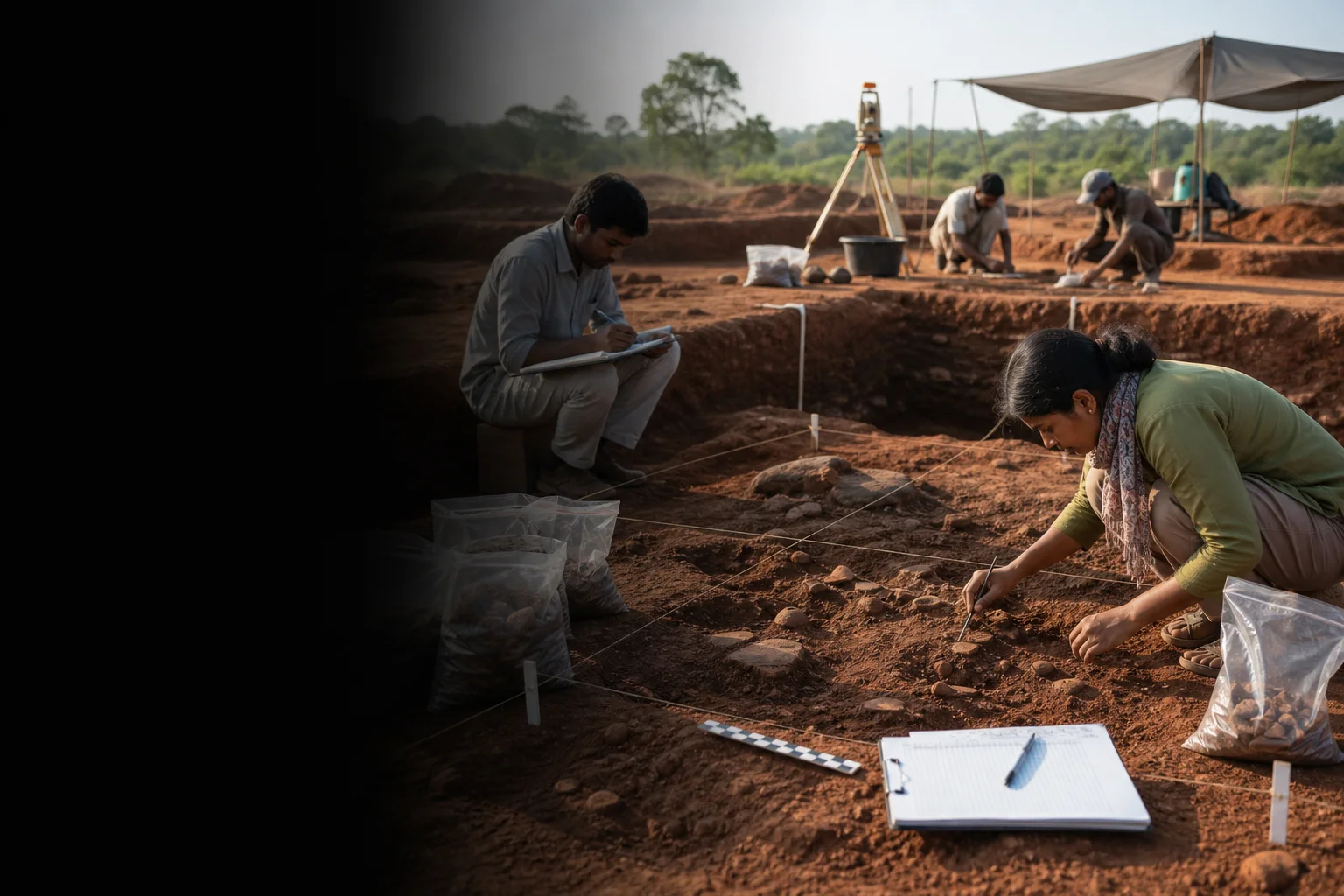
These project-created visuals support orientation. They are not presented as photographs of an excavation, monument, person, or event.
Questions
Frequently asked questions
Were the iron objects themselves dated at both sites?
The particular results discussed here are from associated charcoal, grain or ceramic. Their relevance to iron depends on the recorded relationship between sample and object.
Why combine Sivagalai and Kilnamandi?
Their contrasting burial containers and dating evidence support a substantive comparison without pretending that the sites form one culture or share one chronology.
Can I visit the excavations?
Public access is not verified here. Ask the responsible institution for current arrangements before travelling.
Editorial trust
Sources and further reading
Citations in the article point to this full list. Source type and review date are shown so readers can evaluate the evidence.
- 1Archaeological excavations conducted by the DepartmentTamil Nadu Department of ArchaeologyOfficial excavation register
- 2Porunai River Civilization, Sivagalai, p. 54Tamil Nadu Department of Archaeology / Tamil Virtual Academy libraryInstitutional archaeological publication; indexed text consulted
- 3Ongoing Archaeological Excavations in Tamil Nadu: Status Report (July 2020), SivagalaiTamil Nadu Department of ArchaeologyPrimary interim fieldwork report; indexed text consulted
- 4Archaeological Excavations in Tamil Nadu: Kilnamandi accountTamil Nadu archaeological publication, Tamil Virtual Academy libraryInstitutional excavation account; indexed text consulted
- 5Site descriptions: Kilnamandi, p. 69Tamil Virtual Academy library, archaeological site descriptionsInstitutional report; indexed site-description passages consulted
- 6Megaliths of South India: Regional VariantsINFLIBNET / university course materialsUniversity archaeology teaching resource
- 7Antiquity of Iron: Recent Radiometric Dates from Tamil Nadu (2025), pp. 15, 36–40Tamil Nadu Department of Archaeology; K. Rajan and R. SivananthamPrimary departmental dating report; interpretations attributed
- 8Scientific Dating Techniques for Archaeology and Historic BuildingsHistoric EnglandInstitutional methods guidance
- 9Radiocarbon Dating and Chronological Modelling: The Bayesian ProcessHistoric EnglandInstitutional scientific-dating guidance
- 10Dry, rainfed or irrigated? Reevaluating the role and development of rice agriculture in Iron Age–Early Historic South IndiaVegetation History and ArchaeobotanyPeer-reviewed archaeobotanical study
- 11Implications of phytolith records from an Early Historic megalithic burial site at Porunthal in Southern IndiaJournal of Archaeological Science: ReportsPeer-reviewed phytolith study; abstract consulted
- 12Excavations at Adichchanallur (2020)Archaeological Survey of India; Sathyabhama BadhreenathPrimary excavation report
- 13Situating megalithic burials in the Iron Age–Early Historic landscape of southern India (2013)Smriti Haricharan, Hema Achyuthan and N. Suresh; AntiquityPeer-reviewed luminescence and burial study; abstract consulted
Editorial review: Factual claims were checked against the linked primary and institutional sources on 15 November 2026. Where the sources support only a range or interpretation, the article keeps that limitation visible.