
Before the Sangam world
Iron Age and Megalithic Tamil Nadu
Stone circles and burial urns make the past visible. The harder task is to recover the lives, work and changing communities behind them.
Orientation
Overview
Site-specific chronologies; Iron Age and early historic practices overlap
A ring of stones can survive long after a house has vanished. That imbalance shapes our picture of the Iron Age in Tamil Nadu. Burial monuments are conspicuous, while traces of cooking, repairing tools, keeping animals and building homes can be scattered or buried beneath later activity. A history assembled mainly from graves therefore needs to keep asking where the living were. The objects placed with a burial were selected for a particular occasion; they were not a complete inventory of a household.
Two familiar labels describe different things. Iron Age draws attention to technology and its place in society. Megalithic refers to monuments, literally large stones, but South Indian archaeology also uses it for related burial traditions without prominent stone structures. Urns belong in this discussion alongside chambers and circles. Neither label names a single people or kingdom. The distinction matters when comparing a metalworking settlement with a cemetery, or a northern stone-built tomb with an urn burial in the Tamiraparani region.[1]
Chronology
A careful timeline
Dates refer to particular sites, samples or research events. Phases overlap and are not a uniform regional calendar.
Earlier ways of living
Farming, herding and stone tools provide regional backgrounds; transitions differ by landscape.[7]
Metal and mortuary landscapes
Date individual contexts; no single starting year applies throughout Tamil Nadu.[11]
Persistent burial practices
The Siruthavoor pilot study demonstrates why burial appearance alone cannot establish a narrow date.[15]
Earlier iron proposed
The departmental report proposes a much earlier chronology; sample association remains central to evaluating it.[12]
Historical reading
What lies beneath the stones
A cist is a chamber assembled from stone slabs. A dolmen is a stone-built chamber often visible above ground; distinctions between these terms can depend on construction and surviving ground level. A cairn is an accumulation of stones, while a stone circle marks an enclosure. These features can occur together. The circle visible on the surface is not necessarily the container that held the remains. Excavation plans are essential for understanding how the exterior marker relates to the burial below.[2]
Urn burials use large pottery vessels. Sarcophagi are coffin-like containers; in this regional setting they can be made of terracotta and supported on legs. IGNOU’s archaeology material describes pit, chamber and urn arrangements rather than treating every monument as one standard design. At a museum, look first for the material and construction of the container, then for how it was placed. A display label saying only megalithic can conceal a surprisingly elaborate sequence of digging, building, depositing and closing.[1]
The temptation is to turn that sequence into a story about a named individual: a warrior, a chief, a priest. Such identifications need independent support. A blade in a grave establishes a decision to include a blade. It does not, on its own, tell us the occupation of the deceased, whether the object was used in combat, or whose property it had been. Burial interpretation begins with those small distinctions.
Historical reading
A cemetery belongs to a wider landscape
The ASI’s national inventory includes combinations such as cairn circles with urn burials, stone circles with cists, and burial grounds associated with habitation mounds. The entries are a useful reminder that surviving monuments form networks across ordinary agricultural country. Famous excavations represent only part of that distribution. An inventory establishes that a place has been recorded; it does not guarantee a visitor entrance, an excavated display, or identical dates for all its features.[3]
Several questions make a burial landscape easier to read. Where is the nearest dependable water? Is workable stone available nearby? How far would materials have to move? Does the cemetery occupy a ridge, a slope or land adjoining a settlement? These questions concern possibilities, not automatic explanations. A nearby rock outcrop suggests a potential source, but matching it to the tomb requires geological or archaeological investigation. Present fields and roads may also hide earlier relationships.
Recent scholarship on the Maski region in Karnataka examines megalithic places through changes in social relationships and memories of earlier landscapes. That is a regional comparison, not a substitute history for Tamil Nadu. Its value here is the question it opens: could a monument’s significance have changed as later people encountered it? A structure need not have held one meaning throughout its existence.[4]
Historical reading
Ironworking beyond the finished blade
An iron implement and an iron-production site answer different questions. The implement shows that a finished object reached a context. A workshop requires evidence of making or working metal: installations, waste and their relationships. The distinction is particularly important when a burial discovery is described as proof of smelting at that exact spot. Objects can move. A workshop can supply several settlements, while a cemetery can receive goods made elsewhere.
Ironworking also involves more than the moment of heating ore. Someone has to obtain raw materials, prepare fuel, maintain equipment and finish the object. A useful reconstruction asks which parts of this work are actually represented. A concentration of waste might indicate production; wear on a tool concerns use; repair concerns its later working life. Keeping these stages apart allows a history of skills and labour to emerge without imagining a complete industry from a handful of finds.
Kodumanal provides an important connection to production and exchange. The Department’s overview lists beads, inscribed pottery and graffiti-bearing sherds, while the parliamentary inventory records glass, semiprecious beads and iron implements among its finds. These different materials invite a study of how crafts shared a settlement. They do not establish that every listed object was made there or that all the activities belonged to the same occupational phase.[5][6]
Historical reading
Food, fields and what a grain can tell us
The background to Iron Age food production was varied. Fuller’s research on the Southern Deccan identifies the importance of locally rooted millet and pulse cultivation, while also tracing the adoption of other crops. Its main fieldwork lies outside Tamil Nadu. It helps frame regional diversity, but it would be misleading to copy one Deccan crop calendar into every Tamil landscape. Upland cultivation, pastoral movement and riverine farming require their own local evidence.[7]
Rice is especially easy to overread. Archaeobotanical research on Iron Age–Early Historic South India warns that the presence of rice does not establish its dominance in everyday meals. The study discusses millets, pulses and tubers alongside rice and distinguishes ceremonial deposits from ordinary consumption. An urn containing grain may preserve a deliberate offering. It cannot, by itself, tell us what proportion of a community’s fields grew that crop or whether the fields were irrigated.[8]
At Porunthal, a phytolith study examined plant traces associated with early historic burials and interpreted differences between deposits as evidence of varied ritual choices. This brings attention to material too small to notice in a display case. Archaeobotany depends on recovery and analysis, not just on spectacular heaps of grain. The absence of visible seeds in a photograph is no evidence that plants were absent from the burial or the surrounding economy.[9]
For a reader, the practical distinction is between a dated plant and a reconstructed landscape. The first can be attached to a sample number and context. The second needs a pattern: species, quantities, preservation, recovery methods and comparison across deposits. A single grain can contribute substantially to chronology while saying relatively little about the scale of agriculture.
Historical reading
Three different windows onto the period
Adichanallur is indispensable for its urn-burial evidence and the history of its investigation. The ASI report on the 2004–05 work explains why the site was revisited: earlier collections were rich, but their precise excavation locations were not always adequately documented. The newer work therefore offered a chance to reconnect material with recorded contexts. This is a methodological advance, not simply another addition to an antiquities collection.[10]
Sivagalai brings burial and habitation research into the same southern river landscape. Kilnamandi, in Tiruvannamalai district, offers a northern comparison with terracotta sarcophagi. The departmental register identifies both as Iron Age excavations. Their value is greater when their differences remain visible. Similar pottery or the presence of iron gives researchers a basis for comparison; it does not make their burial customs, economies or histories interchangeable.[11]
The companion Sivagalai and Kilnamandi article follows those contrasts more closely. Mayiladumparai addresses another question: how to discuss Neolithic evidence and later iron without turning a complex sequence into a clean technological handover. Together these pages are routes into particular problems. The Archaeology hub remains the broader place to browse excavations, museums and kinds of evidence.
Historical reading
Why the chronology remains an active question
The departmental monograph Antiquity of Iron, published in 2025, argues for substantially earlier iron in Tamil Nadu, including a fourth-millennium BCE horizon at Sivagalai. This is an important published proposal, not a reason to assign its oldest number to every iron object or burial in the state. The age of a sampled material and its association with metal must both be assessed. The paired-site guide explains the relevant samples more closely.[12]
Radiocarbon laboratories measure carbon-bearing material and convert results into calendar estimates through calibration. The Oxford laboratory’s explanation makes clear that the measurement belongs to the submitted sample. A charcoal result is therefore first a statement about that charcoal. Archaeology supplies the argument connecting it with a burial, a hearth or an iron implement. Laboratory precision cannot repair a poorly understood association.[13]
Wood introduces an additional problem: the carbon in an inner growth ring can be older than the tree’s cutting or burning. Historic England’s guidance recommends identifying and assessing wood or charcoal before dating. This old-wood possibility does not automatically invalidate a particular Tamil Nadu result. It explains why sample selection matters and why short-lived material, well-recorded contexts and multiple determinations can strengthen an argument.[14]
The chronology of burial traditions is a separate question. At Siruthavoor, Haricharan and colleagues’ pilot luminescence study reported a range extending from around 300 BCE to 600 CE despite shared material culture. The result cautions against reading a familiar grave form as a narrow date stamp. Iron use, monument building and early historic settlement can overlap rather than succeeding one another in a neat line.[15]
Historical reading
Approaching the early historic world
The route towards early historic Tamil society is best followed through several kinds of change: larger or more connected settlements, craft production, writing, exchange and political relationships. None has to begin everywhere at once. A cemetery may preserve older forms while nearby households use new goods. A written name on pottery belongs to a particular object; it should not lend its date to every uninscribed sherd that looks similar.
Sangam poetry adds voices, values and remembered landscapes, but literary comparison should not become a shortcut around archaeology. A poem about grief may help us think about commemoration without identifying the person in an excavated tomb. A reference to metalworking does not establish the date of a furnace. Archaeology and literature are most productive together when each keeps its own questions and limits.
The linked Keezhadi guide shifts attention toward settlement evidence; Adichanallur keeps the burial record in view. Reading them together is useful precisely because their contexts differ. Before comparing objects, establish whether they came from a house, a workshop, a grave or a disturbed deposit. That small habit prevents a general account of Tamil history from flattening distinct communities into one archaeological culture.
Historical reading
Looking carefully in a museum or landscape
Begin with the label rather than the most dramatic object. Note the site, excavation season, context and whether the display contains an original, a cast or an illustration. A grouped showcase may bring together finds from different places. Where the label is incomplete, leave the connection open instead of assuming that everything shown was discovered together.
At an outdoor monument, the surviving stones may be only part of the structure. Avoid stepping into chambers, shifting slabs or removing pottery fragments. A fragment left in place can retain information about distribution that disappears when it becomes a souvenir. For visits, use current information from the responsible institution; a site’s inclusion in a history article does not establish public access. The guides linked below provide geographic orientation without inventing opening hours or promising an active excavation can be entered.
Human scale
People and institutions
The people who made and used these objects are often unnamed. Research teams, museums and local communities help preserve their traces.
Potters and metalworkers
Their skills are approached through materials, manufacturing traces and tools, not through invented workshop biographies.
Families and burial communities
Their choices shaped which objects and remains were placed in graves.
Field archaeologists and laboratory specialists
Excavation context and scientific analysis contribute different parts of the chronological argument.
Historical geography
Connected places
Places are linked only when a substantive My Tamil Nadu guide already exists. Other entries remain non-clickable research context.
Visual reading
Images with explicit provenance
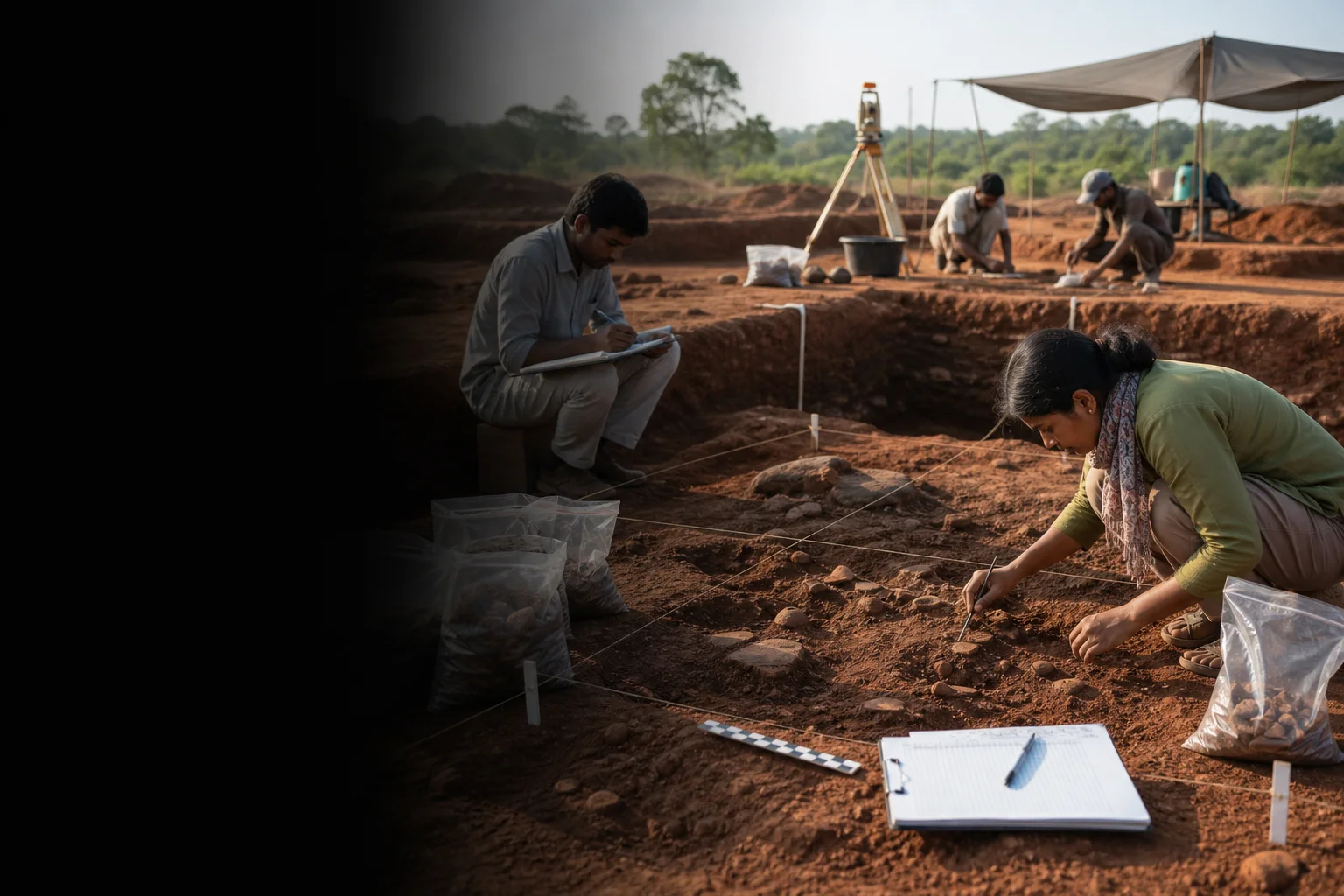
These project-created visuals support orientation. They are not presented as photographs of an excavation, monument, person, or event.
Questions
Frequently asked questions
Are Iron Age and megalithic the same thing?
They overlap in regional archaeological usage, but one concerns technology and the other mortuary monuments and related traditions. Their chronologies must be established locally.
Does every stone circle mark a warrior’s grave?
No. Burial form and grave goods do not establish an individual’s occupation or identity without further evidence.
Does the 2025 report settle the first use of iron?
It presents a proposed early chronology. Its implications depend on the samples, their contexts and the relationship between dated material and iron.
Editorial trust
Sources and further reading
Citations in the article point to this full list. Source type and review date are shown so readers can evaluate the evidence.
- 1Iron Age Cultures, Block 2Indira Gandhi National Open UniversityUniversity archaeology teaching resource
- 2Megaliths of South India: Regional VariantsINFLIBNET / university course materialsUniversity archaeology teaching resource
- 3Megalithic cairn circles: built-heritage inventoryArchaeological Survey of India, National Mission on Monuments and AntiquitiesOfficial archaeological inventory
- 4The politics and historicity of megalithic places in early South IndiaJournal of Social ArchaeologyPeer-reviewed regional interpretation; abstract and indexed text consulted
- 5KodumanalTamil Nadu Department of ArchaeologyOfficial excavation overview; indexed text consulted
- 6Lok Sabha unstarred question 217: archaeological excavation findingsParliament of IndiaOfficial parliamentary answer
- 7The Origins of Agriculture in South India: Botanical and Archaeological Perspectives (2000)Dorian Q. Fuller; University of Cambridge / UCL DiscoveryDoctoral research; institutional abstract consulted
- 8Dry, rainfed or irrigated? Reevaluating the role and development of rice agriculture in Iron Age–Early Historic South IndiaVegetation History and ArchaeobotanyPeer-reviewed archaeobotanical study
- 9Implications of phytolith records from an Early Historic megalithic burial site at Porunthal in Southern IndiaJournal of Archaeological Science: ReportsPeer-reviewed phytolith study; abstract consulted
- 10Excavations at Adichchanallur (2020)Archaeological Survey of India; Sathyabhama BadhreenathPrimary excavation report
- 11Archaeological excavations conducted by the DepartmentTamil Nadu Department of ArchaeologyOfficial excavation register
- 12Antiquity of Iron: Recent Radiometric Dates from Tamil Nadu (2025), pp. 15, 36–40Tamil Nadu Department of Archaeology; K. Rajan and R. SivananthamPrimary departmental dating report; interpretations attributed
- 13Oxford Radiocarbon Accelerator UnitUniversity of Oxford, School of ArchaeologyUniversity laboratory explanation
- 14Radiocarbon Dating and Chronological Modelling: The Bayesian ProcessHistoric EnglandInstitutional scientific-dating guidance
- 15Situating megalithic burials in the Iron Age–Early Historic landscape of southern India (2013)Smriti Haricharan, Hema Achyuthan and N. Suresh; AntiquityPeer-reviewed luminescence and burial study; abstract consulted
Editorial review: Factual claims were checked against the linked primary and institutional sources on 15 November 2026. Where the sources support only a range or interpretation, the article keeps that limitation visible.
Historical reading
What a large monument says about social life
Monument building required people to coordinate effort. Someone selected a location, obtained material and arranged the work. That makes a cemetery relevant to social history even when no names survive. But the size of a tomb cannot simply be converted into a ruler’s rank or a population estimate. A larger structure might reflect a different building tradition, several episodes of use or different access to stone. Comparison needs both construction details and an independent chronology.
The social interpretation of megalithic places in the Maski research asks how such monuments participated in changing relationships and distinctions between people. Applied as a question here, this encourages attention to the space around a burial as well as the goods inside it. Could people see it from a route? Did later deposits respect its boundaries? Was it rebuilt? None of those answers follows from the word megalithic. Plans, excavation sequences and landscape observations would be needed to develop them.[4]