Reformers · Other Historically Significant People
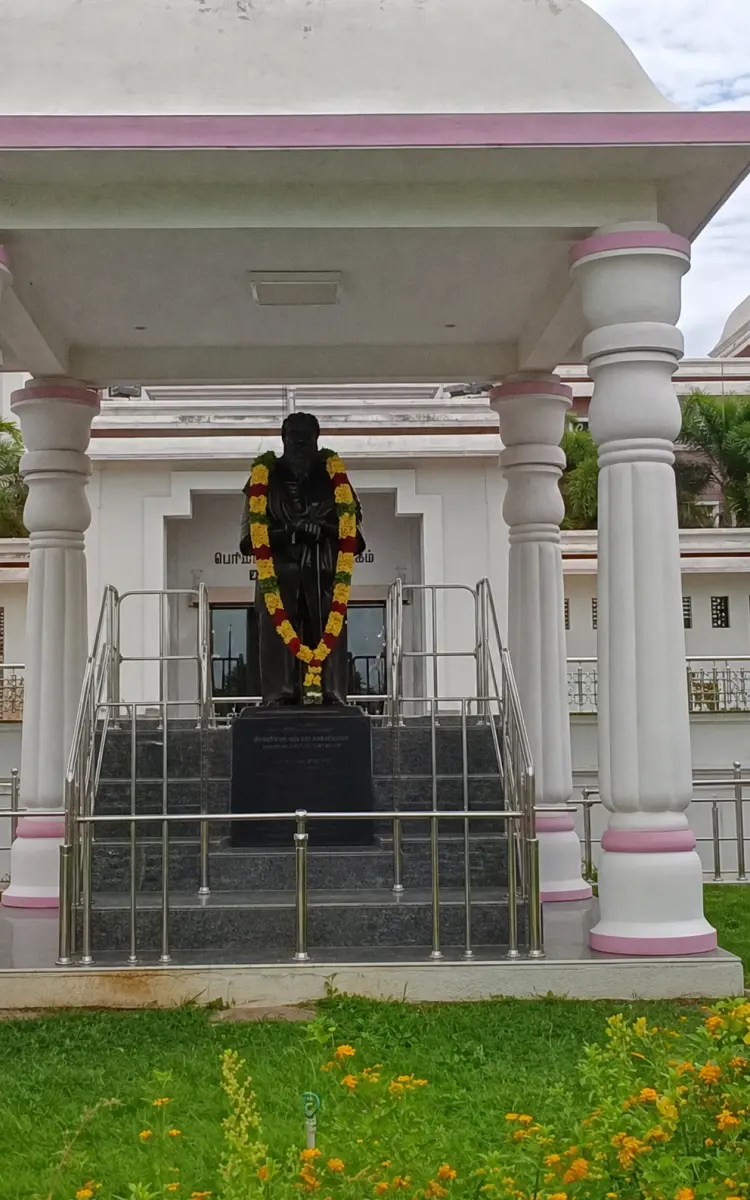
Periyar E.V. Ramasamy
பெரியார் ஈ. வெ. இராமசாமி
17 September 1879 – 24 December 1973
Periyar E.V. Ramasamy was a central organizer and polemicist in twentieth-century Tamil social and political life. His campaigns against caste hierarchy, religious authority and patriarchy helped shape the Self-Respect and Dravidian movements, while his methods and language remain subjects of historical argument.
Editorial status: Published · Reviewed 10 August 2026- Born
- 17 September 1879 in Erode [1]
- Died
- 24 December 1973 [2]
- Known for
- Self-Respect Movement, anti-caste and rationalist advocacy
- Publications
- Kudi Arasu and other movement newspapers
- Organizations
- Indian National Congress, Justice Party and Dravidar Kazhagam at different periods
- Editorial note
- Political claims and remembered titles require contextual reading
Life and context
Who Periyar E.V. Ramasamy Was
Erode Venkata Ramasamy, widely called Periyar, lived from 1879 to 1973 and worked across commerce, municipal politics, anti-colonial organization, social reform, publishing and mass campaigning. The honorific Periyar became part of his public identity, but it should not substitute for explaining the institutions and arguments through which he gained influence. University and scholarly accounts place him at the centre of the Self-Respect movement and later Dravidian politics. [1][3]
His public programme challenged caste hierarchy, Brahminical authority, untouchability, religious orthodoxy, compulsory Hindi, and unequal gender relations. Those positions were expressed through speeches, journals, conferences, symbolic protest and organization rather than through one fixed manifesto. Admirers read this record as radical emancipation; critics question his rhetoric, political choices and treatment of religious communities. A responsible biography keeps both consequence and controversy visible. [4][6]
Life and context
Erode, Family, Commerce, and Early Public Life
Periyar was born in Erode, then within the Madras Presidency. Accounts describe a commercially established family and a limited period of formal schooling, followed by work in family trade. These circumstances gave him resources and local standing, but later movement narratives sometimes turn early episodes into moral parables. The secure point is that he entered civic and charitable activity before becoming a full-time political organizer. [1]
Erode today is a city and district in Tamil Nadu; it is not a direct map of colonial administrative boundaries. The region's trade, agrarian economy, religious institutions and caste relations formed part of his early environment. Biographical writing should avoid pretending that one town alone explains his later programme. His ideas changed through Congress politics, movement conflicts, travel, publishing and debate over several decades.
Life and context
Congress Politics and Vaikom
Periyar joined the Indian National Congress during the mass-politics phase after the First World War and held positions in the Tamil organization. He participated in non-cooperation and temperance campaigns, but increasingly disputed representation and caste practice inside nationalist institutions. Accounts of his departure emphasize repeated conflict over communal representation and a Congress-supported gurukulam where dining arrangements reproduced caste separation. The exact sequence is best reconstructed from contemporary records, not a single anecdote. [1][3]
His participation in the Vaikom satyagraha in Travancore is an important part of this period. The campaign concerned access to roads around the temple and involved local leaders, national figures, multiple organizations and repeated arrests. Periyar's role was significant, but he did not create or single-handedly complete the movement. Describing the collective campaign prevents a commemorative title from erasing Kerala's organizers and the longer history of anti-caste action. [2]
Life and context
The Self-Respect Movement
After leaving Congress politics in the mid-1920s, Periyar helped organize the Self-Respect movement as a public challenge to caste status, inherited authority and ritual hierarchy. Conferences, local associations and newspapers circulated arguments for dignity, representation, inter-caste association and critical inquiry. The movement was not socially uniform: activists adapted its ideas to different towns, caste locations, occupations and political needs. [1][5]
Self-respect marriages rejected priestly mediation and Sanskrit ritual as requirements for a valid union, while movement discussions also addressed widow remarriage, education, property, reproductive roles and women's public speech. These interventions opened political space without automatically eliminating patriarchy inside the movement or wider society. Feminist scholarship therefore treats the programme as consequential and internally complicated, not as a completed achievement. [4][6]
Life and context
Caste, Religion, and Rationalism
Periyar argued that caste inequality was sustained by scripture, ritual, social custom, marriage and control of knowledge. He attacked the authority of texts and deities used to naturalize hierarchy and promoted atheism and rationalist criticism. His demonstrations often used deliberate provocation. The historical question is not whether every listener accepted his conclusions, but how these interventions altered public debate about caste, religion and dignity. [7][2]
The language of Brahminism in his politics referred to a structure of authority but could also become sweeping when directed at Brahmins as a social group. This distinction matters. Anti-caste analysis should identify institutions and power without reproducing collective hostility. His writings also need to be located alongside earlier non-Brahmin, Dalit and anti-caste thinkers rather than presented as the beginning of every reform current in Tamil society. [6][5]
Life and context
Language, Representation, and Dravidian Politics
Language policy became a major arena of Periyar's politics, especially opposition to compulsory Hindi in schools. He connected language to access, employment and political dominance, while also criticizing forms of Tamil classicism that he considered socially conservative. That combination resists a simple portrait of him as either a language romantic or an opponent of Tamil. He treated language primarily as an instrument of equality, communication and power. [2]
Periyar later led the Justice Party and, in 1944, the organization became Dravidar Kazhagam. It did not contest elections under his leadership. The later split associated with C.N. Annadurai and the formation of the DMK created a separate electoral path. Modern Dravidian parties inherited parts of this vocabulary, but none can be treated as a complete or unchanged expression of Periyar's programme. [1][2]
Life and context
Print, Conferences, and Transnational Networks
Kudi Arasu and related publications were not secondary publicity tools; they created an archive of editorials, speeches, disputes, translations and organizational notices. Print helped local meetings speak to a wider Tamil-reading public, but survival is uneven and later compilations reflect editorial selection. Individual quotations should therefore be checked against dated issues or critical editions before reuse. This page paraphrases rather than offering decorative quotations. [3]
Periyar's 1929 visit to Malaya shows that Self-Respect politics travelled through diasporic institutions and was reshaped there. Scholarly research describes public meetings across Malayan towns and a dialogue about home, host society and Tamil belonging. This was not one-way export from Tamil Nadu. Overseas activists interpreted, contested and reapplied movement ideas in their own colonial setting. [3]
Life and context
Women, Marriage, and the Limits of Reform
Periyar placed marriage, family and women's autonomy inside his critique of caste. Self-Respect arguments supported companionate marriage, widow remarriage, inter-caste unions, education and women's ability to reject compulsory roles. Scholars emphasize that these ideas linked control of sexuality and reproduction to the maintenance of caste. Their force lay in treating household power as political rather than private. [4][6]
Movement platforms also depended on women speakers, writers and organizers whose lives should not be reduced to evidence of one male leader's progressiveness. Nor did strong rhetoric immediately transform property, labor, violence or domestic authority. Evaluating this history requires attention to women's own interventions and to the gap between programme, law and lived practice. That gap is an analytical question, not a reason to dismiss the reforms.
Life and context
Independence, Democracy, and Political Disagreement
Periyar's response to Indian independence differed sharply from celebratory nationalist narratives. He feared that transfer of power would leave caste and northern political dominance intact, and he supported versions of a separate Dravidian political future at different points. These positions changed with constitutional, linguistic and electoral circumstances. They should be reported as political arguments, not converted into timeless regional consensus. [2]
He maintained influence outside electoral office through campaigns and public criticism. Relationships with Congress governments and Dravidian leaders varied between opposition, tactical support and disagreement. A biography that labels every episode as either victory or betrayal misses how a non-electoral movement interacted with law, parties and mass democracy. The relevant evidence includes speeches, organizational resolutions, newspapers, legislation and accounts from political opponents.
Life and context
Legacy, Public Memory, and How to Read Periyar
Periyar's legacy is visible in debates about reservation, language, self-respect marriages, rationalism, caste naming, women's autonomy and the public role of religion. Statues, institutions and annual commemorations show durable memory, but commemoration is not independent verification. Current political parties select different parts of his record, and modern disputes often quote short phrases without the surrounding publication or occasion. [6]
Readers should compare movement publications with scholarship on caste, gender, nationalism and regional politics. They should also place Periyar alongside Iyothee Thass, Rettamalai Srinivasan, B.R. Ambedkar, women Self-Respecters and other organizers whose projects overlapped without being identical. This broader frame recognizes his scale of influence while resisting a single-founder history of social equality in Tamil Nadu.
Images with explicit provenance
Places and historical context
Chronology
Timeline
- 1879
Born in Erode on 17 September. [1]
- 1919
Joined the Indian National Congress during the non-cooperation era. [1]
- 1924–1925
Participated in the Vaikom campaign and left Congress amid disputes over caste and representation.
- Mid-1920s
The Self-Respect movement took organized form through conferences, print and local associations.
- 1929
Travelled to Malaya, where Self-Respect politics entered a transnational Tamil debate. [3]
- 1944
The Justice Party was reorganized as Dravidar Kazhagam. [2]
- 1973
Died on 24 December. [2]
Keep exploring
Places, periods, and connected guides
Places
Questions
Frequently asked questions
What does Periyar mean?
Periyar is an honorific commonly translated as a great or respected elder. It became closely identified with E.V. Ramasamy, but the title does not replace his personal name or provide evidence for a historical claim.
Did Periyar begin every anti-caste movement in Tamil Nadu?
No. His movement was highly influential, but anti-caste thought and organization preceded and surrounded it. A fuller history includes Dalit, non-Brahmin, religious, labor, feminist and local initiatives.
Was the Self-Respect movement only about marriage?
No. Marriage reform was one visible programme within a wider challenge to caste, ritual authority, representation, gender relations, education and public culture.
Why is his legacy contested?
His attacks on hierarchy and patriarchy remain influential, while his rhetoric, atheism, political alliances and statements about social groups attract criticism. Both impact and dispute belong in the historical record.
Are quotations on social media reliable?
Not by themselves. Verify wording, date, newspaper issue, language, translation and occasion before attributing a quotation.
Editorial trust
Sources & further reading
- Social Movements in India: E.V. Ramasamy Periyar and the Self-Respect MovementPeriyar University · University study materialAccessed 10 August 2026
- Self-Respect MovementTamil Nadu Open University · University study materialAccessed 10 August 2026
- The Self-Respect Movement and Tamil Politics of Belonging in Interwar British Malaya, 1929–1939Cambridge University Press · Darinee Alagirisamy · 2016 · Peer-reviewed research articleAccessed 10 August 2026
- Gender and CasteINFLIBNET Centre · Academic teaching resourceAccessed 10 August 2026
- Dalit Movement and Backward Class Assertions in IndiaINFLIBNET Centre · Academic teaching resourceAccessed 10 August 2026
- The Cambridge Companion to PeriyarCambridge University Press · 2025 · Scholarly edited volumeAccessed 10 August 2026
- Women, Caste and ReformSATHEE / IIT Kanpur and NCERT · National textbook resourceAccessed 10 August 2026