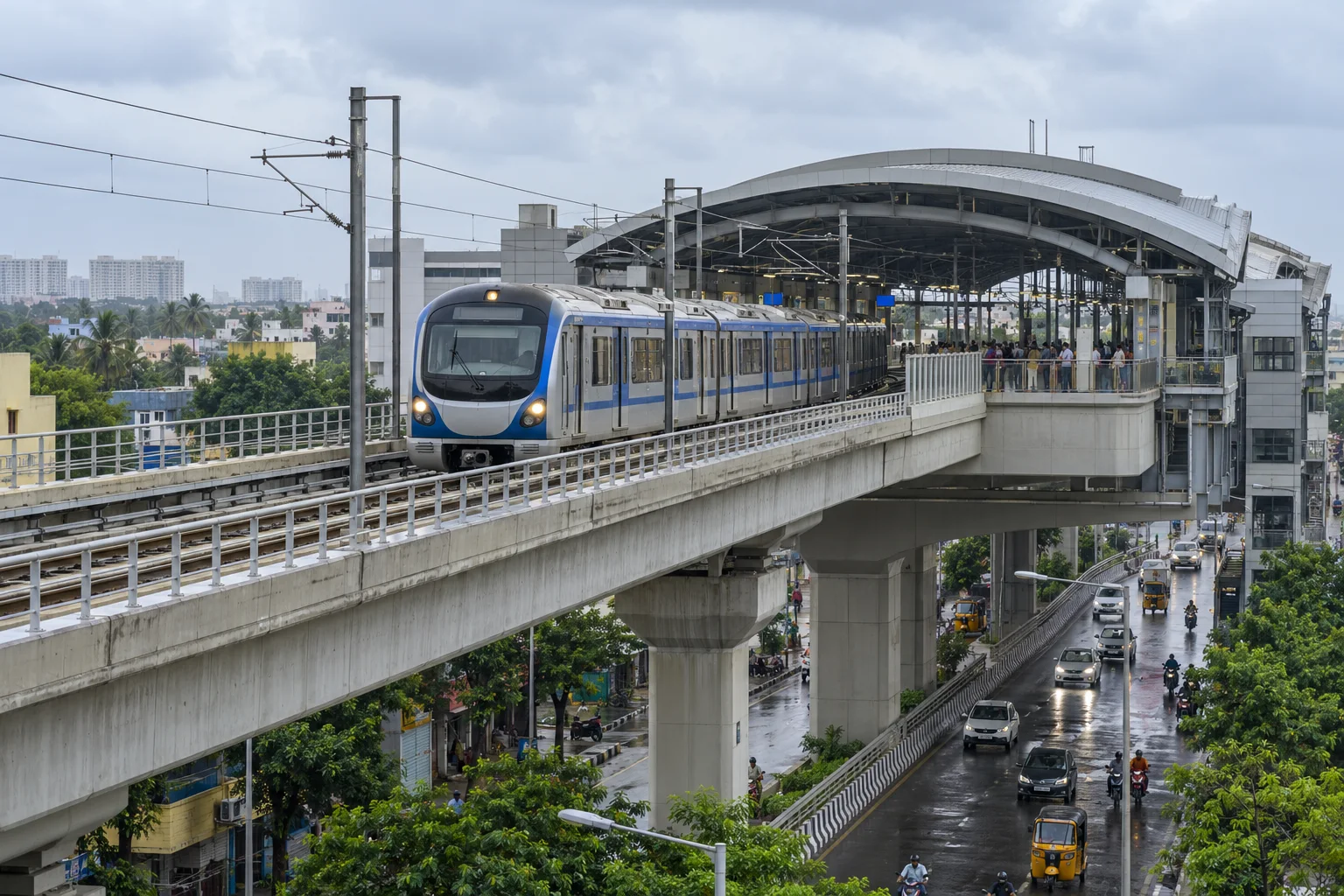
What opened in October 2026, and what did not
Passenger service began on the Poonamallee Bypass–Vadapalani portion of Chennai Metro Phase II in October 2026. The operating section is about 14.6 kilometres long and forms the western part of Corridor 4, the route planned more broadly between Poonamallee Bypass and Lighthouse. For a traveler, its immediate value is simple: western neighbourhoods around Poonamallee, Iyyappanthangal and Porur now have a rail connection to Vadapalani, where the established Green Line opens onward journeys through the Phase I network.
Do not read the entire Phase II map as an open network. Corridors 3, 4 and 5 contain many stations and construction packages that will enter service in stages. Even within the newly operating section, trains currently make a long run between Porur Junction and Vadapalani rather than serving every future station drawn along Arcot Road. A map that is correct as a project plan can therefore be misleading as a same-day travel plan.
CMRL issued passenger-service notices on 10 October and revised timings on 21 October. That sequence is a useful reminder that a new line can change quickly after opening. This article fixes the basic geography, but your travel time should come from CMRL's current timetable, travel planner or station information on the day you ride.
Sources for this section: Phase II passenger service, Revised service timings, Corridor 4 project context.
Read the open-station pattern before choosing your stop
The opening connects Poonamallee Bypass and Vadapalani through the Poonamallee and Porur side of the city. Public opening information identifies eleven passenger stations on the operating stretch: Poonamallee Bypass, Poonamallee Bus Stand, Poonamallee Government Hospital, Karayanchavadi, Kumananchavadi, Kattupakkam, Iyyappanthangal, Thelliyaragaram, Porur Bypass, Porur Junction and Vadapalani. Naming can vary slightly between project documents, station boards and English transliteration, so use the current CMRL interface when matching a station to an address.
The crucial detail is the gap after Porur Junction. Stations shown on the future alignment between Porur and Vadapalani are not necessarily passenger stops in the present operating pattern. Do not promise a pickup at Valasaravakkam, Alwarthirunagar, Saligramam or another construction-stage station merely because it appears on a Phase II map. Route the traveler to an actually open station and then plan the surface leg.
Station choice should follow the destination side of a major road, not only straight-line distance. A pin that appears one kilometre closer can still require a difficult crossing, an indirect service road or a long walk in heat and rain. Ask a hotel, host, hospital or meeting venue which open station and exit they currently recommend, then compare that advice with the official station listing.
- Confirm that the station is open for passenger service.
- Match the station to the correct side of the road or junction.
- Check the current first and last train before committing to a late arrival.
- Keep a surface-transport fallback for the final kilometre.
Sources for this section: Poonamallee–Vadapalani inauguration, Phase II passenger service, Official Phase II map.
Use Vadapalani as the bridge to the established network
Vadapalani is the practical hinge of the new journey. The Phase II service reaches the same broad interchange area as the existing Green Line, allowing passengers to continue toward CMBT, Arumbakkam, Anna Nagar, Egmore, Chennai Central, Alandur and St. Thomas Mount. The exact transfer path, platform and walking time matter when traveling with luggage, children, older adults or a tight railway connection, so allow more than the shortest journey-planner estimate on a first visit.
For Chennai Central or Egmore, the Green Line is usually the natural continuation from Vadapalani. For the airport, the journey requires understanding the Phase I network and may involve changing at Alandur depending on the current route shown by the official planner. A single fare result or through-ticket option does not remove the need to follow platform signs carefully. Ask Metro staff when the transfer path is unclear rather than following a crowd that may be heading to another line.
A new corridor is most useful when the full trip is planned from door to door. Include the time to reach the origin station, security screening, ticket purchase or QR validation, interchange walking and the final surface connection. The train ride may be predictable while the first and last kilometre remain the most variable parts of the journey.
Sources for this section: CMRL travel planner, Official Phase II map.
Treat fares and timings as live operational information
CMRL maintains an official fare table, fare calculator, timetable material and travel planner. The fare table was updated immediately before the Phase II opening, which makes it a better source than an undated blog graphic or a screenshot shared in a messaging group. Enter the actual origin and destination instead of assuming that every extension uses an old maximum fare or a flat introductory price.
The same rule applies to first and last trains. A revised service notice was issued soon after opening, and operating hours or frequency can differ by day, direction and service stage. Check again when your journey depends on an airport departure, an early intercity train or the final service at night. Leave a fallback budget for a verified taxi, auto-rickshaw or bus if the connection becomes too tight.
Digital QR tickets and stored-value products can reduce time at the station, but buy through CMRL's current official channels. A search advertisement, forwarded payment link or unofficial app should not be trusted merely because it uses a Metro logo. Confirm the developer or domain and read the payment recipient before authorising the transaction.
Sources for this section: CMRL fare table, CMRL travel planner, Revised service timings, CMRL stored-value pass.
Example 1: a family travels from Poonamallee to Chennai Central

A family staying near Poonamallee has an afternoon train from Chennai Central. They first confirm which open Phase II station is easiest to reach with luggage. They do not choose a construction-stage station shown on a general map. On the morning of travel, they use CMRL's planner to check the current service from the western section to Vadapalani and the Green Line continuation toward Central.
They add generous interchange time because one traveler walks slowly and the family is using a new station for the first time. Their railway buffer begins at the Central concourse, not at the moment the Metro is scheduled to arrive. Tickets, security, lifts and wayfinding all sit inside the plan. A taxi number is saved as a fallback, but no driver is paid in advance through an unsolicited link.
At Vadapalani, the family follows the official interchange signs and asks staff before changing platforms. This example is deliberately less dramatic than a fastest-route video. The goal is not to prove the Metro can beat every road journey; it is to create a repeatable trip with enough margin to absorb an unfamiliar transfer.
Sources for this section: CMRL travel planner, Revised service timings.
Example 2: a Porur visitor builds an airport trip with a fallback
A traveler in Porur has an evening flight from Chennai International Airport. The new line makes rail a meaningful option, but the traveler does not assume that Porur Junction has a direct airport train. The official planner is used to identify the required interchange through the existing network, and the airport terminal's recommended arrival margin remains the controlling deadline.
The traveler checks the final train sequence before leaving the hotel and compares it with road travel under current traffic and weather. One medium suitcase is manageable; several oversized bags would change the decision. The route includes lift access and transfer walking, while the fallback is a verified cab booked early enough that switching modes will not threaten check-in.
This method also protects against a common planning error: comparing only in-vehicle times. The Metro calculation starts at the hotel door and ends at the correct terminal entrance. The road calculation includes pickup uncertainty and traffic. The better option is the one with the safer total journey on that day, not the one with the most impressive headline time.
Sources for this section: CMRL travel planner, CMRL fare table.
Check access and parking station by station
An operating station does not guarantee that every entrance, parking area, feeder service or pedestrian approach works the way an older map suggests. CMRL publishes parking information, but capacity and availability can change. If you plan to leave a vehicle, check the specific station rather than relying on a network-wide parking symbol. Photograph the bay and closing information without exposing personal details, and keep the payment method required by the current facility.
For step-free travel, verify the route from street to platform and through the interchange. A lift inside the station does not solve a broken footpath or a difficult road crossing outside it. Travelers with wheelchairs, strollers, heavy luggage or limited stamina should ask the destination and station staff about the most practical exit and allow time for an alternative lift if one is temporarily unavailable.
After dark or during heavy rain, shorten the walking assumption. Use a recognised pickup point and verify the vehicle and driver before entering. Do not stand in a traffic lane while waiting, and do not ask a driver to stop on a viaduct approach or bus-only area. The safest last mile may begin at a slightly less convenient exit with a proper pickup space.
Sources for this section: CMRL parking, CMRL travel planner.
Use a five-minute check before every Phase II journey
The opening is significant because it changes the practical geography of western Chennai. Poonamallee and Porur are no longer connected to the established Metro only by a future promise. Yet the wider Phase II network remains a staged project, and that makes precision more important than enthusiasm. Say which section is operating, which station you will use and where the interchange occurs.
Before leaving, open CMRL's current planner or notice, confirm both stations, check the first or last train if relevant, verify the fare through the official tool and inspect the final kilometre. If a future station appears in search results, look for an explicit passenger-service status rather than a construction update. A tunnel breakthrough, trial run or completed structure is not the same as an open stop.
Travelers should also keep the journey proportionate. The Metro is excellent when it removes a difficult road segment or creates a dependable interchange. It is not automatically the best answer for every hotel, every amount of luggage or every late-night arrival. A good guide gives you the information to choose, not a command to use one mode regardless of circumstances.
- Confirm the station is open.
- Check the stopping pattern after Porur Junction.
- Use the official planner for the Vadapalani transfer.
- Verify fare and service hours on the day.
- Add walking, screening, luggage and last-mile time.
- Keep a verified fallback when the deadline matters.
Sources for this section: Phase II passenger service, Revised service timings, CMRL travel planner.
Sources & Further Reading
These authoritative references support the historical, geographic, or seasonal context in this story. Current conditions and operating details still require a fresh official check.
- Chennai Metro Rail Limited Phase 2 Corridor-4 Stage 1A Passenger Service · Chennai Metro Rail Limited
- Phase 2 Corridor-4 Stage 1A & 1B Passenger Service: Revised Service Timings · Chennai Metro Rail Limited
- Poonamallee-Vadapalani Stretch of Phase II of Chennai Metro Rail Project · Press Information Bureau, Government of India
- Updated Environmental Impact Assessment Report for CMRL Phase II Corridor 4 · Chennai Metro Rail Limited
- Chennai Metro Phase II Map · Chennai Metro Rail Limited
- Chennai Metro Rail Travel Planner · Chennai Metro Rail Limited
- CMRL Fare Table · Chennai Metro Rail Limited
- Parking Facility at Stations · Chennai Metro Rail Limited
- Store Value Pass and Online QR · Chennai Metro Rail Limited
Related Stories

Tamil Nadu Digital Tourism 2026: AI, Apps and Smarter Trip Planning
Tamil Nadu's new tourism website, app, AI content and innovation challenge point toward a more connected trip. Here is how to use the change carefully.
Tamil Nadu Festival Travel 2026: How to Plan Trains, Buses and Return Trips
A practical guide to Tamil Nadu's festival travel rush, with train, bus, Chennai-return, family and temple-event planning examples.

Fake Tamil Nadu Tourism Booking Sites: How to Verify Before You Pay
TTDC is warning travelers about fraudulent websites misusing its identity. Learn how to verify hotels, tours and boat-house bookings before paying.
Frequently asked questions
Is Chennai Metro Phase II open?
Yes, the Poonamallee Bypass–Vadapalani section opened for passenger service in October 2026. The complete Phase II network is not yet open.
Can I travel from Poonamallee to Chennai Central by Metro?
The operating western section connects to Vadapalani, where the established Green Line provides an onward route toward Chennai Central. Confirm the current transfer in CMRL's official planner.
Does the new line go directly to Chennai Airport?
Do not assume a direct train. Use the official planner to confirm the current interchange through the existing network, and include walking and luggage time.
Are all stations between Porur and Vadapalani open?
No. The current passenger service runs between Porur Junction and Vadapalani without serving every future station shown on the Phase II project map.
How do I check the current fare?
Use CMRL's official fare table, fare calculator or travel planner with the actual origin and destination. Avoid undated screenshots.
Where can I check first and last trains?
Use CMRL's current timetable, travel planner, press releases or station information. Service timings changed shortly after the opening, so check on the day.
Can I park at every new Metro station?
Do not assume so. Check CMRL's current station-specific parking information and availability before leaving a vehicle.
Is the full Poonamallee–Lighthouse corridor operating?
No. Corridor 4 is a larger staged project. The currently operating portion is the western Poonamallee Bypass–Vadapalani section.
Should I trust a Phase II route map found online?
Use it for project context, then verify passenger-service status with CMRL. Construction maps often include stations that are not yet open.
Is Metro always faster than a taxi?
Not necessarily. Compare the complete door-to-door journey, including station access, transfer walking, luggage and the final kilometre, against current road conditions.
Editorial attribution
Prepared and reviewed by My Tamil Nadu Editorial Desk. Modified 25 October 2026.