
What Tamil Nadu launched for digital tourism in 2026
On World Tourism Day, 27 September 2026, the Tamil Nadu Tourism Department announced a group of digital and artificial-intelligence initiatives at an event in Coimbatore. The official district release identifies a revamped Tamil Nadu Tourism Development Corporation booking website and mobile application, AI videos about tourism circuits, the Reimagine TN AI video competition and the Tamil Nadu Tourism Innovation Challenge 2026. These are related initiatives, but they do not all do the same job.
The booking platform is the immediately practical layer. According to the detailed government release, it is intended to let travelers view TTDC hotels, tours and boat houses, check room availability, make online payments, use OTP verification and receive QR-based booking tickets. It also brings destination information about temples, beaches, hill stations and other places into one platform. The release describes intended functions; travelers should still confirm that the exact property, tour, date and feature they need are currently available before paying.
The AI videos are a discovery and communication layer, not proof of present conditions. The innovation challenge is different again: StartupTN and Tamil Nadu Tourism invited startups, students, professionals and technologists to propose solutions for culinary, agri and rural, heritage and culture, eco and adventure, digital and other tourism themes. Its official page describes mentoring, a bootcamp, final pitching and possible pilot opportunities. A challenge idea or prototype should not be mistaken for a deployed public service.
Sources for this section: World Tourism Day launch, Official launch press release, Tourism Innovation Challenge.
What travelers can use now, and what still needs checking
Start with the official TTDC booking domain rather than a search advertisement, forwarded message or lookalike link. The refreshed platform presents itself as the official place for TTDC hotel, tour and boat booking. Use it to discover options, compare the displayed inventory and begin a transaction. Before payment, read the property or package name, dates, guest count, inclusions, cancellation conditions, taxes and contact details shown in the final summary. A polished interface does not remove the need to review the actual contract.
A digital ticket can reduce paper handling and make check-in faster, but it is not the same as a universal entry pass for Tamil Nadu. A TTDC room or tour confirmation does not automatically grant access to a separately managed temple, forest trail, monument, transport service or festival area. Each operator can have its own reservation, identity, permit, dress, safety and photography requirements. Keep separate confirmations clearly named on the phone so one QR code is not presented for the wrong service.
Current availability is also narrower than destination inspiration. An AI video can suggest a hill route; the booking platform may show a nearby TTDC stay; a forest or district authority may still control trail access. Use the digital tourism system as one layer in a chain. Confirm long-distance transport, the final road transfer, weather, local access and any special permit through the organization responsible for that step. The newest tool is useful when it makes the chain clearer, not when it encourages travelers to skip it.
Sources for this section: Official launch press release, Official TTDC booking.
Where AI can help a trip, and where it can mislead
AI can make a useful first draft. It can group interests, compare route shapes, suggest questions, translate a simple planning note and reveal that a traveler interested in Chola architecture may prefer a Cauvery-delta base over a rushed statewide circuit. It can also help a family list mobility needs, meal constraints and backup options before anyone starts booking. These are low-risk planning tasks because the output remains a proposal to review.
AI is much weaker as a source of live operational truth. It may repeat an old timetable, merge similarly named temples, invent a ticket counter, overlook a weekly closure or present an estimated journey time as a guarantee. A generated image can also combine architecture, clothing, ritual and landscape in ways that look convincing but never existed together. Treat AI travel content as orientation unless it links to the responsible authority and the fact can be verified there.
Use a two-column habit: inspiration on one side, confirmation on the other. The inspiration column can contain routes, food ideas, stories and alternatives. The confirmation column should contain the official booking record, operator contact, current timing, access rule, weather source and cancellation terms. Never give a public chatbot passport numbers, card credentials, one-time passwords, medical records or more personal detail than the service genuinely requires. Convenience is not permission to disclose everything.
- Ask AI to compare route options, not to guarantee availability.
- Verify every time-sensitive claim with the responsible operator.
- Keep booking references outside the chat that helped plan the trip.
- Do not use generated images as evidence of access, appearance or current conditions.
Sources for this section: World Tourism Day launch, Official launch press release.
Example 1: booking a family stay and boat-house outing
Imagine three adults planning a four-day break from Chennai. They want one TTDC stay and a boat-house outing, while an older traveler needs short walking distances and predictable rest. The group can begin on the official booking platform, compare the displayed properties or packages and capture the final name, location, dates, room type and inclusions. They should not assume that a photograph proves lift access, an accessible bathroom or a short path from parking to reception.
Before paying, one person calls or uses the official property contact to ask precise questions: Are there steps from vehicle drop-off to the room? Is the requested room type on the ground floor? Is boat access subject to weather, water level or local operating decisions? Which parts are refundable? The answers are recorded beside the booking, not left in a family chat full of unrelated links. Payment is then completed only on the official domain, and the confirmation is checked before the browser closes.
The group saves the QR ticket as an offline screenshot or PDF, keeps the booking number in plain text and carries a printed copy for the traveler who does not use a smartphone. They still check weather and call again if conditions become uncertain. Digital booking has removed several phone calls and a physical payment step, but it has not certified accessibility or guaranteed an outdoor activity. The technology succeeds because it organizes the decision while human verification protects the traveler.
Sources for this section: Official launch press release, Official TTDC booking.
Example 2: using AI to shape a heritage weekend
A couple interested in architecture has two nights and asks an AI planner for a Tamil Nadu heritage weekend. The first draft offers Chennai, Mamallapuram, Kanchipuram and Thanjavur in one loop. That list contains strong places but a poor weekend. Instead of accepting the answer, they ask it to compare two realistic choices: Chennai with Mamallapuram, or Tiruchirappalli with Thanjavur. They then use the permanent destination and itinerary guides to understand what each cluster offers.
For Chennai and Mamallapuram, the digital layer can organize a city base, one road excursion and a weather-aware return. For Tiruchirappalli and Thanjavur, it can organize rail arrival, one transfer and focused Chola context. Official monument, temple and transport sources settle opening, access and booking details. If an AI video inspires a particular viewpoint or performance, the couple searches for the named place and current organizer rather than assuming the scene is a purchasable experience.
Language assistance can help with a simple message, but a machine translation should not be treated as a final interpretation of an inscription, ritual or community history. The couple uses AI to prepare respectful questions and leaves authoritative cultural explanation to museums, site publications, qualified guides and community practitioners. Their final plan contains fewer stops than the first draft. That is a sign of better digital planning: the tool has helped narrow the trip rather than inflate it.
Sources for this section: World Tourism Day launch, Tamil Nadu destination guide.
Example 3: a nature trip with a QR ticket and no signal
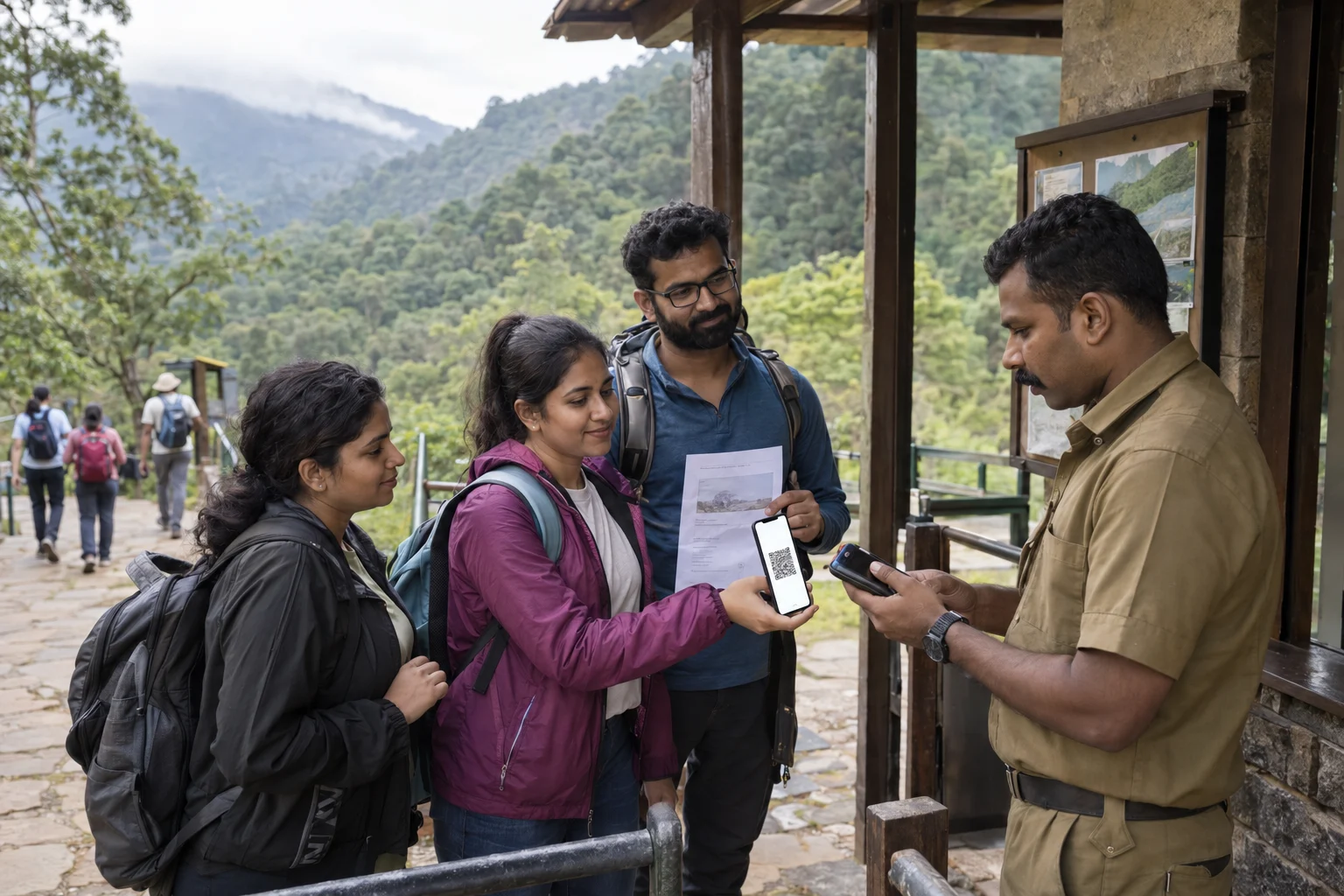
Three friends plan a hill or forest outing after finding a route through a digital travel video. They identify the authority that actually manages the site and check whether advance registration, guide assignment, identity proof or a separate permit is required. The TTDC app may help with accommodation or a connected package; it should not be assumed to replace an ecotourism or forest booking unless the official flow explicitly says so.
At home, they download every confirmation, screenshot the QR code, record the booking number and save the operator's contact. One traveler carries a printed sheet. They download an offline map for orientation but do not use it to leave a marked trail. At the checkpoint, they follow staff instructions if the device will not scan or the day's conditions have changed. No one argues that an old digital ticket overrides a closure made for weather, wildlife or safety.
The group also avoids broadcasting a fragile location simply because a generated recommendation called it hidden. Responsible digital tourism should direct demand toward places prepared to receive visitors, distribute benefits to local guides and services, and explain limits. It should not expose nesting sites, archaeological surfaces or unregulated paths to sudden attention. A good digital experience ends with better behavior on the ground, including carrying waste back, respecting residents and accepting that access can be refused.
Sources for this section: Official launch press release, Tourism Innovation Challenge.
Protect the payment, the booking and your personal data
Digital tourism creates new convenience and a familiar risk: a fake booking page can look more urgent than the real one. Type the known official address or reach it from a verified government page. Check the full domain before entering details. Do not install an app from a link in an unsolicited message, share an OTP with a caller or approve a payment request merely to receive a refund. The official release says OTP verification is part of the booking experience; an OTP should be entered only in the legitimate transaction you initiated.
Save evidence after payment: the booking confirmation, transaction reference, amount, date, merchant name, cancellation policy and relevant correspondence. If money is debited but no booking appears, contact the official operator and payment provider through independently verified channels. Do not keep retrying a large transaction until you understand the first result. The National Cyber Crime Reporting Portal advises victims of online financial fraud to call 1930, and its guidance emphasizes retaining transaction and communication evidence.
Privacy matters even when no fraud occurs. A travel app may ask for identity, phone, email, location or payment information. Provide only what the booking requires, review permissions and avoid uploading identity documents to a general AI assistant. Share the itinerary selectively; a public post revealing an empty home, children's details or live location can create risk. Delete obsolete ticket images from shared chats after the group no longer needs them, while retaining records required for refunds, complaints or accounts.
Sources for this section: Official launch press release, National Cyber Crime Portal, Financial fraud safety guidance.
What better digital tourism should deliver next
Tamil Nadu's innovation challenge is notable because it reaches beyond itinerary software. Its themes include food, agriculture and rural experience, heritage and culture, eco and adventure tourism and digital innovation. The official selection criteria include tourism impact, cultural value, local livelihoods, sustainability, feasibility and scalability. Those criteria point toward a wider test: does a tool help the traveler while also respecting the place and the people whose work makes the experience possible?
A useful future service could make Tamil and English information equally dependable, state who last verified a detail, expose accessibility facts instead of vague labels, show the responsible operator, work under weak connectivity and separate paid promotion from neutral guidance. It could help visitors book a trained local guide, understand why a trail has a capacity limit or discover a prepared rural experience without turning a household into a spectacle. AI should make provenance clearer, not disappear it behind a confident answer.
For the traveler in 2026, the practical method is already available. Use digital tools to discover and organize. Use official systems to confirm and pay. Keep offline evidence. Ask humans about needs a form cannot certify. Recheck conditions close to departure. Then put the phone away long enough to notice the place. Tamil Nadu's digital-tourism shift will matter if it produces fewer booking dead ends and better-informed journeys, not merely more screens between the visitor and the destination.
- Discover through digital tools, but confirm through the responsible authority.
- Separate deployed services from competitions, prototypes and promotional content.
- Save the booking number, QR ticket and cancellation terms offline.
- Verify accessibility, safety and local access with a human when necessary.
- Choose services that support local knowledge, livelihoods and environmental limits.
Sources for this section: Tourism Innovation Challenge, World Tourism Day launch.
Sources & Further Reading
These authoritative references support the historical, geographic, or seasonal context in this story. Current conditions and operating details still require a fresh official check.
- Digital Technology and Artificial Intelligence-Based Tourism Initiatives Launched on the Occasion of World Tourism Day 2026 · Coimbatore District Administration, Government of Tamil Nadu
- World Tourism Day 2026 Digital Tourism Initiatives Press Release · Coimbatore District Administration, Government of Tamil Nadu
- Tamil Nadu Tourism Innovation Challenge 2026 · StartupTN
- Tamil Nadu Tourism Official Hotel, Tour and Boat Booking · Tamil Nadu Tourism Development Corporation
- Tamil Nadu · Ministry of Tourism, Government of India
- National Cyber Crime Reporting Portal · Indian Cyber Crime Coordination Centre, Ministry of Home Affairs
- Financial Fraud Cyber Safety Guidance · National Cyber Crime Reporting Portal
Related Stories

Why Tamil Nadu Leads India's Overnight Leisure Trips in 2026
A new national survey puts Tamil Nadu at the centre of India's overnight leisure and pilgrimage travel. Here is what the figures mean for a real trip.

Tamil Nadu Travel Trends 2026: How to Plan an Experience-Led First Trip
A practical guide to the experience-led Tamil Nadu travel trend: nature, food, wellness, heritage walks and flexible routes beyond a sightseeing checklist.

Tamil Nadu Craft Tourism: Plan a Weekend with Weavers and Makers
A practical guide to craft-focused travel, with three Tamil Nadu route ideas, workshop questions and ways to make your visit worthwhile for local makers.
Frequently asked questions
What digital tourism services did Tamil Nadu launch in September 2026?
The official release identifies a revamped TTDC booking website and mobile app, AI tourism-circuit videos, the Reimagine TN AI video competition and the Tamil Nadu Tourism Innovation Challenge 2026.
What can be booked through the refreshed TTDC platform?
The government release says travelers can view and book TTDC hotels, tourism packages and boat houses, subject to the inventory, terms and functionality currently shown on the official platform.
Does a TTDC QR ticket cover temples, forests and monuments?
Not automatically. A TTDC booking applies to the service named on it. Separately managed temples, protected areas, monuments and transport operators may require their own tickets, permits or checks.
Can AI provide an accurate Tamil Nadu itinerary?
AI can draft and compare routes, but travelers should verify journey times, opening details, access rules, weather and availability with the responsible official source before booking.
How should I verify a Tamil Nadu tourism booking website?
Use the official TTDC domain reached through a trusted government source, inspect the full address and transaction summary, and avoid payment or app-installation links received through unsolicited messages.
What should I save after an online booking?
Keep the booking number, QR ticket, payment reference, amount, dates, property or package name, cancellation terms and official contact details. Store an offline copy and consider a printed backup.
What should I do if I suspect online booking fraud?
Contact the official operator and your payment provider through verified channels. For online financial fraud in India, the National Cyber Crime Reporting Portal directs victims to call 1930 and preserve transaction and communication evidence.
Is every Tourism Innovation Challenge idea already available to travelers?
No. The challenge invites proposals and may lead to mentoring, pitches, incubation referrals or pilots. An idea, shortlisted project or pilot is not automatically a statewide public service.
Editorial attribution
Prepared and reviewed by My Tamil Nadu Editorial Desk. Modified 14 October 2026.