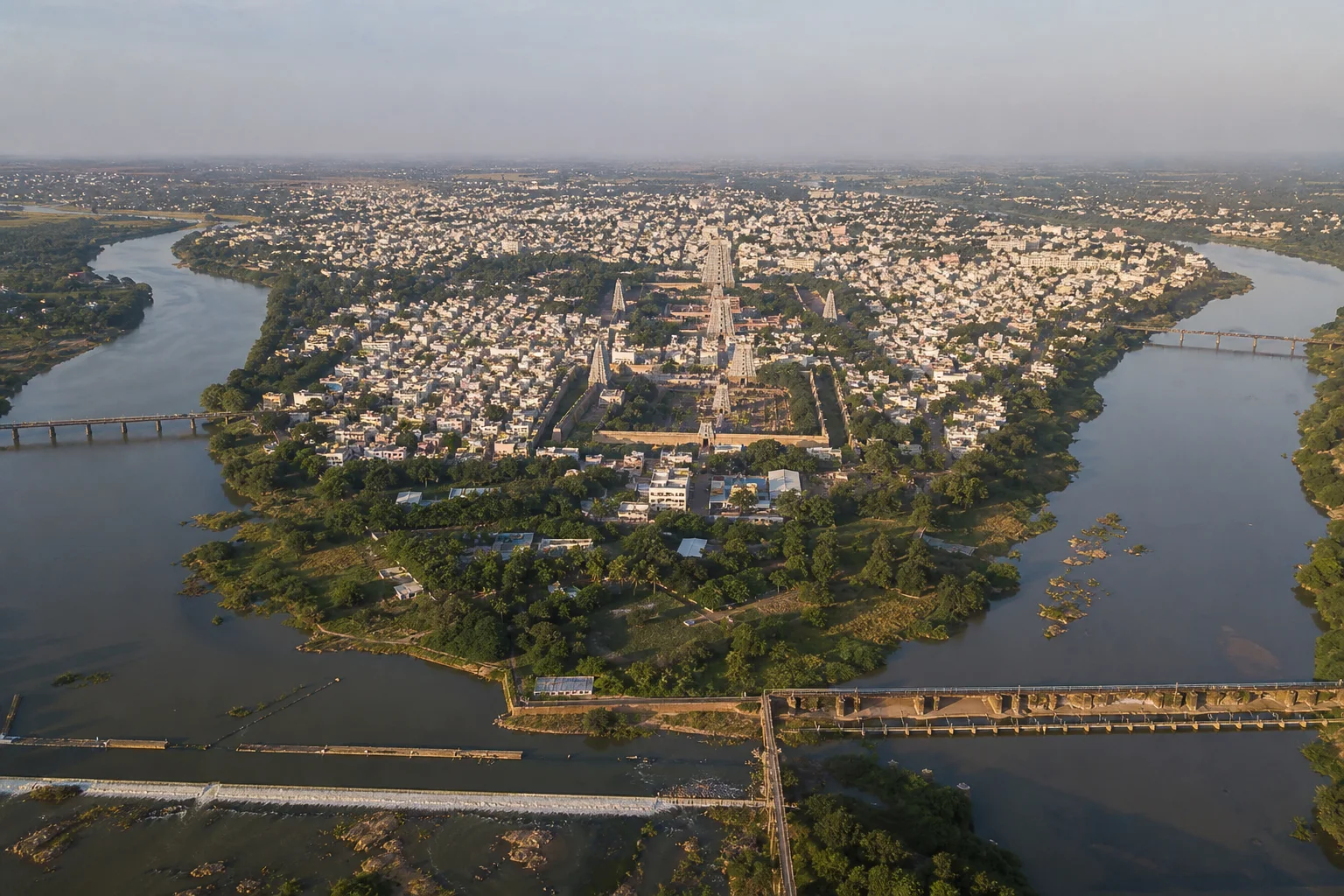
Begin with the island, not the gateway
Srirangam is part of Tiruchirappalli's urban world, yet its geography gives it a distinctive form. The Cauvery and its northern branch, the Kollidam or Coleroon, define the river island on which the settlement stands. District and government records describe this branching river system and identify the temple on the island. Approaching Srirangam only as the location of a famous shrine misses the first relationship that made the place possible: land, water and routes converging around a settled sacred centre.
An island is not automatically isolated. Bridges, roads, river crossings and the wider growth of Tiruchirappalli connect Srirangam to the city and region. Historically, however, channels and changing water regimes shaped access, agriculture, risk and the imagination of place. The visible river today cannot be used to reconstruct every earlier period, and a dry channel or high flow on one visit proves little about the long history. Geography provides the frame; dated hydrological and archaeological evidence must supply the detail.
Sources for this section: Tiruchirappalli District Srirangam, Tiruchirappalli District river geography, Census Tiruchirappalli handbook.
Temple and town are spatially interlocked
The Ranganathaswamy Temple is not a freestanding object separated from settlement by an empty buffer. Its nested enclosures, gateways and streets establish a layered sacred and urban order. Inner precincts concentrate ritual space, while outer enclosures and surrounding streets meet houses, shops, institutions, movement and hospitality. The relationship makes Srirangam legible as a temple town: architecture organizes approaches, but ordinary life also gives those approaches meaning beyond a monument visit.
This does not mean every street or building belongs to one original plan. Sacred towns are repeatedly rebuilt. Patronage, conflict, repair, changing materials, municipal services and household adaptation produce historical layers. A diagram of concentric enclosures can clarify spatial logic, yet it should not erase later change or imply that the entire island is one protected monument. The permanent temple guide is the right place for monument-specific architecture and evidence; here the purpose is to see how a large sacred institution participates in a lived settlement.
Sources for this section: Tiruchirappalli District Srirangam, Ministry of Tourism Srirangam, Srirangam conservation project.
Streets become part of the sacred landscape
In a pilgrimage town, movement is not merely the interval between important buildings. Approaches, circumambulation, thresholds and processional routes can make streets part of religious practice. At Srirangam, the sequence of enclosure and gateway gives movement a strong directional character. A visitor can notice how views open and close, how commerce gathers near paths of arrival and how the scale of a gateway changes the experience of crossing from one zone to another.
Festival processions intensify these relationships, but schedules and routes are current information and can change. They should be verified with the temple administration rather than copied from an undated travel page. Even on an ordinary day, streets carry overlapping claims: residents need access, worshippers need space, vendors work, vehicles move and visitors stop for photographs. Reading the sacred town responsibly begins by recognizing that its public realm is not a staged heritage set.
Sources for this section: Tiruchirappalli District Srirangam, Tiruchirappalli civic places.
Evidence reveals layers rather than a single founding moment
Srirangam carries religious traditions of great antiquity, but tradition, inscription, architecture and archaeology answer different questions. Sacred literature and community memory explain meaning and continuity. Inscriptions can document gifts, offices, patrons and historical events. Architectural study can distinguish building phases. Archaeological excavation can recover material sequences below or beside later structures. Good history allows these forms of evidence to meet without pretending that one automatically proves every claim made by another.
The Tamil Nadu Department of Archaeology records excavations at Srirangam during 2013 to 2015 and describes material findings from investigated areas. Such work is valuable precisely because the modern town is layered: evidence can survive beneath spaces that remain active. Excavation results do not turn the whole island into an archaeological site open for speculation. They provide bounded findings from particular trenches and contexts, which should be interpreted through official reports and specialist scholarship rather than generalized into an exact age for every street.
Sources for this section: Tamil Nadu Archaeology Srirangam, Srirangam conservation project.
A living sacred town is not an open-air museum
People live, study, worship and work within Srirangam. The town contains homes and everyday services alongside spaces oriented toward pilgrimage. That continuity is part of its significance, but it also means visitor behaviour has direct effects on residents. Blocking a doorway for a photograph, treating a residential street as a costume backdrop or assuming every person welcomes attention reduces a lived place to scenery. Sacred etiquette and ordinary civic courtesy belong together.
The same principle applies to food, lodging and shopping. Pilgrimage economies can sustain particular occupations and forms of hospitality, yet individual businesses change. This article does not recommend vendors, prices or operating hours. Instead, notice the pattern: activity thickens near gateways and movement routes, quietens in residential pockets and changes with the ritual calendar. A town-centred reading can make a temple visit more attentive without turning private life into an attraction.
Sources for this section: Ministry of Tourism Srirangam, Tiruchirappalli civic places.
Srirangam belongs to a wider river and sacred landscape
The island should also be read in relation to nearby places. Tiruchirappalli's Rockfort rises from a very different landform and anchors another historical urban centre. Thiruvanaikaval, associated with the Jambukeswarar Temple, forms part of the island's broader sacred geography. River channels, bridges and city growth bring these places into everyday proximity, even though each has its own institution, history and devotional meaning.
This wider view prevents Srirangam from becoming a single-site checklist. It invites comparison between a Vaishnava sacred centre, a Shaiva temple landscape, an urban rock and the river system that connects them. Comparison must preserve difference: proximity is not evidence that all monuments share one date, patron or ritual system. The district guide provides the broader administrative geography, while maps can show contemporary routes without claiming to reproduce historical movement.
Sources for this section: Tiruchirappalli District Srirangam, Tiruchirappalli District river geography, Ministry of Tourism Srirangam.
Visit as a learner in an active sacred place
A useful Srirangam visit can begin outside the main entrance. Pause where it is safe, orient yourself to the river island and notice how streets lead toward successive gateways. Inside, follow current rules on dress, photography, queues and restricted areas. Do not assume that all spaces are open to every visitor. Temple timings, festival arrangements, river conditions, traffic controls and conservation work are live matters that require direct verification with the responsible authority.
Allow the town to resist a single summary. Srirangam is simultaneously an island landform, a major sacred institution, a historical archive, a residential settlement and a node in Tiruchirappalli's urban region. None of those descriptions cancels the others. The reward of looking beyond the temple is not a more elaborate sightseeing list; it is an understanding that pilgrimage landscapes are made through relationships among environment, architecture, memory, movement and daily life.
Sources for this section: Tiruchirappalli District Srirangam, Srirangam conservation project.
Sources & Further Reading
These authoritative references support the historical, geographic, or seasonal context in this story. Current conditions and operating details still require a fresh official check.
- Srirangam Temple · Tiruchirappalli District Administration
- Agriculture · Tiruchirappalli District Administration
- Srirangam · Tamil Nadu Department of Archaeology
- Srirangam · Ministry of Tourism, Government of India
- Places of Interest · Tiruchirappalli City Municipal Corporation
- District Census Handbook: Tiruchirappalli · Census of India
- Conservation and Restoration of Srirangam Temple · Press Information Bureau, Government of India
Related Stories
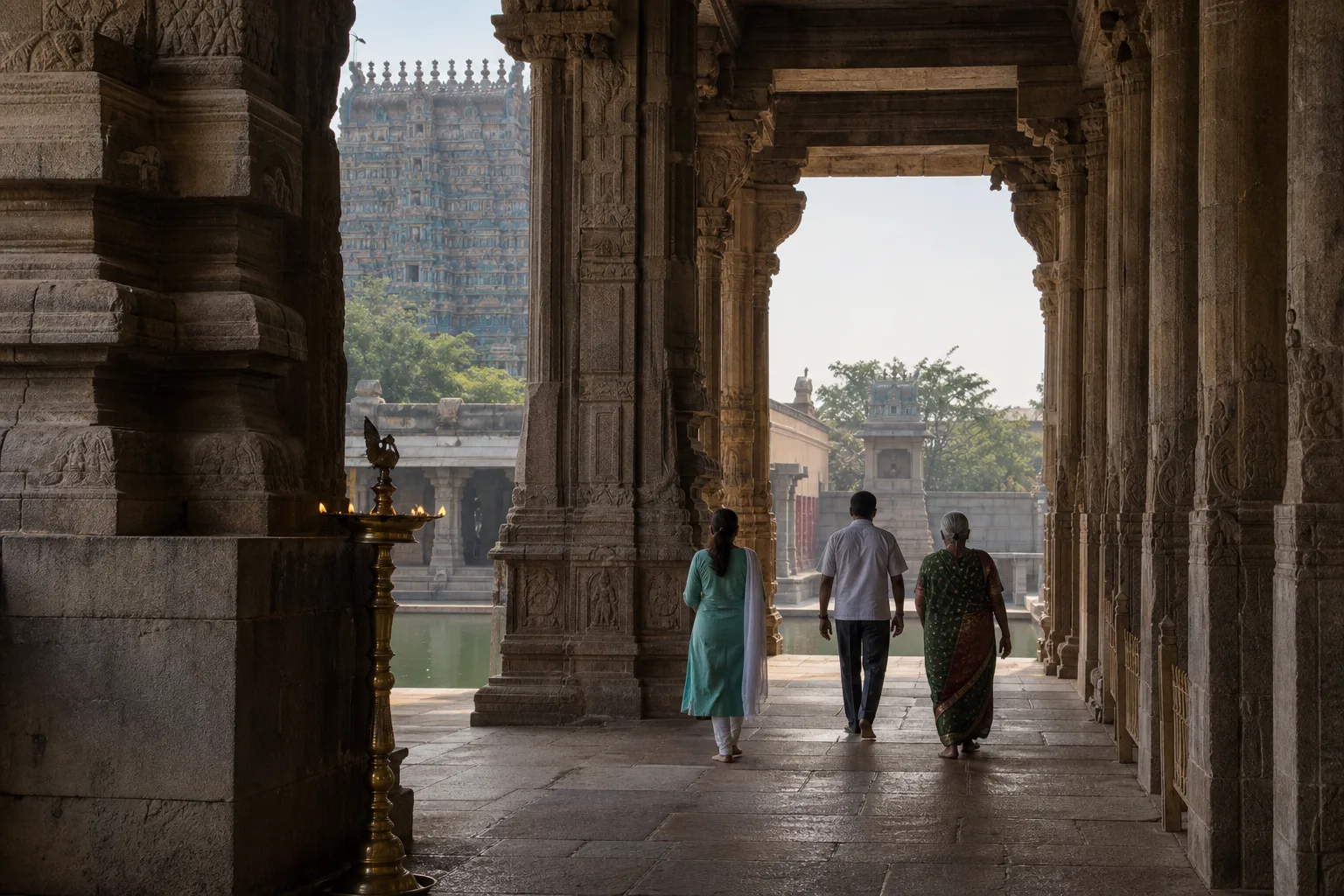
How to Read a Tamil Nadu Temple: Architecture, Ritual Space and Respectful Travel
A visitor's guide to reading temple architecture and ritual space without forgetting that the monument is also a living sacred place.
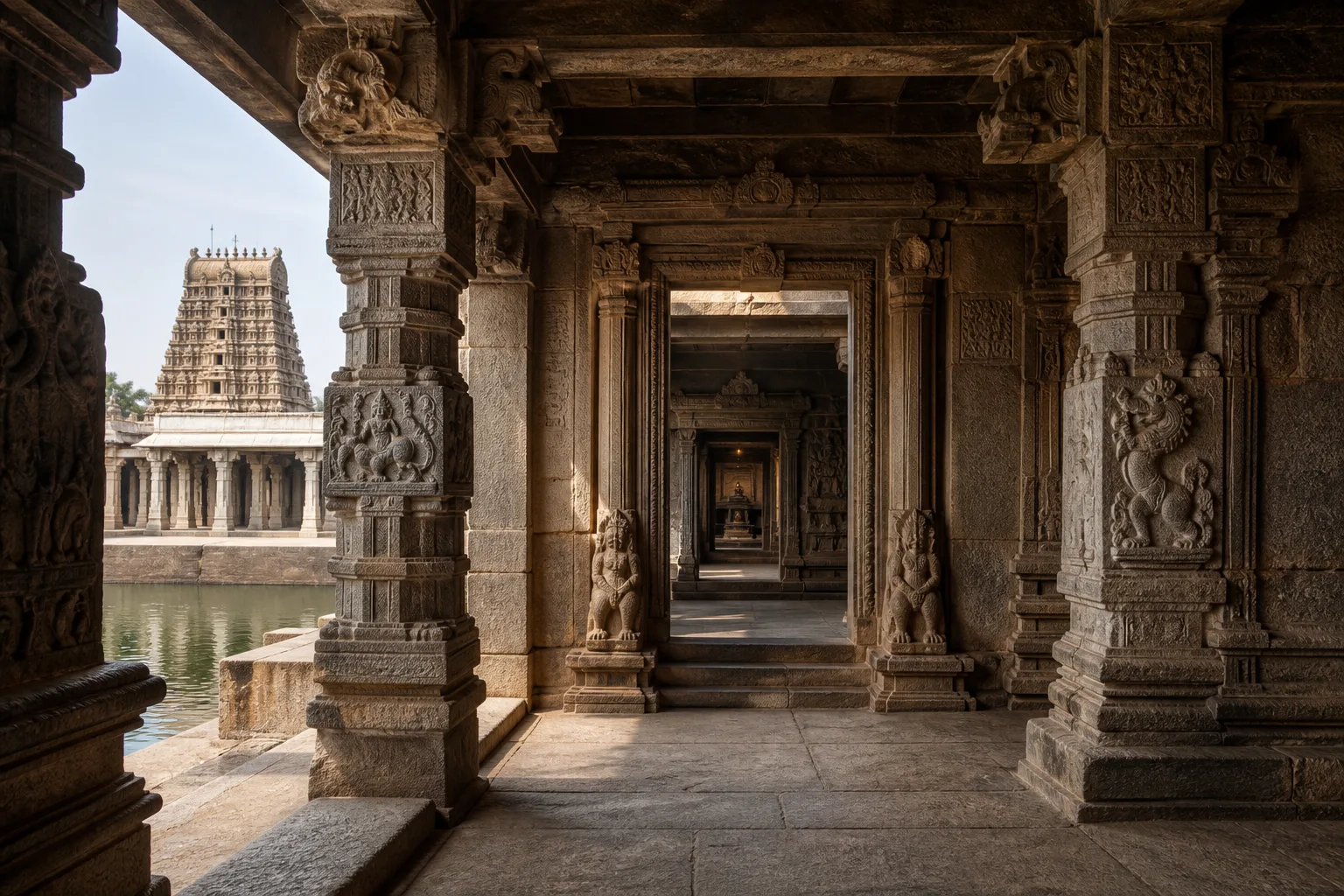
How to Read a Tamil Nadu Temple: Gopurams, Mandapams, Prakarams and Sacred Space
An architectural reading guide to gateways, halls, enclosures, sanctuary towers, tanks, sculpture and inscriptions, grounded in the fact that temples remain living sacred places.
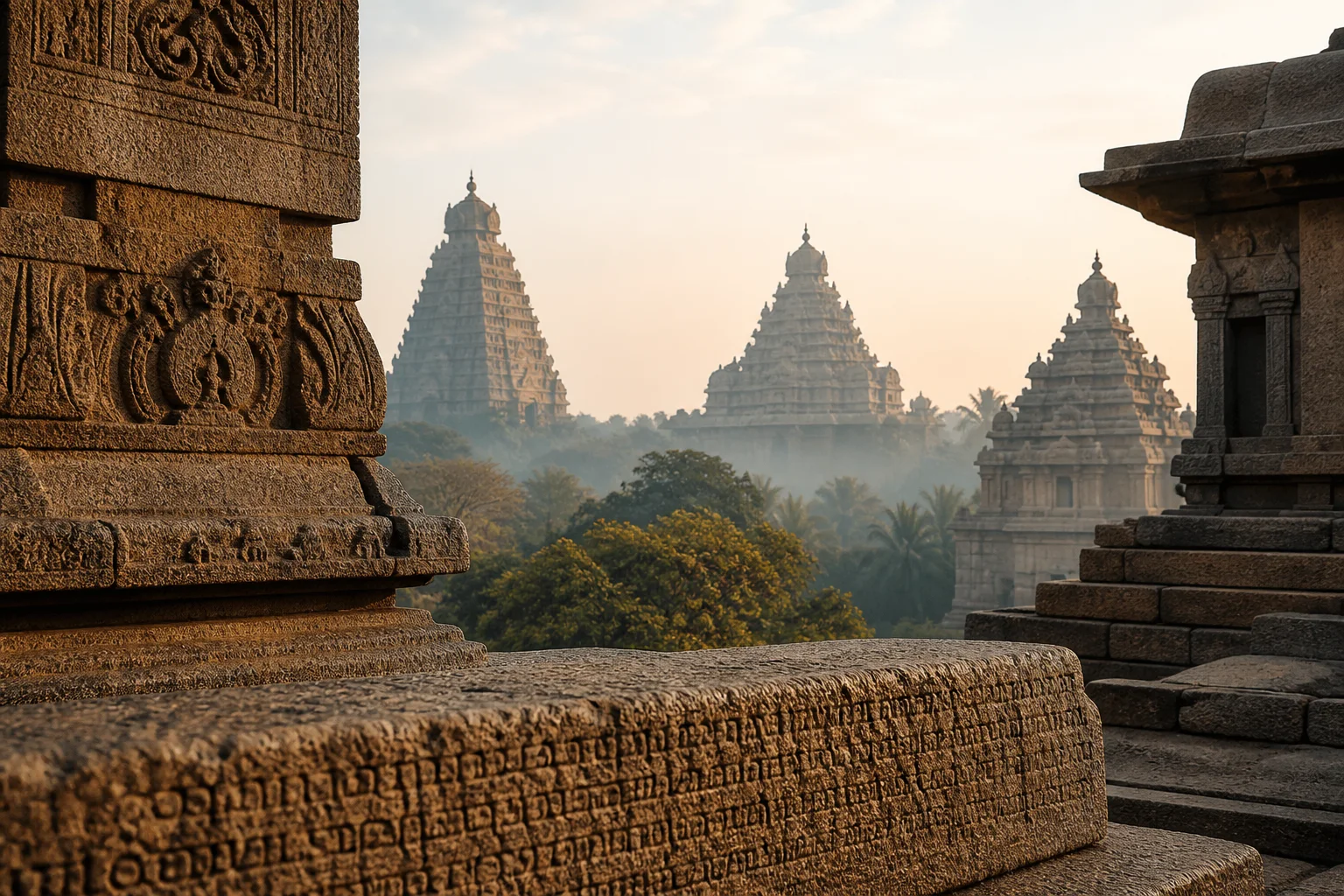
A Journey Through Chola Heritage in Tamil Nadu
Follow a thoughtful route through three living Chola temple landscapes, learning to read architecture, inscriptions, patronage, and place without rushing.
Editorial attribution
Prepared and reviewed by My Tamil Nadu Editorial Desk. Modified 22 August 2026.