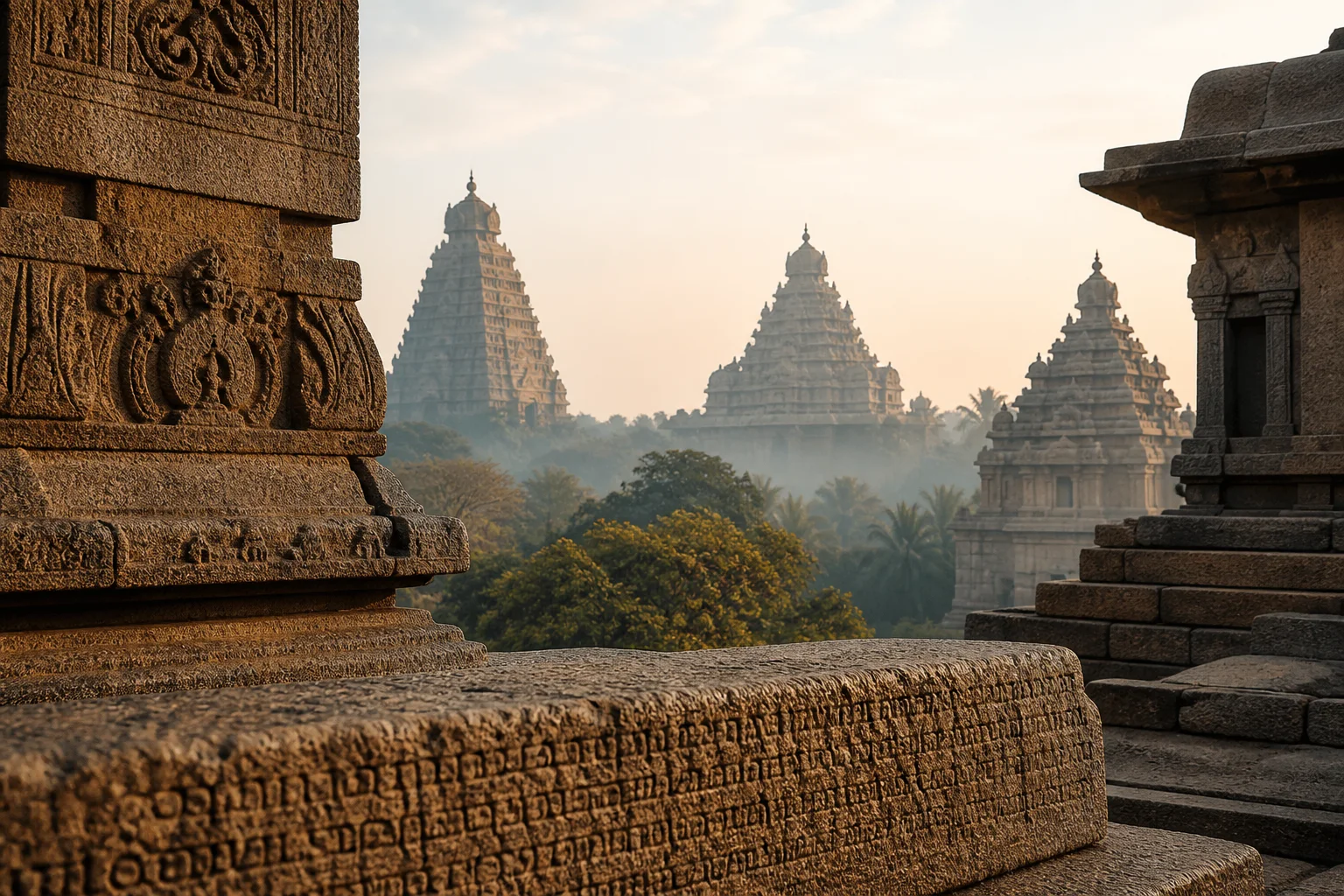
Begin with a journey, not a ranking
Chola heritage in Tamil Nadu cannot be reduced to a list of tallest towers, famous rulers, or must-see photographs. It survives through buildings, inscriptions, sculpture, ritual, settlement patterns, museum collections, remembered names, and continuing debate about how evidence should be read. A journey is useful because it allows those forms of evidence to accumulate. What seems monumental in Thanjavur changes the questions you bring to Gangaikondacholapuram; what feels intimate at Darasuram can send you back to the larger complexes with a sharper eye.
The three temples in this story form the UNESCO World Heritage property called the Great Living Chola Temples: Brihadisvara at Thanjavur, Gangaikondacholisvaram, and Airavatesvara at Darasuram. The word living matters. These are protected heritage places and active sacred environments, not abandoned ruins arranged for a visitor's convenience. Travel slowly enough to notice worship, conservation, movement, sound, shade, and the relationship between a temple and the place around it.
Sources for this section: UNESCO Great Living Chola Temples, UNESCO extension decision.
Thanjavur: let scale become a question
Thanjavur is a strong beginning because Brihadisvara Temple makes scale immediately visible. The enclosure, axial movement, massive stone forms, inscriptions, subsidiary structures, and urban setting ask different questions from a detached photograph of the vimana. Walk through the sequence of spaces before deciding what the monument means. Notice how the tower is approached, where your attention is directed, how human movement is organised, and where later activity sits beside the Chola-period core.
A large temple was not simply a stone sculpture. Inscriptions and scholarship point toward an institution connected with patronage, ritual, gifts, personnel, land, artistic production, and public memory. Those relationships should not be collapsed into a single slogan about royal power, nor should every visible feature be assigned to one moment without evidence. The permanent temple and city guides carry the detailed reference layer; the traveller's task here is to see the complex whole before collecting isolated details.
Sources for this section: UNESCO Great Living Chola Temples, IGNCA Brhadisvara study.
Inscriptions are not captions on a wall
It is tempting to treat an inscription as a label that confirms a date or ruler and then move on. Epigraphy is more demanding. The placement, language, script, formula, physical surface, later copying, and condition of an inscription all affect what can be learned from it. Tamil Nadu's archaeological authorities describe inscriptions as primary documentary evidence for political, social, economic, religious, and cultural history. That makes them powerful, but not self-explanatory.
At a temple, look for inscription bands without touching, rubbing, chalking, wetting, or tracing the stone. You do not need to read the script to understand that the wall also functions as an archive. A translated extract in a scholarly or official source is safer than a confident social-media caption. Distinguish what an inscription records from what a later historian infers, and distinguish both from a modern legend. That habit will improve every stop on this journey.
Sources for this section: Tamil Nadu Epigraphy, Tamil-script inscriptions.
Gangaikondacholapuram: read a capital through what remains
The move from Thanjavur toward Gangaikondacholapuram shifts the story from one celebrated monument to the remains of a capital landscape associated with Rajendra Chola I. The temple is the most visible anchor, but archaeological work at places including Maligaimedu broadens the frame. A vanished palace or urban system should not be reconstructed in the imagination more precisely than the evidence allows. Absence, buried material, altered land use, and incomplete excavation are part of the historical reality.
At Gangaikondacholisvaram, compare rather than rank. The relationship between mass and curvature, the movement through the enclosure, sculptural placement, and the temple's position in a quieter settlement create a different encounter from Thanjavur. Similarity does not mean repetition, and difference does not require a claim that one building is more refined than another. The UNESCO serial-property framework invites a developmental reading across the components while preserving each temple's individual setting and sacred life.
Sources for this section: UNESCO Great Living Chola Temples, Rajendra Chola Site Museum.
Darasuram: allow detail to slow the journey
Airavatesvara Temple at Darasuram changes the physical pace of looking. Its smaller overall scale relative to the largest complexes does not make it a minor experience. Architectural rhythm, carved narrative and ornamental detail, steps, columns, miniature forms, and the transitions between structural parts reward close observation. Move without pressing against sculpture or blocking worshippers, and let changing light reveal texture without treating every carving as a puzzle that must be instantly named.
Darasuram also discourages a simple story of Chola art moving from great to greater. Artistic traditions respond to patronage, workshop knowledge, ritual purpose, available space, material, and historical circumstance. A responsible comparison names visible differences and then asks what evidence supports an explanation. It does not convert taste into chronology. By the third temple, you may find that the journey has moved from awe to attention; that is a gain, not a reduction.
Sources for this section: UNESCO Great Living Chola Temples.
Compare the three temples without flattening them
After all three stops, compare a limited set of observations: how the main tower meets the ground, how the enclosure controls approach, how subsidiary spaces relate to the principal shrine, where inscriptions appear, how ornament changes across structural zones, and how the present settlement meets the protected site. A sketchbook can be more useful than a burst of photographs because it forces you to select relationships rather than collect surfaces.
Keep the UNESCO label precise. The Great Living Chola Temples are a serial World Heritage property made up of these three components; the designation does not turn every Chola-period structure in Tamil Nadu into part of that property. The extension decision added Gangaikondacholapuram and Darasuram to the earlier Thanjavur inscription. Protected boundaries, buffer zones, and management language are technical matters best read in official documents, not guessed from a map screenshot.
Sources for this section: UNESCO Great Living Chola Temples, UNESCO extension decision.
Remember that heritage protection and worship coexist
The living character of the temples changes visitor ethics. A mandapa is not merely a composition frame, a procession is not staged entertainment, and a shrine queue is not an obstacle to architectural viewing. Follow dress expectations, footwear rules, photography restrictions, and instructions from temple and site staff. Give worshippers space. If a ritual area is restricted, the boundary itself is sufficient explanation; heritage interest does not create a right of access.
Conservation can also affect what is visible or reachable. Scaffolding, protected surfaces, controlled movement, and temporary restrictions should not be treated as defects in a trip. They are reminders that these places require continuous care. Current opening arrangements, special observances, photography rules, and conservation work can change, so this article deliberately avoids presenting them as permanent. Confirm them with the responsible temple, monument, or district authority.
Sources for this section: UNESCO Great Living Chola Temples.
Follow Chola art beyond the monument, carefully
Chola-period artistic history also travels through metal images, painting, sculpture, inscriptions, and techniques maintained or reinterpreted in later practice. Museum collections can help a visitor see an object at close range and understand provenance, iconography, or material study, but a museum label and a temple object answer different questions. Do not call every south Indian bronze a Chola bronze on style alone, and do not use a modern craft demonstration as direct proof of an unchanged medieval process.
The most useful bridge is evidence: a secure provenance, an inscription, archaeological context, technical study, or a carefully qualified art-historical attribution. This keeps admiration from becoming overclaim. It also makes room for craftspeople and ritual communities without turning them into scenery for a royal narrative. Tamil Nadu's heritage is richer when architecture, object history, practice, and conservation are allowed to remain connected but not interchangeable.
Sources for this section: ASI Chola bronzes study, IGNCA Brhadisvara study.
Place Rajaraja and Rajendra inside the evidence
Rajaraja Chola I and Rajendra Chola I are central to the stories of Thanjavur and Gangaikondacholapuram, but biography can overpower a site if every feature is narrated as one ruler's personal act. Royal inscriptions, titles, gifts, campaigns, institutions, and building patronage are evidence for historical interpretation; they also belong to formulaic and political contexts that scholars examine critically. A person page should open inquiry, not turn a complex society into a single heroic life.
Read the two biographies beside the dynasty guide, then return to the temples with more specific questions. Which claim rests on an inscription? Which comes from archaeology? Which describes a later memory? Where do artisans, administrators, donors, ritual specialists, and local communities enter the record? The journey becomes historically useful when famous names help organise evidence without erasing everyone else who made, maintained, used, and interpreted these places.
Sources for this section: Tamil Nadu Epigraphy, IGNCA Brhadisvara study.
Do not let the road between monuments disappear
A temple route can make the landscape between sites look like empty transit. It is not. River systems, irrigation histories, fields, settlements, later sacred sites, roads, museums, and changing district boundaries all shape how Chola heritage is encountered today. The modern route is not a medieval map, and present administrative geography should not be projected backward without qualification. Even a place-name can carry several historical layers.
Kumbakonam can help travellers connect Darasuram with a wider sacred and urban region, while Ariyalur District provides the current geographic frame for Gangaikondacholapuram. Use those guides to understand today's places, then let historical sources explain earlier political space. This separation prevents a common error: treating a modern district boundary as proof of a historical territory, or treating an old capital name as if it described the contemporary settlement in full.
Sources for this section: Rajendra Chola Site Museum.
Plan the route responsibly
Do not compress all three temples into an exact schedule copied from another traveller. Road conditions, traffic, worship, conservation work, heat, rain, personal mobility, and time spent reading a site can all change the day. Choose bases and order only after checking a live map and current official information. Build generous pauses, carry water in a reusable bottle, protect yourself from sun and rain, and avoid arriving with the expectation that every area will be photographable or accessible.
The route should leave enough attention for each place. For some travellers that means separate days or a nearby overnight base; for others it means selecting two components now and returning later. This article does not provide current opening hours, ticket details, ritual times, road times, or photography rules. Confirm those with the responsible authorities. A slower itinerary is not only safer and more comfortable; it also supports the central purpose of the journey, which is to compare evidence rather than count monuments.
What the journey can teach
By the end, Chola heritage should feel less like a finished chapter and more like a disciplined conversation. Architecture provides spatial evidence. Inscriptions record selected acts in particular forms. Archaeology tests what survives beneath or beyond the standing monument. Sacred practice keeps places active. Conservation decisions shape access and visibility. Museums and scholarship bring objects and texts into new settings. None of those sources can carry the whole story alone.
That is the value of moving from Thanjavur to Gangaikondacholapuram and Darasuram. The route gives comparison a physical form while resisting the idea that heritage is a ranking of spectacular objects. Return to the permanent guides for detail, follow their sources, and keep uncertainty visible. The most respectful Chola journey is one that leaves the traveller more observant, more cautious with claims, and more curious about the many people and institutions through which the past remains present.
Sources for this section: UNESCO Great Living Chola Temples, Tamil Nadu Epigraphy, IGNCA Brhadisvara study.
Sources & Further Reading
These authoritative references support the historical, geographic, or seasonal context in this story. Current conditions and operating details still require a fresh official check.
- Great Living Chola Temples · UNESCO World Heritage Centre
- Decision 28 COM 14B.17: Extension of the Brihadisvara Temple property · UNESCO World Heritage Committee
- Epigraphy · Department of Archaeology, Government of Tamil Nadu
- Inscriptions in Tamil Script · Department of Archaeology, Government of Tamil Nadu
- Rajendra Chola Site Museum, Gangaikondacholapuram · Department of Archaeology, Government of Tamil Nadu
- Brhadisvara Temple: Form and Meaning · Indira Gandhi National Centre for the Arts
- South Indian Bronzes · Archaeological Survey of India, hosted by IGNCA
Related Stories
A Heritage Weekend from Chennai: How to Choose a Meaningful Route
A practical way to shape a heritage weekend from Chennai around one good question, a measured pace, and a choice between city and nearby extensions.
How to Read a Tamil Nadu Temple: Architecture, Ritual Space and Respectful Travel
A visitor's guide to reading temple architecture and ritual space without forgetting that the monument is also a living sacred place.
How to Read a Tamil Nadu Temple: Gopurams, Mandapams, Prakarams and Sacred Space
An architectural reading guide to gateways, halls, enclosures, sanctuary towers, tanks, sculpture and inscriptions, grounded in the fact that temples remain living sacred places.
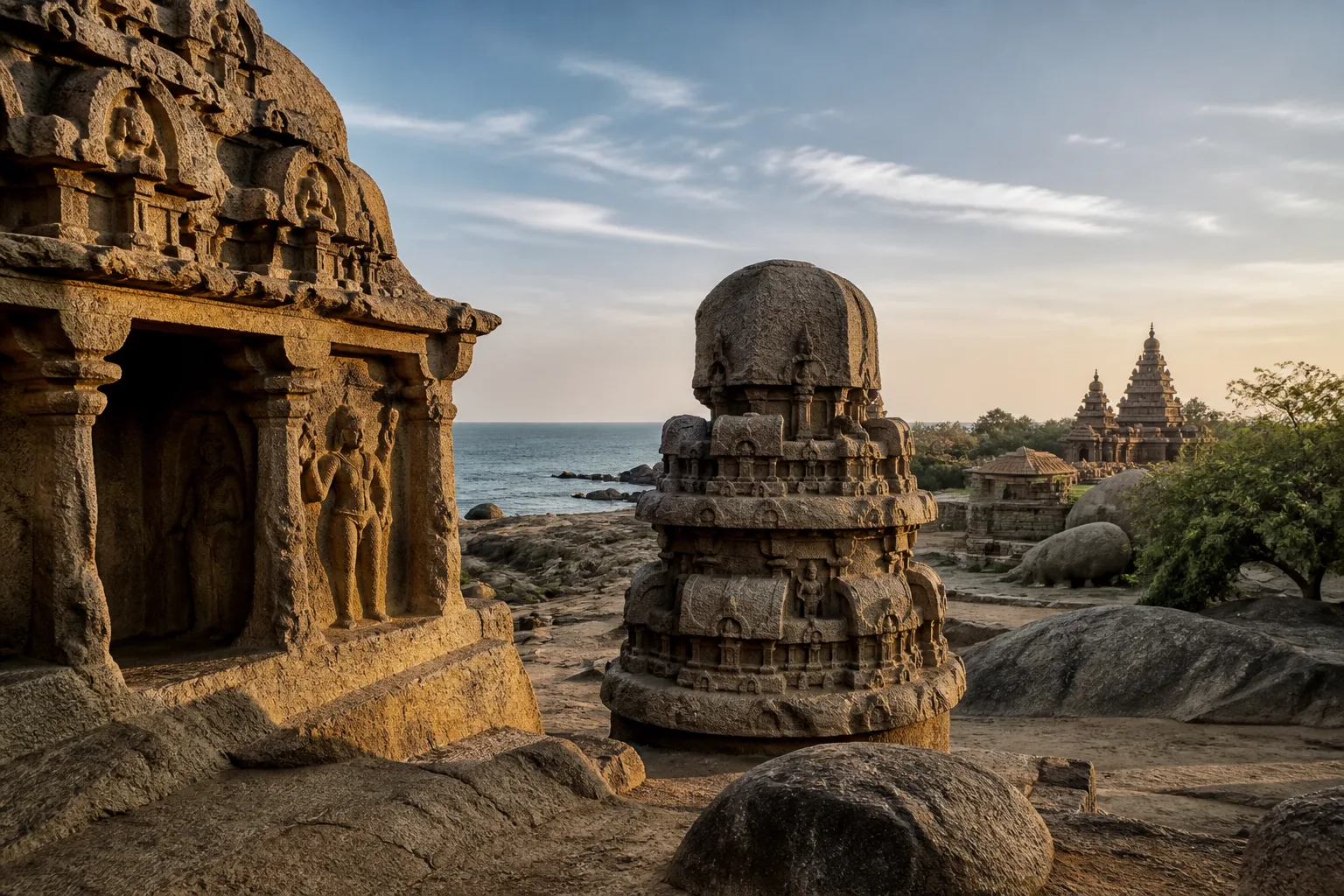
Beyond the Cholas: Exploring Pallava Heritage Across Tamil Nadu
Follow Pallava heritage from Kanchipuram's sacred city to Mamallapuram's coastal stone workshop, learning to compare form, material and evidence.
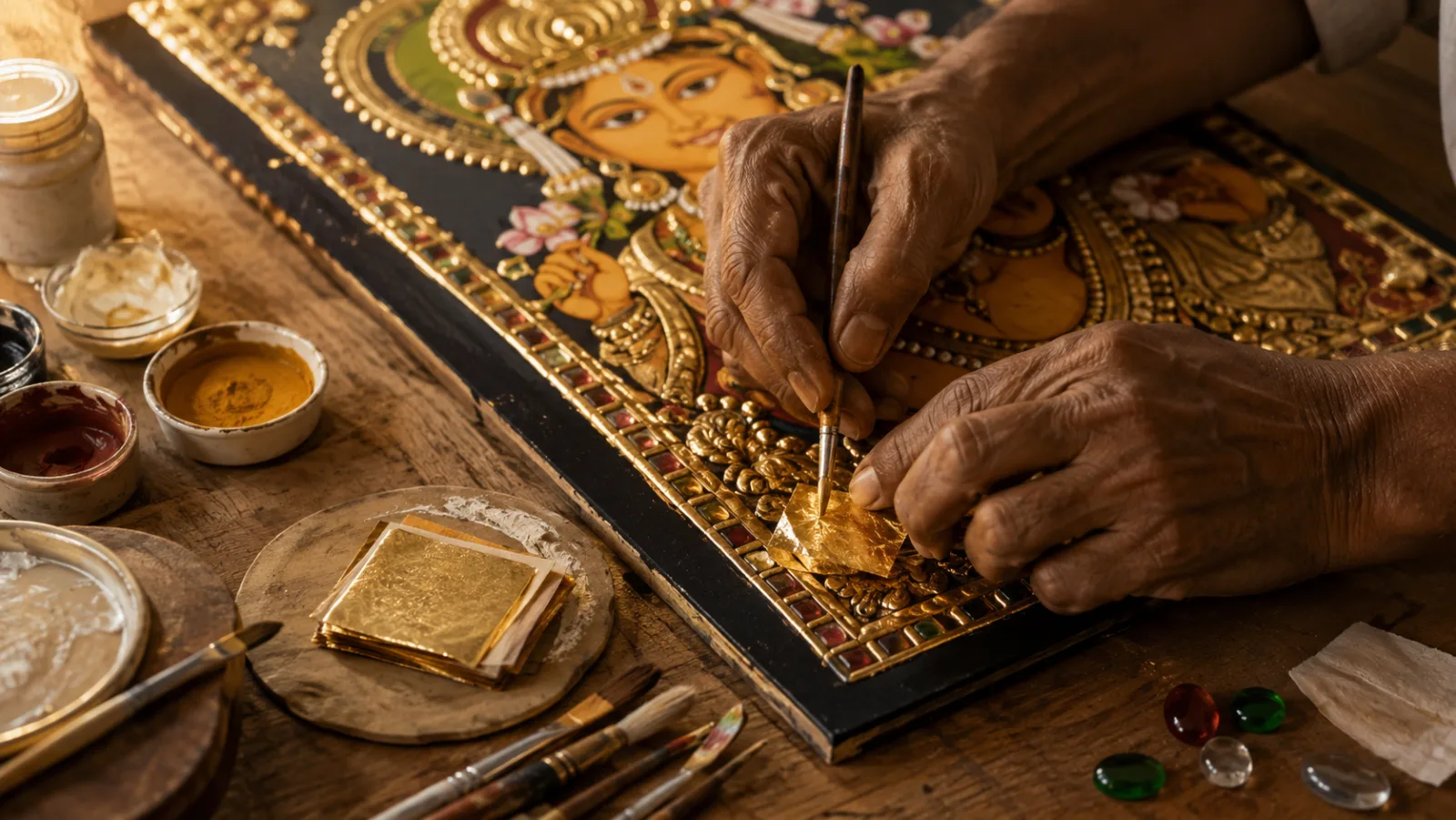
Thanjavur Painting: Read Gold, Relief and Provenance
A material and provenance guide to Thanjavur painting that credits makers and separates visual style, GI records and current authenticity claims.
Frequently asked questions
Are the three Great Living Chola Temples one site?
They form one UNESCO serial World Heritage property with three components: Brihadisvara at Thanjavur, Gangaikondacholisvaram, and Airavatesvara at Darasuram. Each has its own setting and living sacred context.
Can all three temples be visited in one day?
This article does not promise a fixed route time. Traffic, current access, worship, conservation, weather, mobility, and the depth of your visit all matter. Use a live map and current official information, and prefer a pace that allows careful observation.
Are all visible features at these temples from the same Chola-period moment?
No such assumption should be made. Living monuments can contain additions, repairs, conservation interventions, and later layers. Use the individual temple guides and their sources for feature-specific context.
May I photograph inscriptions and sacred areas?
Photography rules can vary by site and area and may change. Follow posted instructions and staff guidance. Never touch, trace, chalk, wet, or rub an inscription or carved surface.
Editorial attribution
Prepared and reviewed by My Tamil Nadu Editorial Desk. Modified 15 August 2026.