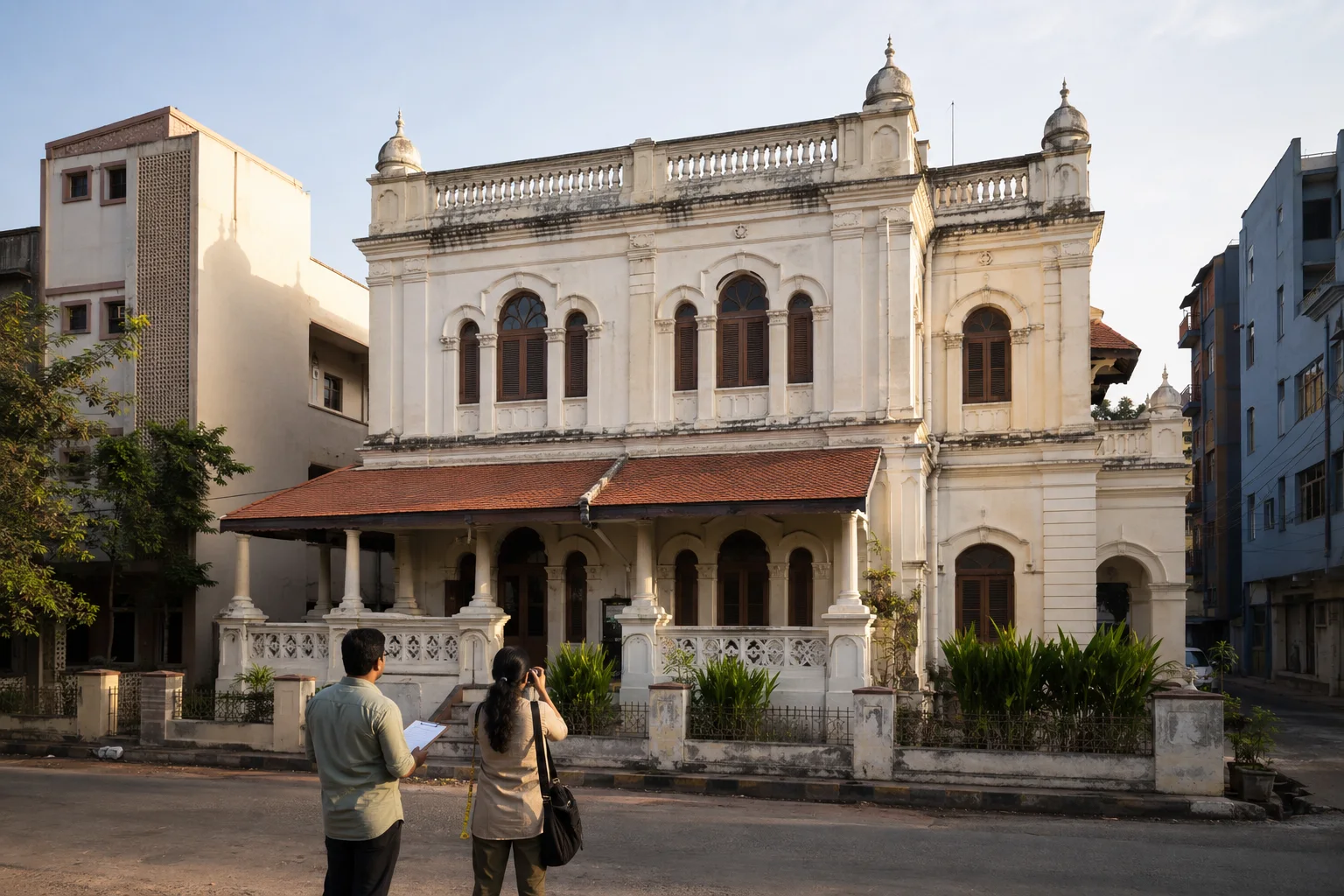
What happened in July 2026
An extraordinary Tamil Nadu Government Gazette dated 16 July 2026 formally constituted the Tamil Nadu Heritage Commission under the Tamil Nadu Heritage Commission Act, 2012. The notification named Dr M. Nambirajan as Chairman and listed ex-officio members drawn from departments and institutions concerned with registration and religious endowments, housing and urban development, municipal administration, rural development, law, museums, archaeology, architecture, environment and public works.
The notification is a constitution order: it establishes the Commission and identifies its membership. It is not a statewide inventory of heritage buildings, a restoration programme, a planning permission or a declaration that every old structure has acquired a new legal status. Those distinctions matter because a short news headline can make an institutional beginning sound like a completed conservation outcome.
The longer chronology is also important. The Legislature enacted Act 24 of 2012 in May 2012. An official government notice says the Act came into force on 1 March 2024. A 2024 amendment was subsequently enacted, and its commencement was notified in January 2025. The July 2026 constitution therefore sits within an amended legal framework rather than creating the framework from nothing.
Sources for this section: Commission constitution, Heritage Commission Act, Official chair notice, 2024 amendment record, Amendment commencement.
Why the Act created a separate Commission
The preamble to the 2012 Act identifies a specific gap. It refers to buildings or premises not covered by the central Ancient Monuments and Archaeological Sites and Remains Act, 1958 or the Tamil Nadu Ancient Monuments and Archaeological Sites and Remains Act, 1966. It then describes the need for a statutory authority to advise on identifying, restoring and preserving heritage buildings and on development or engineering operations likely to affect them.
That purpose gives the Commission a built-environment focus broader than a visitor's familiar list of archaeological monuments. Tamil Nadu's heritage can also be present in civic buildings, institutional campuses, commercial streets, houses, industrial structures, designed landscapes and groups of premises. Age alone is not the test stated in the Act: historical, architectural, environmental or cultural importance and the need for preservation and conservation are central to its definition of a heritage building.
The definition can include adjoining land needed to preserve a building and areas or groups of buildings requiring conservation. This makes setting, streetscape and development pressure relevant. It does not allow a travel writer to decide legal status by visual impression. Identification and classification belong to the official process.
Sources for this section: Heritage Commission Act, Official chair notice.
The Commission is principally an advisory body
Section 11 of the Act describes a substantial advisory role. Local authorities are to refer matters concerning identification, restoration and preservation of heritage buildings, and development or engineering operations likely to affect preservation, for the Commission's advice. The listed functions include advising government on classification and grading, conservation regulations, possible uses, restoration, documentation, public awareness and measures against defacement or destruction.
The section also addresses local planning details: display structures, repair funding, design guidance, building height and essential characteristics, and possible incentives. These provisions show why heritage conservation is not only about repairing a facade. It can involve records, land use, public amenities, streetscape, economics and the relationship between a property and surrounding development.
Calling the Commission advisory should not be read as calling it incidental. The Act gives its advice a defined place in government and local-authority decisions. At the same time, this article does not predict how any future application, classification or dispute will be resolved. Owners, applicants and public authorities should use the current Act, rules, notifications and competent professional advice for a real case.
Sources for this section: Act section 11, Heritage Commission Act.
Do not merge different heritage designations
A building discussed by the Heritage Commission is not automatically a monument protected by the Archaeological Survey of India. It is not automatically protected under the Tamil Nadu archaeology law, included in a local heritage list, recognized by UNESCO or managed as a living religious institution. Each description depends on a different law, notification, nomination, register or responsible authority.
The 2012 Act was expressly framed with reference to buildings outside the two ancient-monuments laws, while its definitions and later legal interpretation can intersect with a wide range of properties. The July 2026 membership itself brings several relevant authorities to one table. Coordination, however, is not the same as erasing their separate mandates.
For My Tamil Nadu, the editorial rule is simple: name the exact designation and cite the exact authority. An old photograph, architectural style, popular nickname or inclusion in a heritage walk may establish cultural interest, but none alone proves statutory protection. Where a current official list is unavailable, say that status requires verification instead of upgrading a place through enthusiastic wording.
Sources for this section: Heritage Commission Act, Official chair notice, Commission constitution.
Constitution is a beginning, not a completed inventory
The Gazette confirms who constituted the Commission in July 2026. It does not, by itself, publish a complete classified register, meeting decisions, site-by-site advice, repair grants or conservation outcomes. Those would require their own official records. Until such material is published, responsible coverage should not fill the gap with inferred lists or declarations copied from promotional sources.
Future evidence worth watching includes notified classifications, regulations, public consultation material, annual reports, local-authority references and decisions that explain how advice is applied. The Act also provides for appeals and revision, reminders that heritage administration can involve process and competing interests rather than a single visual judgment.
This distinction protects both readers and places. A claim that a building is officially listed may affect expectations about ownership, alterations, access and responsibility. A claim that a Commission has saved a structure may obscure the slower work of documentation, consent, technical assessment, financing and maintenance. Report each stage by its proper name.
Sources for this section: Commission constitution, Heritage Commission Act.
Why this matters beyond famous monuments
Tamil Nadu's cities and towns contain buildings whose significance comes from use, neighbourhood setting, craft, public memory or a wider ensemble rather than monumental scale. A functioning Commission can provide a forum in which those values are documented alongside development, engineering and local-government decisions. The Act's concern with classification, records and design guidance makes that wider urban reading possible.
Chennai may draw attention because of its concentration of civic, institutional and commercial architecture, but the Act is statewide. District headquarters, market streets, railway-era settlements, coastal trading towns, industrial landscapes and rural public buildings can all raise conservation questions when supported by evidence. This article does not nominate any of them for classification.
Visitors can help by noticing relationships: verandahs and climate, street width and commerce, materials and repair, public buildings and civic life, or a group of modest facades forming a coherent place. The goal is not to turn every weathered building into a monument. It is to understand why documentation and careful decision-making may be necessary before change becomes irreversible.
Sources for this section: Act section 11, Heritage Commission Act.
Visit built heritage without treating it as public property
Heritage importance does not guarantee public access. A significant building may be a residence, workplace, school, religious place, government office or unsafe structure. Stay on lawful public routes, obey signs, ask before entering or photographing people and do not assume that a locked gate is an invitation to find another way in.
Avoid touching fragile surfaces, leaning equipment on walls, moving objects or flying a drone without the permissions required for that location. Do not publish access points to vulnerable interiors or encourage exploration of abandoned-looking structures. A photograph can document streetscape without exposing a sensitive place to trespass or damage.
If you notice an apparent threat, preserve context rather than confronting workers or making an instant legal accusation. Record the public-facing location and date safely, then consult the relevant local authority or responsible department. Whether a property is listed, whether work is authorized and which body has jurisdiction are questions for current official records.
Sources for this section: Heritage Commission Act, Official chair notice.
A practical test for any heritage-status claim
First, identify the exact place and the exact wording being claimed. Listed, protected, graded, conserved, nominated and historically important are not synonyms. Second, locate the authority: the Tamil Nadu Government Gazette, Archaeological Survey of India, State Department of Archaeology, local planning authority, UNESCO or another named institution. Third, record the notification, list or decision date because status and administrative arrangements can change.
Then separate legal status from visitor information. A protection notification does not establish opening hours, ticket price, photography rules, structural safety or step-free access. Verify those with the manager or responsible authority close to the visit. Likewise, a current closure or repair notice does not redefine the historical significance of the place.
For the Heritage Commission itself, begin with the 2012 Act, the commencement and amendment records, and the July 2026 constitution notification. Add later registers, regulations or decisions only when they are officially published. That method is slower than repeating a headline, but it gives Tamil Nadu's built heritage the precision it deserves.
Sources for this section: Commission constitution, Heritage Commission Act, 2024 amendment record, Amendment commencement.
Sources & Further Reading
These authoritative references support the historical, geographic, or seasonal context in this story. Current conditions and operating details still require a fresh official check.
- Constitution of the Tamil Nadu Heritage Commission and Nomination of Chairman · Tamil Nadu Government Gazette
- Tamil Nadu Heritage Commission Act, 2012 (Act No. 24 of 2012) · Tamil Nadu Government Gazette, reproduced by PRS Legislative Research
- Section 11: Powers and Functions of the Commission · Indian Kanoon reproduction of Tamil Nadu Act 24 of 2012
- Appointment of Chairman to the Post of Tamil Nadu Heritage Commission · Hindu Religious and Charitable Endowments Department, Government of Tamil Nadu
- Tamil Nadu Heritage Commission (Amendment) Act, 2024 (Act No. 38 of 2024) · Tamil Nadu Stationery and Printing Department
- Date of Commencement of the Tamil Nadu Heritage Commission (Amendment) Act, 2024 · Tamil Nadu Government Gazette
Related Stories

Madras Day Beyond One Date: How to Walk Chennai's Layers
A practical way to turn Madras Day curiosity into year-round neighbourhood reading without reducing Chennai's history to one fort or founding story.
Chennai Government Museum: Read a Campus of Collections
A first-visit method for reading the Egmore museum as an evolving campus of architecture, archaeology, bronzes, inscriptions and public education.
Sittannavasal: Read a Jain Hill Through Paint and Stone
A conservation-first guide connecting Sittannavasal's Jain cave, fragmentary paintings, rock beds and inscriptions without forcing them into one date.
Frequently asked questions
Was the Tamil Nadu Heritage Commission newly created in 2026?
The enabling law was enacted in 2012 and brought into force in 2024. The Government formally constituted the Commission and named its membership in July 2026.
Does the Commission replace the Archaeological Survey of India?
No. The Commission's framework does not erase the separate laws, lists and responsibilities of ASI, the Tamil Nadu archaeology authorities, local bodies or managers of living institutions.
Is every old building now protected?
No. Age or appearance alone does not establish listing or legal protection. Check the relevant official classification, notification or register for the specific property.
Can visitors enter a heritage building?
Heritage interest does not guarantee public access. Ownership, use, safety, management and current rules must be checked separately.
Is this article legal advice?
No. It is a public-interest editorial explanation of official records. Property, development or compliance questions require the current law, notifications and qualified advice.
Where should new Commission decisions be verified?
Use the Tamil Nadu Government Gazette and the responsible state or local authority. Treat media summaries as discovery leads, not final proof of legal status.
Editorial attribution
Prepared and reviewed by My Tamil Nadu Editorial Desk. Modified 6 September 2026.