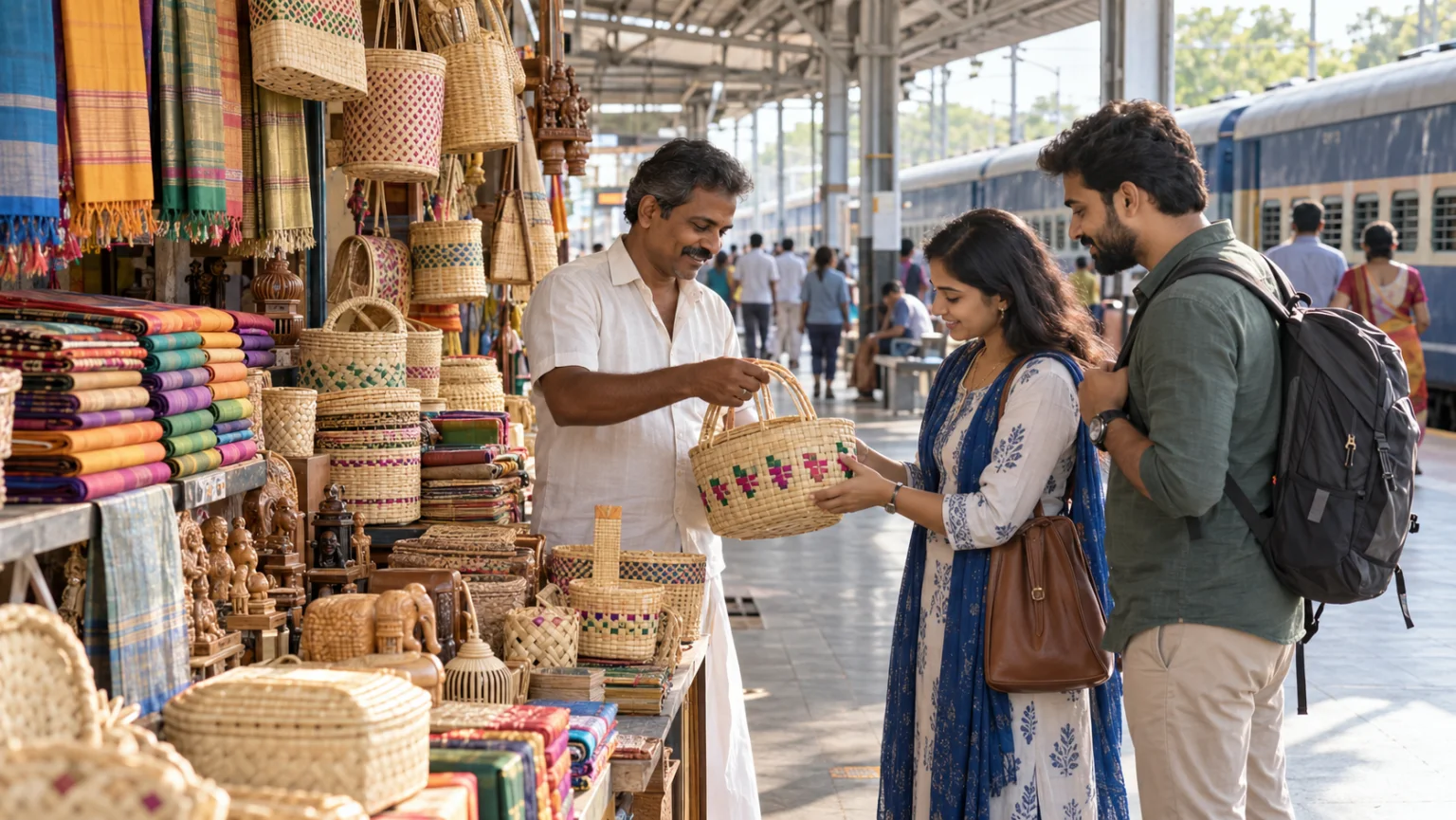
Why One Station One Product matters in 2026
The One Station One Product program was designed to give regional products and producers a visible sales point at railway stations. A March 2026 Press Information Bureau release said the initiative had reached more than 2,000 stations through 2,326 outlets and benefited more than 1.32 lakh people as of 19 January 2026. Those are national figures, not a count of shops guaranteed to be open at every Tamil Nadu station on every day.
For travelers, the idea solves a real problem. A short rail itinerary may not leave time for a weaving town, craft cluster or food market, while a station outlet can provide a direct introduction. For producers, station footfall can create sales and recognition. The best outcome is not simply more souvenirs; it is a purchase in which the traveler understands what the product is, where it comes from and how to use or care for it.
Availability remains dynamic. Product categories, stall locations, operating hours and participating vendors can change. Official releases have cited examples such as cane products at Tenkasi Junction and earlier Tamil Nadu station participation, but they should be read as evidence of the program rather than a live inventory. Ask station staff where the current OSOP outlet is, then decide whether the product suits you without delaying boarding.
Sources for this section: OSOP expansion in 2026, OSOP stations in Tamil Nadu.
What you may find at a Tamil Nadu station outlet
Tamil Nadu's regional product vocabulary is unusually broad: handloom textiles, palm-leaf and cane work, wood and metal craft, dolls, household items, snacks, spices and processed agricultural products. The program may connect a station to a nearby district specialty, but the relationship is not always obvious from a hurried glance. Ask the seller to name the product, production place and material. A clear answer is more valuable than guessing from color or pattern.
At a larger station, a kiosk may be easy to spot near a concourse; at a smaller one, the outlet may occupy a compact table or temporary-looking space. Do not assume that scale proves authenticity. Equally, an attractive display does not guarantee that every item was made locally. Look for product information, producer or group details and a receipt. When a textile has a geographical indication or certified claim, ask what documentation supports that specific item.
Food requires a different check from craft. Read the sealed label for ingredients, allergens, net quantity, manufacturer or packer, batch information, packing or manufacturing date, best-before information and required storage. A familiar local name does not make an unlabelled product suitable for a long journey. If the package is damaged, warm when it should be chilled or beyond its date, leave it.
Sources for this section: OSOP expansion in 2026, Food labeling rules.
Ask seven quick questions before buying
Start with origin: Where was this made, and by whom? Then ask about material and method. For a basket, that may mean the plant fiber and weaving process; for a textile, the fiber, loom and care; for a carved object, the wood or other material. Ask whether the displayed price is final and request a receipt. These questions can be friendly and brief, and a knowledgeable seller will usually welcome genuine interest.
Next consider the journey. Will the object fit safely in your luggage? Can it tolerate rain, pressure and temperature? Is it permitted in your cabin or checked baggage? Food, liquids, sharp tools, plant material and fragile items can create transport complications. Airline or international border rules may be stricter than rail rules, so check the authority that controls the next leg rather than relying on the seller's reassurance.
Finally ask how to care for or consume the product. A handloom may need gentle washing and shade drying. Palm leaf should stay dry and avoid crushing. Food may need refrigeration after opening. Photograph the care information if permitted, but keep the receipt and label. The goal is to bring home something you can actually use, not an object that becomes waste after surviving one platform photograph.
- Where was it made?
- Who made or supplied it?
- What material and process were used?
- What is the final price?
- Can I get a receipt?
- How should I pack it?
- How should I care for or consume it?
Sources for this section: OSOP expansion in 2026, Food labeling rules.
Avoid easy authenticity claims
Authenticity is not a visual style. Bright colors, hand-painted irregularity or a traditional motif do not by themselves prove origin. A station kiosk can be part of an official local-product initiative while still carrying items from different producers or batches. Ask precise questions and accept that the seller may know some answers but not others. It is better to buy a modest, well-described product than an expensive item supported by a dramatic story alone.
Be especially careful with claims that an object is antique, temple-used or made from a restricted natural material. Do not buy antiquities, wildlife products or anything whose legal status is unclear. Genuine old cultural objects can be subject to legal protection and export rules. OSOP is intended to promote contemporary local production, so an implausible archaeological or sacred provenance should be a warning, not a bonus.
Price also needs context. Handmade work can cost more because time and skill are part of the product. Bargaining aggressively in a short station interaction may erase that value. You can ask whether the price is marked or fixed and compare similar items, but do not pressure a producer to match mass-market prices. If the explanation, price or quality does not feel right, thank the seller and walk away without accusation.
Sources for this section: Antiquities guidance, OSOP expansion in 2026.
Example 1: a cane product during a Tenkasi rail connection
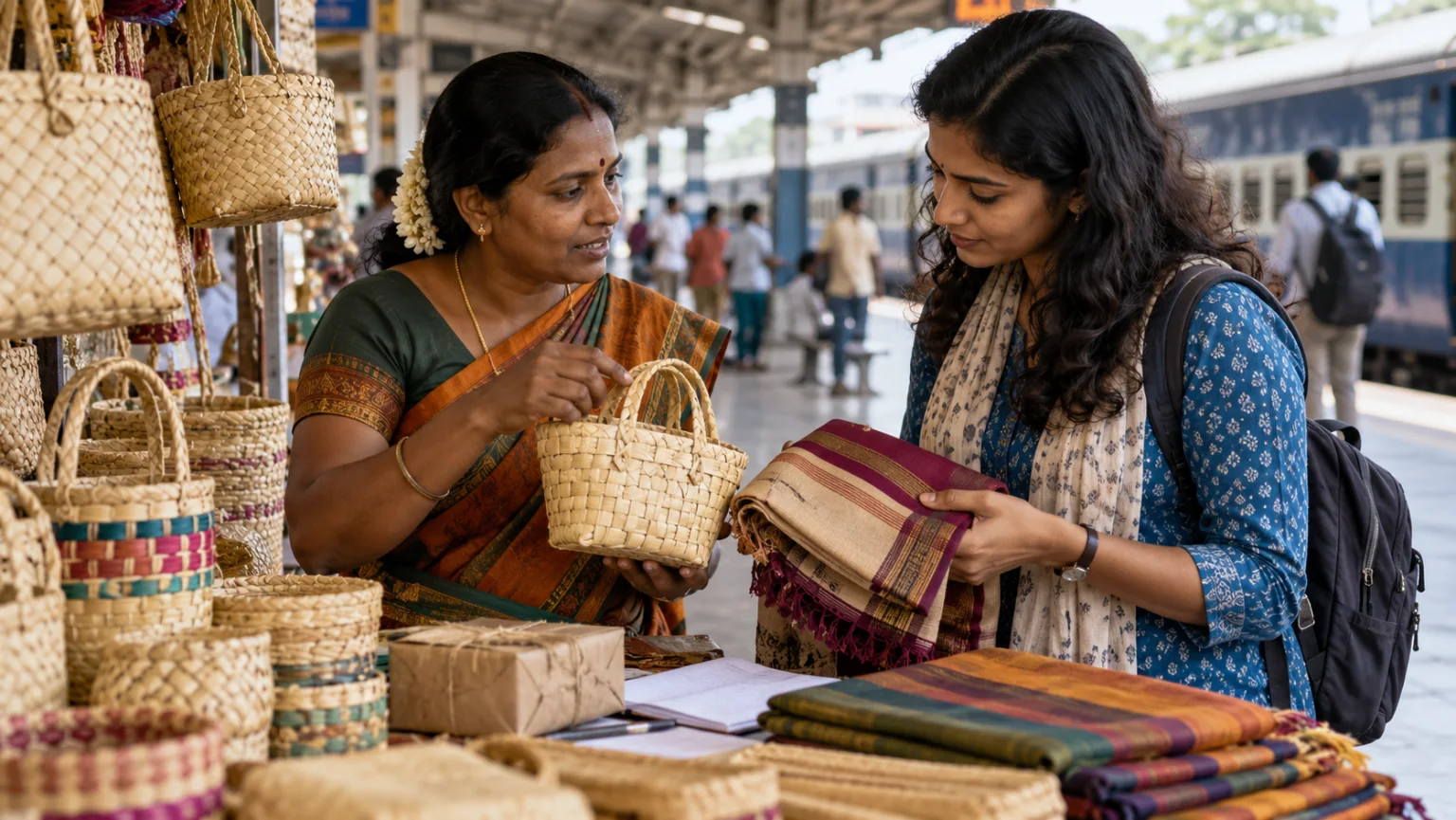
A traveler has twenty-five minutes between reaching Tenkasi Junction and boarding an onward train. A 2026 official release highlighted cane products at the station, so the traveler knows what might be available but does not assume the stall will be open. After locating the platform and confirming the train status, the traveler asks station staff for the OSOP outlet. Boarding remains the first priority.
At the kiosk, the traveler selects a compact cane item rather than a large basket that will be crushed. They ask where it was made, check the weave for broken edges and request the price and receipt. The seller explains that the natural material should be kept dry. The traveler wraps it in clothing inside a structured bag instead of hanging it outside a backpack where it can snag in a crowd.
The purchase takes ten minutes because the traveler arrived with a decision framework. If the outlet is closed or the item is too large, they leave without seeking an unofficial seller beyond the station boundary during a short connection. The product is meaningful because it links the journey to a regional skill, not because completing a shopping mission matters more than the train.
Sources for this section: OSOP expansion in 2026.
Example 2: building a small gift plan at a Chennai station
A couple returning from Chennai wants gifts for six relatives but has limited luggage. They first decide on a budget, maximum size and dietary constraints. At the station they find the current OSOP location only after checking their platform and boarding time. They look for compact textiles or sealed food products rather than buying six fragile decorative objects under pressure.
For textiles, they ask about fiber, dimensions, care and production place. For food, they read the full label and choose packages whose best-before period covers the journey. One relative has a nut allergy, so they do not rely on the product name or a verbal guess; they read the allergen and ingredient information and skip anything unclear. They keep receipts and separate food from damp clothing.
They buy fewer, better-understood gifts and take a photograph of each label before wrapping. If they later fly internationally, they check the destination country's food and plant-material rules. The station purchase becomes a convenient final step, but it does not replace a specialist craft visit when provenance, customization or a high-value item deserves more time.
Sources for this section: Food labeling rules, OSOP stations in Tamil Nadu.
Keep shopping subordinate to station safety
Reach the correct station, entrance and platform before browsing. Tamil Nadu cities can have more than one rail terminal, and a product listing does not tell you where your train departs. Keep luggage in your control, avoid exposing cash or identity documents, and do not follow an unknown person into a secluded area. Use official signs, enquiry points and railway staff for directions.
Set a hard stop for shopping. Train platforms can change and boarding may begin while a transaction is still being packed. Never cross tracks, stand near the platform edge for a product photograph or board a moving train. If a vendor cannot complete payment and packing within your safe window, leave the purchase. A missed train costs far more than the opportunity to buy one local item.
Digital payment can be convenient, but verify the recipient name and amount before authorizing. Do not share a one-time password, screen-control access or unnecessary identity information. Keep the receipt without displaying your phone number publicly. For railway security help, use current official channels displayed by Indian Railways; in an immediate emergency, follow station instructions and the national emergency system.
Sources for this section: Indian Railways, RailMadad.
Make each station purchase count
One Station One Product works best as a doorway. Read the maker information after the journey, learn where the material comes from and use the item regularly. If the product performs well, seek the producer or recognized cluster through reliable channels for future purchases. Do not remove labels before you record care, ingredient or contact information, and share a producer's story only when the product itself supports it.
Travelers can also provide useful feedback through legitimate channels. A clear receipt, product name, station, date and photograph of the item make a quality concern easier to investigate than a vague post. Direct safety or fraud concerns to the proper railway or consumer system. Do not threaten an individual vendor online when the problem may involve packaging, transport or a misunderstanding that can be resolved factually.
The 2026 expansion shows that railway stations are becoming small points of regional discovery, not merely transit halls. Still, the responsible formula is simple: verify the outlet, ask about origin, read the label, protect boarding time and buy only what you can transport and use. A thoughtful ten-minute purchase can support local work and carry a real memory of Tamil Nadu farther than a generic souvenir.
Sources for this section: OSOP expansion in 2026, National Consumer Helpline.
Sources & Further Reading
These authoritative references support the historical, geographic, or seasonal context in this story. Current conditions and operating details still require a fresh official check.
- One Station One Product Scheme · Press Information Bureau, Government of India
- One Station One Product Scheme in Tamil Nadu · Press Information Bureau, Government of India
- Labelling and Display Regulations · Food Safety and Standards Authority of India
- Antiquities and Art Treasures Act · Archaeological Survey of India
- Indian Railways Passenger Services · Ministry of Railways, Government of India
- RailMadad Passenger Grievance System · Indian Railways
- National Consumer Helpline · Department of Consumer Affairs, Government of India
Related Stories

Tamil Nadu Craft Tourism: Plan a Weekend with Weavers and Makers
A practical guide to craft-focused travel, with three Tamil Nadu route ideas, workshop questions and ways to make your visit worthwhile for local makers.

Nilgiri Mountain Railway: Read the Line, Not Just the View
A practical heritage journey from the plains toward Udagamandalam that treats the railway as working engineering, a regional connection and a changing service.

Tamil Nadu Festival Travel 2026: How to Plan Trains, Buses and Return Trips
A practical guide to Tamil Nadu's festival travel rush, with train, bus, Chennai-return, family and temple-event planning examples.
Frequently asked questions
What is One Station One Product?
It is an Indian Railways initiative that provides station sales outlets for products associated with local or regional livelihoods, such as crafts, textiles, foods and agricultural products.
How many OSOP outlets were operating in 2026?
A March 2026 Press Information Bureau release reported 2,326 outlets at more than 2,000 stations nationally as of 19 January 2026. That does not guarantee a particular outlet's current hours.
Which products can I buy at Tamil Nadu railway stations?
Products vary by station and vendor and may include handloom, cane or palm-leaf crafts, dolls, foods and other regional specialties. Check the current outlet instead of relying on an old list.
Are all OSOP products handmade?
Do not assume so. Ask who made the item, where it was produced, what materials and methods were used, and whether any certification claim applies to that specific product.
How do I check packaged food at a station?
Read the sealed label for ingredients, allergens, manufacturer or packer, dates, batch, quantity and storage instructions. Avoid damaged, unlabelled or improperly stored packages.
Can I carry cane, food or craft products on a flight?
Rules depend on the item, airline and destination. Check baggage, biosecurity and customs rules for the next leg before buying, especially for food, plant material, liquids or sharp objects.
What if the OSOP kiosk is closed?
Ask official station staff whether another current outlet exists, but do not leave a short connection or follow an unknown seller. Product availability and hours can change.
Should I bargain at a station craft kiosk?
Ask whether the price is marked or fixed. Handmade work includes labor and skill, so avoid aggressive bargaining. Walk away politely if the price or explanation does not suit you.
Editorial attribution
Prepared and reviewed by My Tamil Nadu Editorial Desk. Modified 18 October 2026.