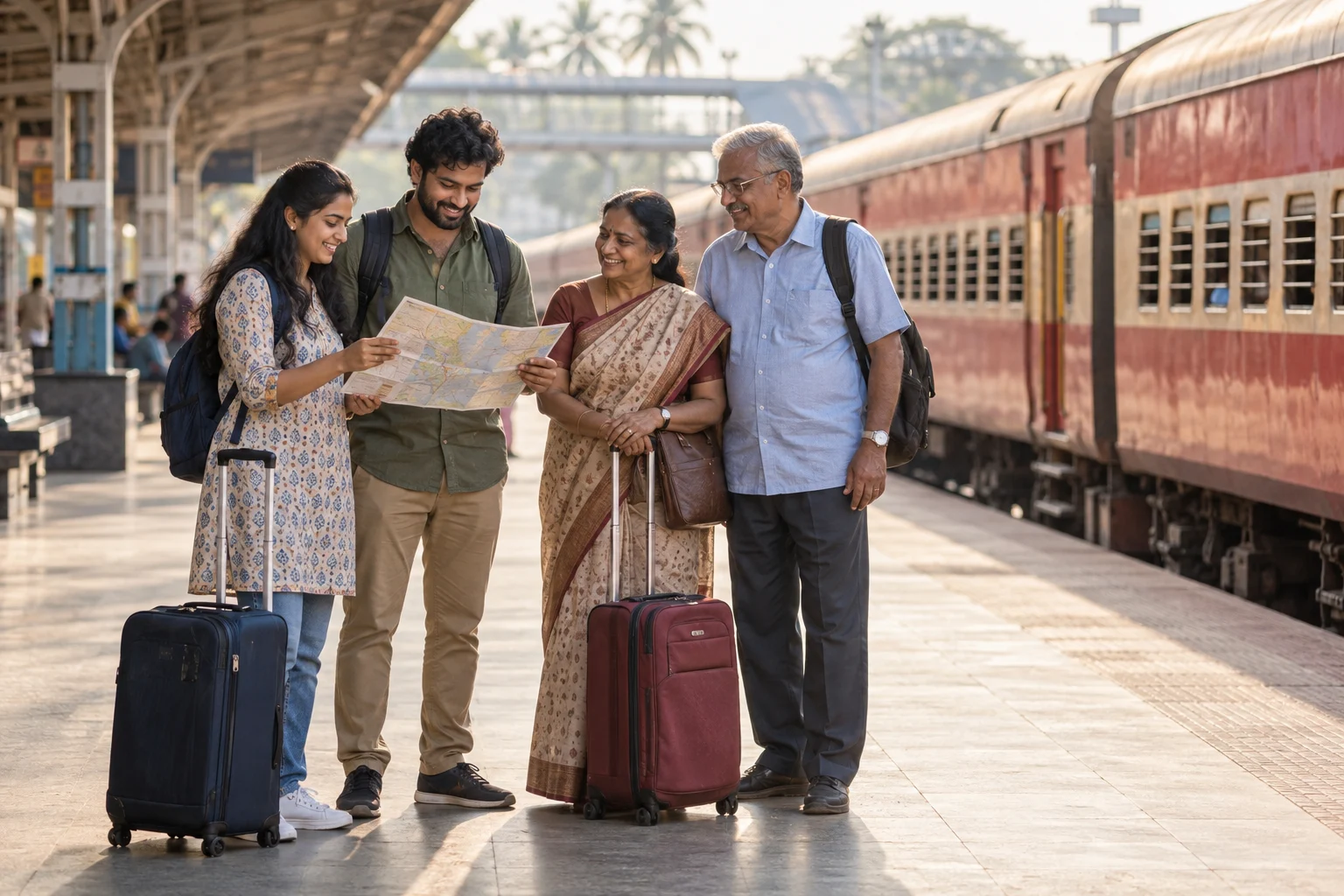
What the new domestic tourism survey found
The National Statistics Office conducted the Domestic Tourism Expenditure Survey from July 2025 to June 2026 as part of the 80th round of the National Sample Survey. It covered 246,113 households and asked about domestic overnight trips, same-day trips, transport, accommodation, duration, purpose and expenditure. For the group of overnight trips reported over a 365-day reference period, pilgrimage and religious travel represented 48 percent nationally, while holidaying, leisure and recreation represented 22 percent. Tamil Nadu received 13.4 percent of visitor-trips across the purposes included in that group, second only to Uttar Pradesh's 15.7 percent.
The Tamil Nadu result becomes even more notable when the purpose categories are separated. Reporting based on the survey tables places Tamil Nadu at 23.8 percent of overnight holiday, leisure and recreation trips and 14.8 percent of pilgrimage and religious trips. Those are shares of trips in the relevant categories, not shares of India's population and not a count of unique people. One household can report more than one trip, and a trip can include more than one visitor.
The survey also gives useful planning context. Around 80 percent of visitors on these overnight trips stayed five days or less. May and October were peak months for holiday and leisure travel. Train was the most-used mode among urban overnight visitors for the relevant trip group, while bus led among rural visitors. These national patterns do not predict the best choice for every Tamil Nadu route, but they explain why short, connected trips deserve more attention than overfilled state-wide itineraries.
Sources for this section: MoSPI survey release, DTES study description, Indian Express survey analysis.
Why 23.8 percent is important, and easy to misread
The cleanest interpretation is that Tamil Nadu was the main destination for almost one quarter of the overnight holiday, leisure and recreation trips represented in the survey's state distribution. It does not mean one quarter of all Indian travelers visited Tamil Nadu, one quarter of every kind of domestic trip ended there, or tourism grew by 23.8 percent. It is a share, not a growth rate. It also describes a survey period and a defined reference window rather than a live visitor counter.
The word overnight matters. A qualifying trip crosses midnight or includes the survey's specified overnight interval, occurs outside the visitor's usual environment and ends with a return to that usual place of residence. Same-day outings are measured separately. Visitor-trips also differ from trips: if several household members travel together, the survey can count their participation while still treating the journey as one household trip. These definitions make national comparison possible, but they should stop us from turning the result into a loose claim about total footfall.
Comparisons with the 2014-15 survey need similar restraint. The ministry and subsequent reporting note that reference periods changed for some purposes, especially pilgrimage and religious travel. The new survey is valuable as a current national picture, yet not every apparent change is a like-for-like trend. The practical conclusion is strong enough without exaggeration: Tamil Nadu occupies an unusually large place in India's recorded domestic leisure and religious travel, and visitors should plan for that demand.
Sources for this section: MoSPI survey release, DTES study description, Indian Express survey analysis.
Why Tamil Nadu works for several kinds of short trip
The survey measures behavior, not motivation, so it cannot prove why Tamil Nadu's share is high. The state's travel geography nevertheless offers a plausible planning explanation. Major gateways connect to distinct clusters: Chennai can anchor museums, neighbourhood food, Kanchipuram and Mamallapuram; Tiruchirappalli and Thanjavur open a compact Cauvery-delta heritage circuit; Madurai connects a living temple city with Chettinad, Dindigul or Rameswaram; and Coimbatore supports western hill, nature and textile routes. A traveler can build a meaningful three-to-five-day journey without attempting the whole state.
Leisure and pilgrimage also overlap without becoming the same thing. A temple town is simultaneously a place of worship, residence, work, transport, food and architectural history. A coastal route may combine sacred travel with ecology and family recreation. A city break may include a museum in the morning, a market meal at midday and a religious complex approached respectfully in the evening. Tamil Nadu's usefulness lies in these layered places, not in collecting a maximum number of attractions.
That variety calls for better labels in your own plan. Decide whether the non-negotiable purpose is worship, family time, architecture, food, nature or rest. Then add only activities that support it. A pilgrimage-led family should protect ritual time and mobility needs; a heritage-led traveler should allow slow observation; a food-led weekend should leave room for changing opening hours rather than locking every meal months ahead. The survey's leading-purpose idea is surprisingly useful: name the reason without which you would not take the trip.
Sources for this section: MoSPI survey release, Tamil Nadu destination guide.
Example 1: a five-day heritage and food journey
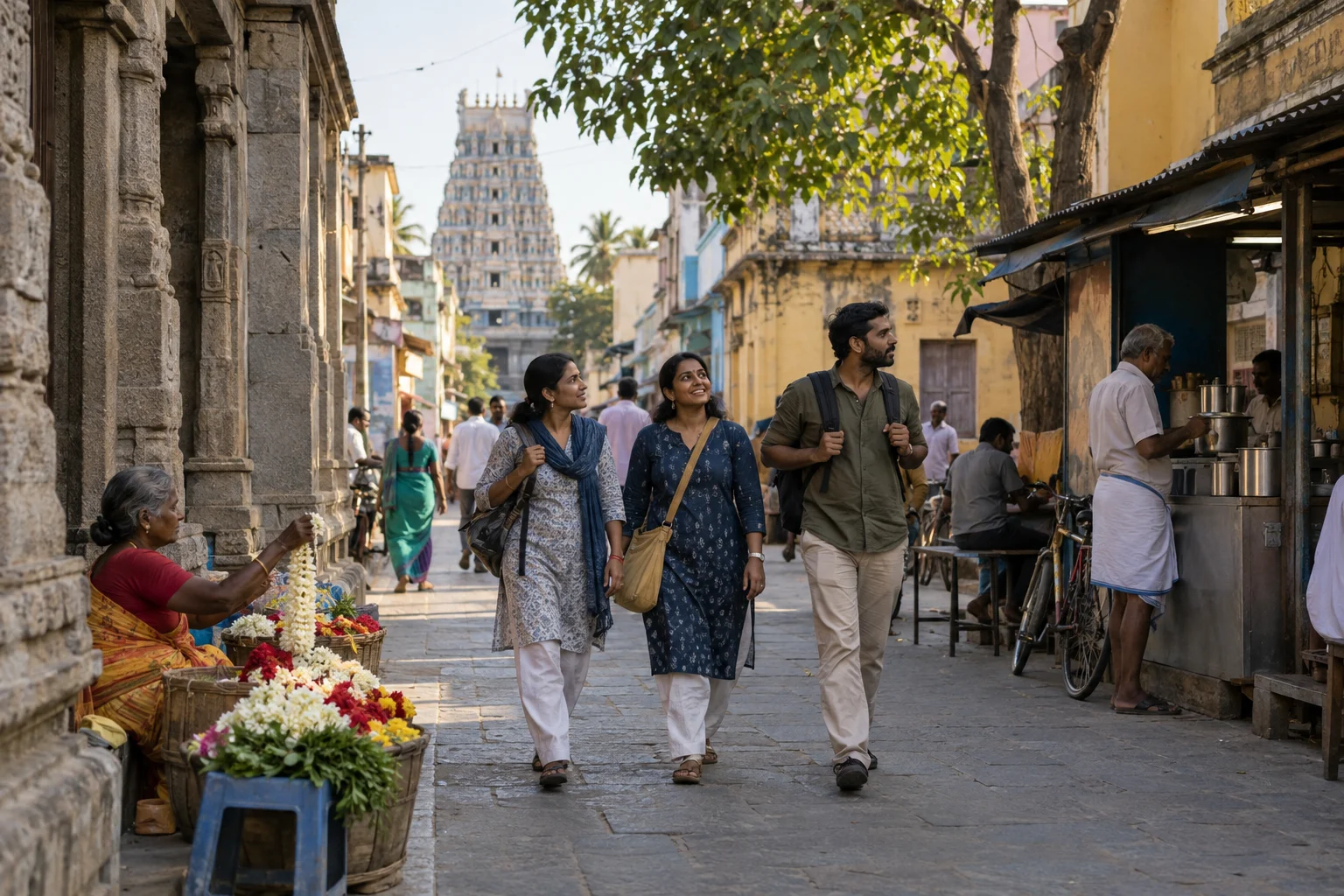
For a first leisure trip, use Chennai as the arrival base rather than a place to escape immediately. Spend day one close to your accommodation: choose one museum or historic neighbourhood, one focused food stop and an early night. On day two, take a pre-checked road connection to Mamallapuram and give the monuments, shore and heat enough time. Do not add Kanchipuram to the same day merely because both names fit on a map.
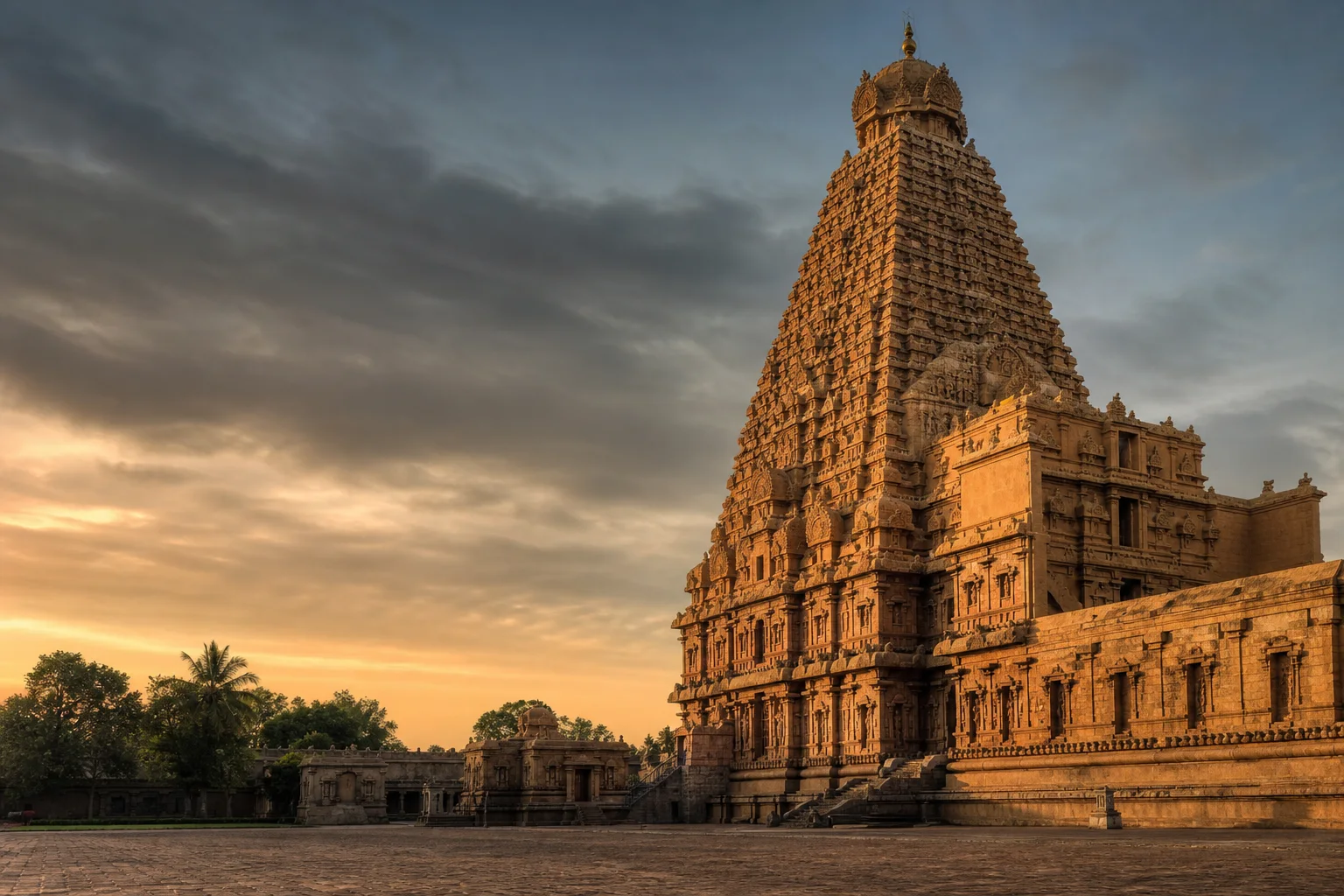
Move toward Thanjavur on day three using the transport option that best matches your confirmed timetable. Day four can centre on the Brihadisvara Temple complex, a museum or palace collection and one unhurried local meal. Treat the temple as a living sacred place as well as a World Heritage component. Verify current entry, photography, dress and worship arrangements through official sources or on-site notices. Use day five as a buffer for another delta stop, the onward journey or rest instead of forcing a long return and a late flight into one fragile chain.
This example works because it has two anchors, not because it covers every famous site. It gives Chennai a real day, protects Mamallapuram from becoming a photo stop and allows Thanjavur to be more than one monument. Families can slow it further by removing the optional delta stop. Travelers with reduced mobility should verify the complete access chain, including station assistance, vehicle drop-off, heat exposure, surfaces, toilets and seating; a destination-level accessibility label cannot guarantee each link.
Sources for this section: Mamallapuram World Heritage, Great Living Chola Temples.
Example 2: a six-day pilgrimage and living-heritage route
For a pilgrimage-led journey, begin with two nights in Madurai. Keep the first arrival period light, then dedicate the next day to worship and the surrounding city at a pace that respects queues, older relatives and current temple procedures. Separate devotional priorities from sightseeing extras before travel. If a ritual or darshan window matters, it should control meals and transfers rather than being squeezed between them.
Use day three for a checked transfer toward Rameswaram and keep days four and five around the island and the pilgrimage purpose. Coastal weather, traffic, bathing access, temple rules and local transport can change, so avoid a minute-by-minute schedule assembled from old social posts. Day six should be an onward or recovery day. Add Chettinad or another stop only by extending the trip; inserting it into the six-day version recreates the rushed itinerary this route is designed to avoid.
Pilgrimage demand is not an excuse to treat sacred towns as service machines. Dress and photography rules may vary by place and inner area. Do not photograph worshippers without consent, block processions, pressure staff for access or assume a paid service overrides local rules. Carry water where permitted, plan shaded rest, confirm medical needs and agree on a family meeting point. Religious travel can be logistically intense even when the map looks simple, and a dignified trip makes room for both devotion and human limits.
Sources for this section: Official temple guide, Tamil Nadu destination guide.
Example 3: a three-day rail-led city break
The survey's transport findings make a rail-led break worth considering, especially for urban households, but the booking should follow the route rather than the trend. Choose one well-connected city such as Chennai, Tiruchirappalli, Madurai or Coimbatore and stay in one base for all three days. Arrival day should remain neighbourhood-scale. Day two can hold the principal museum, heritage area, temple or nature outing. Day three needs enough margin for a meal, a short walk and the return connection.
A Chennai version might combine Egmore's museum zone, one historic neighbourhood and a separately planned Mamallapuram day trip if road time is acceptable. A Tiruchirappalli version can focus on the city and one nearby heritage cluster. A Madurai version can stay entirely within the city. The important choice is not which version wins; it is whether the base gives your group a satisfying trip without daily hotel changes.
Book from the actual operator, confirm the station and boarding point, and recheck the final local transfer. Festival periods, school holidays, weather and major events can alter both availability and crowd levels. Keep one flexible block rather than prepaying every hour. If the headline trend increases your interest in Tamil Nadu, let it lead to a more selective trip, not a race to reproduce someone else's ten-stop reel.
Sources for this section: MoSPI survey release, Tamil Nadu destination guide.
What stronger demand changes for travelers and places
A large share of domestic trips can support guides, drivers, accommodation, food businesses, craftspeople and public transport. It can also concentrate pressure around a small number of gateways, festival dates and famous sites. Travelers experience that pressure as sold-out trains, longer queues, traffic, higher room rates or reduced quiet. Residents experience it through congestion, waste, water demand, disrupted access and work that may be seasonal or unevenly rewarded.
The useful response is distribution with judgment, not the promotion of every quiet place as the next hidden gem. Stay longer in one base, use established local services, visit lesser-known institutions that are prepared for visitors and spend outside a single monument corridor. Do not geotag fragile natural or archaeological locations merely to prove discovery. A place without visitor infrastructure should not be made vulnerable by a trend article.
Booking strategy should reflect what matters most. Reserve the long-distance leg and essential accommodation first, especially around known holiday periods. Keep local meals and minor stops flexible unless a verified reservation is genuinely required. Check cancellation terms, arrival times and whether late check-in is possible. May and October were national peak months for holiday travel in the survey, but that does not make every Tamil Nadu destination busiest on the same dates. Local festivals, monsoons, heat and school calendars still require a current check.
Sources for this section: MoSPI survey release, RMC Chennai.
Turn the 2026 trend into a better trip, not a bigger checklist
Start with one sentence: this trip is mainly for worship, rest, food, heritage, nature or family time. Choose one gateway and no more than two destination clusters for a five-day trip. Map the longest transfer before adding attractions. Then identify the two details that must be current: transport and accommodation at minimum, plus temple access, weather, permits or event arrangements where relevant. Official channels should settle those details close to departure.
Build a daily rhythm with one principal experience, one optional experience and a protected rest or transfer block. That structure works better for children, older relatives and mixed-interest groups than a list of opening times. It also leaves space for a market, conversation, meal or street that cannot be scheduled. Save offline copies of bookings, carry identification required by the operator, and keep emergency and medical information accessible to the group.
Finally, measure success differently. The survey makes Tamil Nadu's scale visible, but your trip does not need to contribute another hurried circuit. A good five-day journey may contain fewer named attractions than a two-day checklist while producing more understanding and less friction. The 2026 data is most useful when it encourages realistic pacing, respect for living places and better decisions about where time and money go.
- Name one leading purpose for the trip.
- Choose one gateway and one or two connected clusters.
- Confirm long-distance transport and essential accommodation first.
- Recheck weather, access, temple rules and event conditions close to departure.
- Keep one flexible block each day and one buffer before the journey home.
Sources for this section: MoSPI survey release, RMC Chennai.
Sources & Further Reading
These authoritative references support the historical, geographic, or seasonal context in this story. Current conditions and operating details still require a fresh official check.
- Press Note on Domestic Tourism Expenditure Survey July 2025 to June 2026 · Ministry of Statistics and Programme Implementation, Government of India
- Domestic Tourism Expenditure Survey, NSS 80th round of July 2025 to June 2026 · MoSPI Microdata Library
- Why Indians travel: Religion drives overnight trips, medical trips most expensive · The Indian Express
- Tamil Nadu · Ministry of Tourism, Government of India
- Group of Monuments at Mahabalipuram · UNESCO World Heritage Centre
- Great Living Chola Temples · UNESCO World Heritage Centre
- Temple Guide · Government of Tamil Nadu HR&CE Department
- Regional Meteorological Centre Chennai · India Meteorological Department
Related Stories
Tamil Nadu Travel Trends 2026: How to Plan an Experience-Led First Trip
A practical guide to the experience-led Tamil Nadu travel trend: nature, food, wellness, heritage walks and flexible routes beyond a sightseeing checklist.
Choosing Your First Tamil Nadu Trip: Heritage, Temples, Hills or Coast?
A decision framework for choosing the kind of Tamil Nadu journey you want before choosing a long list of destinations.
Tamil Nadu Temple Towns Itinerary: A 7-Day Heritage Route
Connect sacred architecture, living worship, Chola heritage, Pandya memory and island pilgrimage through a selective seven-day route.
Frequently asked questions
Did Tamil Nadu receive 23.8 percent of all domestic tourists in India?
No. The 23.8 percent figure refers to Tamil Nadu's share of overnight trips whose leading purpose was holidaying, leisure and recreation in the survey's state distribution. It is not a share of all domestic tourists or all trip purposes.
What was Tamil Nadu's share of pilgrimage and religious trips?
Reporting based on the 2025-26 Domestic Tourism Expenditure Survey places Tamil Nadu at 14.8 percent of overnight pilgrimage and religious trips, ahead of Uttar Pradesh and Rajasthan in that category.
Does the survey count unique travelers?
No. It measures household trips and visitor-trips under defined reference periods. One person or household may make more than one trip, and one trip may contain multiple visitors.
How long should a first Tamil Nadu trip be?
Five to seven days works well for one gateway and one or two connected clusters. Three days can support a single-base city break; ten days or more allows a slower multi-region route.
What were the peak months for leisure trips in the survey?
May and October were the national peak months for overnight holiday, leisure and recreation trips in the survey. Local Tamil Nadu demand still varies by destination, festival, school calendar and weather.
Should I book every activity before traveling?
Book essential long-distance transport and accommodation first. Keep minor stops flexible, and verify time-sensitive details such as weather, temple access, event arrangements and local transfers close to departure.
Can the 2026 survey be compared directly with 2014-15?
Use caution. MoSPI and subsequent reporting note changes in reference periods for some purposes, especially pilgrimage and religious travel, so not every apparent difference is strictly like for like.
Editorial attribution
Prepared and reviewed by My Tamil Nadu Editorial Desk. Modified 8 October 2026.