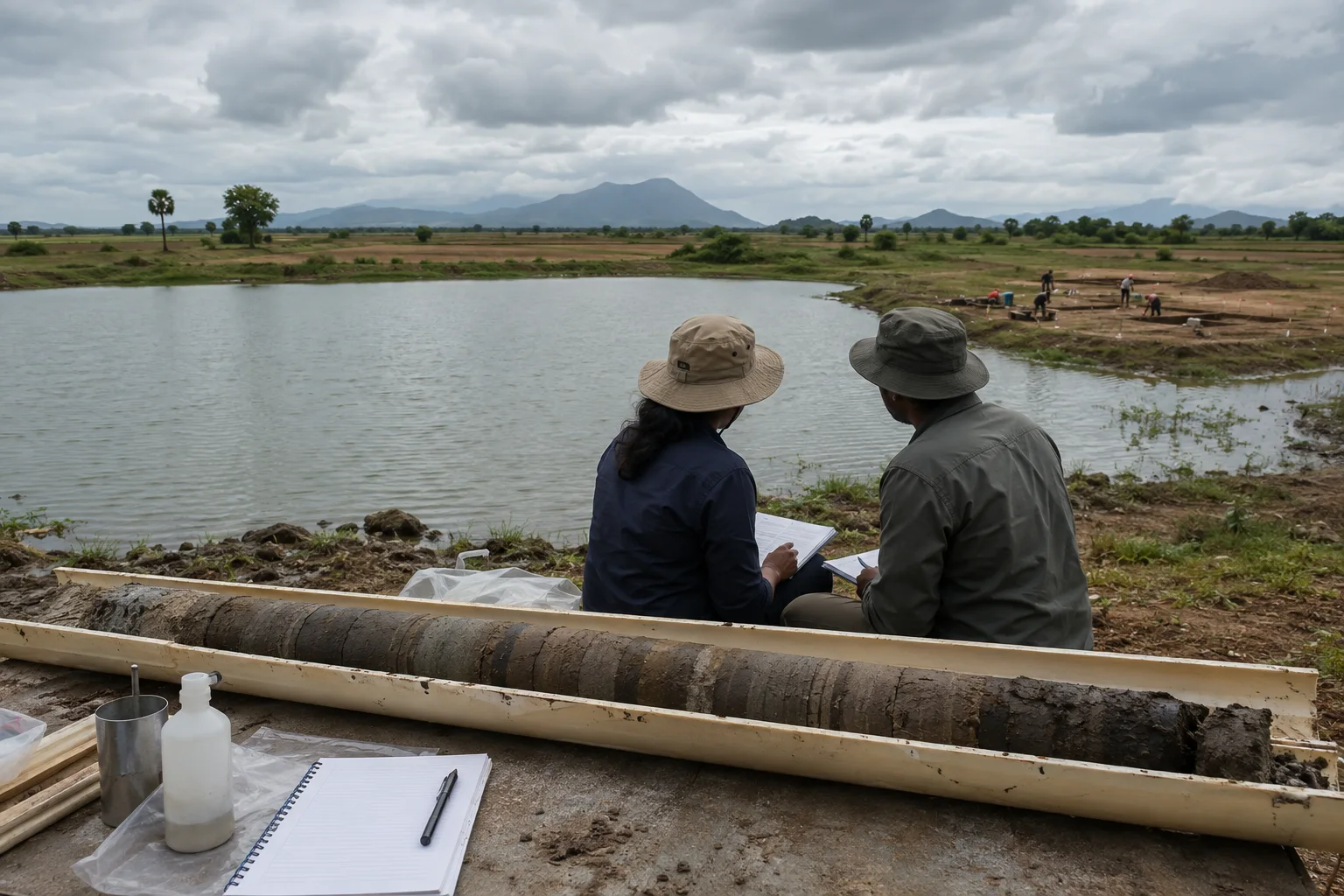
Begin with mud as an environmental archive
Sediment accumulates layer by layer as water, wind, organisms and surrounding land deliver material to a lake. If those layers remain sufficiently ordered, a core can preserve changes in mineral particles, organic matter and biological remains through time.
The Kondagai study uses an accelerator-mass-spectrometry radiocarbon-dated profile and several proxies rather than one dramatic object. The published methods include stable carbon and nitrogen isotopes, organic carbon and nitrogen measurements, their ratio, palynofacies and grain-size analysis.
A proxy is an indirect indicator. Grain size can reflect transport energy; organic chemistry can suggest changes in sources or productivity; palynological material can inform environmental interpretation. None is a diary entry, and each requires context, comparison and uncertainty.
Sources for this section: Kondagai Lake study, Open research paper.
Read what the study argues, not what a headline adds
The peer-reviewed paper presents a multiproxy reconstruction of late-Holocene geochemical and environmental change. A January 2026 science-ministry summary describes the work as an unusually detailed peninsular record relevant to monsoon variability, ecosystem response and the relationship between environment and human habitation.
That relevance does not mean every change in sediment caused a specific archaeological event. Climate, river behaviour, land use, vegetation and human activity can interact, while chronological resolution and local processes limit what can be matched across archives.
Use verbs precisely: the core records, proxies indicate, authors interpret and evidence may be consistent with. Avoid saying the lake proves why a settlement rose or declined unless the underlying study directly tests and supports that causal claim.
Sources for this section: Kondagai Lake study, Science ministry summary.
Keep the lake record and burial record distinct
Kondagai also appears in Tamil Nadu archaeology as a burial-related site within the wider Keezhadi cluster. The State Department of Archaeology's status report describes urn, pit and surface burials documented during excavation. That is archaeological evidence from a particular site and context.
The lake core is a different archive produced by environmental deposition and analysed with different methods. Geographic proximity makes comparison worth investigating, but it does not place excavated objects inside the sediment core or make both records identical in date.
A responsible article therefore maintains two columns in the reader's mind: what the lake study measured and what archaeological excavation documented. Connections belong to research questions until chronology, context and analysis support a stronger statement.
Sources for this section: Tamil Nadu excavation status, Keeladi excavation.
Ask how time enters the core
Radiocarbon dates anchor selected depths rather than stamping a calendar year on every grain. Researchers build an age model between dated points, and the resulting resolution depends on accumulation, disturbance, sampling and laboratory uncertainty.
A layer may combine material deposited over a span of time. Bioturbation, erosion, changing inputs or gaps can complicate the sequence. The presence of multiple proxies helps interpretation, but agreement among them does not erase dating uncertainty.
When comparing a climate curve with an archaeological phase, check the uncertainty on both sides. A broad overlap can support a question or correlation; it should not be rewritten as a day-by-day account of how ancient people experienced one monsoon.
Sources for this section: Kondagai Lake study, Open research paper.
Place the record within Tamil Nadu's two-monsoon setting
Tamil Nadu receives rain through both southwest and northeast monsoon systems, with strong regional differences. A lake in the Vaigai basin responds to that broader climate while also reflecting its own catchment, hydrology and human modification.
The Kondagai research is valuable because well-dated inland multiproxy records are limited in this part of peninsular India. One site, however, cannot stand for every Tamil Nadu coast, hill, delta or tank. Regional reconstruction grows through comparison among archives.
Do not use a long-term paleoclimate record as a present-day forecast. Current travel weather belongs to the India Meteorological Department and other live services, while a sediment core addresses environmental change over much longer timescales.
Sources for this section: Science ministry summary, Kondagai Lake study.
Turn the research into a careful landscape visit
The paper is a research source, not a notice that the core location is a public attraction. Do not seek unpublished coordinates, collect sediment or enter agricultural, excavation or protected land without permission. Sensitive research locations and burial contexts deserve restraint.
For public interpretation, use the Keezhadi museum and official archaeology information, then place the Vaigai, tanks, fields and settlements within a broader environmental question. Confirm current museum opening and site access directly; this article deliberately omits changing hours and fees.
A useful visitor note separates observation from inference: what landscape feature was seen, which official display or paper explains it, what period is involved and what remains uncertain. Kondagai matters because two archives can be read together carefully, not because one can be used to shortcut the other.
Sources for this section: Keeladi excavation, Sivaganga Keezhadi.
Sources & Further Reading
These authoritative references support the historical, geographic, or seasonal context in this story. Current conditions and operating details still require a fresh official check.
- Late Holocene Geochemical and Environmental Changes Inferred from a Multiproxy Investigation in Sediments from Kondagai Lake, Tamil Nadu, India · The Holocene, SAGE Journals
- Kondagai Lake Multiproxy Investigation: Author Manuscript · Birbal Sahni Institute of Palaeosciences
- Climate Records Unearthed from Tamil Nadu Lake Can Enable Conservation and Biodiversity Strategies · Press Information Bureau, Ministry of Science and Technology
- Ongoing Archaeological Excavations in Tamil Nadu: Status Report, July 2020 · Tamil Nadu State Department of Archaeology
- Keeladi · Tamil Nadu State Department of Archaeology
- Keezhadi Excavation · Sivaganga District Administration
Related Stories
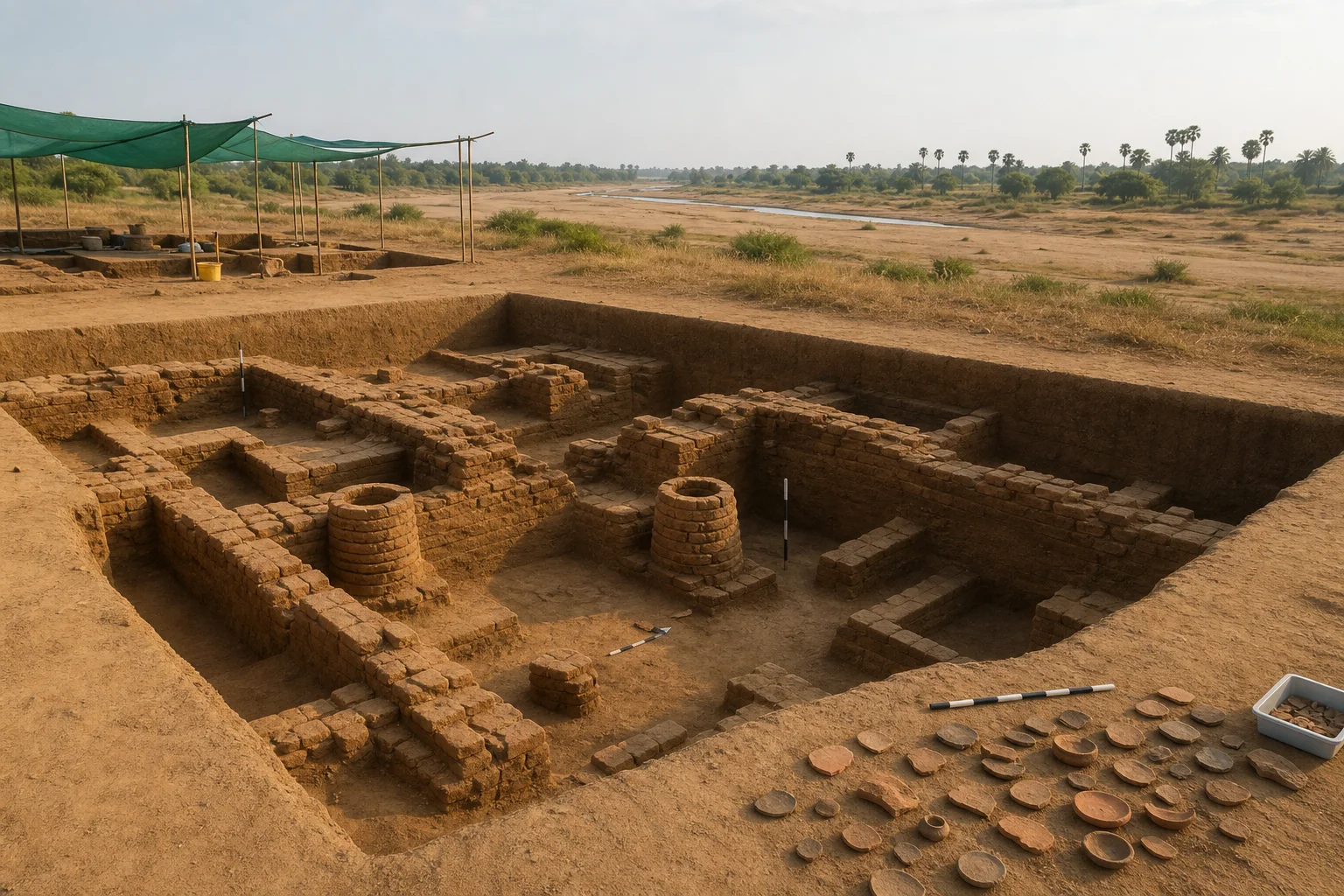
Keezhadi Beyond the Headline: How to Read an Excavation
A practical guide to what excavated walls, pottery, ring wells, inscriptions and laboratory dates can tell us, and where interpretation must remain cautious.
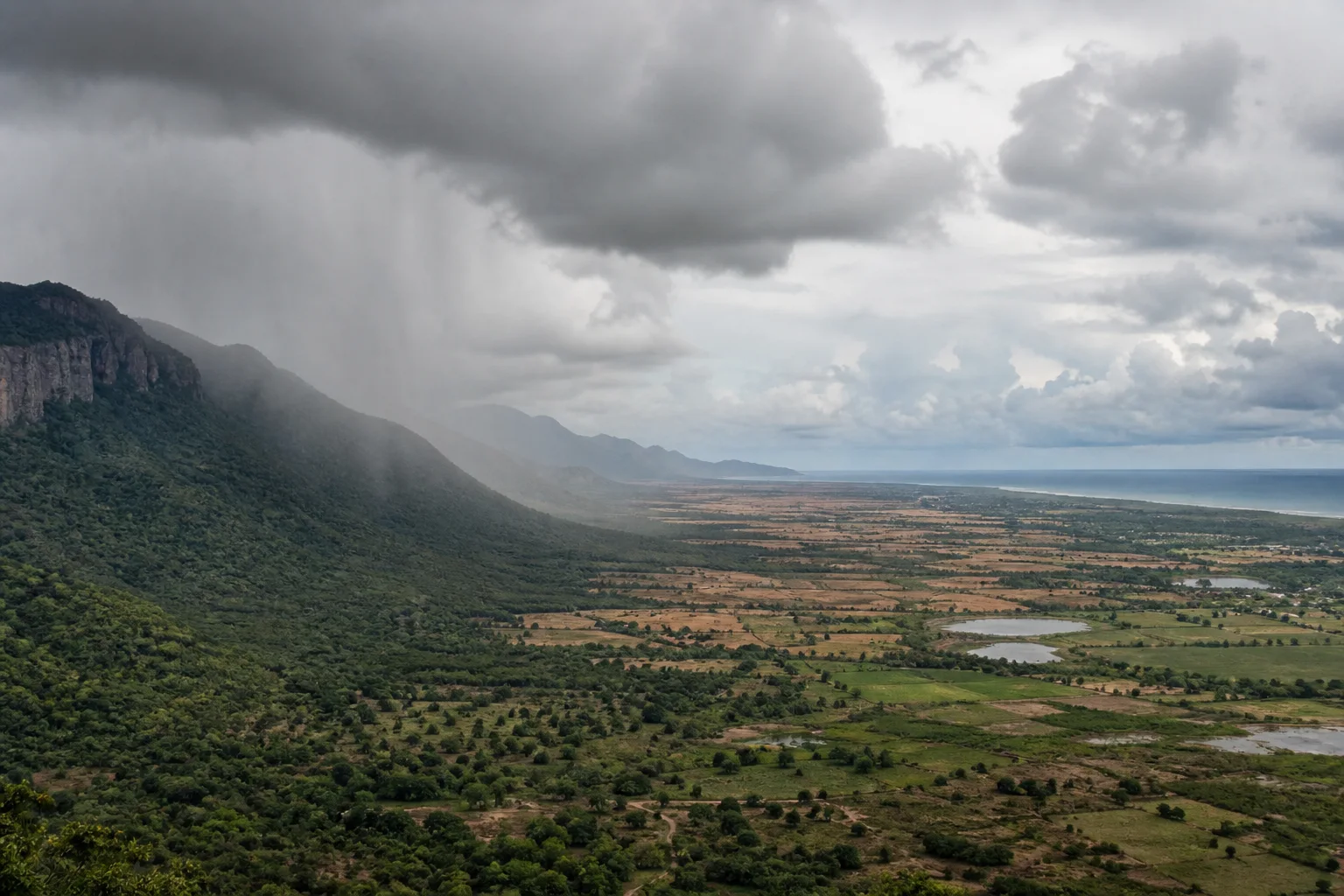
Why Tamil Nadu Has Two Monsoon Seasons: Southwest and Northeast Rain Explained
A geographic explanation of why Tamil Nadu's rain story differs from much of India, and why coast, interior and western hills cannot share one seasonal rule.
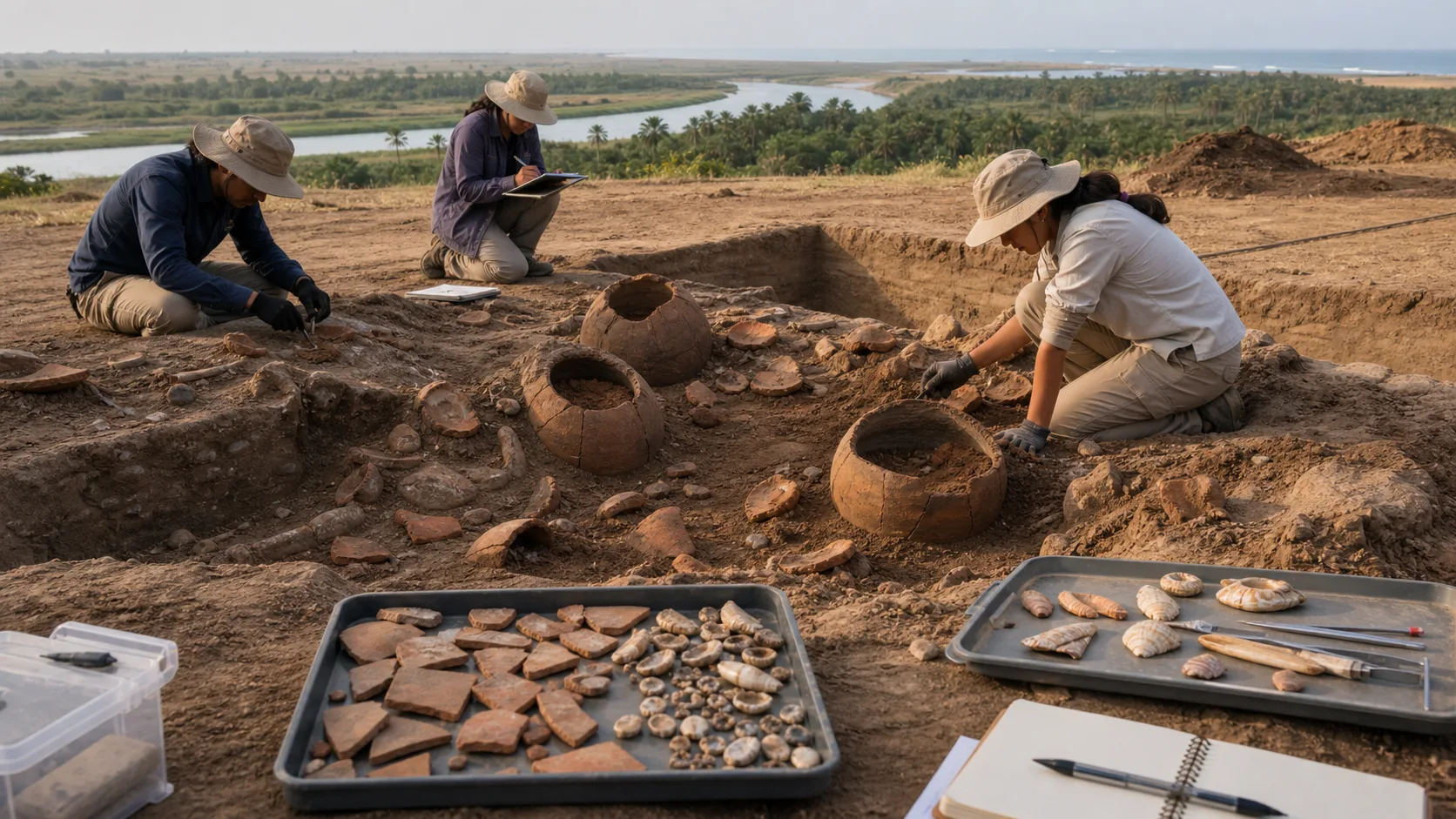
Adichanallur to Korkai: Reading the Tamiraparani Archaeology Landscape
An evidence-first guide to a river-to-coast archaeological landscape where burial, habitation, craft and maritime activity answer different questions.
Frequently asked questions
Did archaeologists find Keezhadi artifacts inside the Kondagai Lake core?
The reviewed lake study concerns environmental sediment proxies. Do not merge that record with archaeological finds from Kondagai's burial-related excavations.
Does the study prove climate caused changes at Keezhadi?
It provides environmental evidence relevant to the regional landscape, but correlation should not be rewritten as a single proven cause without direct support.
Can visitors go to the sediment-core location?
The research location should not be treated as a public attraction. Use official museums and public archaeology information, and respect access and research restrictions.
Editorial attribution
Prepared and reviewed by My Tamil Nadu Editorial Desk. Modified 4 September 2026.