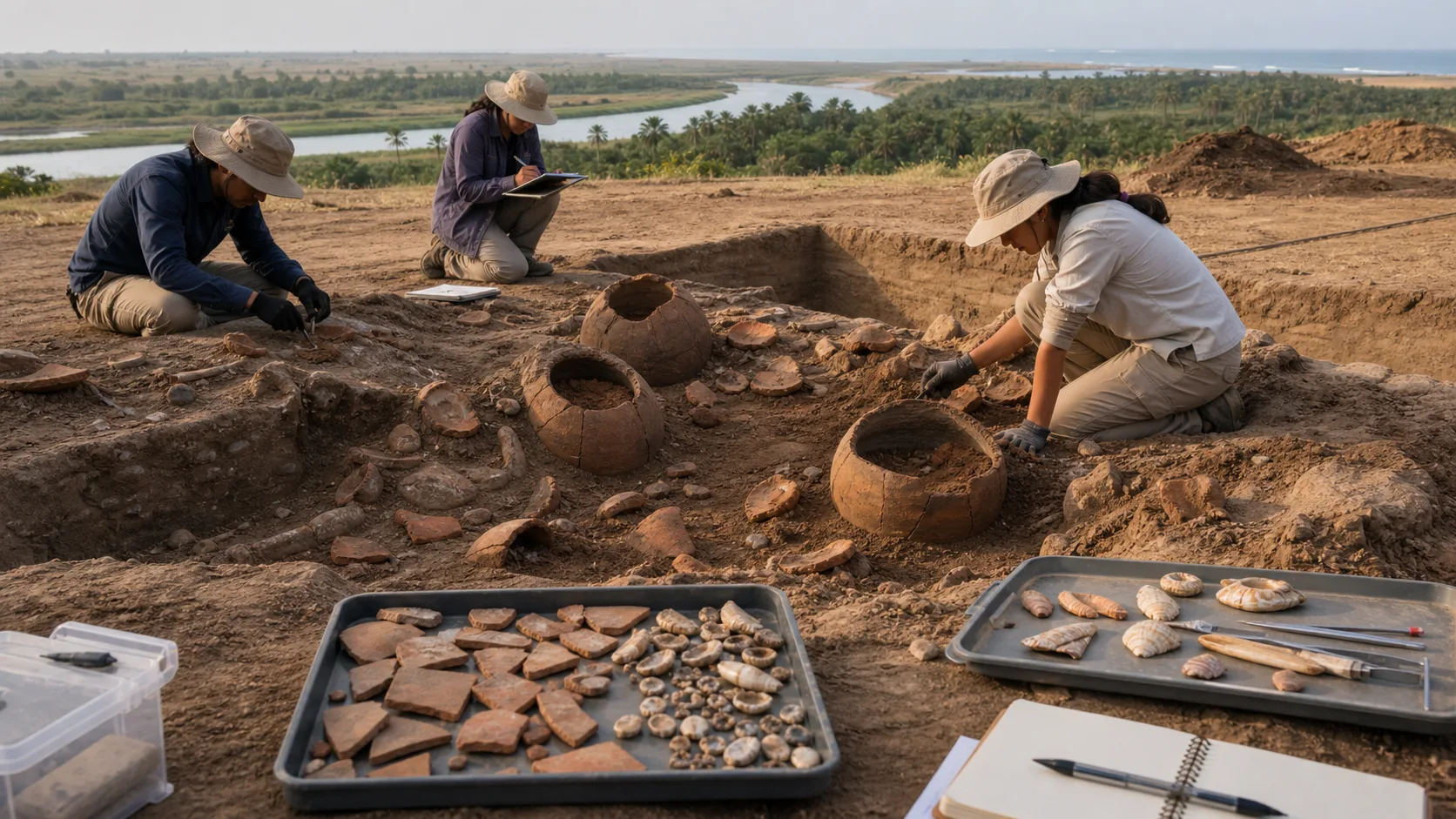
Begin with a corridor, not one giant site
The Tamiraparani flows from the Western Ghats across the plains toward the Gulf of Mannar. Archaeological places associated with this wider landscape include inland settlements, burial grounds, craft areas and locations closer to an ancient coast. They do not form one continuous excavation or prove that one community occupied every point at the same time.
Adichanallur is known principally for extensive urn-burial evidence. Korkai is an early historic settlement associated in literature and archaeology with a port and pearl fishery. A newly reported shell-working area elsewhere on the coast would add another type of evidence, but it should not be merged automatically with either site's date or identity.
Use district and archaeological maps to understand river, coast and modern settlement, but do not use online coordinates to enter excavation ground. Active trenches, protected sites and private land require permission. Responsible discovery begins by refusing to turn a research location into an unsupervised attraction.
Sources for this section: Tamil Nadu excavation register, Korkai excavation.
Adichanallur begins with burial context
The Tamil Nadu excavation register classifies Adichanallur as an Iron Age site and records recent state excavations. Earlier Archaeological Survey of India work documented urn burials, ceramics, metals and human remains. A burial complex can illuminate mortuary practice, technology, health and social difference, but it is not a simple catalogue of a named dynasty.
An urn's position, associated vessels, skeletal material, metal objects, soil and relationship with neighbouring burials matter together. Removing one object from that arrangement destroys information. This is why a visually modest sherd in a recorded layer may be more valuable to research than an impressive unprovenanced object in private hands.
Human remains require special respect. Do not photograph exposed burials without institutional permission, circulate sensational close-ups or assign language, caste, religion or modern community identity from appearance. Archaeological ancestry, cultural identity and present-day belonging are related questions, not interchangeable conclusions.
Sources for this section: Tamil Nadu excavation register, Adichanallur excavation report.
Korkai asks different questions about settlement and coast
The Tamil Nadu Department of Archaeology describes Korkai as a village north of the Tamiraparani and notes that the sea has receded eastward from the ancient settlement. Its excavation record includes brick structures, ring-like features, inscribed potsherds and a radiocarbon determination from charcoal. These are site observations, not permission to compress every find into one date.
Sangam texts and classical geographical references contribute to Korkai's association with port and pearl-fishery activity. Text and trench can illuminate one another, but literature is not a trench label. Archaeologists compare material, stratigraphy, palaeogeography, inscriptions and external references before proposing how a port functioned through time.
The modern shoreline is not the ancient shoreline. River sediment, coastal processes and human intervention change estuaries and channels. A visitor should not stand at one present-day point and announce the exact location of an ancient harbour without geomorphological and archaeological evidence.
Sources for this section: Korkai excavation, Tamil Nadu excavation overview.
Worked shell is evidence of choices and sequences
A shell-working area may preserve raw shell, cut pieces, blanks, unfinished objects, drilling or grinding traces, completed ornaments and manufacturing waste. The waste is crucial: it can reveal the stages of production and whether work occurred at the location rather than finished goods merely arriving there.
Species identification, tool marks, context and dating are needed before shell can support claims about sourcing, craft organisation or trade. A conch fragment near the Gulf of Mannar may be locally available, but local raw material does not by itself establish who worked it, where the finished object travelled or which text describes the activity.
Recent reporting can alert readers to a discovery while excavation reports and laboratory studies remain pending. Treat preliminary descriptions as provisional. This article does not reproduce a precise active-site location or convert a reported area estimate into a settled protected boundary.
Sources for this section: Tamil Nadu excavation register, Reported shell-working discovery.
Keep dates, phases and identities separate
A scientific date belongs to a sampled material and archaeological context, with a method and uncertainty. It does not automatically date every object at a site. Similarly, a potsherd assigned by style or script to a range answers a different question from radiocarbon dating charcoal or analysing human remains.
Terms such as Iron Age, megalithic and early historic are analytical period labels. They can overlap in regional sequences and should not be used as ethnic names. Pandya, Tamil, maritime and urban are also not interchangeable labels that can be attached to every burial or artefact in the river basin.
Good interpretation keeps a claim close to its evidence: this trench contained, this sample produced, this inscription reads, this report proposes. When a headline moves from an object to a civilisation in one sentence, return to the excavation authority and published report before repeating it.
Sources for this section: Korkai excavation, Adichanallur excavation report, Tamil Nadu excavation overview.
Build a museum-and-landscape journey, not a trench hunt
Begin with published interpretation or a museum collection, then use district guides to understand river and coast. The Government Museum in Chennai identifies Adichanallur material among its notable archaeological collections, while official site and district museums can provide regional context. Current display, opening and photography rules must be confirmed directly.
At a village or protected site, remain on public routes, obey signs and ask before photographing residents. Never collect pottery, shell, metal or bone, even when it appears loose. Do not buy antiquities, share coordinates for unprotected finds or probe the ground. Report a possible find to the archaeology or district authority without cleaning it.
The value of the Tamiraparani corridor lies in difference: burial beside habitation, inland river beside changing coast, raw material beside craft waste, text beside excavated context. Holding those differences together produces a stronger history than forcing every discovery into one spectacular story.
Sources for this section: Government Museum collections, Archaeological site museums.
Sources & Further Reading
These authoritative references support the historical, geographic, or seasonal context in this story. Current conditions and operating details still require a fresh official check.
- Archaeological Excavations Conducted by the Department of Archaeology · Tamil Nadu State Department of Archaeology
- Korkai · Tamil Nadu State Department of Archaeology
- Adichchanallur Excavation Report 2004-05 · Archaeological Survey of India
- Excavations in Tamil Nadu: An Archaeological Report · Government Museum Chennai
- Government Museum Chennai · Department of Museums, Government of Tamil Nadu
- Site Museums · Tamil Nadu State Department of Archaeology
- Tamil Nadu Excavators Unearth Ancient Shell Industry off Gulf of Mannar · The Times of India
Related Stories
Keezhadi Beyond the Headline: How to Read an Excavation
A practical guide to what excavated walls, pottery, ring wells, inscriptions and laboratory dates can tell us, and where interpretation must remain cautious.
Rameswaram as an Island: Temple, Pamban, Dhanushkodi and the Sea
A connected reading of Rameswaram's sacred town, mainland crossing, exposed eastern coast and protected marine context rather than four unrelated stops.

A Food Journey Through Tamil Nadu's Regional Cuisines
Travel across Tamil Nadu through the relationships among region, crop, technique, household memory, migration, worship, and changing city life.
Sittannavasal: Read a Jain Hill Through Paint and Stone
A conservation-first guide connecting Sittannavasal's Jain cave, fragmentary paintings, rock beds and inscriptions without forcing them into one date.
Frequently asked questions
Are Adichanallur and Korkai the same archaeological site?
No. They are distinct sites with different principal contexts and research questions within a wider river-to-coast landscape.
Does a shell object automatically prove overseas trade?
No. Context, species, production evidence, dating and comparative material are needed before making a trade claim.
Can visitors enter an active excavation?
Only through an explicitly authorised public arrangement. Never enter trenches, protected land or private property without permission.
Editorial attribution
Prepared and reviewed by My Tamil Nadu Editorial Desk. Modified 30 August 2026.