Begin with several settings, not one festival script
Vinayagar Chaturthi honours Ganesha, widely called Vinayagar or Pillaiyar in Tamil. In Tamil Nadu it may be observed in a home, a local shrine, a larger temple or a neighbourhood installation. Duration, scale, food, music and procession practice differ, so a visitor should not import one city's template into every place.
The Tamil Nadu Hindu Religious and Charitable Endowments festival calendar lists Vinayagar Chaturthi across multiple temples. For 2026, its September calendar records the observance on 14 September. That date is useful for this year only and does not establish identical programmes, access or timings at every temple.
Ask what kind of setting you are entering. Household worship is private unless invited; a temple follows its administration and ritual sequence; a street event shares space with residents and traffic. Respect grows from recognising the setting before reaching for a camera or expecting participation.
Sources for this section: HR&CE festival calendar, Pillayarpatti festival.
Read the image through material and making
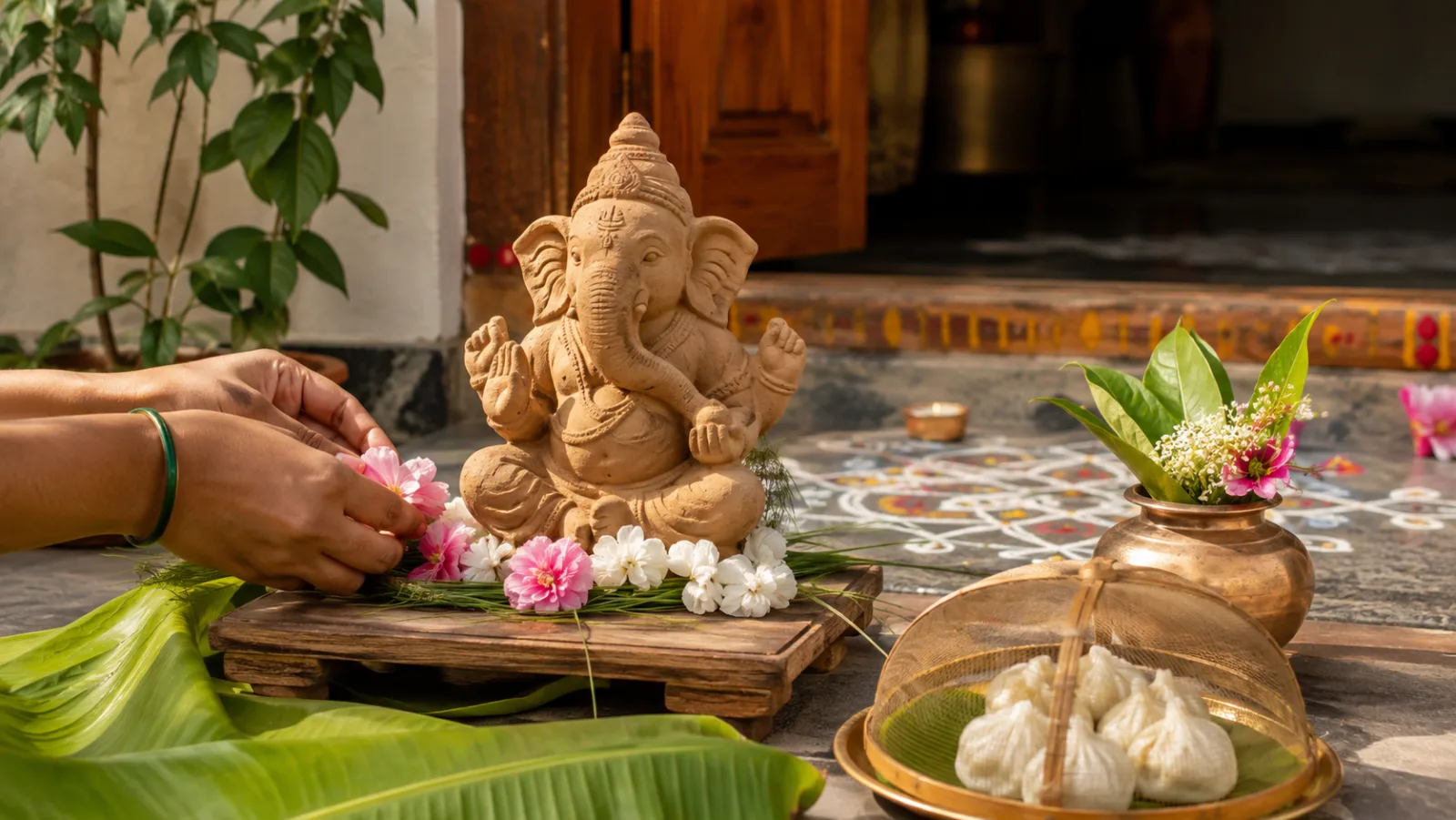
A small clay Vinayagar image can make the material cycle visible: earth is shaped for worship and may later return through a controlled immersion. Yet clay appearance alone is not proof of composition. Paint, internal support and added decoration can change what enters water or remains after the festival.
The Central Pollution Control Board's revised guidance addresses materials, colours, size, designated immersion arrangements and collection of worship materials. Tamil Nadu Pollution Control Board reporting explains why plaster of Paris, toxic paints and floating decorations can affect water quality and aquatic systems.
When buying, ask what the image and colour are made from rather than relying only on an eco-friendly label. Choose a manageable scale and minimise plastic, foam, glitter and detachable decoration. The aim is not aesthetic austerity; it is to understand the material consequence of the celebration.
Sources for this section: CPCB immersion guidelines, TNPCB immersion report.
Approach kozhukattai as food, offering and household work
Kozhukattai, a steamed preparation commonly made with rice flour and fillings that may include coconut and jaggery, is strongly associated with Vinayagar worship in Tamil households. Recipes, shapes, names and savoury or sweet versions vary. No single filling proves that a household is observing the festival correctly.
Food is also labour. Soaking or preparing flour, shaping dough, managing steam and coordinating an offering take time and knowledge. If invited, wait for the host to explain when food may be eaten, and disclose allergies or dietary limits without demanding that a ritual kitchen reorganise itself for a visitor.
Commercial sweets require the same practical questions as any fresh food: ingredients, preparation time, storage and allergens. This article does not recommend a shop or promise a shelf life. Buy quantities suited to the day, carry food cleanly and avoid photographing a private offering without permission.
Sources for this section: Pillayarpatti festival, HR&CE festival calendar.
Let temple and street practice remain place-specific
Pillayarpatti in Sivaganga district is one important Tamil setting for Vinayagar worship, with its own temple history and festival programme. The Ministry of Tourism event page describes a multi-day temple celebration, music and processional elements. It should not be treated as the standard schedule for Chennai or another district.
Current programmes can alter because of administration, weather, crowd management or local conditions. Confirm with the responsible temple or organiser. Keep entrances, procession paths and emergency movement clear, and never step into a route because a wide-angle photograph makes the crowd appear farther away.
A visitor can participate respectfully without claiming insider knowledge. Dress for the sacred setting, follow footwear and photography rules, keep sound low around worship and describe only what was publicly observed. Devotional belief should be attributed to the community or source rather than rewritten as archaeological fact.
Sources for this section: Pillayarpatti festival, HR&CE festival calendar.
Treat immersion as a regulated environmental act
Immersion is not permission to use any convenient lake, beach, river or well. TNPCB states that the public should use water bodies notified by the Government of Tamil Nadu, while CPCB guidance provides a broader framework for designated sites, temporary arrangements, material control and post-event management.
Follow the current district, police, municipal and pollution-control instructions for the specific year. Do not reproduce an old list of sites or timings as if it remains valid. Remove packaging and non-biodegradable decoration through the system provided, and do not leave flowers, food, plastic or frames at the water edge.
Safety and ecology align here. Crowded banks, waves, traffic and deep water are live risks, while paint, plaster and debris can outlast the event. A household-scale alternative permitted by current guidance may be more responsible than travelling to an unauthorised natural water body for a dramatic farewell image.
Sources for this section: TNPCB immersion report, CPCB immersion guidelines.
Use a simple visitor method
Before the date, identify whether your plan is a private invitation, temple visit or public event. Check the current official notice, transport changes and weather. Carry modest clothing, water and only essential belongings. Expect queues and altered road access without inventing a precise crowd forecast.
During the observance, watch one complete sequence before recording. Ask permission around homes, artists and children; keep flash off where prohibited; and do not handle an image, offering or decoration unless invited. Support a local maker by asking informed material questions rather than bargaining from an anonymous online price.
Afterward, separate memory from generalisation. Record the place, organiser, date, material information and practice actually witnessed. Vinayagar Chaturthi becomes clearer when devotion, craft, food and environmental care remain connected, while the variation between Tamil households and temples remains visible.
Sources for this section: HR&CE festival calendar, TNPCB immersion report.
Sources & Further Reading
These authoritative references support the historical, geographic, or seasonal context in this story. Current conditions and operating details still require a fresh official check.
- Festival Calendar, September 2026 · Tamil Nadu Hindu Religious and Charitable Endowments Department
- Report on Water Quality across Tamil Nadu Pre- and Post-Idol Immersion · Tamil Nadu Pollution Control Board
- Revised Guidelines for Idol Immersion · Central Pollution Control Board
- Vinayagar Chaturthi Festival at Arulmigu Karpaga Vinayagar Temple, Pillayarpatti · Utsav, Ministry of Tourism, Government of India
Related Stories
Beyond Pongal: How to Read Tamil Nadu's Festival Calendar
A cultural guide to the many clocks behind Tamil Nadu's festivals, from harvest and household practice to temple calendars and pilgrimage.
Deepavali in Tamil Nadu: Morning Rituals, Food and Shared Safety
A household-centred guide to the festival of light that respects regional variation and keeps safety, neighbours and current public rules in view.
Navaratri Golu in Tamil Nadu: Reading the Stories on the Steps
A respectful guide to the dolls, household creativity, visits, music, food and changing narratives that make Golu more than a decorative display.
Frequently asked questions
When is Vinayagar Chaturthi in Tamil Nadu in 2026?
Tamil Nadu HR&CE's September 2026 calendar records 14 September. Verify the programme and timing for the specific temple or organiser.
Can an idol be immersed in any nearby water body?
No. Follow current notified-site and local authority instructions; old lists and convenient natural waters should not be assumed valid.
Is every clay-coloured idol environmentally suitable?
Not necessarily. Ask about the base material, paint, support and decorations rather than judging composition only by appearance.
Editorial attribution
Prepared and reviewed by My Tamil Nadu Editorial Desk. Modified 3 September 2026.