
Trade, ports and the Indian Ocean
Arikamedu and East-Coast Trade
A port and production site in present-day Puducherry shows why the history of Indian Ocean exchange cannot be reduced to a Roman trading station.
Orientation
Overview
Early historic and later archaeological phases
Arikamedu lies in present-day Puducherry, outside the modern state of Tamil Nadu. It belongs in this history because east-coast trade crossed boundaries that did not yet exist, and because its finds have shaped interpretations of several Tamil Nadu sites. Imported Mediterranean ceramics made it famous. Indian pottery, bead production and the site’s longer archaeological sequence make its significance broader than that fame suggests.[4]
The most useful starting point is a change of perspective. Rather than imagine a Roman enclave first and fit every object inside it, begin with an inhabited coastal settlement and ask which activities the evidence supports. Some finds demonstrate overseas connections; others concern manufacture, daily use or writing. Their combination reveals a place participating in several networks, each with its own material traces and chronology.
Chronology
A careful timeline
Dates identify documented phases and broad ranges. They do not imply uninterrupted rule or certainty where the evidence remains debated.
Wheeler’s excavations
Mediterranean ceramics helped frame the influential trading-station interpretation.[1]
Casal’s investigations
Further material complicated the initial chronology.[1]
Reassessment
Begley reconsidered chronology and the attribution of rouletted ware.[1][2]
Renewed fieldwork
A collaborative excavation programme examined the site’s more complex history.[4]
Historical reading
How a trading-station label took hold
Wheeler’s interpretation connected Arikamedu with the Roman world through amphorae and Arretine ware found in excavated contexts. It offered a chronological bridge between material in South India and better-dated Mediterranean pottery. Begley’s 1983 reassessment showed why this could not remain a complete history of the site: the settlement and its trading activity appeared to extend earlier than the narrow framework associated with Augustus. Her paper made a longer sequence central to the discussion.[1]
This change matters beyond a dispute over start dates. If the history begins only when a recognisable western object appears, local activity before that moment becomes a prelude rather than a subject in its own right. A longer sequence allows researchers to ask what changed with overseas exchange and what was already present. It also prevents an imported ceramic phase from standing in for every occupation, building and craft practice found across the site.
The EFEO publication of the 1989–92 investigations explicitly describes a site more complicated than earlier excavators had understood. Disturbance was a major issue, and the report catalogues material from new and older investigations. Its specialist chapters separate pottery, inscriptions and Mediterranean shipping amphorae. That organisation is a useful guide for readers: the strongest interpretation comes from combining independently assessed classes of evidence, not repeating the best-known historical label.[4]
Historical reading
What the pottery changed
Rouletted ware is a central example. Its impressed decoration originally encouraged comparison with Classical ceramics. Begley’s 1988 study re-examined roughly six hundred sherds and argued that the fine varieties should be considered regional products rather than Mediterranean imports. She also questioned whether the decoration had actually been made with a roulette, suggesting a chattering technique. An archaeological name can therefore preserve an outdated assumption even after specialists have revised the explanation.[2]
Geochemical research by Ford and colleagues adds an independent line of evidence. Their analysis linked rouletted ware, Arikamedu Type 10 and Sri Lankan grey ware to a common geological origin in India. The study also points to a chronology in which some related wares predate Roman pottery arriving in India. These results place Indian manufacture and circulation at the centre of the story, while leaving the identification of particular workshops to further research.[3]
Arikamedu still has genuine Mediterranean ceramic evidence. Correcting the origin of rouletted ware does not erase amphorae or other securely identified imports. Instead it separates overlapping networks that an old classification had bundled together. A display containing both Indian and Mediterranean vessels should explain that distinction visibly. Otherwise a reader can leave with the mistaken impression that every finely finished bowl was foreign and that local potters supplied only everyday coarse wares.
There is also a difference between identifying a broad production region and identifying the actual place of manufacture. Chemically related pottery may point toward shared geological resources without locating a kiln at Arikamedu itself. The site name in “Arikamedu Type 10” names a classification familiar to archaeologists; it is not a certificate that every example was made there. Readers should treat such names as tools for comparison and look separately for the evidence supporting a workshop attribution.[3]
Historical reading
Beads, glass and skilled production
Bead manufacture restores artisans to the port’s history. Academic discussion of Arikamedu includes both glass and stone ornament production, and considers how local craft traditions interacted with materials and techniques circulating over long distances. Small beads can carry evidence about shaping, drilling, drawing and finishing that is less obvious in a photograph than their colour. Production waste can be especially valuable because it records work carried out before an object was ready to be exchanged or worn.[7]
A specialist research note by Sunil Gupta analysed twelve glass bead and waste samples from Arikamedu. The author explicitly identified them as surface finds. Their chemical differences are informative, but the recovery context limits chronological precision. This is a useful example of two truths coexisting: a laboratory result can be sound while the historical date assigned to the sampled object remains broad. More precise chemistry does not restore a layer that was never recorded.[6]
Older models placed Arikamedu at the beginning of a widespread Indo-Pacific bead-making tradition and envisaged the movement of makers and techniques from there across Southeast Asia. Alison Carter’s 2016 reassessment explains how subsequent research has challenged that single-centre model. Arikamedu remains important, but resemblance between beads at distant sites cannot by itself demonstrate that they all came from one workshop, or that every related technique spread along the same route.[5]
The practical distinction is between moving things and moving skills. A finished bead can travel without a craftsperson; a craftsperson can move and begin using different raw materials; an imitation can reproduce an appearance through another process. To distinguish these possibilities, scholars compare manufacturing traces and chemical composition as well as shape. The broader Indian Ocean hub follows these questions across regions without presenting a family tree of workshops that the evidence cannot securely sustain.
Historical reading
Writing, containers and the missing cargo
The Arikamedu excavation publication includes a specialist study of inscriptions in Brahmi and Tamil-Brahmi. Their presence puts writing alongside the ceramic and craft record. A short mark on a portable object is not an account book, however. It can preserve a name or a convention of marking without explaining the language used in every negotiation. The publication’s separation of epigraphy from ceramic study is important: the pot and the inscription require related but different expertise.[4]
Transport containers invite the question of what else moved through the port. Durable pottery survives far more readily than cloth, foodstuffs, packing material or wooden equipment. A room full of excavated sherds is therefore not a proportional inventory of ancient commerce. Textiles can belong in a discussion of the wider trade economy without being presented as a recovered cargo from every building. The distinction between regional historical possibility and a site-specific find should remain explicit.
The same applies to the function of structures. Calling a building a warehouse, dyeing workshop or merchant residence adds an interpretation to the surviving masonry. Such labels need associated evidence, not merely a plausible story about what a port ought to contain. A careful visitor asks which observed feature supports the identification and whether later research still accepts it. Without that step, an attractive reconstruction can outlive the evidence that originally inspired it.
Historical reading
An east-coast node with several horizons
Arikamedu’s ceramics have been discussed in relation to material from Sri Lanka and other Indian Ocean sites. The value of this comparison is not simply that similar objects occur far apart. Scientific provenance studies can test whether visually related vessels share a production background, while chronological study asks whether they circulated at comparable times. Together these approaches help distinguish a real exchange pattern from a map made by connecting any two places with superficially similar finds.[3]
Along the Tamil coast, Alagankulam makes a particularly useful comparison because its ceramic terminology also needs critical reading. Poompuhar brings literary testimony and a changing coastal landscape into the discussion. Inland Kodumanal shifts attention toward manufacturing and terrestrial connections. These comparisons do not require every journey to start or end at Arikamedu. They show how ports, settlements and production sites performed different roles within a connected region.
Westward links also require intermediate geography. A Mediterranean object at Arikamedu does not prove a direct voyage from Italy to this particular riverbank. Goods could change hands or vessels, and a merchant’s home need not match the place where a container was made. Eastward, shared bead traditions do not identify a single exporter. The thematic hub keeps Sri Lanka and Southeast Asia within the larger network, with lines treated as historical connections rather than plotted sailing tracks.
Historical reading
What archaeology actually shows
Arikamedu supports a history of overseas contact, Indian production and changing participation in exchange. The strongest claims identify their material basis: Mediterranean ceramics for imports; workshop-related evidence for making; inscriptions for particular written acts; layers and associations for chronology. None of those categories can be replaced by a generic statement that the site was “Roman”. That adjective obscures the very questions the excavation record makes possible.
Its research history is itself part of the lesson. Initial classifications were productive because they made comparison possible, but they were also revisable. Later work challenged ceramic origins, expanded the chronological frame and questioned simple models of bead diffusion. These revisions do not make the site less significant. They let local work, earlier activity and multiple trading relationships become visible in a place once described mainly through its connection to a distant empire.
Human scale
People and institutions
Named rulers are only one part of the history. These groups and individuals help show how evidence and social life connect.
Vimala Begley and collaborators
Reassessment and renewed fieldwork changed how the chronology and ceramics were understood.
Bead makers and other artisans
Manufacturing evidence shifts attention from imported luxuries to skilled local work.
Historical geography
Connected places
Places are linked only when a substantive My Tamil Nadu guide already exists. Other entries remain non-clickable research context.
Visual reading
Images with explicit provenance
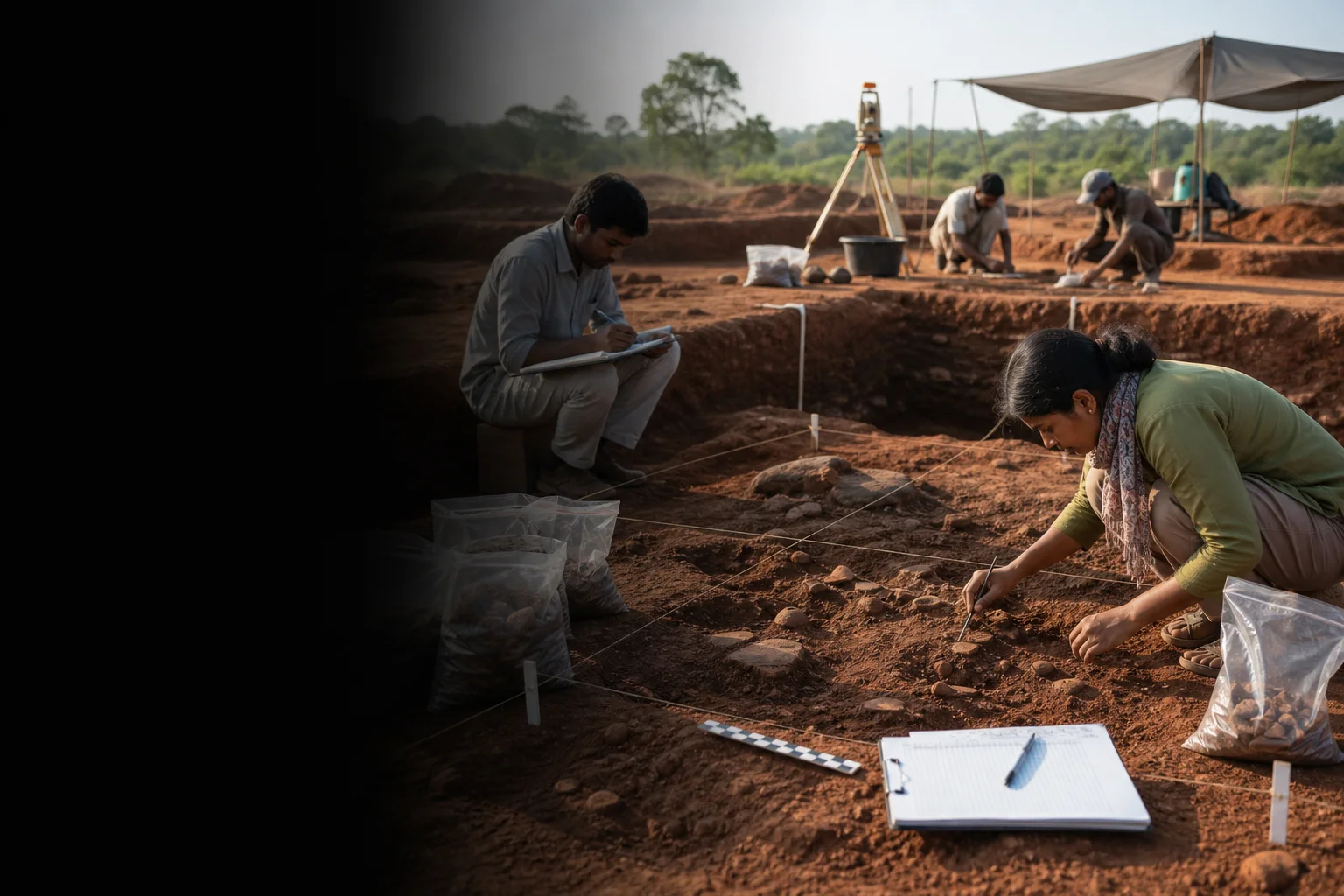
These project-created visuals support orientation. They are not presented as photographs of an excavation, monument, person, or event.
Questions
Frequently asked questions
Is Arikamedu in Tamil Nadu?
No. It is in present-day Puducherry. It is included because its archaeological record is essential to understanding the neighbouring Tamil coast and wider Indian Ocean networks.
Was it a Roman colony?
Imported goods do not establish a colony. This guide describes a coastal settlement and production site with Mediterranean connections, without assigning a foreign identity to the whole community.
Did all Indo-Pacific beads originate here?
That older single-centre model has been challenged by later research. Similar-looking beads need manufacturing and compositional comparison before their origins can be assigned.
Editorial trust
Sources and further reading
Citations in the article point to this full list. Source type and review date are shown so readers can evaluate the evidence.
- 1Arikamedu ReconsideredVimala Begley, American Journal of Archaeology (1983)Peer-reviewed reassessment; abstract consulted · Reviewed 16 November 2026
- 2Rouletted Ware at Arikamedu: A New ApproachVimala Begley, American Journal of Archaeology (1988)Peer-reviewed ceramic study; abstract consulted · Reviewed 16 November 2026
- 3A geochemical investigation of the origin of Rouletted and other related South Asian fine waresFord, Pollard, Coningham and Stern, AntiquityPeer-reviewed compositional research; abstract consulted · Reviewed 16 November 2026
- 4The Ancient Port of Arikamedu: New Excavations and Researches 1989–1992, Volume OneÉcole française d’Extrême-OrientExcavation report; publisher synopsis and contents consulted · Reviewed 16 November 2026
- 5The Production and Exchange of Glass and Stone Beads in Southeast Asia: an assessment of the work of Peter FrancisAlison Carter, Archaeological Research in Asia (2016)Peer-reviewed reassessment; abstract and introductory discussion consulted · Reviewed 16 November 2026
- 6New analyses of Indo-Pacific beads and glass waste from Arikamedu, IndiaSunil Gupta, Bead Study Trust Newsletter 35 (2000)Specialist analytical research note · Reviewed 16 November 2026
- 7The Archaeological Record of Indian Ocean Engagements: Bay of Bengal (5000 BC–500 AD)Oxford University PressAcademic synthesis; bead-production discussion consulted · Reviewed 16 November 2026
Editorial review: Reviewed 16 November 2026 using accessible excavation records, institutional summaries and scholarly research. Some full publications were unavailable; abstracts and indexed excerpts support only the specific claims discussed, while the publications also provide further reading. Dates and interpretations retain their stated uncertainties.

A Journey Through Chola Heritage in Tamil Nadu
Follow a thoughtful route through three living Chola temple landscapes, learning to read architecture, inscriptions, patronage, and place without rushing.
Tharangambadi: Read the Fort, Printing History and Living Coast
A layered coastal-town guide that begins before the Danish fort, follows trade and printing history, and returns heritage to a living Bay of Bengal shoreline.

Mamallapuram: Read a Coastal World Heritage Landscape
A connected reading of Mamallapuram that moves from granite outcrops and carved caves to monolithic experiments, open-air reliefs, the Shore Temple and a living coastal town.