
Trade, ports and the Indian Ocean
Kodumanal, Karur and the Inland Trade Routes
The ocean trade story begins with makers and inland settlements. These two sites show why ports cannot be understood in isolation.
Orientation
Overview
Early historic connections, with later Indian Ocean developments identified separately
Maritime history often begins with a ship approaching a harbour. At Kodumanal the more revealing starting point is a small piece of worked stone. A partly made bead can connect a source of material to a sequence of skilled operations; discarded fragments can reveal manufacture that a finished ornament conceals. Karur brings another scale into the picture: an inland centre whose excavated pottery, regional finds and nearby inscriptions place exchange alongside political and religious life.
The purpose of this page is to connect the two places through production and movement. The existing Kodumanal archaeology guide remains the fuller introduction to that individual site. Here the question is how an inland workshop and an inland town help explain the wider trade system. Their relationship to western passages and coastal destinations is significant, but no single route should be allowed to replace the many possible exchanges that linked a region.[5]
Kodumanal lies in present-day Erode district; Karur stands beside the Amaravati. These modern locations help a reader orient the evidence without enclosing it in present-day district boundaries. Excavated materials, inscriptions, museum objects and proposed corridors operate at different geographical scales. Keeping those scales distinct allows us to discuss an interconnected landscape without pretending that archaeology has recovered a complete transport map.[6][3]
Chronology
A careful timeline
Dates identify documented phases and broad ranges. They do not imply uninterrupted rule or certainty where the evidence remains debated.
Settlement and mortuary landscapes
Kodumanal’s habitation and burials require contextual comparison rather than a single date for every feature.[8]
Craft and exchange
Stone ornaments, iron objects and inscribed pottery document several activities in the inland record.[7]
Karur and nearby Pugalur
Excavations and a Tamil-Brahmi genealogy add different evidence for Karur’s regional importance.[3]
Reconstructing connections
Excavation, artefact analysis and museum documentation build route interpretations; the interpretations remain open to revision.[5]
Historical reading
A productive comparison, not two versions of one town
Kodumanal’s settlement and burial areas preserve different kinds of archaeological deposits. The department’s summary records pottery, inscribed and marked sherds, beads and iron objects, including a concentration of carnelian beads associated with a burial. Those finds establish a community whose possessions entered both everyday and mortuary settings. A grave assemblage is not a workshop inventory: its contents were selected for a particular act, even when some objects had earlier lives in circulation.[1]
At Karur, the department reports Tamil-Brahmi sherds in association with amphora fragments and rouletted ware. The published excavation report provides the fuller ceramic discussion behind the short web summary. The combination places locally used writing and externally connected goods in the same archaeological conversation. It does not mean the script belonged to foreign merchants, or that the imported vessels arrived while a particular named ruler was governing.[2][4]
These distinctions shape the comparison. Kodumanal helps ask how objects were made and selected. Karur helps ask how goods circulated through an inland centre with political and religious associations. Neither role was exclusive. People lived, worked, used vessels and made choices in both places; “craft site” and “trade centre” are useful descriptions only while they remain open to that range of activity.
Historical reading
Reading the unfinished bead
Evidence for manufacture is strongest when several steps survive together. Raw pieces, shaped blanks, failed drilling and finished objects form a sequence that can be compared rather than merely admired. The archaeological publication Graffiti and Tamili describes material at Kodumanal in different stages of working, together with chips and grooved slabs. That is evidence for local operations, rather than an inference based only on the presence of attractive ornaments.[9]
The sequence raises practical questions. Was the stone reduced near its source or brought into the settlement as prepared material? Did one artisan complete all stages, or were tasks shared? Were unsuccessful pieces discarded beside the working place or moved with other refuse? These are questions for concentrations, wear and context. They are more precise than imagining a single factory serving an overseas market.
An institutional catalogue identifies a carnelian bead from Kodumanal, but a catalogue entry and a production study are different tools. The former records a surviving object and its assigned provenance; the latter examines how a material was worked. Carnelian in a grave cannot be counted automatically as output from the nearest workshop. A settlement can manufacture some ornaments while acquiring others, and consumers can prefer imported materials even when local alternatives are abundant.[6]
This matters for route maps. A line drawn from Kodumanal to a distant port should not imply that every bead of a similar colour came from this village. Matching must involve more than resemblance. Material composition, drill traces, manufacturing choices and chronology can strengthen an attribution. Without that comparison, the responsible description is a possible connection within a broader production and exchange network.
Historical reading
Iron objects, textile tools and a mixed working economy
The parliamentary inventory of archaeological finds lists iron implements, beads, pottery, writing and structural remains at Kodumanal. Such an inventory is a useful check against a story focused on one craft alone. It is less useful for reconstructing exact workshop arrangements because a list does not retain every object’s excavation context. The evidence supports a varied material world; the organisation of work requires the reports behind the list.[7]
A sword found with a burial speaks first to the objects selected for the dead. Slag or a furnace, where securely identified in a working deposit, addresses another question: where and how metal was processed. A settlement may both make and import iron objects. To understand its role, metal analysis must be connected to excavated features, not detached from them and turned into a general claim about technological superiority.
Textile-related finds broaden the picture further. Spindle whorls are reported at Kodumanal, as is a surviving piece of woven cotton in the archaeological literature. These deserve attention because cloth usually leaves a less abundant trace than fired clay or stone. They do not identify a specific overseas customer. The possibility of export belongs within a wider argument about distribution, while the tools themselves also make sense within local demand for thread and cloth.[9]
Thinking in terms of a mixed economy changes the social story. The same community needed vessels, food, repairs, clothing and tools, whether or not some products travelled far. Export-oriented interpretations should not erase that support. A port’s distant connections depended on people whose work may have remained entirely inland. Their contribution is visible in production evidence even when no written source names them.
Historical reading
Why the burial record belongs in a trade history
Pondicherry University’s archaeology text describes Kodumanal’s cists and grave goods within the broader settlement landscape. Gunasena’s examination makes the difference between habitation and burial material more concrete: her habitation sample was dominated by quartz, much of it production debris, while she notes the contrasting prominence of carnelian in published burial assemblages. Her analysed settlement sample contained only one carnelian item. These are observations about selected assemblages, not proportions that can be extended automatically to the whole site.[8][11]
The contrast complicates a simple export-centre label. Material conspicuous in workshop waste need not be what a community most valued for burial; objects selected for burial need not be what its artisans chiefly produced. For the proposed Kodumanal–Karur connection, that means searching for two different patterns: the distribution of products matching local working evidence, and the incoming materials chosen by consumers. A route could have carried goods in both directions. The burial evidence therefore helps frame inland demand, not merely a supply of ornaments destined for ports.
The chronology also needs care. A cemetery and a habitation area can lie close together without every excavated feature being contemporary. Before comparing their materials as a single economic snapshot, researchers need to establish which phases overlap. This is especially important when a proposed trade route depends on a sequence of sites: objects separated by several generations do not demonstrate one simultaneous chain of transactions.
Historical reading
Writing at work, royal names nearby
Karur’s excavation summary records Tamil-Brahmi sherds alongside amphora fragments and rouletted pottery. This association is useful to the inland trade question because it puts writing and circulating goods within an excavated settlement, rather than connecting them only through a poem or a later museum display. The next step is contextual comparison: whether particular inscribed vessels belong to the same occupation phase as the imports, and how their use relates to the settlement’s other pottery.[2]
Near Karur, the Pugalur inscriptions supply a different kind of written evidence. The department’s museum account describes three generations of Chera rulers in a record associated with a gift to a Jain ascetic. This anchors names and relationships in an inscriptional setting. It does not define the rulers’ complete territory, identify every trader who used the interior or prove that all craft production operated under royal direction.[3]
Putting the records beside one another is more revealing than making one explain everything. Pottery writing concerns portable objects; a donative inscription records a particular public act. Their coexistence in a region suggests several settings in which writing mattered. Trade, patronage and religious institutions could intersect, but the connection must be demonstrated in each case rather than assumed from proximity.
Historical reading
Across the Ghats: Muziris as context
The Palghat Gap gives the western route a clear geographical setting. Scholarly work places Kodumanal near an important overland corridor linking the coasts. The reconstruction becomes plausible because the landscape and the archaeological distributions can be considered together. Geography supplies an opportunity; artefacts and dates help assess whether that opportunity was used during a given period.[5]
On the Kerala side, Pattanam’s excavations document a settlement engaged in maritime exchange. The official Muziris Heritage Project presents Pattanam’s identification with ancient Muziris as a possibility supported by finds and location. That is the appropriate framing here. An ancient port could involve a larger estuary and several activity areas, and a written place-name need not correspond to the exact boundaries of a modern excavation.[10][12]
It is tempting to join Muziris, Kodumanal, Karur and an east-coast port with one continuous arrow. As a schematic that may help readers grasp the region’s orientation. As a historical claim it is too strong unless each connection is supported. Loads could take different paths, arrive in different seasons or pass through settlements absent from the surviving record. A network is not a conveyor belt.
The same caution applies to the eastward direction. The Kaveri region and its ports belong in the wider discussion, but an amphora at Karur does not announce which coast it crossed. The useful question is comparative: which proposed route best fits the dated distribution of a particular material? The answer may differ for stone, cloth and imported containers, and it may change between phases.
Historical reading
Testing a proposed inland connection
Imagine a bead of similar form recovered at an inland workshop and at a coastal settlement. The first check is whether the two contexts overlap in date. The second is whether the materials and working traces agree. A shared shape with different manufacturing methods may indicate imitation rather than a single source. A close technological match still leaves open the number of intermediaries and the direction of movement. Each step narrows the explanation without supplying a fictional itinerary.
That approach also helps keep this trade page distinct from a site inventory. The individual Kodumanal guide asks what was found and how the settlement is understood. The present comparison asks what would connect those findings to Karur and beyond. A convincing answer needs observations from both ends, not simply a line between famous names. New analysis may strengthen one corridor while weakening another; the region’s importance does not depend on every proposed route remaining unchanged.
Historical reading
Karur’s collections: evidence with a collecting history
Karur’s site museum combines material recovered by excavation and exploration, and its displays cover many centuries. A visitor can therefore encounter early coins, later coins, inscriptions and other finds in one institution. The collection is evidence for the area’s layered history, not proof that all displayed objects circulated together. An accession record and excavation reference are often as important as the object’s appearance.[3]
For an imported vessel, ask about the identified fabric, the diagnostic part and the context. For a coin, ask whether its findspot is secure and whether the date refers to issue or deposition. For an inscription, distinguish a reading of letters from an interpretation of the person or institution named. These questions turn a museum visit into an encounter with the trade evidence rather than a search for foreign objects alone.
Human scale
People and institutions
Named rulers are only one part of the history. These groups and individuals help show how evidence and social life connect.
Bead makers
Their working sequences survive in unfinished material and discarded pieces.
Users and mourners
Objects entered households and graves through choices that need not mirror workshop output.
Carriers and intermediaries
Movement connected places, although individual journeys usually remain unnamed.
Historical geography
Connected places
Places are linked only when a substantive My Tamil Nadu guide already exists. Other entries remain non-clickable research context.
Visual reading
Images with explicit provenance
These project-created visuals support orientation. They are not presented as photographs of an excavation, monument, person, or event.
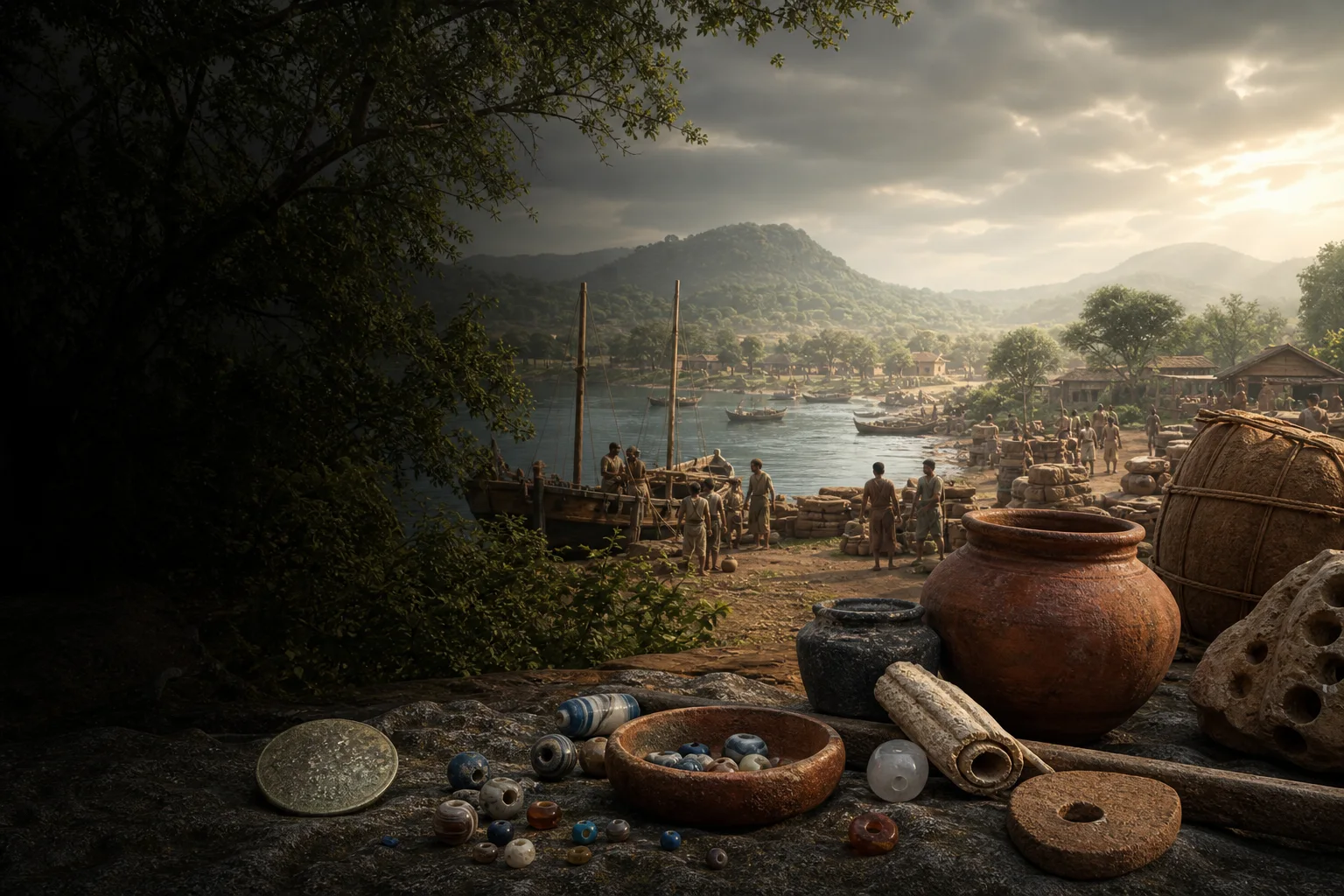
Questions
Frequently asked questions
Was Kodumanal a port?
No. Its significance here is inland production, settlement and burial evidence connected to wider exchange.
Did every bead found there originate locally?
No. Manufacturing evidence must be distinguished from finished ornaments acquired, used or deposited at the site.
Is the Muziris–Karur route fully mapped?
No. The corridor is an archaeological and historical reconstruction. It is not a surveyed continuous ancient road or a complete account of every consignment.
Editorial trust
Sources and further reading
Citations in the article point to this full list. Source type and review date are shown so readers can evaluate the evidence.
- 1Kodumanal: excavation summaryTamil Nadu Department of ArchaeologyOfficial excavation summary · Reviewed 16 November 2026
- 2Karur: excavation summaryTamil Nadu Department of ArchaeologyOfficial excavation summary; ceramic terminology requires comparison with later research · Reviewed 16 November 2026
- 3Chera Site Museum, KarurTamil Nadu Department of ArchaeologyOfficial museum and epigraphy overview · Reviewed 16 November 2026
- 4Karur Akazhaivu: excavation reportTamil Nadu Department of ArchaeologyPrimary excavation publication; Tamil · Reviewed 16 November 2026
- 5Craft Specialization, Technology and Social Change: a study of stone bead production in Early Historic South IndiaUniversity of Wisconsin–MadisonGwendolyn Kelly, doctoral research; university repository · Reviewed 16 November 2026
- 6Kodumanal bead, accession GM-TET-TN-1190000Archaeological Survey of India, National Mission on Monuments and AntiquitiesInstitutional object catalogue · Reviewed 16 November 2026
- 7Excavated sites and finds: Kodumanal and Karur in the annexed inventoryParliament of India / Ministry of CultureOfficial parliamentary archaeological inventory · Reviewed 16 November 2026
- 8Introduction to the Study of Archaeology: KodumanalPondicherry UniversityUniversity archaeology teaching text · Reviewed 16 November 2026
- 9Graffiti and Tamili: Kodumanal craft-production discussionTamil Virtual Academy digital libraryArchaeological publication; bead production, spindle whorls and cotton evidence · Reviewed 16 November 2026
- 10Pattanam: excavations and the possible Muziris identificationGovernment of Kerala, Muziris Heritage ProjectOfficial heritage synthesis · Reviewed 16 November 2026
- 11Interactions between Sri Lanka and South India in the Early and Middle Historic through the perspective of personal adornmentUniversity of Exeter; author-uploaded research copyKaushalya Gunasena, doctoral thesis, 2018; relevant chapters and assemblage discussion · Reviewed 16 November 2026
- 12Pattanam excavation handbook, 2008Kerala Council for Historical ResearchExcavation project publication · Reviewed 16 November 2026
Editorial review: Reviewed 16 November 2026 using accessible excavation records, institutional summaries and scholarly research. Some full publications were unavailable; abstracts and indexed excerpts support only the specific claims discussed, while the publications also provide further reading. Dates and interpretations retain their stated uncertainties.

A Journey Through Chola Heritage in Tamil Nadu
Follow a thoughtful route through three living Chola temple landscapes, learning to read architecture, inscriptions, patronage, and place without rushing.
Tharangambadi: Read the Fort, Printing History and Living Coast
A layered coastal-town guide that begins before the Danish fort, follows trade and printing history, and returns heritage to a living Bay of Bengal shoreline.
Sittannavasal: Read a Jain Hill Through Paint and Stone
A conservation-first guide connecting Sittannavasal's Jain cave, fragmentary paintings, rock beds and inscriptions without forcing them into one date.