
Trade, ports and the Indian Ocean
Alagankulam and Mediterranean Contact
At the lower Vaigai, imported objects meet a settlement of makers, users and traders. Its history reaches beyond the label “Roman trade”.
Orientation
Overview
Early historic and later archaeological phases
Alagankulam brings the Indian Ocean story into the lower Vaigai landscape. The archaeological site lies in Ramanathapuram district, near the east coast, and has produced imported pottery alongside inscribed vessels, beads and structural remains. Those associations are more revealing than any isolated foreign object: a settlement used, handled and discarded goods arriving through different networks. The Department of Archaeology identifies Mediterranean material among its finds, while later scientific research has refined the classification of some ceramic groups.[1][3]
The phrase Mediterranean contact is deliberate. An imported jar establishes the movement of a container; it does not identify everyone who handled it. A Roman coin has an issuing authority, but the person who eventually lost it need not have been a Roman subject. These distinctions leave room for intermediaries and local initiative. Alagankulam is important because it lets us investigate how overseas connections were embedded in an inhabited Indian settlement, rather than treating that settlement as a passive destination for distant merchants.
Chronology
A careful timeline
Dates identify documented phases and broad ranges. They do not imply uninterrupted rule or certainty where the evidence remains debated.
Repeated excavation seasons
The state register records multiple campaigns, including 2014–15 and 2016–17.[2]
Writing and ceramics
Inscribed pottery and varied ceramic groups require context-specific dates.[1]
Coins in the assemblage
Coin issues and their archaeological deposition are different chronological events.[5]
Laboratory studies
Ceramic and sediment research adds questions about manufacture and settlement activity.[3][4]
Historical reading
A coastal story rooted in the Vaigai
The river setting gives Alagankulam an inland dimension. The Vaigai links the coast to a wider landscape of settlement, including the region studied at Keezhadi. That geographical relationship makes comparison useful; it does not establish a single continuously navigable ancient shipping lane. The modern river, shoreline and road network should not be traced onto an ancient map without environmental evidence. A river corridor can support several kinds of movement, including overland journeys alongside water.[1]
For this reason, a route diagram should show the lower Vaigai as a connection zone rather than label a precise quay, ferry or warehouse without documentation. Changes in channels and sediment can alter access to the sea. Trade depends on landing conditions, storage, food and local transport as well as the ability to cross an ocean. The archaeological question is how those activities came together here, and which parts of that system survive in the excavated record.
Historical reading
Pottery: separate the imports from the lookalikes
The official site summary lists amphora fragments and rouletted ware among material associated with Mediterranean connections. That wording needs qualification. Rouletted ware is not a reliable synonym for Roman pottery. Studies of related South Asian fine wares support manufacture in India, even where the finished vessels resemble Mediterranean products. The correction changes the historical picture: some attractive tableware travelled through Indian networks, rather than all of it arriving from the west.[1][6]
Odelli and colleagues examined ceramics from Alagankulam and Keezhadi using mineralogical, petrographic and spectroscopic approaches. Their study addresses a recurring problem: visual resemblance can confuse locally made wares, imports and imitations. The fabric of a vessel—the clay and inclusions forming its body—can answer questions that a photograph of its polished surface cannot. Their work supports treating pottery groups individually, with particular care over claims that a red-slipped sherd is Mediterranean sigillata.[3]
An amphora fragment poses a different set of questions. What vessel form does it belong to? Is the identification based on a diagnostic rim or handle, or on an indistinct body sherd? What dates are known for that form elsewhere? Was the fragment found in an undisturbed layer? A clear answer to one question does not automatically answer the others. Even where a transport jar is securely imported, its original contents and its later uses may remain uncertain.
Historical reading
Coins and writing: different kinds of dates
Coins expand the time depth of the contact evidence. The state summary mentions late Roman coins, while the ASI annual review includes a coin identified with Arcadius in its Alagankulam report. The published summaries should not be flattened into one list of emperors with a single date for the port. A coin may circulate or be retained long after minting; its issue gives an earliest possible point for its deposition, not the date on which an entire settlement began.[1][5]
Tamil-Brahmi letters on red-ware sherds bring writing into the material history of the site. The Department assigns examples to the first century BCE. That is an attribution for particular finds, not a date to stamp onto every inscribed object recovered there. Script study, the position of a sherd in a layer and the circumstances of recovery all matter. A short inscription may record a name or mark a relationship to an object without explaining the transaction in which the vessel was used.[1]
Coins and inscriptions also differ in their relationship to authority. An imperial portrait belongs to the history of the coin’s production. Writing added to a pot belongs to its use, marking or ownership. Neither category provides a census of the port. Their value lies in showing distinct practices at different scales: an object with a distant monetary origin and an everyday surface carrying a locally intelligible written mark.
Historical reading
Work, ornaments and the life around trade
The ASI review describes glass and coral beads, shell ornaments, iron objects and slag among the finds. Such an assemblage draws attention away from a display case of imports and toward ordinary activity. Some objects were worn or used; others may relate to manufacture. A finished ornament and a piece of industrial waste should never be made to carry the same claim. Together, properly contextualised, they can reveal the relationship between consumption, craft and exchange.[5]
A 2024 sediment study examined chemically differentiated deposits from Alagankulam, including areas associated with firing, possible pottery production and storage. The authors interpret the results alongside archaeological observations as evidence for several kinds of human activity. Their discussion also retains uncertainties about individual samples and calls for more extensive sampling in places. The important addition is methodological: the ground itself can preserve traces of work that do not survive as complete tools or finished products.[4]
The resulting picture is of an economic place with more than one purpose. Food preparation, storage, making and repair belong beside the movement of luxury goods. This does not justify inventing a street of workshops or assigning each trench to a named professional group. It does allow a better question than “Which foreign traders visited?”: what local work made sustained exchange possible, and how can that work be recognised independently of imported pottery?
Shell working deserves particular attention in a coastal settlement. A bangle is a manufactured object, not simply a shell brought ashore: the desired form requires selection, cutting and finishing. Where excavation associates ornaments with production debris, the relationship can distinguish a consumer’s possession from a place of work. The sediment study discusses a proposed shell-bangle production area but leaves the interpretation of one sampled deposit unresolved. That small qualification matters; an uncertain feature should not be used to draw an entire industrial quarter with confidence.[4]
Historical reading
What archaeology actually shows
For Alagankulam, the strongest public account begins with recorded objects and their classifications. Imported ceramics and late Roman coins support connections extending beyond the peninsula. Tamil-Brahmi pottery adds writing. Ornament, metal and settlement evidence widens the picture to local activity. These are complementary observations, but they are not interchangeable proofs. A reconstruction becomes weaker when a secure statement about an object is quietly expanded into an unsupported statement about the whole population.
Calling Alagankulam a Roman settlement would require evidence addressing residence and community organisation, not just possession of goods made in Roman territories. It would also need to explain the local assemblage and the settlement’s different phases. No such categorical claim is made here. The same restraint applies to ethnic labels assigned from pottery styles: a vessel can move by gift, resale, reuse or many stages of commercial exchange before it reaches its final archaeological context.
Nor should all finds be arranged into a single busy day at the harbour. Excavation reports combine material from levels accumulated over time, and separate campaigns investigate different parts of a site. The earlier inscribed pottery and later coins need not describe the same moment. Keeping that temporal depth visible makes it possible to ask how connections changed, instead of turning the entire record into one timeless scene of international commerce.
Historical reading
Read Alagankulam alongside other places
Arikamedu offers a useful comparison because the interpretation of its pottery has been repeatedly revised. That history warns against importing an old “Indo-Roman” label unchanged into another site. Korkai provides a different coastal story, especially around pearl fisheries and shell evidence. Poompuhar introduces a port landscape in which literature and coastal archaeology must be read together. These places belong in a network, but differences in their surviving records are precisely what makes comparison productive.
Inland, Keezhadi helps situate the Vaigai within a settlement history broader than foreign trade. Kodumanal and Karur raise questions about craft production and connections across the peninsula. These links are explanatory rather than a claim that every bead or pot at Alagankulam came through one named inland town. The thematic trade hub follows those wider relationships; the archaeological guides retain each site’s particular context, so that regional history does not erase the evidence on which it rests.
For a reader following the evidence, the best sequence is to compare one category at a time. Start with a documented ceramic group at Alagankulam and ask whether the comparison at another site concerns fabric, shape or decoration. Then check whether the dates overlap. Move to beads or inscriptions only after making that first comparison. This approach reveals the strength of the connection without assuming that every shared material arrived together or through the same merchants. It also keeps a regional map open to revision as fuller excavation catalogues become available.
Human scale
People and institutions
Named rulers are only one part of the history. These groups and individuals help show how evidence and social life connect.
Excavators and laboratory researchers
Field records and material analysis answer different questions and must be read together.
Makers and users
Ornaments, vessels and working debris make local activity visible without naming every occupation.
Historical geography
Connected places
Places are linked only when a substantive My Tamil Nadu guide already exists. Other entries remain non-clickable research context.
Visual reading
Images with explicit provenance
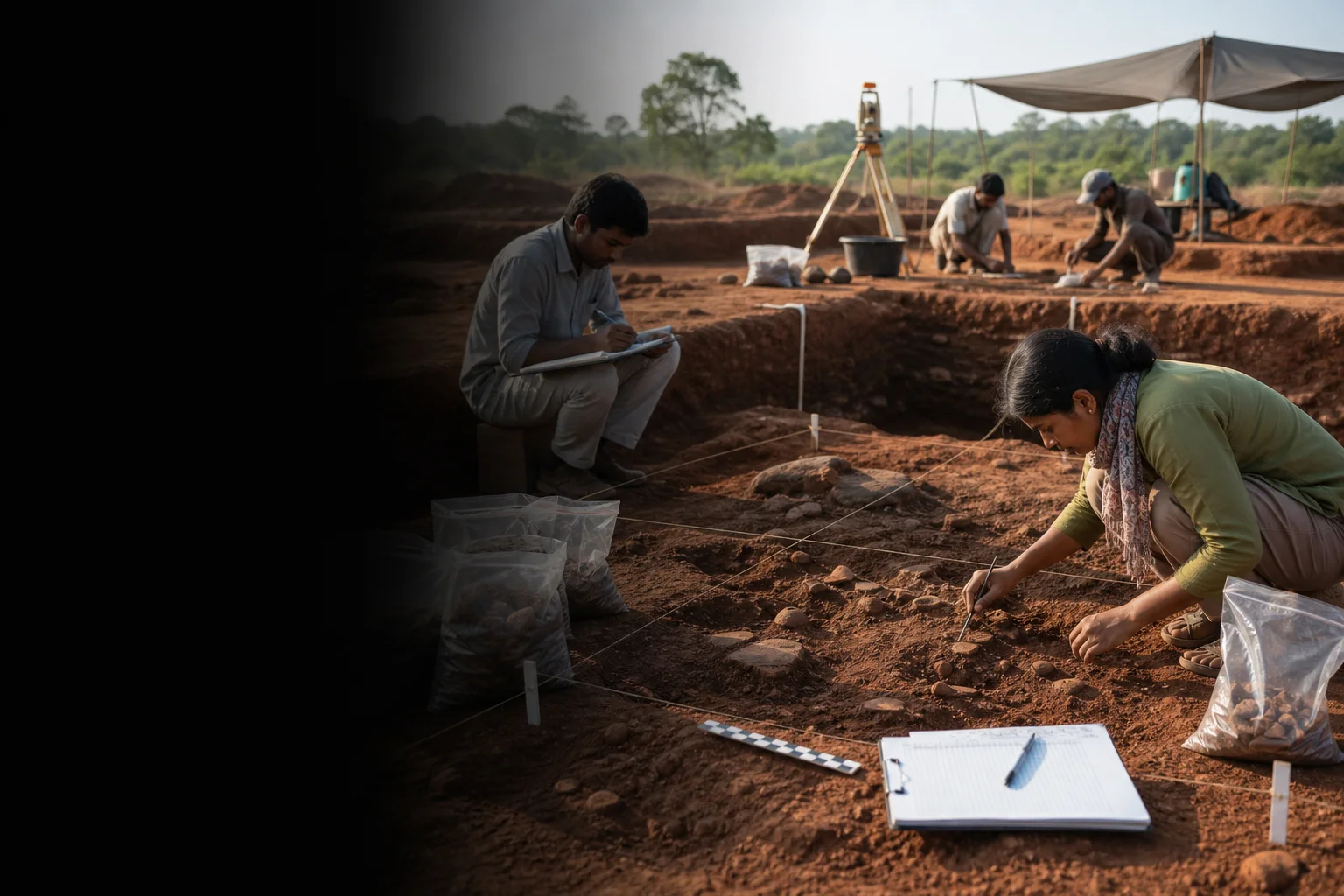
These project-created visuals support orientation. They are not presented as photographs of an excavation, monument, person, or event.
Questions
Frequently asked questions
Does rouletted ware prove a Roman import?
No. South Asian rouletted ware is generally understood as Indian production. A particular sherd still needs specialist identification and context.
Do the coins date the founding of Alagankulam?
No. An issue date is not a foundation date, and a coin can remain in circulation or be retained before entering the ground.
Why does this guide discuss uncertainty?
The distinction between an excavated object and a historical reconstruction is part of the evidence. It keeps future discoveries from being forced into an inherited story.
Editorial trust
Sources and further reading
Citations in the article point to this full list. Source type and review date are shown so readers can evaluate the evidence.
- 1Alagankulam: excavation overviewTamil Nadu Department of ArchaeologyOfficial site summary; ceramic terminology checked against later research · Reviewed 16 November 2026
- 2Archaeological excavations conducted by the DepartmentTamil Nadu Department of ArchaeologyOfficial excavation register · Reviewed 16 November 2026
- 3Pottery production and trades in Tamil Nadu region: new insights from Alagankulam and Keeladi excavation sitesOdelli and colleagues, Heritage Science (2020)Peer-reviewed archaeometric research · Reviewed 16 November 2026
- 4Rare earth elements sediment analysis tracing anthropogenic activities in the stratigraphic sequence of Alagankulam (India)Scientific Reports (2024)Peer-reviewed sediment research · Reviewed 16 November 2026
- 5Indian Archaeology 1990–91: A Review — AlagankulamArchaeological Survey of IndiaAnnual excavation report · Reviewed 16 November 2026
- 6A geochemical investigation of the origin of Rouletted and other related South Asian fine waresFord, Pollard, Coningham and Stern, AntiquityPeer-reviewed compositional research; abstract consulted · Reviewed 16 November 2026
Editorial review: Reviewed 16 November 2026 using accessible excavation records, institutional summaries and scholarly research. Some full publications were unavailable; abstracts and indexed excerpts support only the specific claims discussed, while the publications also provide further reading. Dates and interpretations retain their stated uncertainties.

A Journey Through Chola Heritage in Tamil Nadu
Follow a thoughtful route through three living Chola temple landscapes, learning to read architecture, inscriptions, patronage, and place without rushing.
Tharangambadi: Read the Fort, Printing History and Living Coast
A layered coastal-town guide that begins before the Danish fort, follows trade and printing history, and returns heritage to a living Bay of Bengal shoreline.
Sittannavasal: Read a Jain Hill Through Paint and Stone
A conservation-first guide connecting Sittannavasal's Jain cave, fragmentary paintings, rock beds and inscriptions without forcing them into one date.