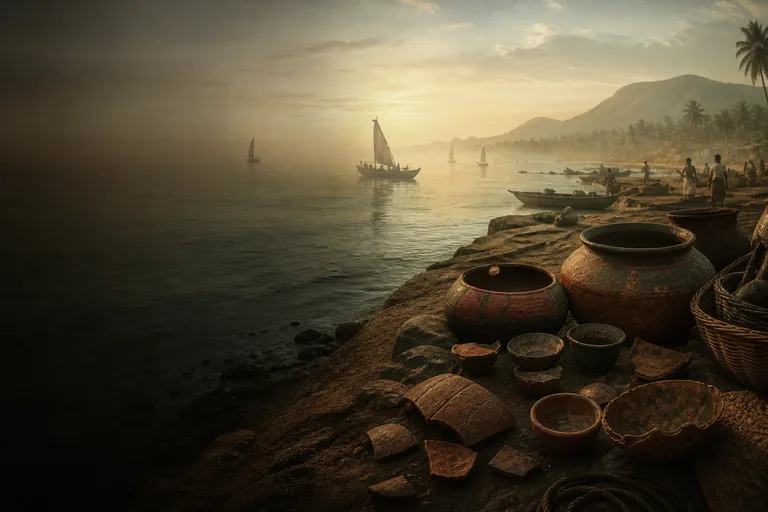
Trade, ports and the Indian Ocean
Trade, Ports and the Indian Ocean World
Follow the work behind the cargo: coastal fisheries, inland bead makers, river towns and the many exchanges that connected the Tamil region with the wider ocean.
Orientation
Overview
Early historic connections, with later Indian Ocean developments identified separately
A port begins inland. Before a bead could enter a ship’s cargo, someone had to obtain its stone, shape it, drill it and find a buyer. Before a pearl reached a distant household, coastal workers had to locate oysters, bring them ashore and separate a valuable object from an uncertain catch. The history of Tamil maritime exchange therefore reaches beyond the waterfront. It includes workshops, burial grounds, river settlements, paths across the peninsula and the people who connected those places.
Korkai, Poompuhar, Alagankulam and Arikamedu reveal different parts of this world. Kodumanal and Karur bring the interior into view. Their surviving records are uneven: one place is especially prominent in literature, another in imported ceramics, another in manufacturing debris. Reading them together creates a richer account than treating each as an identical “Roman trading port”. Arikamedu is in present-day Puducherry; it belongs here because the historical east-coast network crossed today’s administrative borders.[2][7][8][9]
This guide concentrates on early historic exchange, then follows selected connections into later centuries. Sri Lanka and Southeast Asia remain part of that wider story. They were neither passive destinations for Tamil exports nor interchangeable stops on one fixed route. Different communities supplied materials, knowledge, ships, customers and places of exchange. The links below lead to fuller site studies, while this page asks how their evidence fits together.[10]
Read the connections
From inland production to the ocean
A schematic of relationships discussed below. Lines group regions; they do not identify a proven road, a direct voyage or a single period.
West coast
Muziris belongs to present-day Kerala and the western maritime network.
Context for interpreting cross-peninsular exchange.
Kodumanal · Karur
Craft remains, settlement evidence and regional routes bring the hinterland into view.
Read the inland studyPorts and coastal sites
Korkai · Poompuhar · Alagankulam · Arikamedu
Separate sites with different assemblages and occupation histories.
Western Indian Ocean
Mediterranean-region imports belong to broader maritime circulation. Their arrival need not imply one direct voyage.
Sri Lanka and the Bay of Bengal
Compare early material exchange with later merchant inscriptions, keeping their chronologies separate.
Original editorial diagram · no coordinates, ancient boundaries or exact shipping lanes claimed. Evidence and sources appear in the relevant sections below.
Five ways into the evidence
Compare the sites
Korkai
Pearl-fishery traditions; excavated structures and inscribed pottery.
Keep in view: A port tradition does not date every excavated layer.
Poompuhar / Kaveripattinam
Literary accounts, terrestrial remains and offshore investigations.
Keep in view: Underwater features need individual identification and dating.
Alagankulam
Ceramic assemblages, imported containers, coins and writing.
Keep in view: Rouletted ware is not automatically a Roman import.
Kodumanal and Karur
Craft production, settlement, burials and regional connections.
Keep in view: A reconstructed corridor is not a documented cargo itinerary.
Arikamedu
Imported ceramics and local craft activity in Puducherry.
Keep in view: Mediterranean goods do not establish a Roman colony.
Chronology
A careful timeline
Dates identify documented phases and broad ranges. They do not imply uninterrupted rule or certainty where the evidence remains debated.
Workshops and coastal exchange
Inland craft assemblages, written sherds and port finds reveal overlapping networks; each site needs its own chronology.[11]
Mediterranean connections
Imported vessels and other finds connect parts of southern India with the wider exchange system reaching Roman Egypt.[1][9]
Changing Bay of Bengal connections
Overseas inscriptions add different kinds of evidence for merchant organisation; they must not be projected onto early historic workshops.[12]
Surviving textiles
Indian fabrics preserved in Egypt illuminate a later trading world, not the design of Sangam-period cloth.[13]
Historical reading
Four coastal sites, four different records
Korkai’s importance lies in the combination of pearl-fishery references and an excavated settlement in the Tamiraparani region. Literary descriptions associate it with Pandya power and valued marine products. Archaeological work also records worked conch, making shell manufacture visible alongside the better-known pearl story. The two materials should not be confused: a cut conch shell is evidence for a craft operation, whereas a pearl is a different product with a different history of recovery and preservation.[14][15]
At Poompuhar, also called Kaveripattinam or Puhar, the Kaveri’s meeting with the sea provides the setting for a famous literary port. Excavation at Kizharveli exposed brickwork and wooden posts interpreted by the department as a wharf. Coastal and underwater investigations extend the field of study beyond the modern shore. They do not establish that every literary street, market or catastrophe has been located. A poem, a submerged feature and a dated piece of wood answer related but different questions.[16][17]
Alagankulam draws attention to the Vaigai’s coastal region. Amphora fragments, inscribed pottery, beads and Roman coins make external connections visible within a local settlement record. The coins and ceramics need separate dating: a late Roman coin cannot be used to date every imported sherd at the site. Arikamedu, farther north near Puducherry, is another essential comparative site, particularly for Mediterranean imports and the development of ceramic chronologies. Neither site can be reduced to a foreign enclave on the strength of portable objects.[8][9]
A useful comparison therefore begins with function and evidence, not a ranking of greatness. Was an object made locally, consumed locally, stored before onward movement or placed in a grave? Is a structure securely identified as waterfront infrastructure, or merely near an old shoreline? A place may have performed several roles at once. The supporting guides keep those distinctions visible rather than assign every site a single permanent commercial identity.
Historical reading
From inland production to the water’s edge
Kodumanal shifts attention from arrival to manufacture. Its archaeological record includes settlement and burial evidence, beads, iron objects, pottery and inscribed sherds. Research on production examines unfinished objects and discarded material as well as finished ornaments. Karur offers a different combination: excavated ceramics and structures, coins, regional collections and the nearby Pugalur inscriptions. These are complementary records of an interior that participated actively in exchange.[2][3][18]
The Palghat or Palakkad Gap matters as a passage through the Western Ghats. Studies place Kodumanal within routes connecting the western coast and the interior around Karur. That geographical relationship supports a network model; it does not preserve an ancient freight timetable. A cargo could change hands, split into smaller loads or move through intermediate settlements. Nor must every imported object in Karur have arrived through the same port.[18]
Muziris belongs in this discussion as west-coast context, in present-day Kerala. Pattanam has produced substantial evidence for maritime exchange, and its identification with the Muziris of written sources is a major archaeological interpretation. The Kerala heritage account itself presents the identification as a possibility. This guide accordingly uses “Muziris context” rather than treating the ancient name, one excavation mound and an entire harbour landscape as exact synonyms.[6][19]
A map-style connection between workshop, river town and port is a reading aid. It should show a corridor or a proposed relationship, not a surveyed ancient road. The most defensible arrows indicate questions to investigate: where did raw stone originate, where was it worked, and where do comparable finished products occur in contemporary contexts? The dedicated Kodumanal–Karur guide develops those questions without duplicating the existing archaeological site guide.
Historical reading
Pearls: a fishery before a luxury
Pearls enter historical narratives as objects of wealth, but their history starts with a marine environment and demanding labour. The literary association of Korkai with pearl fishing helps explain why the site matters to economic history. It also directs attention to workers who rarely appear as named individuals: divers, boat crews, sorters and those who brought a catch into exchange. A courtly reference to abundance tells us how pearls were valued; it is not a surviving annual production return.[14]
Archaeological shell needs its own description. Species identification, cut marks, unfinished pieces and disposal patterns can distinguish food remains from craft waste. The official Porunai publication’s discussion of cut conches at Korkai supports shell-working activity. It cannot supply the quantity of pearls exported in a particular year. Keeping those propositions separate makes the coastal economy more interesting: communities worked with several marine resources, not a single luxury commodity.[15]
Historical reading
Beads: small objects with long production histories
Beads are unusually useful for following skilled work because failures can survive beside successes. Rough-outs, drilling attempts and fragments may reveal stages that a polished ornament conceals. At Kodumanal, the contrast between habitation material and burial assemblages also matters. Gunasena’s study reports quartz-rich production material in the settlement sample and a different emphasis on carnelian in mortuary contexts. The distinction warns against treating every bead recovered at a manufacturing site as a product of its workshops.[4]
Colour and shape alone cannot establish a route. Similar ornaments may share a source, imitate a popular form or reflect related techniques used in separate places. Analysis becomes stronger when mineral identification, working traces and archaeological context agree. Even a persuasive technological relationship does not name the carrier. The journey of a bead might involve a raw-material supplier, an artisan, several merchants and an eventual wearer; the excavation usually preserves only a few points in that sequence.[18]
Historical reading
Textiles: important cargo, uneven survival
Cloth is less visible than pottery because its preservation demands unusual conditions. That imbalance can distort a trade story built only from museum display cases. The Ashmolean’s research on Indian textiles distinguishes Roman-period written references to Indian cloth from the much later surviving printed fabrics in its Egyptian collections. The early evidence should not be illustrated as though medieval patterns or techniques automatically belonged to the first centuries CE.[20]
Spindle whorls and reported cotton remains at Kodumanal contribute evidence for textile-related work. A spindle whorl is a tool, however, not a labelled export consignment. It cannot establish the destination, quality or volume of finished cloth on its own. Later Indian fabrics preserved in Egypt offer a valuable comparison for what organic survival can reveal, but they illuminate another period. Textile history becomes clearer when tools, written commodity references and actual surviving cloth retain their separate dates.[21][13]
Historical reading
Iron: work, tools and the limits of an export claim
Iron objects in Kodumanal’s record include weapons and other implements; craft studies also address production activity. An iron object in a burial shows deliberate selection for deposition. Evidence of smelting or working concerns the making of metal or its transformation into useful forms. Those categories overlap in the history of a community, but they are not interchangeable archaeological observations.[11][22]
An oceanic export claim requires more than proof that metalworking occurred inland. It needs a connection between production, movement and a receiving context. This page does not call every ancient iron object “wootz”, assign a workshop’s products to Roman armies or infer an overseas destination from technical skill. Metallurgy can establish composition and manufacturing processes; identifying a trading relationship requires additional evidence. Local agricultural and craft demand also belongs in the explanation of why metalworking mattered.
Historical reading
Pottery: containers, tableware and connections
Amphora fragments are particularly helpful when their fabrics and forms can be assigned to known manufacturing traditions. Such vessels carried products through Mediterranean and connected trading systems. Finding a fragment in southern India gives material substance to contact, but its precise contents and journey require further study. The vessel may have been reused, and its arrival need not coincide with its final breakage or burial.[1][23]
Rouletted ware requires a different caution. Older summaries sometimes place it alongside Mediterranean imports in ways that imply a shared foreign origin. Modern ceramic research examines Indian production and distribution and does not support labelling every rouletted sherd “Roman”. Odelli and colleagues’ study of Alagankulam and Keeladi demonstrates why composition and manufacturing analysis matter alongside visual classification. Imported amphorae and Indian fine wares can occur together without having been made in the same region.[5]
Ordinary pottery deserves equal attention. Cooking, storage, serving and disposal provide the setting in which exceptional imports were used. A collection consisting only of attractive foreign pieces hides that setting. Excavation reports are therefore more informative than a photograph of an amphora handle: the surrounding assemblage helps establish what sort of place received it, and whether a find belongs to a secure deposit or a mixed layer.
Historical reading
Coins: movement without a passenger list
Roman coins are evidence of objects travelling beyond the empire’s political territory. Their images and legends may identify issuers, while their metals, wear and archaeological contexts offer further clues. The date of issue is not necessarily the date of arrival in India or the date at which a coin entered the ground. A coin could circulate, be saved, be valued for metal or be reused before deposition.[8]
Karur’s museum brings together coins from several periods and collecting histories. That breadth is valuable, but a museum collection is not a single ancient deposit. A coin recovered in excavation, a riverbed discovery and an object acquired without a precise findspot carry different information. None supplies the nationality of the person who last handled it. Nor does the presence of imperial currency establish Roman jurisdiction over an Indian settlement.[3]
Historical reading
Sri Lanka, Southeast Asia and the wider ocean
The sea connected Tamil coastal communities to Sri Lanka through a regional setting that was also open to longer journeys. Gunasena’s comparative research uses ornaments from Sri Lankan sites alongside Alagankulam and Kodumanal to examine interaction beyond political narratives. This is a productive change of scale. Similar materials and techniques can reveal relationships among people whose lives are scarcely described in chronicles, although they cannot always distinguish travelling artisans from circulating objects.[4]
The island should not appear merely as a stepping stone to somewhere else. Its settlements, consumers and makers participated in selecting and transforming goods. A shared ornament type can therefore raise several possibilities: exchange, local imitation, related production or a taste that crossed the water. Establishing which explanation fits requires dated samples on both sides. Geographic closeness makes contact plausible; archaeological comparison is what gives the argument substance.
Southeast Asia introduces another set of regional histories. Later Tamil inscriptions overseas offer evidence for merchant organisation and endowed facilities, including the Tamil record at Takuapa discussed in Miksic’s study. Such records add named institutions and public acts to the material story. They belong to a later historical setting than the early Mediterranean imports considered above. A medieval merchant association cannot simply be inserted into the social organisation of an early historic bead workshop.[12]
The broad Indian Ocean network linked coastal and inland exchanges across many societies. Monsoon winds shaped opportunities for sailing, while ports connected sea journeys to land transport. The Metropolitan Museum’s account of Roman Asian trade places the Red Sea, Nile and Alexandria within this larger movement of goods. That western connection is one part of the story, not its organising centre: Sri Lankan and Southeast Asian exchanges deserve attention on their own terms.[1][10]
Historical reading
A trading journey was made of several exchanges
A modern map can make an ocean crossing look like one transaction between two destinations. An archaeological object rarely permits that simplification. Its raw material might have moved before manufacture; the finished product could then have entered regional exchange before reaching a coast. After a sea passage it might be unloaded, stored, resold and carried inland again. The findspot marks one surviving stage, not necessarily the intended end of its first journey.
The Muziris papyrus supplies a rare documentary example. Steven Sidebotham’s contribution to the KCHR handbook discusses a Greek contract, dated approximately to the middle of the second century CE, concerning a loan and a consignment from Muziris. The surviving ship name is Hermapollon. The named cargo included ivory, nard and textiles. Unlike a distribution map assembled from scattered finds, this document places particular goods within a commercial arrangement and connects that arrangement to onward transport in Roman Egypt.[19]
Sidebotham describes the Egyptian leg as movement from a Red Sea port across the desert to Coptos, followed by transport along the Nile to Alexandria. The surviving document does not preserve the Red Sea port’s name, the contracting parties’ names or an exact date. The date is assessed from handwriting. This makes the example unusually instructive: a documented consignment can reveal transport and finance while still leaving some of the people and places in the transaction unidentified.[19]
For the Tamil inland sites, the papyrus offers a comparison rather than a missing shipping receipt. It does not name a Kodumanal workshop or connect its cargo to Karur. What it changes is the question asked of the archaeological record. Objects did not simply move because a route existed; someone arranged transport, credit and delivery. The document makes those arrangements visible for one western consignment. At the Tamil sites, their material consequences must instead be sought in production, storage and distribution, without assigning the same contractual machinery to every exchange.
For readers moving between the supporting pages, the most useful comparison is consequently specific. Compare an imported ceramic with another identified ceramic, a working deposit with another working deposit, or a written reference with its literary setting. Then bring the results together. Korkai’s coastal labour, Poompuhar’s changing waterfront, Alagankulam’s material contacts, Arikamedu’s ceramic record and Kodumanal’s inland manufacture each contribute something distinctive. Their differences are what make the wider network intelligible.
Historical reading
What archaeology actually shows
Consider three claims of increasing reach. An imported amphora fragment establishes an object of external manufacture in a particular context, once its identification is secure. An assemblage of such objects may support a sustained trading connection. A claim that a resident Roman community occupied the site needs further evidence about people and settlement. Moving from the first statement to the third without an argument is precisely the leap this guide avoids.
Dates need the same discipline. A charcoal sample dates the measured material within a context; an inscription may be dated through letter forms; a coin gives an issue date; a poem has its own composition and transmission history. A modern overview can place these on a common timeline, but it cannot make their uncertainties disappear. The meaningful result is a connected history with visible seams: productive inland communities, changing coastal places and exchanges whose scale is clearer than every individual itinerary.
Human scale
People and institutions
Named rulers are only one part of the history. These groups and individuals help show how evidence and social life connect.
Artisans
Stone working, metalworking and textile-related activity made inland communities active participants in exchange.
Coastal workers
Fishing, shell working, boat handling and the sorting of marine products underlay the luxury trade.
Merchants and intermediaries
Goods could change hands repeatedly; an object’s origin does not identify its final carrier.
Historical geography
Connected places
Places are linked only when a substantive My Tamil Nadu guide already exists. Other entries remain non-clickable research context.
Visual reading
Images with explicit provenance
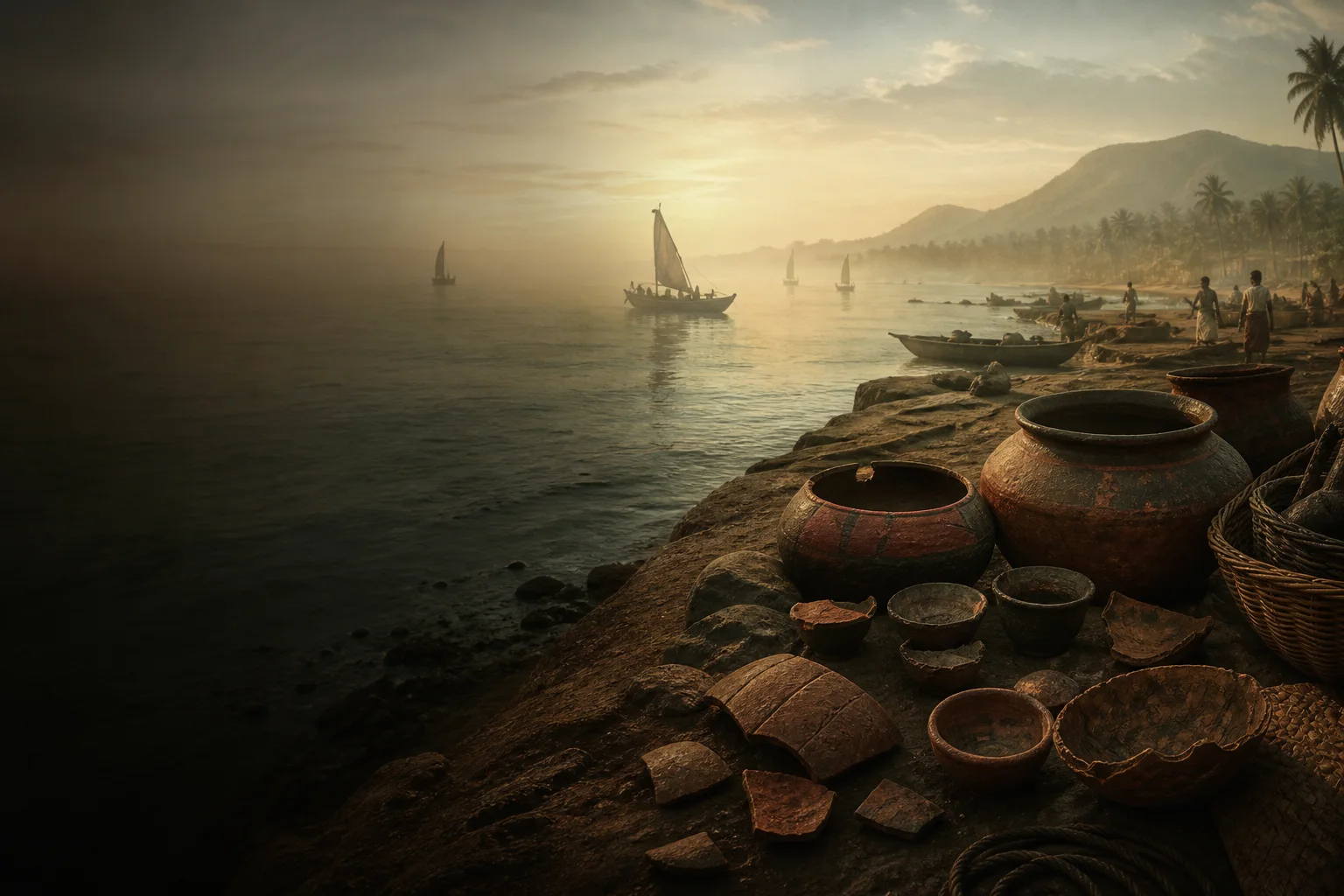
These project-created visuals support orientation. They are not presented as photographs of an excavation, monument, person, or event.
Questions
Frequently asked questions
Was every imported object carried directly from Rome?
No. Objects could pass through several ports and intermediaries. Mediterranean manufacture does not by itself prove a direct voyage from Rome.
Why is there no separate Muziris page?
Muziris is included as west-coast context for the inland and maritime network. The focus here remains Tamil Nadu, with Pattanam’s identification treated as an archaeological interpretation.
Are early and medieval trade networks the same?
No. Places, institutions and evidence changed. Later inscriptions and surviving medieval cloth are labelled separately from early historic finds.
Editorial trust
Sources and further reading
Citations in the article point to this full list. Source type and review date are shown so readers can evaluate the evidence.
- 1Trade between the Romans and the Empires of AsiaThe Metropolitan Museum of ArtMuseum scholarly essay · Reviewed 16 November 2026
- 2Kodumanal: excavation summaryTamil Nadu Department of ArchaeologyOfficial excavation summary · Reviewed 16 November 2026
- 3Chera Site Museum, KarurTamil Nadu Department of ArchaeologyOfficial museum and epigraphy overview · Reviewed 16 November 2026
- 4Interactions between Sri Lanka and South India in the Early and Middle Historic through the perspective of personal adornmentUniversity of Exeter; author-uploaded research copyKaushalya Gunasena, doctoral thesis, 2018; relevant chapters and assemblage discussion · Reviewed 16 November 2026
- 5Pottery production and trades in Tamil Nadu region: new insights from Alagankulam and Keeladi excavation sitesHeritage ScienceOdelli and colleagues, peer-reviewed archaeometric study, 2020 · Reviewed 16 November 2026
- 6Pattanam: excavations and the possible Muziris identificationGovernment of Kerala, Muziris Heritage ProjectOfficial heritage synthesis · Reviewed 16 November 2026
- 7Karur: excavation summaryTamil Nadu Department of ArchaeologyOfficial excavation summary; ceramic terminology requires comparison with later research · Reviewed 16 November 2026
- 8Alagankulam: excavation summaryTamil Nadu Department of ArchaeologyOfficial excavation summary · Reviewed 16 November 2026
- 9Beyond Arikamedu: Macro Stratigraphy of the Iron AgeIndira Gandhi National Centre for the ArtsScholarly archaeological chronology study in institutional repository · Reviewed 16 November 2026
- 10About the Silk RoadsUNESCOInstitutional overview of interconnected land and sea networks · Reviewed 16 November 2026
- 11Excavated sites and finds: Kodumanal and Karur in the annexed inventoryParliament of India / Ministry of CultureOfficial parliamentary archaeological inventory · Reviewed 16 November 2026
- 12Archaeology, Trade and Society in Northeast SumatraISEAS – Yusof Ishak InstituteJohn Miksic, academic research; overseas Tamil inscriptions in regional context · Reviewed 16 November 2026
- 13Made in India, Found in Egypt: Red Sea Textile Trade in the Thirteenth and Fourteenth CenturiesThe Metropolitan Museum of ArtMuseum textile scholarship; explicitly medieval evidence · Reviewed 16 November 2026
- 14Pearl Fishery of the Tamil CoastAnnamalai University / Tamil Virtual Academy digital libraryUniversity historical monograph; early literary discussion distinguished from later fishery history · Reviewed 16 November 2026
- 15Porunai River Civilization: Korkai excavationTamil Nadu Department of Archaeology / Tamil Virtual AcademyOfficial archaeology publication · Reviewed 16 November 2026
- 16Poompuhar: excavation summaryTamil Nadu Department of ArchaeologyOfficial excavation summary · Reviewed 16 November 2026
- 17Coastal archaeological evidence and shoreline change around Poompuhar and TranquebarCSIR–National Institute of Oceanography / Current SciencePeer-reviewed coastal archaeological study, 2017 · Reviewed 16 November 2026
- 18Craft Specialization, Technology and Social Change: a study of stone bead production in Early Historic South IndiaUniversity of Wisconsin–MadisonGwendolyn Kelly, doctoral research; university repository · Reviewed 16 November 2026
- 19Pattanam excavation handbook, 2008Kerala Council for Historical ResearchExcavation project publication · Reviewed 16 November 2026
- 20Indian Ocean textile trade: India to EgyptAshmolean Museum, University of OxfordMuseum collection scholarship; distinguishes early references from medieval fabrics · Reviewed 16 November 2026
- 21Graffiti and Tamili: Kodumanal craft-production discussionTamil Virtual Academy digital libraryArchaeological publication; bead production, spindle whorls and cotton evidence · Reviewed 16 November 2026
- 22Introduction to the Study of Archaeology: KodumanalPondicherry UniversityUniversity archaeology teaching text · Reviewed 16 November 2026
- 23Karur Akazhaivu: excavation reportTamil Nadu Department of ArchaeologyPrimary excavation publication; Tamil · Reviewed 16 November 2026
Editorial review: Reviewed 16 November 2026 using accessible excavation records, institutional summaries and scholarly research. Some full publications were unavailable; abstracts and indexed excerpts support only the specific claims discussed, while the publications also provide further reading. Dates and interpretations retain their stated uncertainties.

A Journey Through Chola Heritage in Tamil Nadu
Follow a thoughtful route through three living Chola temple landscapes, learning to read architecture, inscriptions, patronage, and place without rushing.
Tharangambadi: Read the Fort, Printing History and Living Coast
A layered coastal-town guide that begins before the Danish fort, follows trade and printing history, and returns heritage to a living Bay of Bengal shoreline.

Mamallapuram: Read a Coastal World Heritage Landscape
A connected reading of Mamallapuram that moves from granite outcrops and carved caves to monolithic experiments, open-air reliefs, the Shore Temple and a living coastal town.