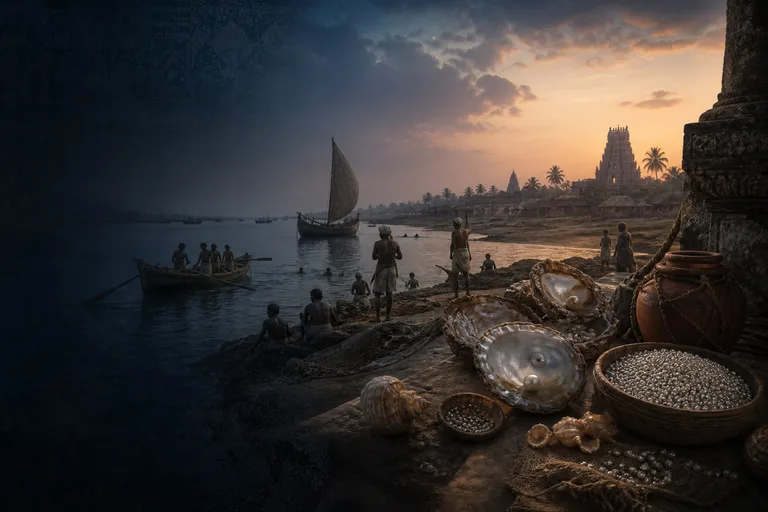
Ports and maritime livelihoods
Korkai and the Pearl Fisheries
An inland village today, Korkai opens a history of changing shores, written pottery and a maritime commodity whose brilliance can hide the work behind it.
Orientation
Overview
Early historic port evidence, with later fisheries used only as comparison
Korkai changes the scale at which Tamil maritime history can be told. Instead of beginning with an emperor or a distant market, begin with a settlement on the Tamiraparani coastal plain and the work of reaching, collecting and exchanging marine resources. The village is now inland. Its history therefore asks readers to imagine a different relationship between river, shore and settlement, while keeping that reconstruction separate from the places that can be walked today.[1]
The familiar pairing of Korkai and pearls rests on more than one kind of record. Ancient geographical writing discusses a pearl fishery in the Pandyan region; Tamil literary memory gives the port a place in southern political history; excavation establishes material occupation and the use of writing. Each contributes something different. None alone supplies a complete account of how a fishing season was organized, which boat carried a particular pearl, or who received its final sale price.[2]
Chronology
A careful timeline
Dates identify documented phases and broad ranges. They do not imply uninterrupted rule or certainty where the evidence remains debated.
Written and built traces
Excavated pottery and structures give the settlement a material history.[1]
A maritime text
The Periplus describes Colchi and pearl fisheries within a Pandyan political setting.[2][3]
A wider Gulf history
Later fisheries around India and Sri Lanka have their own evidence and institutions.[7]
Ecology and archaeology
Fisheries science and shell-midden research ask different questions of the same maritime region.[5][7]
Historical reading
What archaeology actually shows
The state excavation summary records brickwork, large terracotta rings beneath a structure and potsherds with Tamil-Brahmi letters. It interprets the rings provisionally as soakage installations. These finds establish a built settlement with pottery use and writing; they do not expose an entire harbour plan. The department also reports a charcoal determination of 785 BCE and assigns the inscribed sherds broadly to 300 BCE–200 CE. Those are separate claims about different evidence, not a single founding date for the port.[1]
A date attached to charcoal is a date for sampled organic material. To connect it securely to a harbour, a building or an inscribed pot requires the recorded relationship among sample, layer and object. The compact official account does not reproduce the laboratory documentation or a complete stratigraphic argument. Accordingly this guide does not advertise an exact year when Korkai began trading. Readers looking for the earliest occupation should pursue that narrower question through the excavation publication and its dating records.[10]
Historical reading
A pearl port in an outsider’s account
Section 59 of the Periplus of the Erythraean Sea places pearl fisheries at Colchi, conventionally associated with Korkai, within the Pandyan kingdom. Its brief remark about condemned people working the fishery is striking. It is testimony from a particular author, however, rather than an excavation finding or a comprehensive description of labour. Quoting the remark as if it described every diver across centuries would give a short passage more authority than it can bear.[2]
The University of Athens introduction explains the practical purpose and uneven geographical detail of the Periplus. The work offers information useful to maritime commerce, and modern scholars differ on its precise first-century date. Read in that setting, its southern references establish commercial awareness across a very wide region. They do not prove that the writer personally observed every place, or that ships travelled directly from Roman Egypt to every market mentioned.[3]
Historical reading
Names on pots, people behind exchange
Tamil-Brahmi gives Korkai a different sort of connection: the use of writing on everyday portable material. The department’s epigraphy overview documents the script on pottery, coins, seals and rings as well as on rock surfaces. It also notes objects bearing the script outside India. This distribution makes mobility an important question, but the argument must remain object-specific. A marked pot can travel farther than its maker, owner or writer.[4]
At a port-associated settlement, an inscribed sherd invites questions about possession, recognition and circulation. Was a mark made before or after firing? Was it a readable name or a different kind of sign? Did the vessel arrive complete, or was the fragment redeposited? Those questions determine what writing can tell us about exchange. This page therefore does not convert the presence of letters into a literacy percentage, a merchant census or a claim that all marked pots were commercial labels.[4]
Historical reading
Pearls begin with an uneven marine resource
Pearl fisheries depended on living oyster populations, not an inexhaustible stock of finished gems. CMFRI’s account of Indian molluscan resources describes the Gulf of Mannar banks and their uneven productivity, including long intervals with few oysters. It identifies habitat change, predators and moving sand among the pressures involved. These modern observations are not measurements of ancient Korkai. They explain why a historical pearl economy should be understood as dependent on ecological conditions rather than as a steady annual output.[5]
This distinction alters the economic story. A port can be well placed for exchange while the resource on which part of its trade depends fluctuates. Political control over a coastal settlement does not itself make oyster beds productive. Nor does the later fame of a fishery establish the quantity gathered in an earlier century. A convincing account of ancient production would need evidence for both human organization and the marine environment. The current evidence does not justify export totals or a fixed ancient harvesting calendar.[5]
Historical reading
The work concealed by a finished pearl
Later Gulf of Mannar history reveals how much activity a pearl fishery could concentrate. Scholarship on the Ceylon fishery between 1800 and 1925 treats the fishery as an event that brought labour and capital together for a limited period. Its archival evidence identifies diving communities, buyers and shore-side processing. These records help recover labour from a story often dominated by luxury consumption, but they belong to later political and commercial arrangements.[6]
For Korkai, that comparison is useful precisely because it has limits. It suggests questions about boats, provisions, diving knowledge, sorting and bargaining. It does not permit the names of nineteenth-century occupational groups, wage practices or revenue systems to be copied into an early historic scene. Ancient workers should not disappear from the narrative simply because their names are missing; equally, a vivid account of their lives should not be invented to fill the silence.[6]
Historical reading
Shell heaps can tell a history that pearls cannot
A 2024 archaeological study on the Sri Lankan side of the Gulf examined pearl-oyster middens and a coastal settlement. Species identification, shell measurements, ceramics and radiocarbon analysis allowed the researchers to investigate extraction and ecological pressure. Their dated evidence concerns the tenth to nineteenth centuries. This is an unusually clear example of what a production history can look like when discarded material, rather than only prized objects, becomes the focus.[7]
Those middens are neither excavations at Korkai nor proof of an identical early fishery on the Indian shore. Their relevance is methodological and regional: identify the shell, establish its context, date the deposit and then ask what human activity created it. A pile of shells might otherwise be misread as food refuse, craft waste or the residue of pearl extraction. The history of an exported gem becomes more precise when its local waste is studied with equal care.[7]
Historical reading
One gulf, several histories of pearling
The 1976 history of the Indian pearl banks explicitly notes that the beginning of exploitation is unknown. Its main evidence concerns the banks from 1904 onward, which is why its detailed record cannot simply extend an ancient chronology. The value of that later record lies in showing change: particular banks mattered at particular times, and the fishery had to respond to conditions rather than follow a timeless routine.[8]
The modern history of pearl culture adds another distinction. CMFRI’s 1987 introduction places natural fisheries alongside the scientific development of cultured pearls. Cultivation changes the relationship between oyster, pearl and human intervention. A demonstration of pearl culture today is therefore not a direct survival of an early historic extraction technique. Keeping these processes separate helps visitors understand both the ingenuity of modern fisheries research and the uncertainty surrounding ancient practice.[9]
Historical reading
Reading Korkai beside other sites
Korkai belongs in a southern coastal history, but it should not be made to stand for every port. Alagankulam raises different questions about ceramics and imported objects. Kodumanal brings inland craft production into view. Adichanallur offers a nearby regional comparison centred on burials, with a different archaeological purpose. Reading these places together is valuable when the differences remain visible: a settlement, a production site and a burial landscape cannot be treated as interchangeable trade stations.
The connection to Sri Lanka is best approached at the scale of the Gulf and wider maritime networks. The two shores share a history of pearl resources, while individual voyages, political relationships and the chronology of particular fisheries require their own evidence. Korkai’s significance does not depend on claiming that all pearls travelled through it or that every overseas contact was direct. It lies in the meeting of coastal resources, settlement, writing and the historical memory of exchange.
Historical reading
Reading the landscape today
The present distance between village and sea is part of the historical question, not a reason to dismiss the port tradition. It also makes an imagined ancient waterfront a poor navigation aid. Use the district guide for modern orientation and archaeological publications for reconstructed geography. The History and Archaeology guides explain the wider chronology; this page keeps attention on the relationship between the settlement and pearl fisheries.
At the site or in a collection, seek labels that identify where an object was recovered and what dates are assigned to its context. A photograph of a sherd is more useful with a site, layer and catalogue reference than with a sweeping caption about global trade. Respect private land and protected remains, leave surface material in place, and treat new discoveries as evidence to be documented rather than souvenirs. The most informative visit may begin with a small, securely described object.
Human scale
People and institutions
Named rulers are only one part of the history. These groups and individuals help show how evidence and social life connect.
Divers and shore workers
Essential to pearl extraction; early organization cannot be reconstructed from later labour records alone.
Writers and pot users
Inscribed pottery preserves acts of marking, without identifying every user as a merchant.
Historical geography
Connected places
Places are linked only when a substantive My Tamil Nadu guide already exists. Other entries remain non-clickable research context.
Visual reading
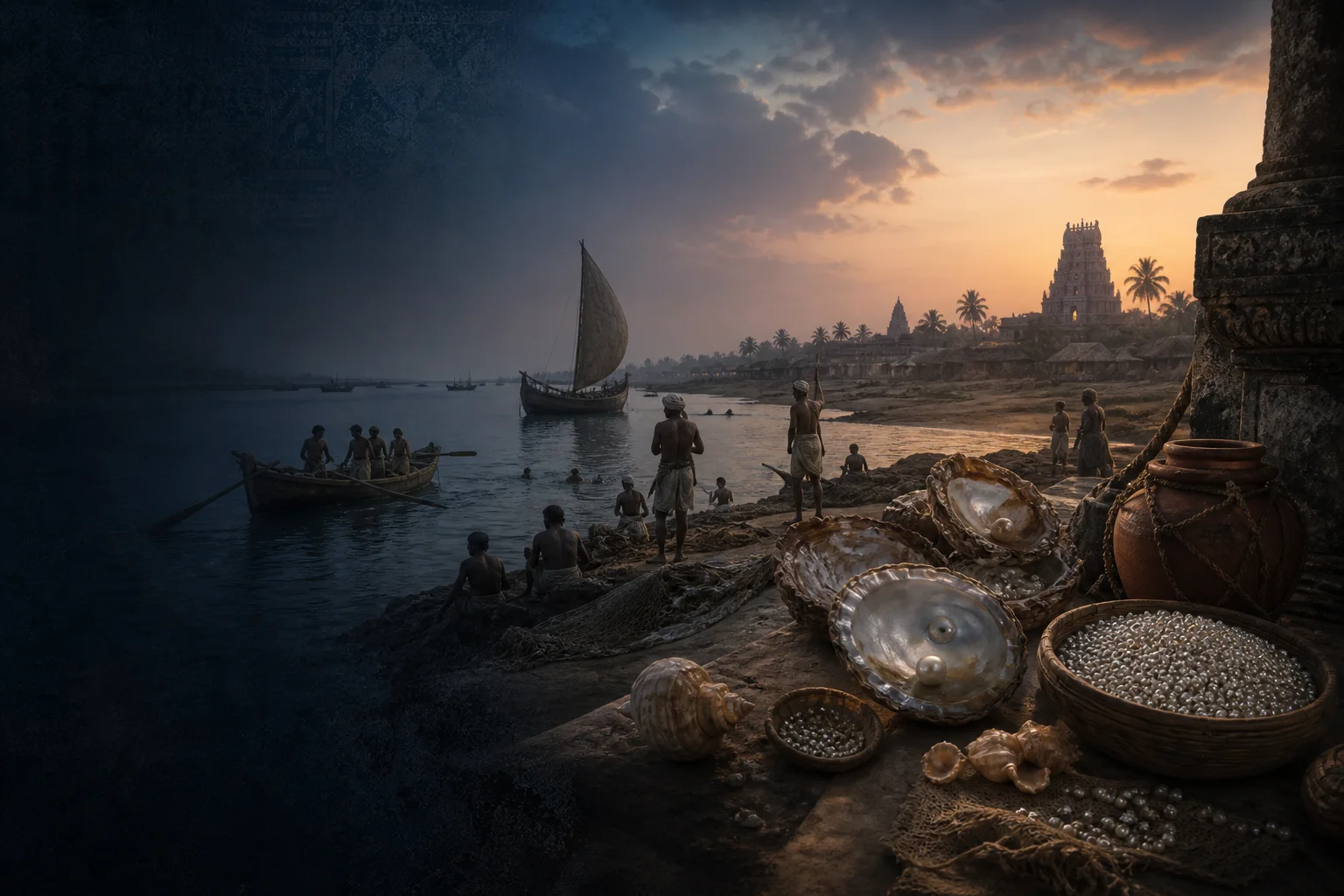
Images with explicit provenance
These project-created visuals support orientation. They are not presented as photographs of an excavation, monument, person, or event.
Questions
Frequently asked questions
Does 785 BCE date the port’s foundation?
No. The department reports a charcoal determination; a sample date cannot automatically date the establishment of a harbour.
Were all pearl divers prisoners?
A brief statement in the Periplus is not a complete labour history. It should not be generalized across all places or periods.
Are the Sri Lankan shell middens evidence from Korkai?
No. They are comparative research on the other side of the Gulf, mostly dating to much later centuries.
Editorial trust
Sources and further reading
Citations in the article point to this full list. Source type and review date are shown so readers can evaluate the evidence.
- 1Korkai: excavation summaryTamil Nadu Department of ArchaeologyOfficial excavation summary; indexed text checked · Reviewed 16 November 2026
- 2Periplus of the Erythraean Sea, sections 59–60Anonymous ancient author; W. H. Schoff translation (1912)Primary literary source in an early translation · Reviewed 16 November 2026
- 3The Periplus of the Red Sea: introductionNational and Kapodistrian University of AthensUniversity introduction to the ancient text · Reviewed 16 November 2026
- 4Inscriptions in Thamizhi (Tamil-Brahmi) scriptTamil Nadu Department of ArchaeologyOfficial epigraphic overview; indexed text checked · Reviewed 16 November 2026
- 5The molluscan fishery resources of IndiaCentral Marine Fisheries Research Institute; S. JonesFisheries research; historical ecological context · Reviewed 16 November 2026
- 6Seeing Like the Sea: A Multispecies History of the Ceylon Pearl Fishery, 1800–1925Past & Present / Oxford University PressPeer-reviewed environmental history; indexed excerpt checked · Reviewed 16 November 2026
- 7Pearl Fisheries in South Asia: Archaeological Evidence from Pre-Colonial and Colonial Shell Middens around the Gulf of Mannar in Sri Lanka (2024)Siriwardana, Dissanayake and Çakırlar; International Journal of Historical ArchaeologyPeer-reviewed archaeological research; full text checked · Reviewed 16 November 2026
- 8History of the Indian pearl banks of the Gulf of Mannar (1976)Tamil Nadu Department of Fisheries / Journal of the Marine Biological Association of IndiaScientific historical review; indexed introduction checked · Reviewed 16 November 2026
- 9CMFRI Bulletin 39: Pearl culture, introduction (1987)Central Marine Fisheries Research Institute; K. AlagarswamiInstitutional fisheries research; abstract checked · Reviewed 16 November 2026
- 10Underwater Archaeology Wing, question 4019, 28 March 2022Ministry of Culture / Lok SabhaOfficial parliamentary answer · Reviewed 16 November 2026
Editorial review: Reviewed 16 November 2026 using accessible excavation records, institutional summaries and scholarly research. Some full publications were unavailable; abstracts and indexed excerpts support only the specific claims discussed, while the publications also provide further reading. Dates and interpretations retain their stated uncertainties.

A Journey Through Chola Heritage in Tamil Nadu
Follow a thoughtful route through three living Chola temple landscapes, learning to read architecture, inscriptions, patronage, and place without rushing.
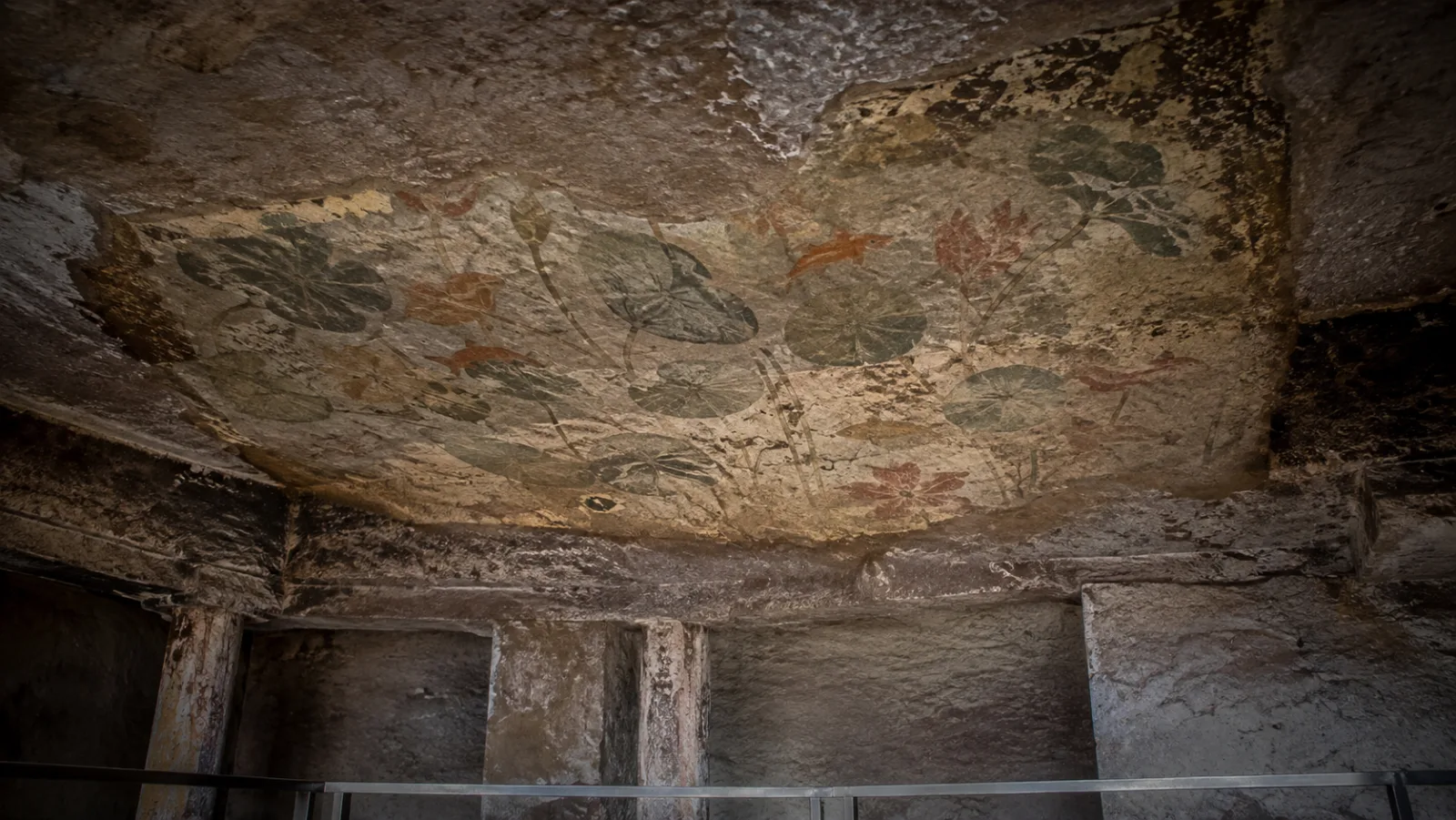
Sittannavasal: Read a Jain Hill Through Paint and Stone
A conservation-first guide connecting Sittannavasal's Jain cave, fragmentary paintings, rock beds and inscriptions without forcing them into one date.

Chennai Government Museum: Read a Campus of Collections
A first-visit method for reading the Egmore museum as an evolving campus of architecture, archaeology, bronzes, inscriptions and public education.