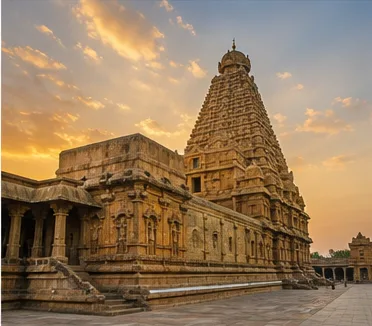
Early modern court and knowledge centre
Maratha Thanjavur
Read Thanjavur after the Nayakas as a multilingual Maratha court shaped by inscriptions, palace institutions, scholarship, performance, and an increasingly powerful East India Company.
Orientation
Overview
Late 17th century to 1855, with political authority changing before the dynasty's cultural legacy ended
Maratha rule at Thanjavur began in the late seventeenth century after the end of the local Nayaka line. The Bhonsle rulers established a court in a Tamil-speaking Kaveri delta already shaped by Chola institutions, Nayaka patronage, temples, agrarian networks, merchants, and multilingual scholarship. Their history is therefore neither an external appendix to Tamil Nadu nor a replacement of everything that came before.[1][7]
The court left a substantial written and material record. Tamil Nadu Archaeology documents Marathi inscriptions on stone and copper plates, as well as Nagari-script records connected with the dynasty. The palace complex preserves Nayaka and Maratha phases, while the Sarasvati Mahal Library developed from earlier royal collections and grew significantly under Maratha patronage, especially Serfoji II.[1][2][3][4]
Political autonomy narrowed as the English East India Company expanded its fiscal and territorial power. Yet cultural, religious, medical, literary, and artistic activity cannot be described simply as decline. Court institutions and networks continued to produce, collect, translate, perform, and preserve knowledge under changing conditions.[4][5]
Chronology
A careful timeline
Dates identify documented phases and broad ranges. They do not imply uninterrupted rule or certainty where the evidence remains debated.
A Maratha dynasty at Thanjavur
Ekoji/Venkoji established a new ruling line after the Thanjavur Nayakas; exact political transitions should be read from regional evidence.[1][7]
A regional court in a contested south
Thanjavur negotiated with neighbouring powers and European companies while sustaining delta institutions and patronage.[1]
Serfoji II's court
Serfoji II is closely associated with the expansion of library, educational, medical, artistic, and collecting activity, even as Company power constrained sovereignty.[4][2]
Manora
The tower was built under Serfoji II to commemorate a British victory over Napoleon, a monument to the court's place within global imperial politics.[6]
Company annexation
The East India Company took over the administration after the end of the ruling line; palace, family, religious, and cultural histories continued beyond annexation.[1]
Historical reading
From Nayaka Thanjavur to a Maratha court
The transition followed conflict involving the Thanjavur and Madurai Nayaka polities and wider Deccan powers. Ekoji, a half-brother of Shivaji, established control at Thanjavur, but the resulting kingdom developed within the institutions and social landscape of the Kaveri delta. A dynastic label identifies the ruling house, not the language or identity of every subject.
Marathi-speaking court groups joined Tamil, Telugu, Sanskrit, Persianate, and European-connected networks. Temples, Brahman settlements, cultivators, artisans, performers, merchants, military households, and officials interacted with the court in different ways. Inscriptions help locate gifts and public acts, while palace records and manuscripts reveal selected institutional worlds.[1][2]
Historical reading
A multilingual inscriptional and archival record
Tamil Nadu Archaeology identifies Marathi records across temples, churches, dargahs, tanks, choultries, hospitals, memorials, palaces, bridges, fields, and ritual objects. That range matters: political and charitable activity extended beyond a palace narrative. Tamil and other languages continued alongside Marathi, and scripts do not map neatly onto one community.[1]
At Brihadisvara Temple, the long Nagari inscription commissioned under Serfoji II presents a dynastic history. It is valuable primary evidence and also an act of royal memory. Its genealogy and narrative choices must be compared with records made closer to the events they describe.[2][8]
Historical reading
Library, medicine, education and collecting
The Sarasvati Mahal collection originated under earlier Thanjavur rulers and was enlarged by the Maratha court. The Ministry of Culture describes manuscripts in multiple languages and scripts across literature, medicine, mathematics, philosophy, music, and other subjects. Serfoji II's collecting and copying programmes are a major part of this history, but the library was built through generations of scribes, scholars, cataloguers, and custodians.[4]
Serfoji's interests in medicine, print, education, mapping, and European knowledge are often celebrated. They are best understood within an unequal colonial setting where intellectual exchange, court agency, missionary contact, and Company power coexisted. Avoiding a simple hero narrative makes the institutional achievement more, not less, intelligible.[4][5]
Historical reading
Music, dance, painting and courtly culture
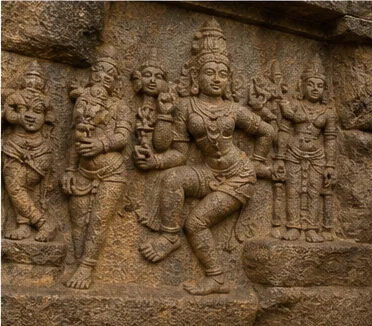
Thanjavur became a major centre of music and dance through work that crossed court, temple, household, and public institutions. Rulers provided patronage, but composers, performers, teachers, instrument makers, dancers, and hereditary communities created and transmitted practice. Later classicization changed how those histories were remembered.
The palace preserves murals, stucco, halls, towers, and collections with both Nayaka and Maratha phases. Conservation findings can reveal an earlier painting beneath a later one, making the building itself a record of reuse. Labels should identify the documented phase rather than calling the whole palace uniformly Maratha.[3][5]
Historical reading
Sovereignty under Company pressure
The eighteenth-century south was shaped by warfare among regional states, Nawabi authority, Maratha networks, Mysore, and European companies. Thanjavur's rulers made treaties and faced military and fiscal pressure. By Serfoji II's reign, the East India Company controlled much of the administration while the ruler retained a more limited courtly domain.
Annexation in 1855 ended the kingdom's remaining formal political status, but it did not erase the dynasty's family, palace, manuscript, temple, and cultural legacies. Separating administrative takeover from cultural continuity prevents both a triumphalist court history and a colonial story in which local institutions suddenly vanish.[1][4]
Historical reading
What can be explored responsibly today
The Thanjavur palace complex, Maratha Museum, Sarasvati Mahal Library, Brihadisvara Temple inscriptions, and Manora provide different forms of evidence. A museum display is curated selection; a library is a working institution; a temple is a living sacred place; a protected monument can close areas for conservation.
Visitors should verify access with the responsible institution, follow photography and manuscript-handling rules, and avoid treating a painted portrait as a contemporary likeness without checking its date. Current hours, fees, and gallery status are deliberately not reproduced here.[3][5][6]
Study desk
Research notes for careful readers
Use these questions to move from an overview of Maratha Thanjavur to evidence-led historical study.
Build chronology from anchors
Begin with evidence that carries its own recoverable context: a dated inscription, an excavated layer, a documented coin hoard, a building phase, a letter, or an administrative file. Then place less certain material around those anchors. A royal genealogy, literary allusion, stylistic comparison, or later tradition may be highly informative without supporting an exact year. Writing the evidence type beside every date prevents a reconstructed sequence from looking more certain than its foundations.[1]
Watch for gaps and overlaps. Dynastic names can disappear from one kind of record and return in another; two rulers may claim authority at the same time; a monument can be begun, enlarged, repaired, and reinterpreted under different patrons. Period labels are tools for organizing change, not walls between communities. A timeline should therefore identify phases and transitions instead of pretending that one court handed a complete territory to the next on a single day.[2]
Read maps as arguments
Historical maps are reconstructions. An inscription naming a victory, a poem praising a ruler, a coin found in circulation, and a grant made in a village describe different relationships to place. None by itself proves a permanently administered frontier. Useful maps distinguish core areas, attested sites, campaign claims, routes, tributary relationships, and uncertain zones. They also use the coastline, river course, and place names appropriate to the period being discussed.[3]
Modern Tamil Nadu remains the geographic focus of this site, but historical networks crossed its present boundary. Ports connected to Sri Lanka and the wider Indian Ocean; inland routes crossed the Ghats; religious and merchant institutions operated across several political regions; the Madras Presidency extended far beyond today's state. A regional history becomes clearer when present-day borders orient the reader without containing the past.
Account for survival and silence
Stone temples, copper plates, official files, and elite literary collections survive for particular reasons. Durable material and institutional custody make some voices much louder than others. Workers may appear only through wages or duties, women through gifts or prosecutions, rural communities through tax demands, and defeated groups through an opponent's praise. Silence can indicate loss, exclusion, or the source's purpose; it cannot safely be converted into proof that a person or practice was absent.[4]
Translation adds another layer. Titles, offices, social terms, ritual vocabulary, and place names do not always have one modern equivalent. A smooth English phrase can hide alternatives in the original language. Where an interpretation depends on one word, consult the transcription, translation notes, and more than one scholarly reading. Quotations should come from a checked edition rather than from unsourced graphics or repeated web summaries.
Compare at the right scale
Comparison is strongest when the units truly match. A burial site should not be measured against a capital city as though they served the same function. One king's regnal inscription should not be compared directly with a literary anthology compiled over time. Instead compare burial with burial, workshop with workshop, grant formula with grant formula, and securely dated architectural phase with another documented phase. Regional synthesis comes after those controlled comparisons.
Public history adds valuable questions but can also reward superlatives. Claims about the oldest, greatest, first, largest, or most advanced require a clearly defined comparison set and published evidence. Historical significance does not depend on winning such a ranking. A site or tradition can matter because it changes an interpretation, preserves an unusual archive, or connects people and landscapes in a way that no simple contest can express.
Preserve the evidence you came to see
Historical study continues at living temples, museums, archives, archaeological sites, streets, water systems, and working landscapes. Follow access rules, never touch or enhance inscriptions, do not remove surface finds, ask before photographing people or rituals, and treat conservation closures as part of responsible care. Record the institution, gallery, accession number, monument, or report behind an observation so that it can be checked later.
The best next question is often narrower than the first: which phase of this building, which version of this text, which sample from which layer, which office produced this file, or which community preserved this memory? Narrow questions are not a retreat from big history. They are how large claims become reliable enough to connect.
Human scale
People and institutions
Named rulers are only one part of the history. These groups and individuals help show how evidence and social life connect.
Ekoji (Venkoji)
Founder of the Thanjavur Bhonsle line within a contested late-seventeenth-century regional transition.
Tulaja II
An eighteenth-century ruler associated with courtly and musical patronage in Thanjavur.
Serfoji II
Ruler and patron closely connected with the library, education, medicine, collecting, print, and the palace record.
Scribes, scholars and performers
Multilingual specialists whose labour created manuscripts, catalogues, music, dance, and institutional memory.
Company officials and intermediaries
Participants in treaties and administrative changes that constrained and eventually displaced royal sovereignty.
Historical geography
Connected places
Places are linked only when a substantive My Tamil Nadu guide already exists. Other entries remain non-clickable research context.
Visual reading
Images with explicit provenance
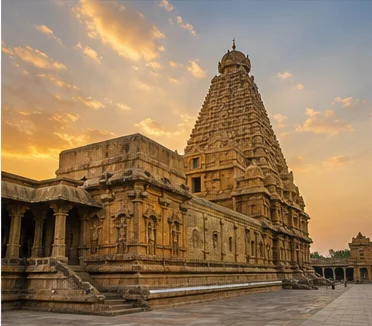
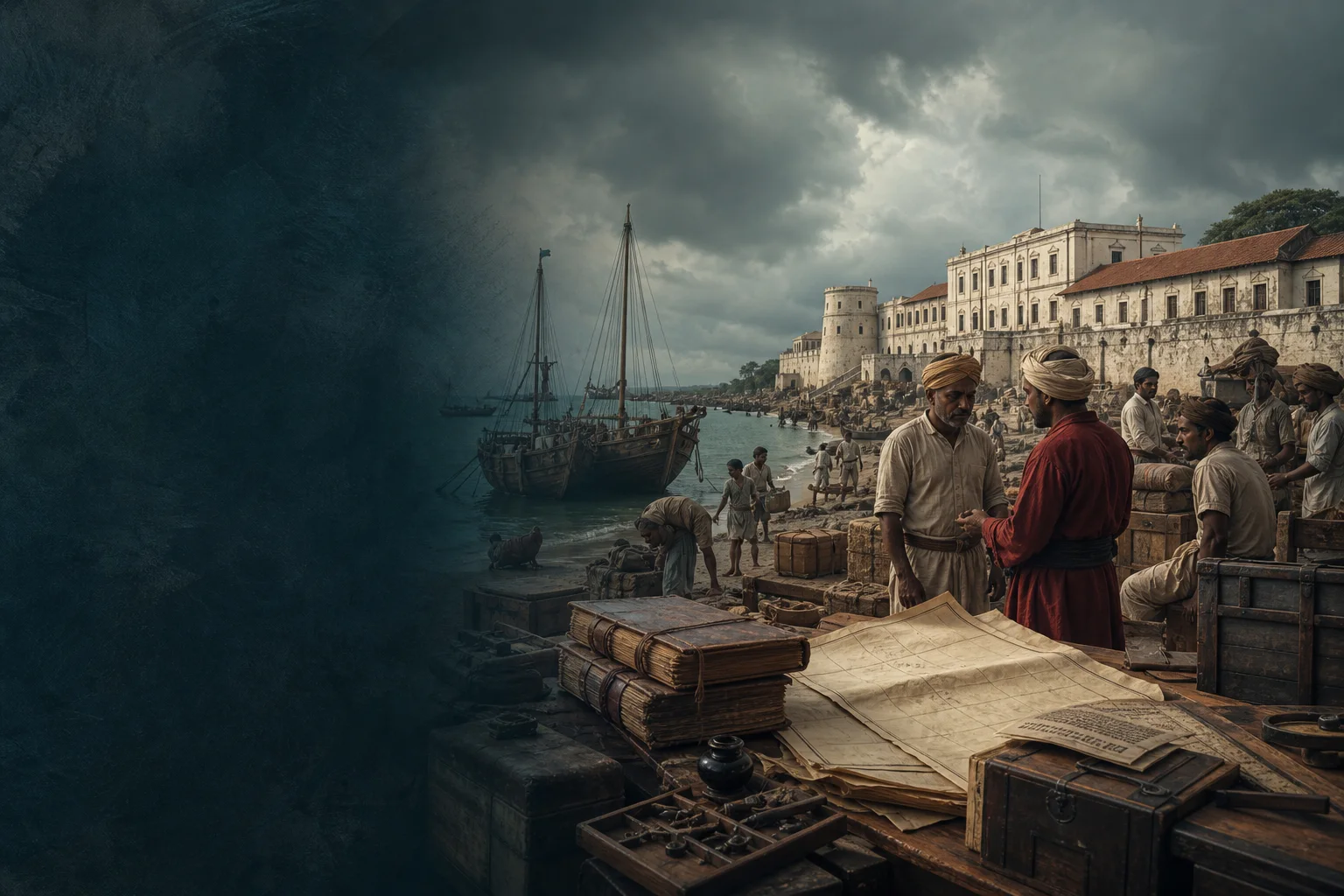
These project-created visuals support orientation. They are not presented as photographs of an excavation, monument, person, or event.
Questions
Frequently asked questions
Why are some dates given as ranges?
Historical periods overlap, and inscriptions, chronicles, archaeological contexts, and later reconstructions do not always support one exact year.
Does a royal inscription provide a neutral account?
No. It is primary evidence made for a purpose. Historians compare its language and setting with other inscriptions, material evidence, texts, and later records.
Can monuments be assigned to only one ruler or period?
Often not. Major complexes were built, enlarged, repaired, and reinterpreted by several patrons and communities.
Are current opening hours or access conditions included?
No. Access, conservation closures, fees, and photography rules can change. Check the responsible authority before visiting.
Can historical interpretation change?
Yes. New publications, excavation results, inscriptions, archival work, and scholarly debate can revise established accounts.
How were sources chosen?
Priority was given to government archaeology and archives, India Code, national cultural institutions, and university history resources.
Editorial trust
Sources and further reading
Citations in the article point to this full list. Source type and review date are shown so readers can evaluate the evidence.
- 1Inscriptions in MarathiTamil Nadu State Department of ArchaeologyOfficial epigraphy overview · Reviewed 21 August 2026
- 2Inscriptions in Nagari scriptTamil Nadu State Department of ArchaeologyOfficial epigraphy overview · Reviewed 21 August 2026
- 3Thanjavur PalaceTamil Nadu State Department of ArchaeologyOfficial protected-monument guide · Reviewed 21 August 2026
- 4Thanjavur Maharaja Serfoji's Sarasvati Mahal LibraryMinistry of Culture, Government of IndiaOfficial institutional history · Reviewed 21 August 2026
- 5Directory of Museums: Maratha Museum, ThanjavurGovernment Museum ChennaiOfficial museum directory · Reviewed 21 August 2026
- 6ManoraTamil Nadu State Department of ArchaeologyOfficial monument guide · Reviewed 21 August 2026
- 7The Nayakas: Political Economy and Cultural DevelopmentsIndira Gandhi National Open UniversityUniversity history module · Reviewed 21 August 2026
- 8EpigraphyTamil Nadu State Department of ArchaeologyOfficial subject overview · Reviewed 21 August 2026
Editorial review: Factual claims were checked against the linked primary and institutional sources on 21 August 2026. Where the sources support only a range or interpretation, the article keeps that limitation visible.
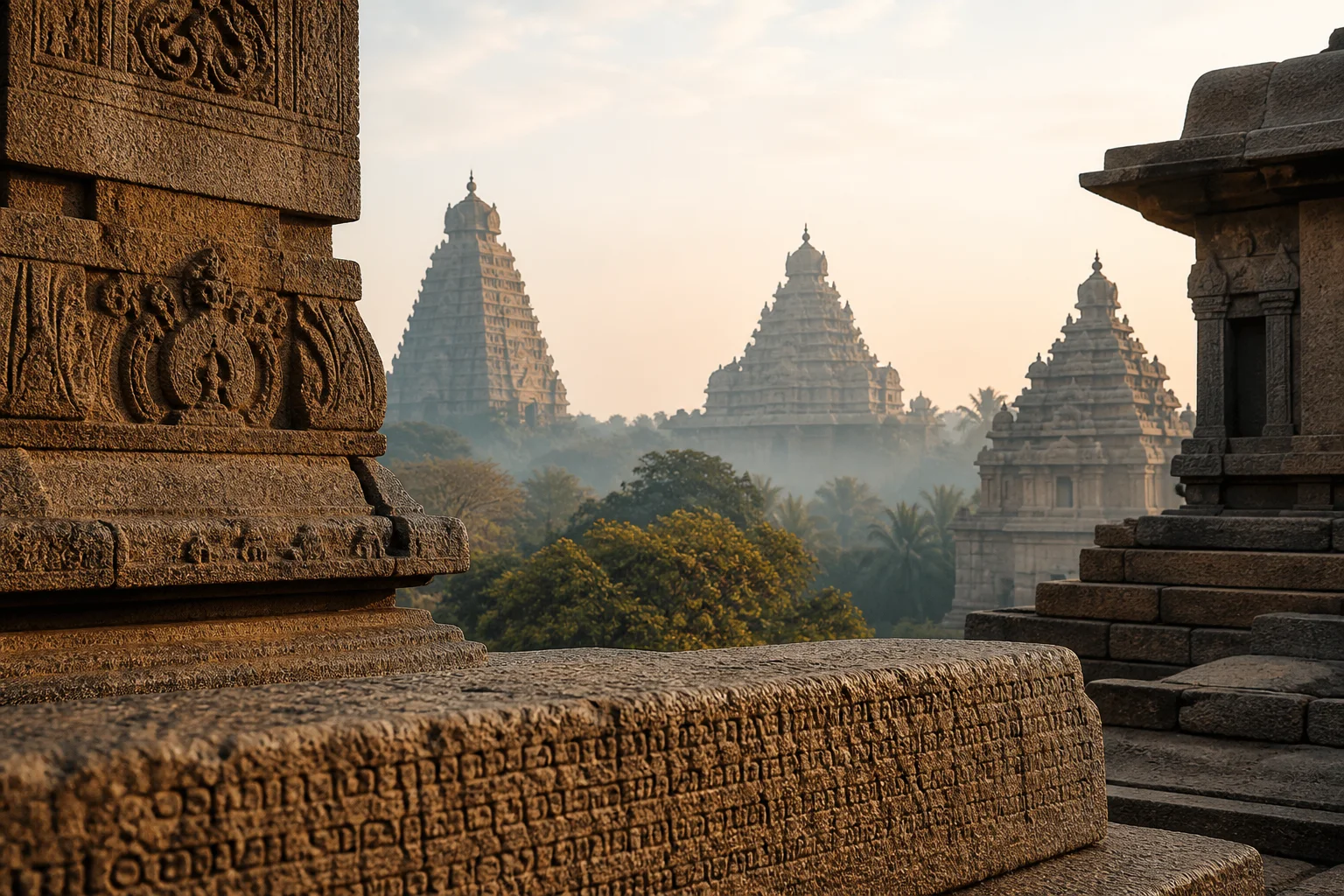
A Journey Through Chola Heritage in Tamil Nadu
Follow a thoughtful route through three living Chola temple landscapes, learning to read architecture, inscriptions, patronage, and place without rushing.
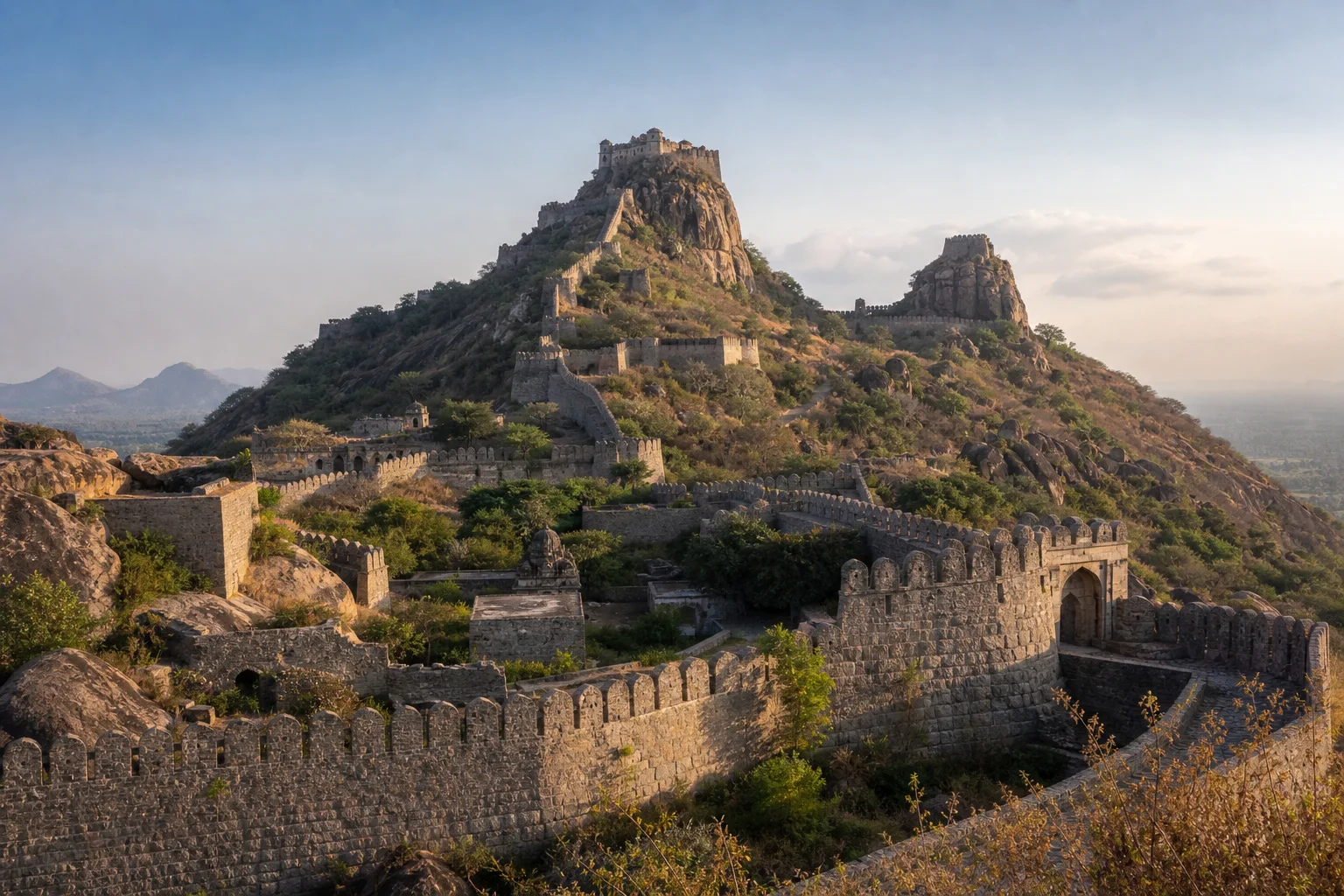
Gingee Fort After UNESCO: Reading a Military Landscape, Not Just a Ruin
What Gingee's place in a 12-fort World Heritage serial property means, and why its granite hills, walls, water and layered history must be read together.
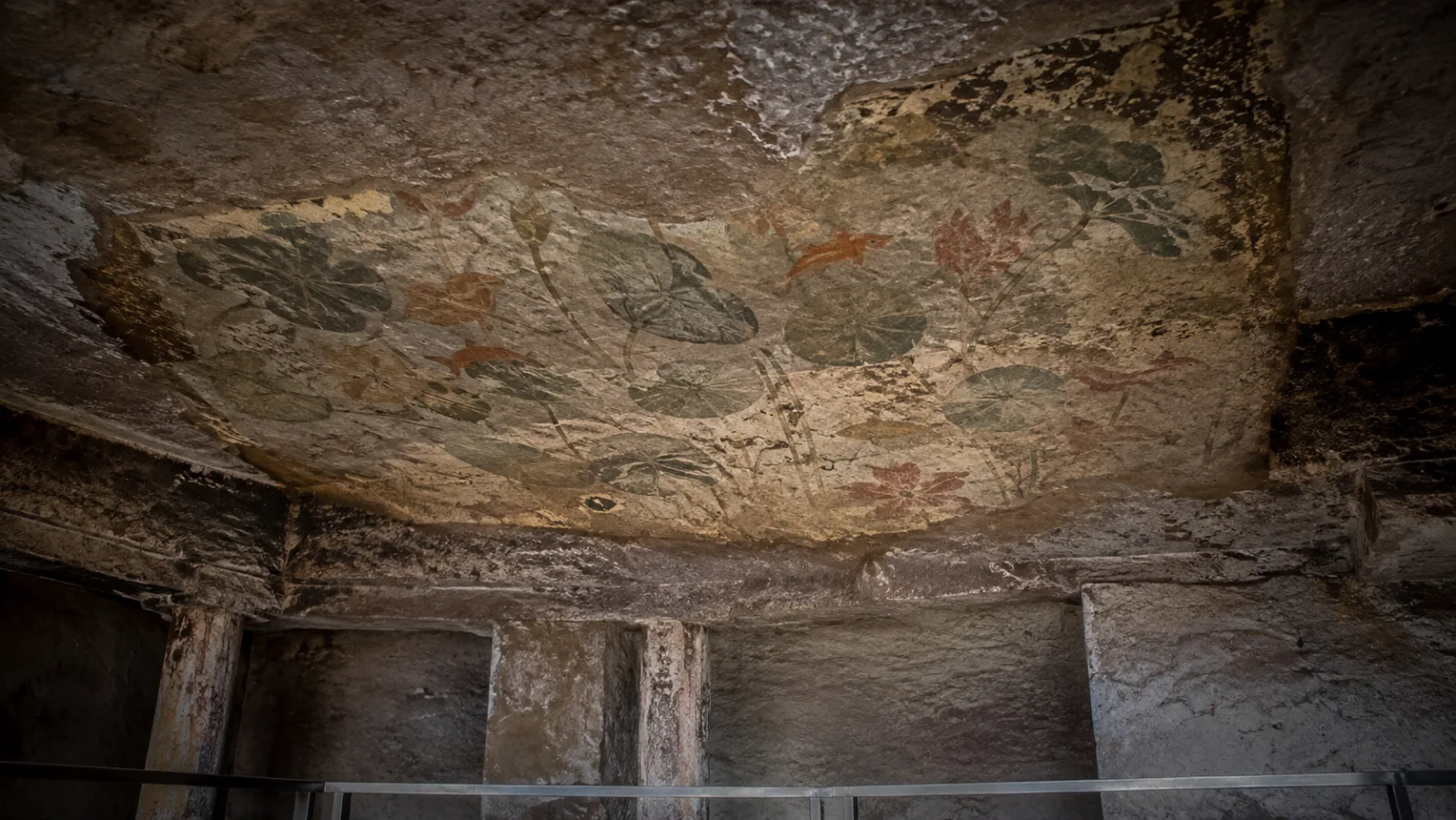
Sittannavasal: Read a Jain Hill Through Paint and Stone
A conservation-first guide connecting Sittannavasal's Jain cave, fragmentary paintings, rock beds and inscriptions without forcing them into one date.