
Medieval to early modern transition
Vijayanagara and Nayaka Tamil Nadu
Follow the Tamil region from the fractured political world after the later Pandyas into Vijayanagara networks and the distinct Nayaka courts of Madurai, Thanjavur, and Gingee.
Orientation
Overview
Broadly the 14th to early 18th centuries; regional chronologies overlap
The history of Tamil Nadu between the later Pandyas and the growth of European colonial power is not an empty interval between famous empires. From the fourteenth century, military campaigns and political alliances connected much of the Tamil region to the expanding Vijayanagara state. Authority was exercised through changing combinations of royal representatives, military commanders, local chiefs, temple institutions, landed interests, merchants, and urban communities. No single date marks an instant transfer of an unchanged territory.[1][3]
Nayaka is both a title and a historical category whose meaning changed. Military leaders received responsibilities over territories and revenue, maintained armed contingents, and operated within Vijayanagara political structures. During the sixteenth and seventeenth centuries, powerful courts at Madurai, Thanjavur, and Gingee developed their own institutions and claims while retaining, at times, symbolic or political relationships with Vijayanagara rulers. Historians therefore debate whether terms such as governor, feudatory, military chief, or independent king fit every phase.[2][3]
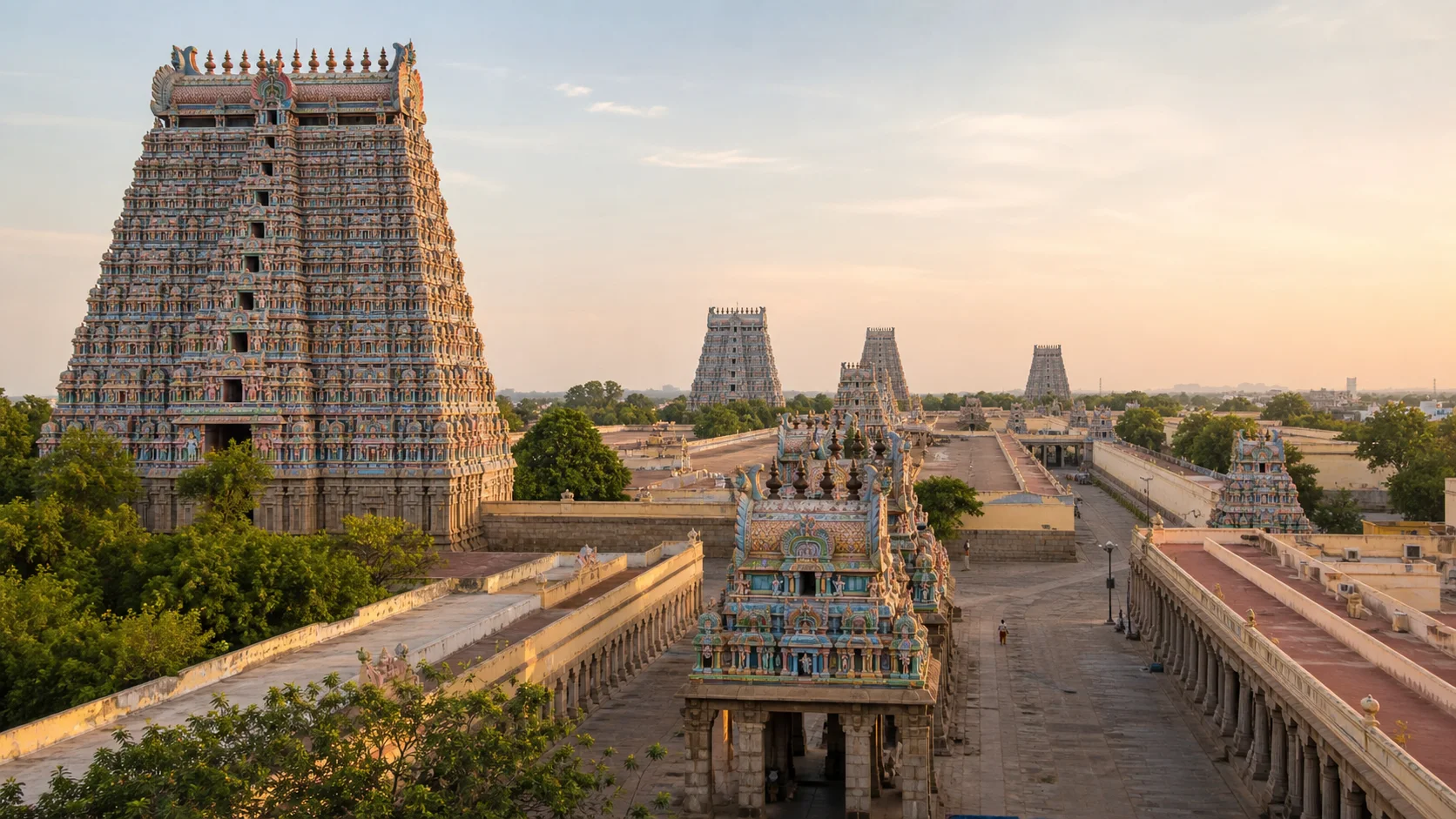
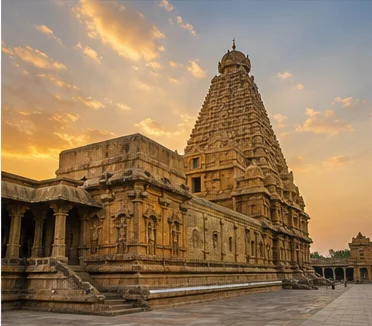
This transition reshaped cities, sacred complexes, fortifications, irrigation, revenue relations, performance, and literary patronage. It also involved conflict and extraction. Monumental corridors and halls should be admired without treating architecture as the work of rulers alone: artisans, labourers, donors, administrators, religious specialists, and communities sustained the institutions visible today.[2][5]
Chronology
A careful timeline
Dates identify documented phases and broad ranges. They do not imply uninterrupted rule or certainty where the evidence remains debated.
Vijayanagara expansion southward
Campaigns, alliances, and appointed commanders connected Tamil regions to a wider south Indian state; local power did not disappear.[1]
Nayaka assignments and regional authority
Military-administrative assignments became an important basis of authority, but their operation varied by place and reign.[3]
Madurai, Thanjavur and Gingee courts
Regional Nayaka polities acquired greater institutional and cultural definition while relationships with Vijayanagara continued to change.[2]
Reconfigured sovereignty
The defeat of a Vijayanagara army at Talikota weakened one centre of power but did not end the dynasty or produce immediate uniform independence across the south.[2][1]
Successor struggles
Nayaka courts faced internal contests and pressure from neighbouring powers; Thanjavur passed to a Maratha dynasty while Madurai's political sequence continued into the 18th century.[2][6]
Historical reading
A transition, not a clean dynastic handover
The decline of Chola and later Pandya dominance did not leave a blank political map. Pandya claimants, Hoysala interventions, Delhi Sultanate campaigns, the Madurai Sultanate, local chiefs, and emerging Vijayanagara authority formed a contested landscape. The documentary record is uneven, and later chronicles can compress complicated decades into moral stories of defeat and restoration.
Vijayanagara power in the Tamil country rested on routes, tribute, military capacity, strategic centres, and negotiated relationships. A court's claim over a region does not prove the same intensity of administration in every village. Inscriptions documenting gifts or offices provide firm local anchors, but they should not be turned into a permanent frontier map.[1][3]
Historical reading
Nayaka authority, revenue and local society
The nayankara system linked territorial revenue and military obligation, but scholars disagree about how centralized or segmentary the Vijayanagara state was. Portuguese travel accounts describe captains maintaining troops and remitting obligations; inscriptions show many Nayakas acting as donors, commanders, and office holders. Neither source alone describes every locality.[2][3]
Regional rulers worked through accountants, military retainers, palaiyakkarars, temple establishments, merchant groups, cultivators, and existing landed networks. Telugu-speaking warrior and administrative groups moved into Tamil areas, while Tamil and other local elites also participated in changing institutions. Migration, language, and political office should not be reduced to a simple story of one homogeneous community replacing another.[2]
Historical reading
Madurai, Thanjavur and Gingee were different courts
Madurai became associated with the line beginning under Visvanatha Nayaka and with later rulers such as Tirumala Nayaka and Mangammal. Thanjavur developed under Sevappa Nayaka and his successors before Maratha rule. Gingee occupied a strategic fortified landscape in northern Tamil country. These courts interacted through war, marriage, diplomacy, tribute, and competition, but they did not follow one identical sequence.[2][3]
Courtly texts and later histories can preserve names, genealogies, ceremonies, and ideals while also legitimizing patrons. Their claims need comparison with inscriptions, buildings, coins, and records from rival powers. The result is a regional history with overlapping sovereignties, not a single uninterrupted capital.
Historical reading
Temple expansion, urban space and cultural patronage
Nayaka-period patronage is visible in the enlargement and renovation of major temple complexes, including halls, gateways, corridors, tanks, processional routes, paintings, and sculpture. A structure inside an older temple may belong to a later building phase, which is why the whole complex should not be assigned to its earliest patron. Srirangam, Madurai, Rameswaram, and other sacred centres preserve such layered histories.
Patronage connected devotion with political presence, urban economy, craft labour, and public ceremony. Courts also supported literature and performance in Tamil, Telugu, Sanskrit, and other languages. Cultural movement across linguistic regions was substantial, but broad labels such as a single Nayaka style can hide local workshops and different building histories.[2][5]
Historical reading
What the period changed
The Vijayanagara-Nayaka centuries altered relationships among forts, capitals, temple towns, agrarian zones, military households, and long-distance routes. They created institutions later rulers inherited, adapted, or challenged. The period helps explain why a Chola foundation, a Nayaka hall, a Maratha inscription, and a colonial record can occupy the same living complex.
Its legacy should not be reduced to monumental splendour. Revenue demands, warfare, migration, labour, and ecological management affected ordinary communities, although their voices survive unevenly. Reading the period well means moving between court and locality, text and object, visible monument and archival silence.
Study desk
Research notes for careful readers
Use these questions to move from an overview of Vijayanagara and Nayaka Tamil Nadu to evidence-led historical study.
Build chronology from anchors
Begin with evidence that carries its own recoverable context: a dated inscription, an excavated layer, a documented coin hoard, a building phase, a letter, or an administrative file. Then place less certain material around those anchors. A royal genealogy, literary allusion, stylistic comparison, or later tradition may be highly informative without supporting an exact year. Writing the evidence type beside every date prevents a reconstructed sequence from looking more certain than its foundations.[1]
Watch for gaps and overlaps. Dynastic names can disappear from one kind of record and return in another; two rulers may claim authority at the same time; a monument can be begun, enlarged, repaired, and reinterpreted under different patrons. Period labels are tools for organizing change, not walls between communities. A timeline should therefore identify phases and transitions instead of pretending that one court handed a complete territory to the next on a single day.[2]
Read maps as arguments
Historical maps are reconstructions. An inscription naming a victory, a poem praising a ruler, a coin found in circulation, and a grant made in a village describe different relationships to place. None by itself proves a permanently administered frontier. Useful maps distinguish core areas, attested sites, campaign claims, routes, tributary relationships, and uncertain zones. They also use the coastline, river course, and place names appropriate to the period being discussed.[3]
Modern Tamil Nadu remains the geographic focus of this site, but historical networks crossed its present boundary. Ports connected to Sri Lanka and the wider Indian Ocean; inland routes crossed the Ghats; religious and merchant institutions operated across several political regions; the Madras Presidency extended far beyond today's state. A regional history becomes clearer when present-day borders orient the reader without containing the past.
Account for survival and silence
Stone temples, copper plates, official files, and elite literary collections survive for particular reasons. Durable material and institutional custody make some voices much louder than others. Workers may appear only through wages or duties, women through gifts or prosecutions, rural communities through tax demands, and defeated groups through an opponent's praise. Silence can indicate loss, exclusion, or the source's purpose; it cannot safely be converted into proof that a person or practice was absent.[4]
Translation adds another layer. Titles, offices, social terms, ritual vocabulary, and place names do not always have one modern equivalent. A smooth English phrase can hide alternatives in the original language. Where an interpretation depends on one word, consult the transcription, translation notes, and more than one scholarly reading. Quotations should come from a checked edition rather than from unsourced graphics or repeated web summaries.
Compare at the right scale
Comparison is strongest when the units truly match. A burial site should not be measured against a capital city as though they served the same function. One king's regnal inscription should not be compared directly with a literary anthology compiled over time. Instead compare burial with burial, workshop with workshop, grant formula with grant formula, and securely dated architectural phase with another documented phase. Regional synthesis comes after those controlled comparisons.
Public history adds valuable questions but can also reward superlatives. Claims about the oldest, greatest, first, largest, or most advanced require a clearly defined comparison set and published evidence. Historical significance does not depend on winning such a ranking. A site or tradition can matter because it changes an interpretation, preserves an unusual archive, or connects people and landscapes in a way that no simple contest can express.
Preserve the evidence you came to see
Historical study continues at living temples, museums, archives, archaeological sites, streets, water systems, and working landscapes. Follow access rules, never touch or enhance inscriptions, do not remove surface finds, ask before photographing people or rituals, and treat conservation closures as part of responsible care. Record the institution, gallery, accession number, monument, or report behind an observation so that it can be checked later.
The best next question is often narrower than the first: which phase of this building, which version of this text, which sample from which layer, which office produced this file, or which community preserved this memory? Narrow questions are not a retreat from big history. They are how large claims become reliable enough to connect.
Human scale
People and institutions
Named rulers are only one part of the history. These groups and individuals help show how evidence and social life connect.
Krishnadevaraya
A major Vijayanagara ruler whose reign provides important evidence for imperial institutions and southern relationships.
Visvanatha Nayaka
Associated with the consolidation of the Madurai Nayaka polity; later accounts require comparison with inscriptions.
Sevappa Nayaka
An early ruler of the Thanjavur Nayaka line and patron within a changing regional order.
Tirumala Nayaka
A seventeenth-century Madurai ruler associated with major courtly and architectural patronage.
Artisans and local institutions
Builders, painters, accountants, cultivators, merchants, and temple personnel who made political and cultural systems work.
Historical geography
Connected places
Places are linked only when a substantive My Tamil Nadu guide already exists. Other entries remain non-clickable research context.
Visual reading
Images with explicit provenance
These project-created visuals support orientation. They are not presented as photographs of an excavation, monument, person, or event.

Questions
Frequently asked questions
Why are some dates given as ranges?
Historical periods overlap, and inscriptions, chronicles, archaeological contexts, and later reconstructions do not always support one exact year.
Does a royal inscription provide a neutral account?
No. It is primary evidence made for a purpose. Historians compare its language and setting with other inscriptions, material evidence, texts, and later records.
Can monuments be assigned to only one ruler or period?
Often not. Major complexes were built, enlarged, repaired, and reinterpreted by several patrons and communities.
Are current opening hours or access conditions included?
No. Access, conservation closures, fees, and photography rules can change. Check the responsible authority before visiting.
Can historical interpretation change?
Yes. New publications, excavation results, inscriptions, archival work, and scholarly debate can revise established accounts.
How were sources chosen?
Priority was given to government archaeology and archives, India Code, national cultural institutions, and university history resources.
Editorial trust
Sources and further reading
Citations in the article point to this full list. Source type and review date are shown so readers can evaluate the evidence.
- 1Vijayanagara Kingdom: Politics, Economy and ArtIndira Gandhi National Open UniversityUniversity history module · Reviewed 21 August 2026
- 2The Nayakas: Political Economy and Cultural DevelopmentsIndira Gandhi National Open UniversityUniversity history module · Reviewed 21 August 2026
- 3Vijayanagara and the Nayaka system in the Tamil countryIndira Gandhi National Open UniversityUniversity history module · Reviewed 21 August 2026
- 4EpigraphyTamil Nadu State Department of ArchaeologyOfficial subject overview · Reviewed 21 August 2026
- 5Thanjavur PalaceTamil Nadu State Department of ArchaeologyOfficial protected-monument guide · Reviewed 21 August 2026
- 6Inscriptions in MarathiTamil Nadu State Department of ArchaeologyOfficial epigraphy overview · Reviewed 21 August 2026
Editorial review: Factual claims were checked against the linked primary and institutional sources on 21 August 2026. Where the sources support only a range or interpretation, the article keeps that limitation visible.

A Journey Through Chola Heritage in Tamil Nadu
Follow a thoughtful route through three living Chola temple landscapes, learning to read architecture, inscriptions, patronage, and place without rushing.
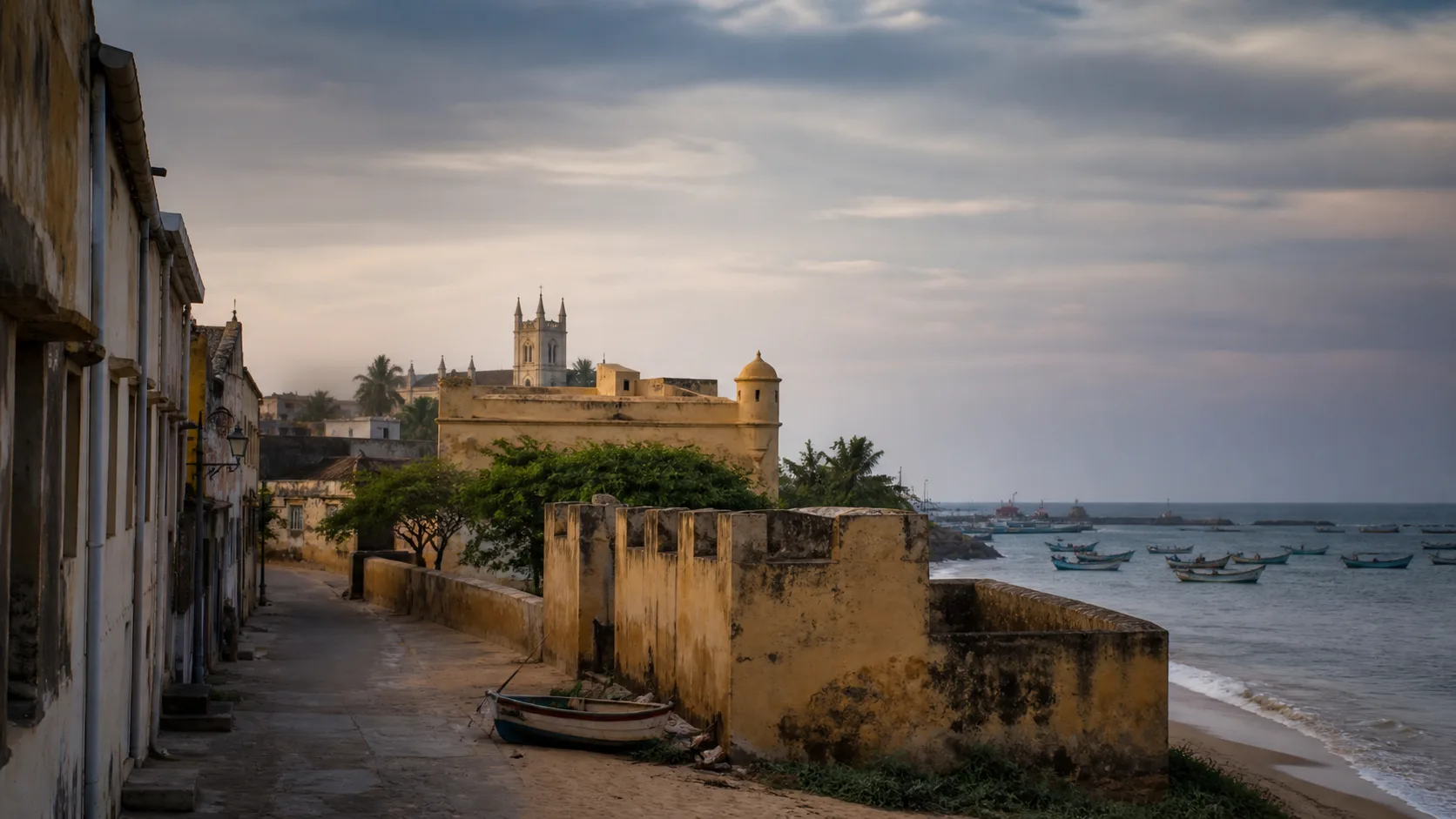
Tharangambadi: Read the Fort, Printing History and Living Coast
A layered coastal-town guide that begins before the Danish fort, follows trade and printing history, and returns heritage to a living Bay of Bengal shoreline.
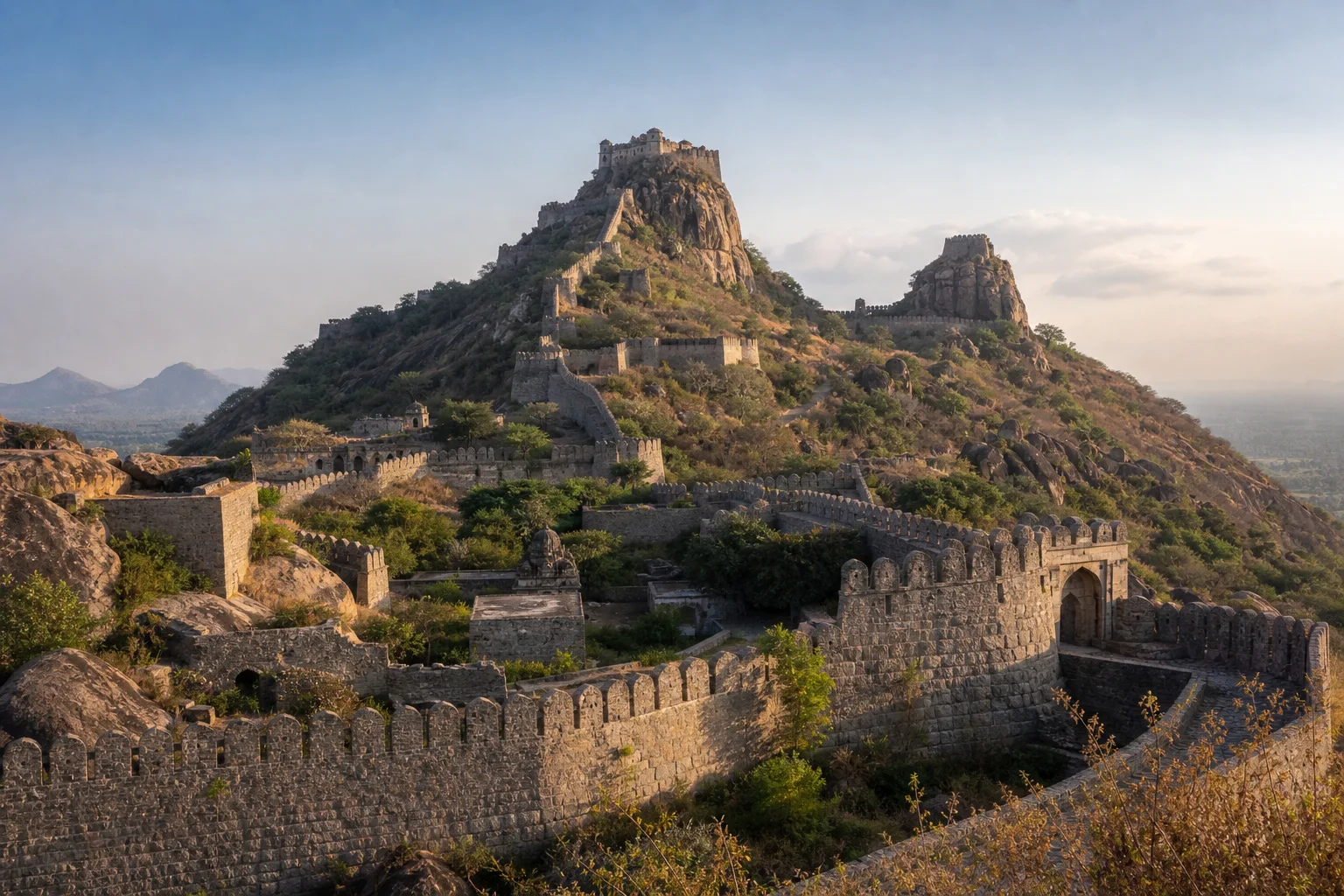
Gingee Fort After UNESCO: Reading a Military Landscape, Not Just a Ruin
What Gingee's place in a 12-fort World Heritage serial property means, and why its granite hills, walls, water and layered history must be read together.