
Poetry, memory and temple institutions
Shaivism, Nayanmars and Bhakti
Tamil hymns, temple records and images of poet-saints preserve different stages in the making of Shaiva traditions.
Orientation
Overview
Early medieval hymns and their later institutional lives
A hymn sung at a shrine, a stone record assigning grain to its reciters and a bronze of a poet-saint are three different kinds of historical object. Together they can show how devotion acquired a public and lasting form. Each, however, belongs to its own moment. The poem may be much older than the inscription, and the bronze later still. Reading them in sequence gives Tamil Shaiva history greater depth than a single account of saints founding temples.
The Nayanmars are remembered as exemplary devotees of Shiva. Among them, Appar, Sambandar and Sundarar are associated with the Tevaram, the opening portion of the Tamil Shaiva canon. The French Institute of Pondicherry’s edition describes roughly eight hundred hymns, probably reaching back to the seventh and eighth centuries. The corpus gives access to poetic voices and named places; later accounts supply much fuller biographies. Those bodies of writing should be brought into conversation without making their dates or purposes identical.[1]
Bhakti is often translated as devotion, but its history involves more than a change in personal feeling. Poems required listeners, learned forms of performance and means of transmission. When rulers or other patrons supported their recitation, an expressive literature also became part of an organised service. This guide follows that movement between composition, collective memory and material support, leaving theology and contemporary religious practice to the communities for whom the texts remain authoritative.
How to read this guide
Different evidence, different questions
These categories are used throughout the article. A tradition can be historically important without independently proving the earlier event it describes.
Archaeology
Objects, structures and their excavated contexts.
Inscriptions
Words recorded on stone, metal or other material.
Literature
Composition, genre, argument and textual transmission.
Institutional records
Grants, catalogues, accounts and administrative arrangements.
Later tradition
Retrospective narratives, sacred memory and lineage claims.
Scholarly interpretation
Explanations built by comparing evidence, with room for revision.
Chronology
A careful timeline
These entries distinguish dated records, broad historical phases and later transmission. Dates of texts, objects and traditions need not coincide.
Dedications in stone
The Mandagapattu record names Brahma, Isvara and Vishnu together.[3]
The Tevaram poets
The edited corpus attributes its hymns to Sambandar, Appar and Sundarar.[1]
Recitation receives recorded support
Brihadisvara inscription 65 records allowances for reciters and accompanying drummers.[2]
Poems, biographies and images
Sekkizhar’s hagiography and images of saints expand the forms of collective memory.[4][6]
Historical reading
Shaiva evidence before a completed canon
The seventh-century Mandagapattu inscription offers a useful starting point outside saint biography. Presented in Tamil Nadu Open University’s epigraphy course, the Sanskrit record describes a shrine commissioned by the ruler called Vichitrachitta for Brahma, Isvara and Vishnu, emphasising construction without several conventional materials. Isvara here belongs to a dedication shared with other deities. The record cannot be turned into proof that the region already possessed the later Tamil Shaiva canon or one exclusive religious identity.[3]
Kanchipuram supplies another scale of evidence. India’s Tentative List dossier identifies Kailasanatha as a royal Pallava foundation associated with Rajasimha. A surviving building and its records allow questions about sponsorship, visual programmes and the language of kingship. They need not be explained solely through a poet’s influence. Royal building, local worship and literary devotion could intersect while retaining different patrons and practical histories.[7]
The word early therefore needs a reference point. An early surviving stone temple is not necessarily the first place where Shiva was worshipped, just as an early surviving hymn need not be the first song performed. Material survival favours some buildings and texts over others. The responsible account begins with the dated or datable evidence that is actually available and avoids filling the earlier gaps with an uninterrupted institutional genealogy.
Historical reading
Three attributed voices, not one biography
In the customary arrangement, Sambandar’s hymns form the first three Tirumurai. The IFP introduction notes his repeated association with Sirkazhi and his practice of identifying himself near a hymn’s close, sometimes explaining the benefit of singing it. Such endings are part of the poem’s address to its audience. They show a composition imagining its own performance and circulation, rather than merely recording a private experience.[8]
Appar, also called Tirunavukkarasar, is associated with the fourth, fifth and sixth Tirumurai; Sundarar, also written Cuntarar, with the seventh. Keeping both personal names and title forms visible helps readers recognise the same figures across editions, inscriptions and temple labels. Differences in spelling often reflect transliteration conventions rather than different people. The attribution of a group of hymns is a useful textual fact, distinct from the later narrative of every journey or encounter.[9][10]
These authors can be approached first through what their works ask a listener to do: attend to a named deity, recognise a place, imagine a relationship and join in praise. That approach gives the poetry its literary force without requiring a reader to endorse its religious claims. It also makes room for differences among compositions. An anthology gathered under three celebrated names need not represent a single occasion, an identical audience or one uniform history of use.
Historical reading
A sacred geography made through language
The IFP shrine concordance explains that most Tevaram hymns are associated with particular places, while a smaller group is not site-specific. It also records the difficulty of securely identifying every name on a modern map. The traditional geographical ordering gives especially extensive attention to the Kaveri region. This is evidence for the organisation of a remembered sacred landscape, not a map of the territorial extent of Shaivism.[11]
A place-name carries several possible histories. A poem can preserve an older name; a later community may identify that name with its shrine; a modern edition may reconcile the literary and administrative forms. Those are related acts of recognition, but not interchangeable ones. Even a persuasive identification does not establish that the present enclosure, tower or image stood there when the poem was composed. The site guide and the literary guide therefore answer complementary questions.
Thinking in terms of connections is more useful than simply counting temples. A named place may recur in several hymns, and one poet’s work may link settlements across a broad area. Recitation gives those relationships a form that can be carried by people rather than fixed to a boundary. The historical question is how such connections were learned and reproduced, and how their importance changed as particular temples gained resources or new audiences.
Historical reading
Musical organisation and textual survival
Digital Tevaram makes two arrangements available: one by musical mode and another by sacred place. The project also links editions, translations, maps and recordings. These different paths through the corpus matter because they reveal that a literary collection can be organised for several uses. The text a researcher reads in sequence is also material that performers learn in selected groupings. A modern recording documents a performance, not an unchanged sound surviving from the seventh century.[1]
The distinction between preserving words and preserving performance is particularly useful here. Written copies can assist memory, while learned recitation supplies phrasing and associations that a bare page does not convey. Editorial choices may make a corpus easier to consult without capturing every local practice. When listening to a hymn alongside a translation, readers should keep the two tasks apart: the translation explains selected meanings, whereas performance brings its own timing and inherited conventions.
Historical reading
An inscription makes support measurable
Brihadisvara inscription 65 records Rajaraja’s assignment of daily paddy allowances to forty-eight people appointed to recite Tiruppadiyam and two people accompanying them on drums. IGNCA’s presentation of the published record connects this service with the Shaiva hymns and notes the significance of names associated with their authors. Unlike a general claim that a king loved poetry, this evidence identifies a recurring task and a provision for those performing it.[2]
The record gives patronage a practical shape: people, service and subsistence are brought into one arrangement. It does not tell us how every temple financed singing or whether the same personnel remained indefinitely. Nor does it make the surviving inscription an original manuscript of the poems. Its value lies in a narrower and stronger conclusion: hymn recitation had a recognised institutional place in this royal temple during the reign represented by the record.
This is also where literary and economic history meet. A regular performance needed more than an admired text. Its continuation depended on appointments, resources and expectations about service. The temple’s material organisation helped make a particular repertoire durable. The agricultural and institutional guides pursue the wider questions of land, income and labour; here the inscription establishes why those questions belong within the history of devotional literature.
Historical reading
Compilation is a historical process
An institutional account at IGNCA relates the recovery and collation of hymns to Nambiyandar Nambi and Rajaraja. Its story of neglected texts recovered at Chidambaram should be identified as a received account of the canon’s past. The later community’s memory of preservation is important, but the narrative is not itself an inventory dated to the moment of recovery. The documented recitation arrangement and the recovery tradition offer different kinds of testimony.[12]
A canon is more than a surviving pile of poems. It gives texts an order, associates them with recognised authors and sets boundaries around a body considered authoritative. Later additions and retrospective biographies can transform how earlier verses are read. A history of canon formation consequently asks who copied, arranged, taught and sponsored the works, as well as who was believed to have composed them. No single surviving source answers all of those questions.
Sekkizhar’s twelfth-century Periyapuranam gives the remembered lives of the sixty-three Nayanmars a sustained literary form. Tamil Virtual Academy presents it as a work about the saints rather than as a contemporary register of their lives. It is valuable evidence for how exemplarity, places and community were narrated. Its marvels and exemplary confrontations need to be read as hagiography, not inserted unlabelled into a political chronology.[4]
Historical reading
Royal sponsorship and local initiative
The research volume The Archaeology of Bhakti II deliberately puts royal and local devotion beside one another. Its published description identifies kings, local elites and devotional communities as separate agents whose roles need examination. This is a helpful correction to an account in which every religious change is attributed to a ruler’s conversion or a new dynasty. A royal name can be prominent in surviving evidence without accounting for every relationship that sustained a shrine.[13]
Charlotte Schmid’s study of Tiruccennampunti provides a concrete example. The IFP catalogue describes an early Chola-period Shaiva temple whose prominent early patrons included the Pallava queen Marampavai, known through inscriptions on pillars from the site. A dynastic label for the building does not neatly contain the affiliations of its patrons. The example makes a more connected history possible, in which gifts and institutions cross the categories used to organise political surveys.[14]
Patronage also raises questions of scale. A building campaign, a lamp endowment and support for reciters are not equivalent acts, even when each is described as devotion. One transforms the monument; another sustains a recurring service. Comparing their terms helps reveal the varied ways people entered an institution. It also prevents the most visually impressive surviving commission from standing for the entire social history of a temple.
Historical reading
Images give memory another material life
The Metropolitan Museum catalogues a copper-alloy Karaikkal Ammaiyar figure to approximately the late thirteenth century. She appears with cymbals, her body rendered in the emaciated form explained by her devotional biography. The museum’s account of a transformation granted by Shiva belongs to that sacred narrative. The sculpture, by contrast, is material evidence that a recognisable image of the saint was made many centuries after the period assigned to her in tradition.[6]
LACMA’s late-fourteenth-century Sambandar bronze offers a comparable distinction. Its pointed finger is interpreted through the story of the child identifying the divine source of his nourishment. That iconography shows how an audience was invited to recognise him; it does not independently verify the miracle. Dating the object gives a historical anchor for the representation, while the story explains its intended meaning. Biography and image support different parts of the interpretation.[15]
Historical reading
From manuscripts to continuing study
The evidence falls into six related categories. Archaeology and architectural study establish material settings; inscriptions record particular transactions. Literature preserves attributed voices, genres and language. Institutional records can reveal offices and resources where their dates and contexts are known. Later religious tradition supplies exemplary biographies and remembered origins. Scholarly interpretation compares these bodies of evidence and explains proposed connections. A claim about the spread of recitation, for example, needs more than a compelling saint story: it needs records of performance or reception in identifiable settings. Keeping the categories visible allows the same site to hold several histories without forcing them into one date.
The IFP manuscript catalogue includes Shaiva Agamas, commentaries, ritual manuals, hymns and local sacred narratives. Its description shows why Tamil Shaiva intellectual life should not be reduced to the Tevaram alone. Manuscript bundles preserve several genres with different purposes. A manual may organise action, a commentary explain an argument and a hymn supply words for recitation. A collection’s modern custody does not, by itself, date the composition of every work it contains.[5]
These materials also bring scholarly interpretation into view. Editors identify texts, compare readings and explain uncertainty; they do not simply uncover a single complete past waiting unchanged in a bundle. Historians can then relate literary transmission to institutions, patrons and places. The resulting account is neither devotional praise nor a dismissal of religious memory. It treats poetry, objects and records seriously enough to ask the particular questions each can answer.
Human scale
People and institutions
Named rulers are only one part of the history. These groups and individuals help show how evidence and social life connect.
Poets and attributed authors
The corpus preserves names and voices through later copying and arrangement.
Reciters and accompanists
The Brihadisvara record makes organised performance visible.
Patrons and editors
Support, preservation and interpretation shaped the later life of the hymns.
Historical geography
Connected places
Explore the landscapes and settlements discussed in this guide.
Questions
Frequently asked questions
Are the Tevaram and all twelve Tirumurai identical?
No. The Tevaram forms the opening part of the wider collection. The three principal hymnists should not be confused with every author represented in the later canon.
Can saint biographies establish every event they describe?
No. They preserve religious memory and literary interpretation. Specific events require comparison with independently dated records or other evidence.
Does temple patronage prove that everybody shared the same beliefs?
No. A grant documents a particular relationship; it does not measure the beliefs of an entire town or kingdom.
Editorial trust
Sources and further reading
Citations in the article point to this full list. Source type and review date are shown so readers can evaluate the evidence.
- 1Digital Tēvāram: corpus, editions and research historyFrench Institute of Pondicherry / EFEOLITERARY / ACADEMIC: edited Tamil corpus and institutional introduction · Reviewed 17 November 2026
- 2Brihadisvara inscription no. 65: allowances for hymn recitationIGNCA / Archaeological Survey of IndiaPRIMARY/EPIGRAPHIC: published editorial account of the inscription · Reviewed 17 November 2026
- 3Indian Epigraphy and Numismatics: Mandagappattu inscriptionTamil Nadu Open UniversityPRIMARY/EPIGRAPHIC / ACADEMIC: university presentation of Sanskrit record · Reviewed 17 November 2026
- 4Periyapuranam: literary history lessonTamil Virtual AcademyLITERARY / INSTITUTIONAL: introduction to Sekkizhar’s hagiography · Reviewed 17 November 2026
- 5Descriptive Catalogue of ManuscriptsFrench Institute of PondicherryINSTITUTIONAL: collection contents and cataloguing practice · Reviewed 17 November 2026
- 6Karaikkal Ammaiyar, Shaiva Saint, ca. late thirteenth centuryMetropolitan Museum of ArtARCHAEOLOGICAL / INSTITUTIONAL: museum object catalogue; miracle narrative is tradition · Reviewed 17 November 2026
- 7Temples of Kanchipuram: Tentative List submissionPermanent Delegation of India to UNESCOARCHAEOLOGICAL / INSTITUTIONAL: monument dossier; not a World Heritage inscription · Reviewed 17 November 2026
- 8Digital Tēvāram: CampantarFrench Institute of PondicherryLITERARY: editorial description of author attribution and poetic signatures · Reviewed 17 November 2026
- 9Digital Tēvāram: ApparFrench Institute of PondicherryLITERARY: attribution of the fourth to sixth Tirumurai · Reviewed 17 November 2026
- 10Digital Tēvāram: CuntararFrench Institute of PondicherryLITERARY: attribution of the seventh Tirumurai · Reviewed 17 November 2026
- 11Digital Tēvāram: shrine names and geographical identificationFrench Institute of PondicherryACADEMIC: site concordance and explicit identification limits · Reviewed 17 November 2026
- 12Brihadisvara Temple: TēvāramIndira Gandhi National Centre for the ArtsINSTITUTIONAL / TRADITIONAL: canon overview; recovery narrative treated as tradition · Reviewed 17 November 2026
- 13The Archaeology of Bhakti II: Royal Bhakti, Local BhaktiÉcole française d’Extrême-OrientACADEMIC: research volume description and contents; full chapters not consulted · Reviewed 17 November 2026
- 14La Bhakti d’une reine: Śiva à Tiruccennampunti — research catalogue descriptionFrench Institute of Pondicherry / EFEOACADEMIC: Charlotte Schmid monograph summary, p. 36; not full-book access · Reviewed 17 November 2026
- 15The Hindu Saint Sambandar, late fourteenth century, accession 56.8Los Angeles County Museum of ArtINSTITUTIONAL: object dating and iconography; biography not accepted as contemporary record · Reviewed 17 November 2026
Editorial review: Reviewed 17 November 2026 using accessible archaeological records, published inscriptions, institutional summaries and scholarly research. Some full publications were unavailable; abstracts and indexed excerpts support only the specific claims discussed, while the publications also provide further reading. Dates and interpretations retain their stated uncertainties.
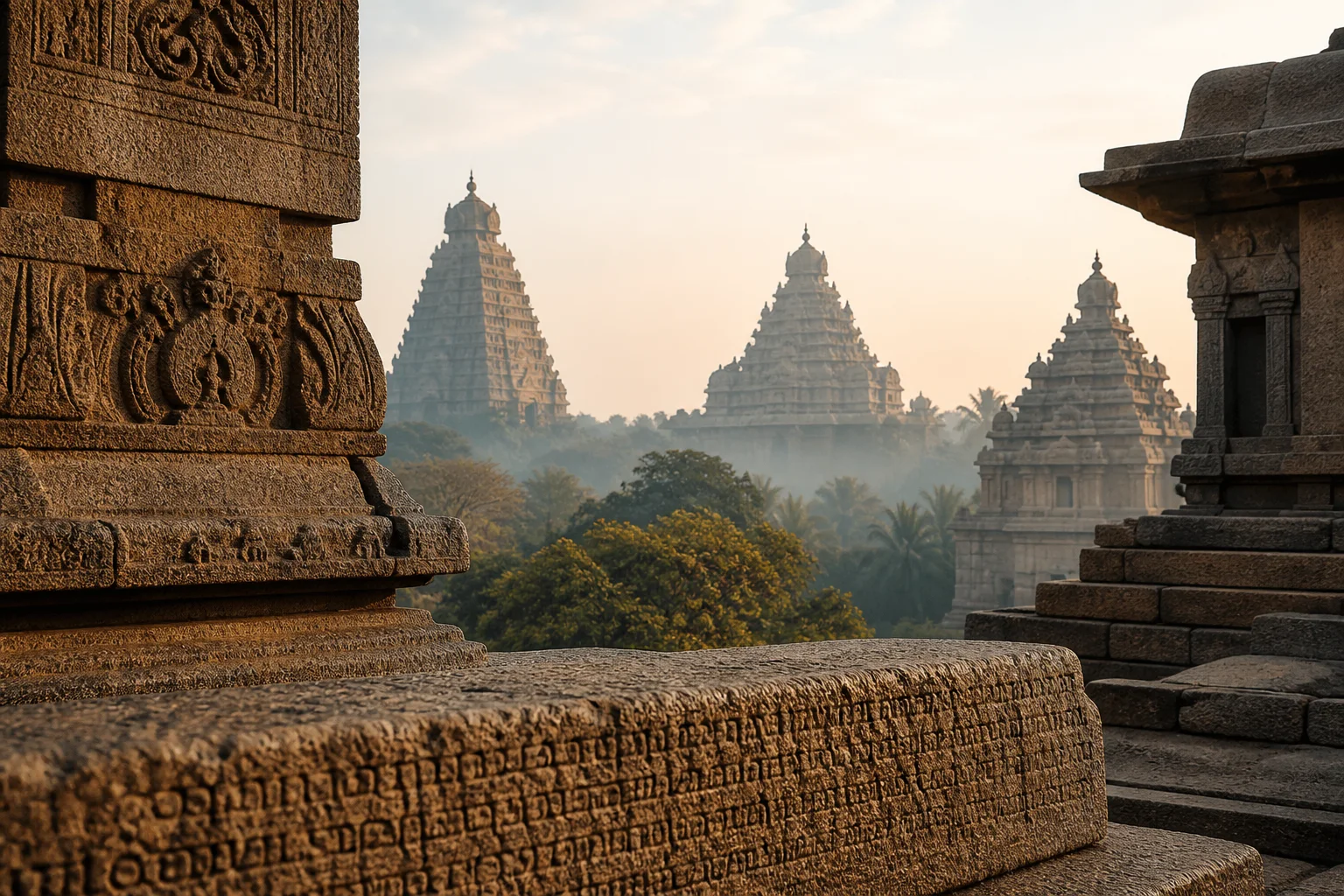
A Journey Through Chola Heritage in Tamil Nadu
Follow a thoughtful route through three living Chola temple landscapes, learning to read architecture, inscriptions, patronage, and place without rushing.

Mamallapuram: Read a Coastal World Heritage Landscape
A connected reading of Mamallapuram that moves from granite outcrops and carved caves to monolithic experiments, open-air reliefs, the Shore Temple and a living coastal town.
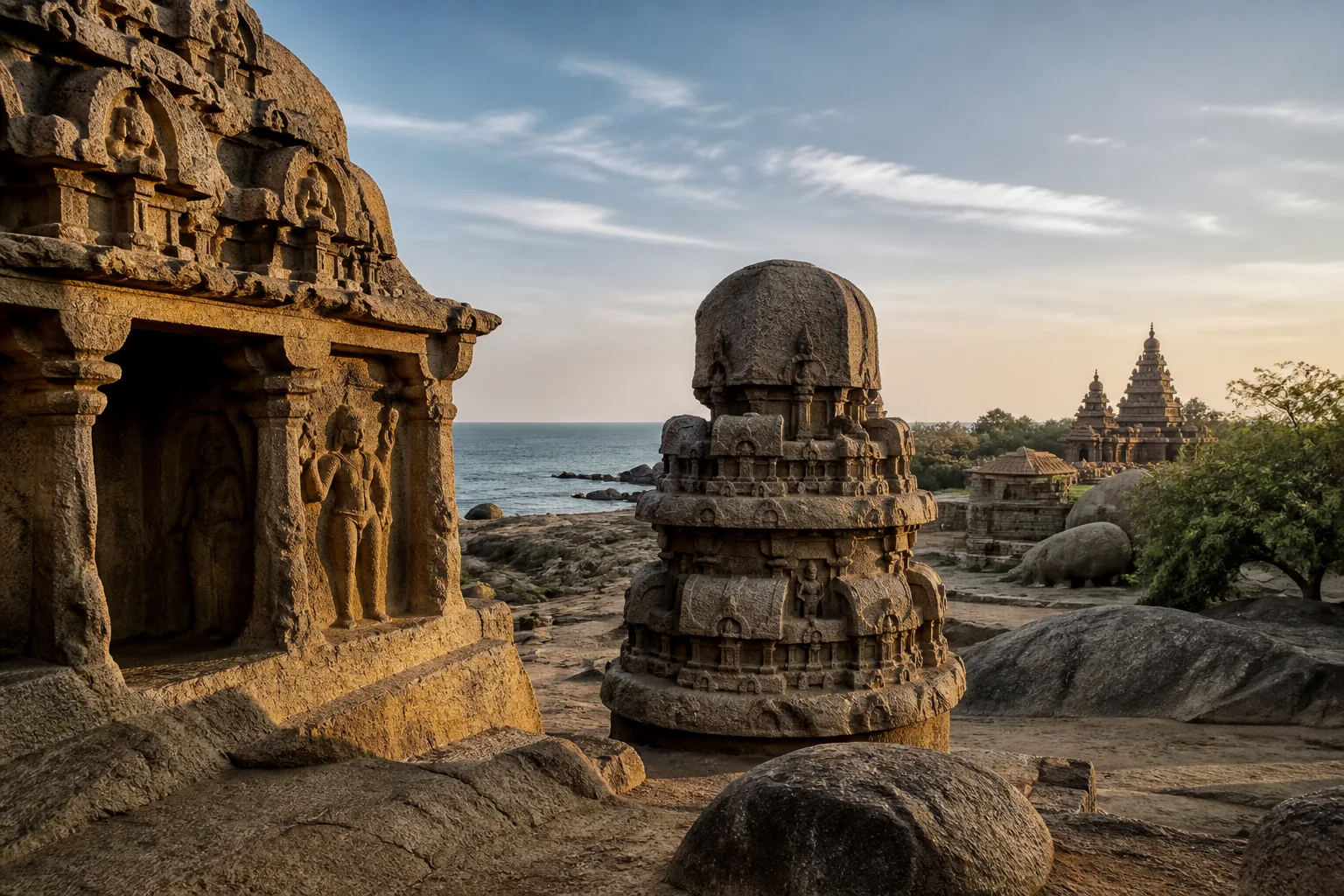
Beyond the Cholas: Exploring Pallava Heritage Across Tamil Nadu
Follow Pallava heritage from Kanchipuram's sacred city to Mamallapuram's coastal stone workshop, learning to compare form, material and evidence.