
Texts, places and communities
Religion, Ideas and Institutions in Tamil History
A cave inscription, a hymn, a bronze and a printed book preserve different histories. Follow the communities that made, used and transmitted them.
Orientation
Overview
Early inscriptions to medieval institutions and later maritime communities
Religious history becomes tangible in a surprising variety of places: a sheltered rock face, a bronze pedestal, a temple wall, a bundle of leaves or a printer’s page. These remains do not simply illustrate beliefs already known from a modern account. They reveal acts of giving, habits of reading, claims to authority and choices about what should be remembered. The people behind them include ascetics, poets, artisans, teachers, merchants and patrons, as well as rulers.
Tamil regions have sustained several religious and intellectual traditions, but their presence cannot be arranged in a single sequence in which each newcomer removes its predecessor. Evidence varies sharply by locality and period. Monumental investment may make one institution conspicuous while a smaller community leaves a scattered written record. A poem can travel beyond the settlement in which it was composed, and an object can survive far from the place where it was worshipped. The task is to recover those different histories without turning survival into a measure of everyone’s allegiance.
This guide connects six more detailed studies. It asks how communities acquired places, how texts became authoritative and how institutions maintained learning across generations. Theology matters as a historical activity: people debated, interpreted and taught. The guide does not judge the truth of religious claims or provide instructions for worship. Individual temple guides remain the place for architecture and visits, while the Culture section follows literature, performance and living traditions.
How to read this guide
Different evidence, different questions
These categories are used throughout the article. A tradition can be historically important without independently proving the earlier event it describes.
Archaeology
Objects, structures and their excavated contexts.
Inscriptions
Words recorded on stone, metal or other material.
Literature
Composition, genre, argument and textual transmission.
Institutional records
Grants, catalogues, accounts and administrative arrangements.
Later tradition
Retrospective narratives, sacred memory and lineage claims.
Scholarly interpretation
Explanations built by comparing evidence, with room for revision.
Choose a reading path
Begin with the evidence below, or follow a tradition into its sites, texts and institutions.
Chronology
A careful timeline
These entries distinguish dated records, broad historical phases and later transmission. Dates of texts, objects and traditions need not coincide.
Shelters and donors
Tamil–Brahmi examples document early writing and named contributions; each inscription needs its own context.[1]
Poetry and religious affiliation
Shaiva and Vaishnava devotional traditions develop alongside other religious literatures.[6]
Institutions and images
Endowments, monasteries, temples and bronze images preserve different records of religious activity.[3][10]
A printing institution at Tranquebar
The mission establishes a press, joining translation and education to a material printing operation.[12]
The survival of manuscripts
Preserved copies can be much younger than the works they transmit.[8]
Historical reading
Six kinds of evidence, six kinds of question
Archaeology begins with material context. Where was a structure found, what lay beside it, and how were its phases dated? An excavated wall, a carved bed and a museum bronze have different histories of recovery. Identification should follow the published evidence, including the circumstances in which an object entered a collection. An image’s present location is not necessarily its original setting. Neither a spectacular find nor the absence of a find can stand in for an entire regional population.
Inscriptions preserve words attached to objects, buildings or land transactions. They may identify a donor, a purpose and a recognised recipient. Literature preserves a different kind of activity: argument, imagination, praise, instruction and memory. Institutional records can show recurring arrangements, but they were made for particular administrative needs. Later religious tradition explains how communities understood their past. Scholarly interpretation brings these materials into relation and remains open to revision. None of these categories needs to be dismissed; each needs to be used for the question it can answer.
Source comparison is most useful when it can change an interpretation. If a museum assigns an object a broad stylistic date and an inscription on it names an institution, the two observations can be combined, but the date remains as broad as the dating method allows. If a later edition prints a poem, the edition establishes access to that version; it does not show how every earlier audience heard it. A careful account carries those limits forward rather than dropping them once the source has been cited.
Readers can follow the same process in the linked studies. Start with the object, passage or transaction actually identified, then distinguish the conclusion drawn from it. A question left open at that point is often a useful research result: it specifies what a new excavation, edition or archival discovery would need to establish.
The simplest example is a text that describes an earlier life. Its account is direct evidence that a story circulated when that version was produced. Whether every episode happened in the period it describes is a second question. Likewise, an endowment shows that a commitment was recorded; it does not automatically establish how reliably the commitment was carried out. Keeping these distinctions visible lets a reader appreciate an account’s historical importance without being asked to accept every claim on the same footing.
Historical reading
Jain and Buddhist histories begin with particular places
The Tamil Nadu Department of Archaeology illustrates Tamil–Brahmi writing with an inscription from Anaimalai in the Madurai region, which it assigns to the second century CE. Such records direct attention to named people and specific locations. The Jain guide examines cave shelters, ascetic beds and inscriptions alongside later sculpture and monuments; these categories need to be related rather than treated as interchangeable evidence of one unchanged institution.[1]
Buddhist material likewise survives unevenly. The Indian Museum catalogue records a standing bronze Buddha from Nagapattinam, accession 6914/A9897, with an approximate thirteenth- to fifteenth-century date. A separate published Tamil label on a Nagapattinam bronze names the Chola Perumpalli. Together, catalogue and epigraphic evidence show why this port deserves attention beyond a simple narrative of early Buddhism followed by disappearance. They do not establish the number of Buddhists in every surrounding district.[2][3]
These examples lead to different scales of enquiry. A rock shelter can be studied in relation to nearby routes and donors. A port monastery raises questions about connections across the sea. A sculpture might reveal an institution’s visual language, while a donation records resources committed to it. The detailed Jain and Buddhist pages follow those distinctions through Madurai-region sites, Sittannavasal, Kalugumalai, Poompuhar, Kanchipuram and Nagapattinam, with the evidence for each place identified separately.
Historical reading
Tamil literature was a place where ideas were made
A religious poem does more than report what a community already thinks. It can persuade an audience, make a place meaningful, challenge an opponent or reshape the language of belonging. Anne Monius’s study of Tamil Buddhist literary culture argues that religious ideals were publicly contested in literature. This shifts attention from treating texts merely as clues to lost buildings towards studying the work that writing itself performed.[4]
The distinction matters when reading a narrative such as Manimekalai. Its arguments and imagined world belong to its literary purpose. A character’s journey can reveal how an author connects places and ideas, but the poem is not an excavator’s plan or a ship’s log. The same discipline applies to devotional hymns and saints’ lives. Their vividness is part of their historical power, not a reason to remove the distance between representation and event.
Languages and genres also need to be kept apart from modern ownership claims. A text in Tamil is part of Tamil literary history; that fact alone does not assign all Tamil learning to a single religious institution. Translation and commentary can move ideas between different audiences. The questions are who used a work, which passages they emphasised, what other works they brought into conversation with it, and how their reading differed from earlier readings. Such activity is intellectual history even when it takes the form of devotion rather than an abstract treatise.
Historical reading
Temples turned gifts into continuing work
The Smithsonian’s account of Chola temples describes a range of workers and contributors: cooks, gardeners, musicians, dancers, craftspeople and patrons of varying means. A gift could therefore sustain recurring activity as well as produce a lasting object. The stone building is only one part of an institution whose life depended on services and supplies.[9]
A lamp illustrates the difference. Its making belongs to craft history; its dedication belongs to a transaction; its lighting requires repeated work. An inscription may illuminate one or more of these stages. A grant of income is not equivalent to a direct description of every person who cultivated the supporting land. Bringing the transaction and the work together helps explain why religious institutions belong beside the site’s studies of agriculture, water and trade.
Institutions also selected what became visible. Leslie Orr’s epigraphic research on temple women treats women as actors in patronage and service, rather than simply as figures within a modern stereotype. The approach encourages attention to individual acts and different social positions. A recorded contribution can demonstrate agency without establishing that everyone enjoyed the same opportunities. Religious history needs room for both participation and unequal access.[11]
Historical reading
Mathas, teachers and the work of transmission
A study by Karashima, Subbarayalu and Shanmugam traces Tamil-country mathas through inscriptions, with evidence beginning in the early ninth century and increasing from the eleventh. That is a chronology of attestation, not proof that every institution began when its first surviving record was cut.[10]
Matha is not a sufficient description of a curriculum, population or property arrangement. A particular institution might be known through its teachers, its support or its relations with a temple; each relationship requires evidence. The institutions guide follows those questions rather than presenting a single model of a medieval university. Learning may be visible through a named teaching role, a text, a commentary or a documented provision. An imposing building, by itself, cannot supply the missing details.
Transmission involved material labour. A work had to be copied, checked, stored and used. A commentary could preserve older language while offering a new argument about it. A succession account could give an institution a remembered lineage, although the order and dates still need independent examination. Intellectual continuity was an achievement repeatedly made by people, not something guaranteed by the survival of an institution’s name.
Historical reading
Kanchipuram: one city, several historical settings
Kanchipuram is an important comparative centre because its religious history cannot be read from a single surviving monument. The academic encyclopedia account describes Buddhist, Jain and Hindu activity during the first millennium, while noting that the surviving material record is very uneven. Its remaining structures do not offer a balanced sample of every tradition that was once present.[5]
A useful city history therefore moves between sites and periods. A Buddhist association preserved in a text, a Jain institution and a Pallava structural temple need not represent equal influence at the same moment. Nor does their presence require one uninterrupted period of harmony or conflict. The question is how a particular institution occupied urban space, obtained support and connected its local setting with wider intellectual networks.
Comparison with other centres makes the point clearer. The Buddhist material from Nagapattinam invites attention to a port setting, whereas the Jain shelters of the Madurai region require a different landscape reading. Srirangam enters through its temple, literary and institutional records. These places are not interchangeable dots on a map of religious importance. Each brings a different archive, and the guide cards provide routes into those archives rather than ranking the centres.
Historical reading
Patronage, competition and coexistence
Religious communities could share a language and literary resources while disagreeing sharply about authority and practice. Comparative research on medieval Tamil Jain and Hindu literature questions a simple contrast between an austere Jain tradition and a devotional Hindu one. It draws attention to Jain devotional expression and overlapping literary concerns. Similar forms do not erase differences, but they do complicate a story built entirely around isolated, opposing camps.[7]
Literary attacks are evidence that disagreement mattered to an author and audience. They are not automatically records of a public debate won exactly as a later narrative describes. Equally, a donation to one institution does not establish a ruler’s hostility towards every other community. Political sponsorship needs to be studied through the particular grant, recipient and setting. The strength of one patronage network can change without every neighbouring institution disappearing.
Coexistence is best understood as a question about relationships, not a promise that life was free of exclusion or conflict. Shared streets, markets and political authorities can coexist with rivalry over prestige, property or interpretation. Where a claim concerns violence, conversion or suppression, the guide asks for contemporary corroboration and identifies retrospective accounts as such. This neither dismisses a community’s memory nor treats a memorable story as a substitute for evidence.
Historical reading
Christian and Islamic histories widen the record
Christian origin traditions associated with Thomas and Mylapore belong in the history of memory and identity. Brockey’s study of later visitors examines the problem of authenticating such claims. An account of how a sacred past was discussed in a later period is different from contemporary proof of an apostolic visit. The combined communities guide retains that distinction while following more extensively documented coastal and colonial institutions.[14]
At Tranquebar, the National Museum of Denmark records the establishment of a mission printing press in 1712. Printing joined translation, schooling and material production. It required types, paper, skilled work and readers; it was not simply the transfer of an idea from Europe. This is one route into a later archive in which correspondence, printed books and institutional records can be compared.[12]
Islamic history brings another set of coastal institutions into view. Research on nineteenth-century Islamic judges examines towns along the South Indian littoral, including Nagore, Pulicat, Kilakkarai and Kayalpattinam. It follows learned authority and community leadership under changing political conditions. Maritime connections are important, but a general history of travel cannot establish the exact foundation date of a particular mosque.[13]
Neither Christian nor Muslim history should be treated as an appendix composed entirely of arrivals from elsewhere. The relevant questions include local families, language, work, patronage and the development of institutions over time. At the same time, maritime routes connected these communities beyond the present state boundary. Their histories add to the intellectual and social landscape rather than supplying a final stage in a sequence of religious replacement.
Historical reading
What survives is also a history of preservation
The French Institute of Pondicherry distinguishes the age of its manuscript copies from the older traditions they transmit. Many palm-leaf manuscripts in the collection belong to the eighteenth and nineteenth centuries, and Sanskrit in Grantha script is prominent alongside other languages and scripts. The collection includes ritual and philosophical texts as well as other learned material. This is evidence of copying and preservation, not a licence to date a work solely by the age of one surviving bundle.[8]
The same distinction applies when a text moves into print or a bronze enters a museum. A new setting changes how it can be encountered and studied. Catalogues provide access, but their dates and identifications can be revised. A historian needs the object’s recorded history as well as its current label. Preservation brings valuable evidence into view while reminding us that much was never collected, recorded or kept.
The supporting studies make this method concrete. Each follows a manageable set of sites, texts and institutions, identifying what is known and what remains disputed. Taken together they connect religious practice with learning, production and political authority. Their purpose is to explain historical change at a scale the evidence can sustain, while leaving room for the diversity of the people whose lives made that change possible.
Human scale
People and institutions
Named rulers are only one part of the history. These groups and individuals help show how evidence and social life connect.
Donors and workers
Resources were given, produced and administered by people with different responsibilities and social positions.
Poets and interpreters
Composition, recitation and commentary gave works successive lives.
Teachers and custodians
Learning depended on transmission, materials and institutional support.
Historical geography
Connected places
Explore the landscapes and settlements discussed in this guide.
Questions
Frequently asked questions
Does the guide treat religious tradition as historical proof?
No. Traditions are important evidence for memory and identity; claims about earlier events need separate evaluation.
Was one tradition simply replaced by another?
The evidence differs by place, period and institution. Patronage changes cannot be turned into a single regional replacement sequence.
Are these temple visitor guides?
No. They explain historical development, literature and institutions. Existing temple and Culture guides provide complementary coverage.
Editorial trust
Sources and further reading
Citations in the article point to this full list. Source type and review date are shown so readers can evaluate the evidence.
- 1Tamil–Brahmi ScriptTamil Nadu Department of ArchaeologyARCHAEOLOGICAL / PRIMARY: official epigraphic overview; indexed example checked · Reviewed 17 November 2026
- 2Buddha, accession 6914/A9897Indian Museum, Kolkata / Museums of IndiaINSTITUTIONAL: museum object catalogue, provenance and approximate dating · Reviewed 17 November 2026
- 3Nagapattinam bronze label: INSTamilNadu00304DHARMA / Government Museum publicationPRIMARY/EPIGRAPHIC: published label, edition and commentary · Reviewed 17 November 2026
- 4Anne E. Monius, Imagining a Place for BuddhismOxford University PressACADEMIC / LITERARY: publisher abstract; full monograph not consulted · Reviewed 17 November 2026
- 5KanchipuramWiley, Encyclopedia of Ancient History: Asia and AfricaACADEMIC: indexed encyclopedia abstract; material and religious history · Reviewed 17 November 2026
- 6South Asia: South, 500–1000 CEThe Metropolitan Museum of ArtINSTITUTIONAL: broad art-historical chronology, not individual saint biographies · Reviewed 17 November 2026
- 7Gods, Gurus, and Ghouls: Jain and Hindu Bhakti in Medieval Tamil LiteratureJournal of Theta Alpha KappaACADEMIC / LITERARY: comparative argument, not a demographic survey · Reviewed 17 November 2026
- 8Manuscripts: collection and transmissionFrench Institute of PondicherryINSTITUTIONAL: collection description; manuscript age distinguished from textual composition · Reviewed 17 November 2026
- 9The Age of TemplesSmithsonian National Museum of Asian ArtINSTITUTIONAL: museum interpretation of Chola patronage and work · Reviewed 17 November 2026
- 10Karashima, Subbarayalu and Shanmugam: Mathas and Medieval Religious Movements in Tamil NaduIndian Historical Review / SAGEACADEMIC / PRIMARY: epigraphic study; accessible abstract used · Reviewed 17 November 2026
- 11Leslie C. Orr, Donors, Devotees, and Daughters of GodOxford University PressACADEMIC / PRIMARY: epigraphic research; publisher summary consulted · Reviewed 17 November 2026
- 12Schools, Missionaries and Book PrintingNational Museum of DenmarkINSTITUTIONAL: historical interpretation of the Tranquebar mission · Reviewed 17 November 2026
- 13Between Law and Politics: Islamic Judges in the South Indian Littoral, 1808–1885Cambridge University Press, Law and History ReviewACADEMIC: historical study of coastal Muslim institutions · Reviewed 17 November 2026
- 14Liam Matthew Brockey, Doubting Thomas: The Apostle and the Portuguese Empire in Early Modern AsiaOxford University PressACADEMIC / TRADITIONAL: later claims and their authentication; not proof of an apostolic visit · Reviewed 17 November 2026
Editorial review: Reviewed 17 November 2026 using accessible archaeological records, published inscriptions, institutional summaries and scholarly research. Some full publications were unavailable; abstracts and indexed excerpts support only the specific claims discussed, while the publications also provide further reading. Dates and interpretations retain their stated uncertainties.
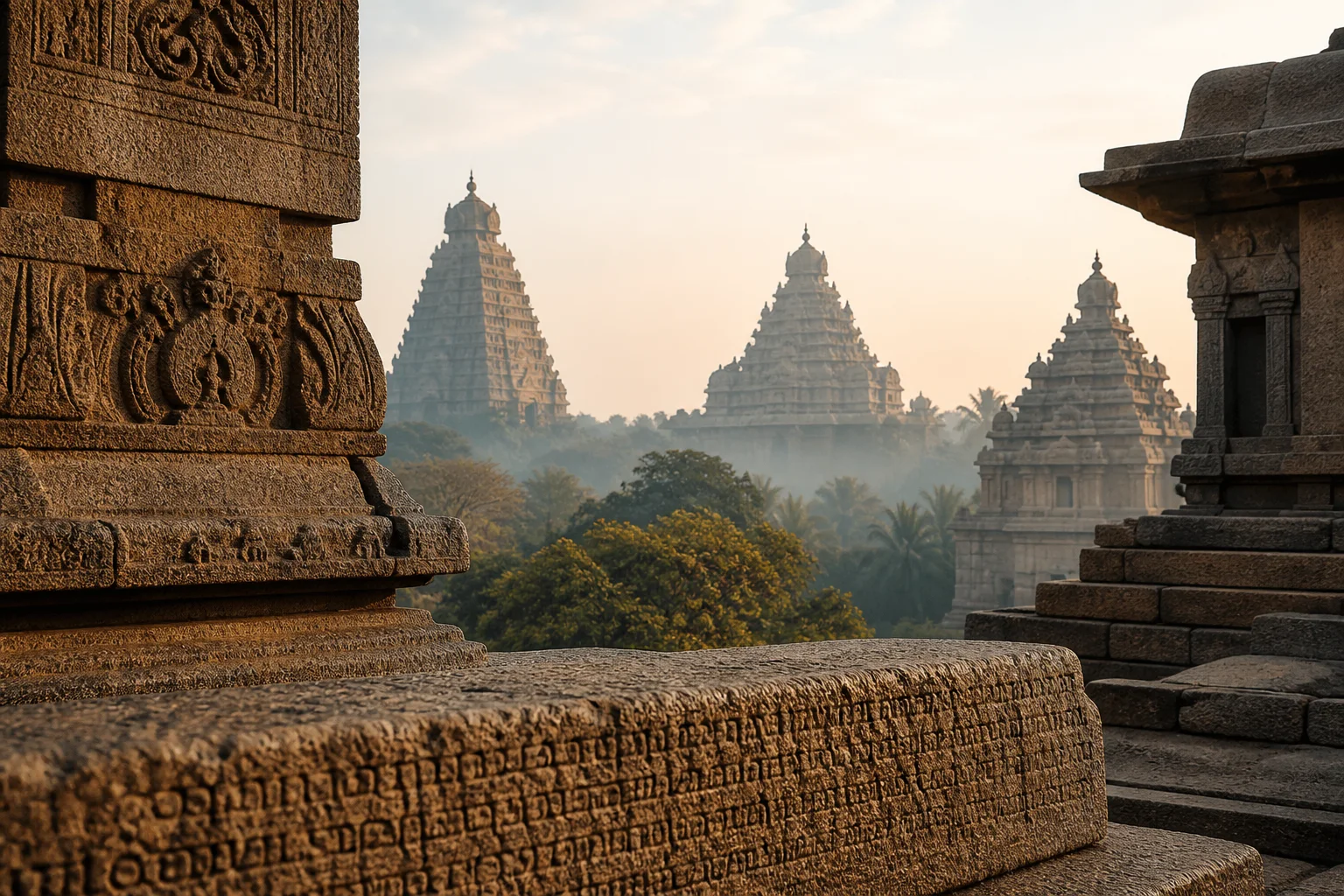
A Journey Through Chola Heritage in Tamil Nadu
Follow a thoughtful route through three living Chola temple landscapes, learning to read architecture, inscriptions, patronage, and place without rushing.
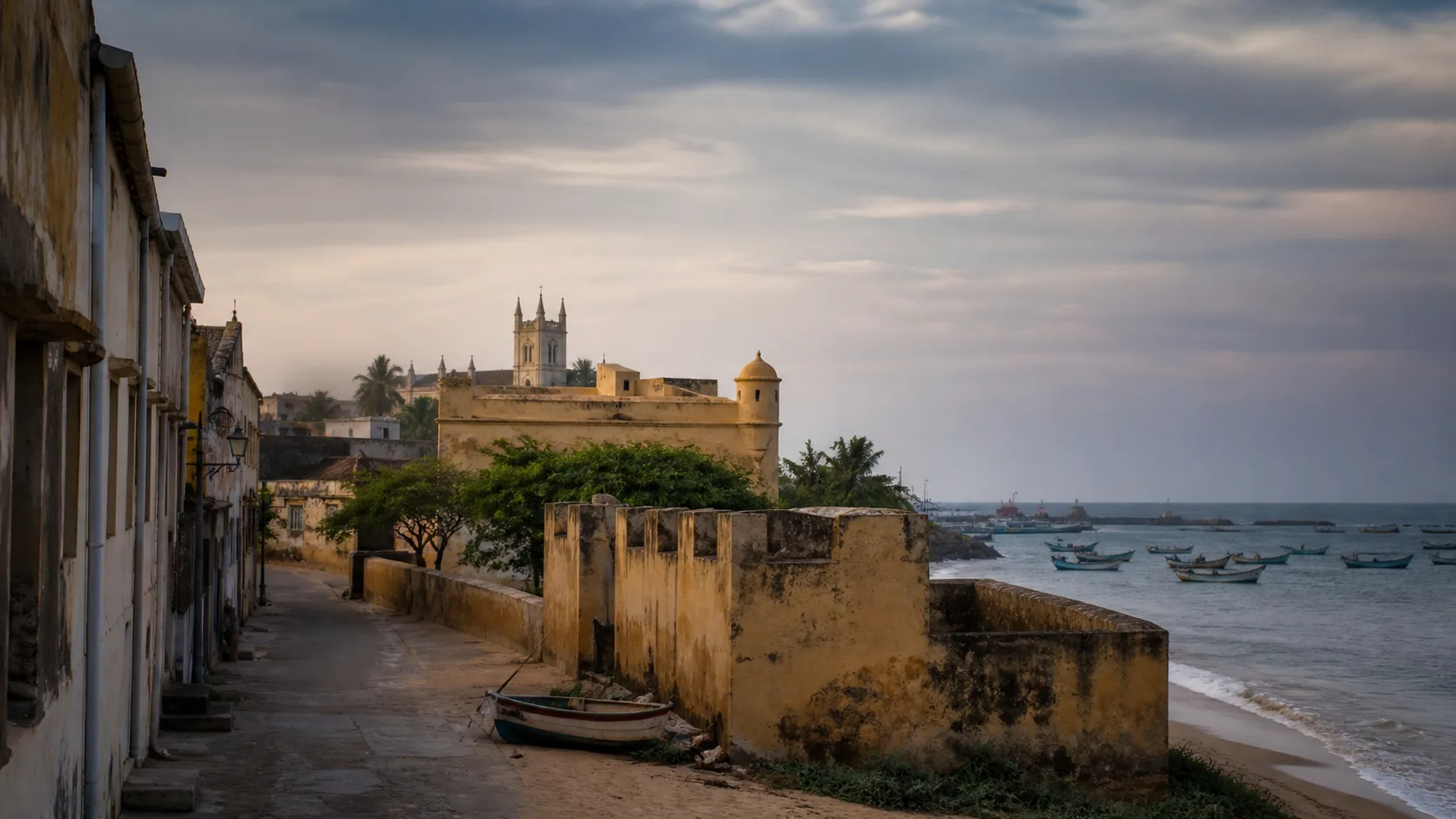
Tharangambadi: Read the Fort, Printing History and Living Coast
A layered coastal-town guide that begins before the Danish fort, follows trade and printing history, and returns heritage to a living Bay of Bengal shoreline.
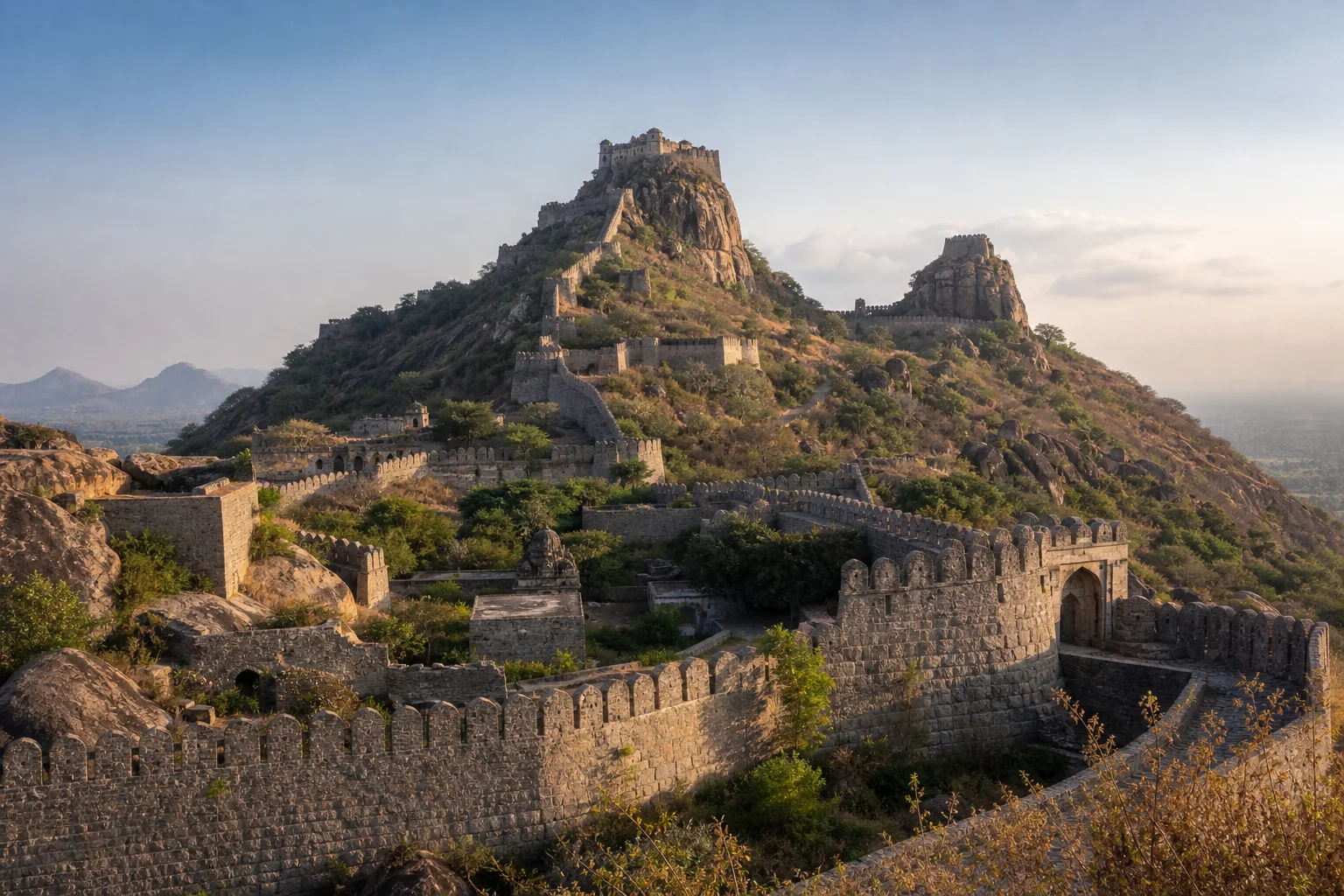
Gingee Fort After UNESCO: Reading a Military Landscape, Not Just a Ruin
What Gingee's place in a 12-fort World Heritage serial property means, and why its granite hills, walls, water and layered history must be read together.