
Poetry, interpretation and scholarly networks
Vaishnavism, Alvars and Sri Vaishnava Traditions
The history of a poem does not end with its author. Alvar hymns acquired new meanings through commentary, recitation and temple institutions.
Orientation
Overview
Early medieval literature and later institutional development
A reader can encounter Tamil Vaishnava history through very different doorways: a poem addressing Vishnu, an inscription recording a gift, a philosophical argument or the remembered life of a teacher. These materials are connected, but they do not all begin at the same time. Earlier forms of Vishnu worship, the songs attributed to the Alvars and later Sri Vaishnava institutions should therefore be placed in relation rather than compressed into the work of a single founder.
The Nalayira Divya Prabandham brings together a revered Tamil corpus associated with the Alvars. In her study of medieval commentary, Suganya Anandakichenin places this poetic literature broadly in the sixth to ninth centuries and distinguishes it from commentaries written centuries later. That interval is part of the history: later readers worked on an inherited text, found new connections and argued over its meaning. A commentary is evidence of that intellectual work, not simply a transparent window onto the original composer.[1]
The term Sri Vaishnava refers to a developing religious and interpretive tradition, not a label that can automatically be attached to every early image of Vishnu. This account follows several connected strands: material settings, Tamil poetry, Sanskrit philosophical writing and institutional support. It treats traditional biographies as important expressions of community memory while reserving stronger historical claims for the evidence that can sustain them.
How to read this guide
Different evidence, different questions
These categories are used throughout the article. A tradition can be historically important without independently proving the earlier event it describes.
Archaeology
Objects, structures and their excavated contexts.
Inscriptions
Words recorded on stone, metal or other material.
Literature
Composition, genre, argument and textual transmission.
Institutional records
Grants, catalogues, accounts and administrative arrangements.
Later tradition
Retrospective narratives, sacred memory and lineage claims.
Scholarly interpretation
Explanations built by comparing evidence, with room for revision.
Chronology
A careful timeline
These entries distinguish dated records, broad historical phases and later transmission. Dates of texts, objects and traditions need not coincide.
Vishnu in a monumental landscape
Kanchipuram’s Vaikuntha Perumal belongs to the history of Pallava royal patronage.[6]
Alvar literature
The poems precede the later medieval commentarial works discussed here.[1]
Ramanuja’s intellectual work
Exact life dates are debated; his Sanskrit works offer a firmer starting point than a complete traditional biography.[2]
Commentarial differences
Several teachers interpret the same Tamil poem through distinct arguments.[1]
Historical reading
Vishnu worship before later institutional identities
The Mandagapattu dedication names Vishnu alongside Brahma and Isvara. Read as an inscription, it establishes a specific royal dedication rather than a complete doctrine or a later sectarian organisation. Its combination of deities is a reminder that modern categories should not decide in advance how every early patron understood a shrine. It also shows why a monumental record and a literary corpus need to be examined on their own terms before being linked.[7]
At Kanchipuram, the Vaikuntha Perumal temple offers a more extensive monumental setting. India’s Tentative List submission associates it with Nandivarman II and identifies the narrative panels presenting Pallava royal history. Such a monument joins religious dedication with political representation. It supplies evidence for the public presentation of kingship and Vishnu worship, without demonstrating that the later teaching institutions of Sri Vaishnavism already existed in their mature form.[6]
This distinction matters whenever a city is described as a religious centre. A city may contain monuments associated with different traditions, built by different patrons over a long period. Their presence does not establish equal prominence or harmonious relations at every date. Kanchipuram is historically interesting because its institutions accumulated and changed; it should not be turned into an unchanging diagram of four communities sharing an identical civic role.
Historical reading
The Alvars and a collected poetic inheritance
The corpus is conventionally described as the Four Thousand Tamil Verses of twelve Alvars. That description identifies a received literary collection, not a census of all early devotees. The teachers and institutions that preserved the collection made certain authors and works especially authoritative. A history of the Alvars must consequently distinguish the attributed poems from the biographies and lineages through which later generations came to know their authors.[2]
Poetry makes relationships visible through its speakers, images and changing forms of address. A speaker’s longing or separation can organise a religious argument without taking the form of a philosophical treatise. This does not make the verse intellectually simple. It asks readers to recognise connections through language, allusion and emotion. Nor should the poetic speaker automatically be equated with an unmediated report of the author’s personal life.
Collection changes the way such writing is encountered. Poems that once circulated through particular teachers or settings can be placed beside one another and learned as an ordered inheritance. Later readers may understand a verse through its position in that whole. The history of a corpus therefore includes both the survival of individual compositions and the recognition of a larger textual body. Neither process can be reconstructed solely from the title attached to the finished anthology.
Historical reading
Andal: the poems and the remembered poet
Archana Venkatesan’s The Secret Garland presents translations of the Tiruppavai and Nacciyar Tirumoli with an introduction and commentary. Keeping both works in view prevents Andal’s literary presence from being reduced to a single familiar devotional sequence. The translated poems can be read as compositions with particular voices and structures, while the commentary introduces the interpretive world around them. The existence of a later explanatory tradition should not be confused with direct documentation of every episode in the poet’s life.[5]
Venkatesan distinguishes the sparse biographical traces within the poems from hagiographies recorded from the eleventh century onward. The poet calls herself Kotai and refers to Vishnucittan, but the precise relationship cannot simply be read back from later stories. The study also follows her transformation from a remembered poet into a goddess within the tradition. This gives historical form to a change in status, without treating a miraculous marriage as a documented human event.[5]
For historical reading, begin with attribution, genre and the passage under discussion. Then identify whether the explanation comes from a poem, a commentator or a later narrative. This method gives Andal’s writing room to be more than an illustration of a familiar legend. It also avoids treating a celebrated female author as proof that all women enjoyed comparable authority, education or freedom in the society around her.
Historical reading
Nathamuni and the problem of remembered recovery
Sri Vaishnava lineage accounts assign Nathamuni a foundational place in gathering the Alvar hymns. The University of Florida thesis used here presents him in a lineage appendix and marks the distinction between traditional dating and academic chronology. This is a guide to the community’s remembered succession, not a contemporary catalogue produced at the moment of compilation. The recovery of an authoritative corpus is itself one of the stories through which a tradition explains its continuity.[8]
A history of preservation can respect that story without claiming independent proof of its miraculous elements. It can ask what the account makes important: the danger of loss, the authority of a teacher, the continuity between a poet and later listeners. Those themes help explain why recovery narratives are repeated. Establishing exactly when particular verses were gathered, however, requires manuscript, citation and inscriptional evidence of a different kind.
Nathamuni should therefore appear between early literary inheritance and later teaching institutions with a clearly stated evidential boundary. The relationship is important even where the details remain uncertain. A missing contemporary record does not justify inventing one, but it also does not make the later tradition historically meaningless. Its strongest use is as evidence for the way subsequent communities represented the transmission of their scripture.
Historical reading
Ramanuja as an interpreter and philosopher
Ramanuja belongs to the eleventh–twelfth-century intellectual setting. The Internet Encyclopedia of Philosophy explicitly distinguishes the traditional lifespan from alternative scholarly dates. It identifies the Sri Bhashya and Vedarthasangraha among his major works and explains his defence of real individual beings within a wider unity. These writings offer a basis for discussing his philosophical contribution without turning a conventional birth anniversary into an uncontested historical date.[2]
A commentary on an authoritative Sanskrit text is an intervention in a field of argument. Its author must explain passages, relate them to one another and answer rival readings. For intellectual history, the significance lies in how an interpretation is made persuasive to an audience trained to recognise those questions. That is a different kind of achievement from founding a building or introducing a local festival, even when later biographies attribute all three to one teacher.
An accessible Oxford scholarly discussion relates Ramanuja’s Vedantic interpretation to the Vaishnava traditions represented by Yamuna and Nathamuni. This helps prevent a picture of isolated philosophical invention. It locates his work among inherited texts and commitments while recognising that a systematic argument can reorganise them. The extent and form of those relationships remain subjects for textual study rather than matters settled simply by a lineage diagram.[9]
Stories about the teacher’s encounters, travels and reforms should be handled at the level of their sources. A later biography may express an institution’s understanding of his authority. A dated endowment would document a different kind of event. Keeping them separate allows Ramanuja’s intellectual importance to be discussed without endorsing every retrospective account of administration or assuming that his teachings were implemented uniformly in every affiliated temple.
Historical reading
Tamil poetry and Sanskrit learning
John Carman and Vasudha Narayanan’s The Tamil Veda is organised around the meeting of Tamil hymns and Sanskrit Vedanta, with Pillan’s interpretation of Nammalvar’s Tiruvaymoli at its centre. Its published contents identify both the commentator’s synthesis and his relationship to Ramanuja as distinct subjects of study. This is a useful framework for seeing the two linguistic inheritances as materials brought into relation through interpretation, rather than as two sealed or automatically opposed traditions.[3]
Calling a work the Tamil Veda is a claim about religious authority within this tradition. A historical account can explain the importance of that claim without presenting it as a judgement that all communities accepted. The phrase points to questions about who could interpret a text, how one body of scripture was related to another and what kinds of learning made an explanation persuasive. Translation alone cannot resolve those institutional questions.
Commentaries also challenge the assumption that Tamil religious history was simply a rejection of Sanskrit. Mixed linguistic registers could make connections among a Tamil verse, technical concepts and other scriptural passages. The resulting work demanded learning in several forms. The question for historians is how that learning was acquired and transmitted, not which language should be declared the sole authentic medium of the tradition.
Historical reading
What later acharyas did with a short poem
Anandakichenin’s study brings together Amalan Ati Piran and three thirteenth- to fourteenth-century commentaries associated with Periyavaccan Pillai, Alakiya Manavala Perumal Nayanar and Vedanta Desika. The publisher’s description identifies their Tamil-Sanskrit Manipravalam, differing techniques and theological positions. A single poem thus becomes the meeting point for several interpreters, rather than an object with only one permanently fixed explanation.[1]
That example gives later acharyas a visible intellectual task. They could select a word for extended discussion, connect a passage with another authority or explain the sequence of a poem. These choices are productive acts, not merely the repetition of an earlier teacher. Comparing them can reveal both shared assumptions and the precise point at which interpretations diverge. It is more informative than treating each new commentary as evidence that an unchanged doctrine simply continued.
Institutional division should likewise be investigated through particular texts and settings. Names later used for branches of the tradition can conceal earlier overlaps and gradual differentiation. A contrast between two celebrated teachers is not enough to supply the date of a complete social split. The works considered here show disagreement within a shared interpretive inheritance; the larger chronology of institutions needs additional records.
Historical reading
Srirangam: a temple-town with an archive
The Archaeological Survey of India’s South Indian Inscriptions XXIV brings together 641 records from Srirangam, with its preface describing material from the tenth century onward. This is a substantial documentary base, but the starting date of the surviving inscriptions is not necessarily the foundation date of worship. The volume makes a different claim from later accounts of an immensely ancient origin: it identifies records available for historical examination.[4]
India’s Tentative List dossier describes Srirangam as a temple-town in which enclosures and settlement are closely connected. That relationship helps explain why religious institutional history extends beyond a sanctum. Houses, routes and spaces of assembly can be part of a setting in which teaching and service take place. The dossier is a nomination document, however, and its broad antiquity claims should not replace the chronology established from individual records.[10]
An inscriptional corpus can be approached by transaction rather than by ruler alone. Who gives, what is transferred and which obligation follows are historical questions about an institution’s operation. A donor’s title may reveal a relationship to a court; a boundary description may connect a temple with land elsewhere. For this guide, the important point is that a centre of religious learning also left records of practical commitments. Intellectual and economic histories need to be read together.
Srirangam should not absorb every part of the story. Kanchipuram and other centres had their own monuments, patrons and learned communities. Relationships among centres could be carried through teachers, texts and remembered affiliations without placing every local institution under identical administration. A network is useful precisely because it allows connections without assuming a single central office or one moment of establishment.
Historical reading
Teaching institutions and performed interpretation
A matha, a temple and a circle of teachers are related possibilities, not interchangeable names. An institutional history needs to establish which body held resources, appointed successors or provided instruction in the particular case being discussed. A teacher’s place in a lineage does not by itself establish the age of a surviving matha building. The companion institutions page follows those questions in detail; here they prevent intellectual succession from being mistaken for an unbroken property record.
Archana Venkatesan’s research on Araiyar performance examines learned recitation, gesture and commentary as connected activities. Her account stresses transmission within a hereditary performance tradition rather than spontaneous improvisation. This is evidence for the practices she studies, not proof that every element has remained identical since the Alvars. It nevertheless shows why a text’s social life cannot be reconstructed from manuscripts alone: explanation may also be voiced and enacted.[11]
The historical significance is the labour of interpretation. Someone has to learn the words, understand an inherited explanation and make it available to an audience. Institutional support may help that learning continue, but continuity still requires people making choices. Manuscript copying, oral instruction, performance and printed editions are distinct means of transmission. Their relationship should be investigated rather than imagined as a perfectly stable chain.
Historical reading
Six kinds of evidence, six different questions
Archaeology and architectural study establish material settings and building phases. Inscriptions document particular gifts, services and public statements. Literature preserves attributed poems and the conventions through which their speakers address Vishnu. Institutional records can illuminate offices, resources and succession when their dates and custody are established. Later religious tradition explains exemplary lives and remembered origins. Scholarly interpretation compares these materials and argues for relationships among them.
A strong account lets each kind of evidence retain its scale. It does not ask a sculpture to prove a philosophical argument or a poem to serve as an administrative ledger. Read together, the sources show how Tamil Vaishnava literature became part of a wider intellectual and institutional history. That history includes devotion, disagreement, preservation and new interpretation, with no need to treat every later development as already present at the beginning.
Human scale
People and institutions
Named rulers are only one part of the history. These groups and individuals help show how evidence and social life connect.
Alvars
Attributed poetic voices whose works were collected and interpreted.
Acharyas and commentators
Teachers gave inherited texts new systematic explanations.
Reciters, donors and custodians
Their work and resources sustained the social life of literature.
Historical geography
Connected places
Explore the landscapes and settlements discussed in this guide.
Questions
Frequently asked questions
Are Alvar poetry and later Sri Vaishnava institutions contemporary?
They belong to related but different historical stages. The poems, their compilation traditions, commentaries and institutional records must be dated separately.
Are Ramanuja’s exact life dates certain?
No. Traditional dates and scholarly reconstructions differ. This page uses a broad eleventh–twelfth-century setting and concentrates on his works.
Does the term Tamil Veda mean Sanskrit disappeared?
No. The history discussed here includes interpretation across Tamil and Sanskrit, including mixed-language commentaries.
Editorial trust
Sources and further reading
Citations in the article point to this full list. Source type and review date are shown so readers can evaluate the evidence.
- 1For My Blemishless Lord: three medieval commentaries on Amalan Ati PiranDe Gruyter / University of HamburgACADEMIC / LITERARY: Suganya Anandakichenin, 2024; scholarly edition overview and contents · Reviewed 17 November 2026
- 2RāmānujaInternet Encyclopedia of PhilosophyACADEMIC: philosophical reference article; distinguishes traditional and scholarly dates · Reviewed 17 November 2026
- 3The Tamil Veda: Pillan’s Interpretation of the TiruvaymoliUniversity of Chicago PressACADEMIC: John Carman and Vasudha Narayanan; publisher description and contents · Reviewed 17 November 2026
- 4South Indian Inscriptions XXIV: Srirangam temple inscriptionsArchaeological Survey of India / IGNCAPRIMARY/EPIGRAPHIC: published corpus; preface and introduction consulted · Reviewed 17 November 2026
- 5The Secret Garland: Andal’s Tiruppavai and Nacciyar TirumoliOxford University PressLITERARY / ACADEMIC: Archana Venkatesan’s translation, introduction and commentary; publisher preview · Reviewed 17 November 2026
- 6Temples of Kanchipuram: Tentative List submissionPermanent Delegation of India to UNESCOARCHAEOLOGICAL / INSTITUTIONAL: monument dossier; not a World Heritage inscription · Reviewed 17 November 2026
- 7Indian Epigraphy and Numismatics: Mandagappattu inscriptionTamil Nadu Open UniversityPRIMARY/EPIGRAPHIC / ACADEMIC: university presentation of Sanskrit record · Reviewed 17 November 2026
- 8J. McKinley, doctoral research: Sri Vaishnava lineage appendixUniversity of FloridaACADEMIC / TRADITIONAL: university thesis, appendix A; lineage distinguished from dated documentation · Reviewed 17 November 2026
- 9Formation: Sri Vaishnava intellectual historyOxford University PressACADEMIC: accessible chapter passage on Yamuna, Ramanuja and Vedanta; not full-book access · Reviewed 17 November 2026
- 10Sri Ranganathaswamy Temple, Srirangam: Tentative List submissionPermanent Delegation of India to UNESCOINSTITUTIONAL: temple-town description; early foundation claims not adopted · Reviewed 17 November 2026
- 11Archana Venkatesan: Fluid Text and Open BoundariesNESAR: New Explorations in South Asia ResearchACADEMIC: research on commentary, translation and Araiyar performance · Reviewed 17 November 2026
Editorial review: Reviewed 17 November 2026 using accessible archaeological records, published inscriptions, institutional summaries and scholarly research. Some full publications were unavailable; abstracts and indexed excerpts support only the specific claims discussed, while the publications also provide further reading. Dates and interpretations retain their stated uncertainties.
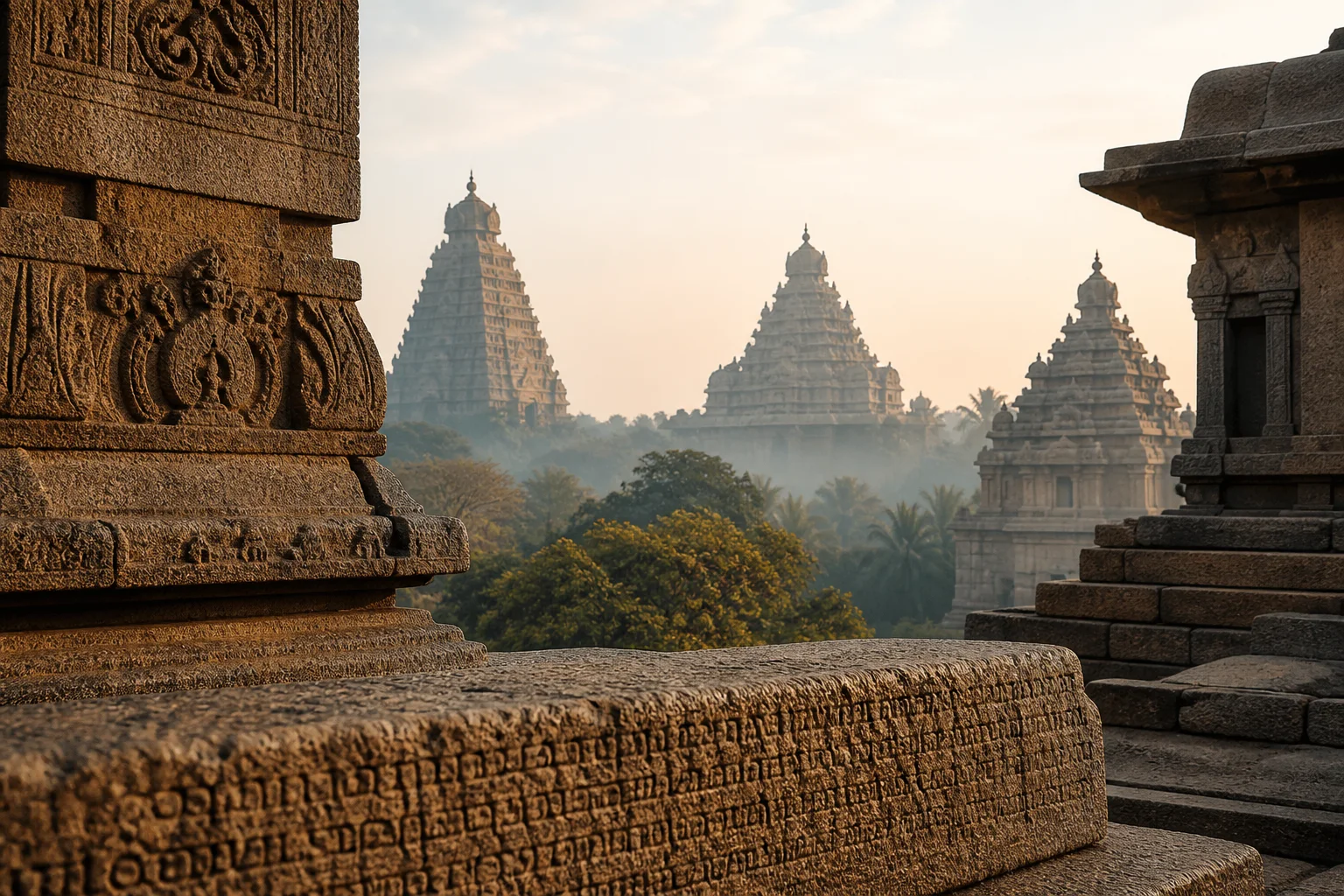
A Journey Through Chola Heritage in Tamil Nadu
Follow a thoughtful route through three living Chola temple landscapes, learning to read architecture, inscriptions, patronage, and place without rushing.
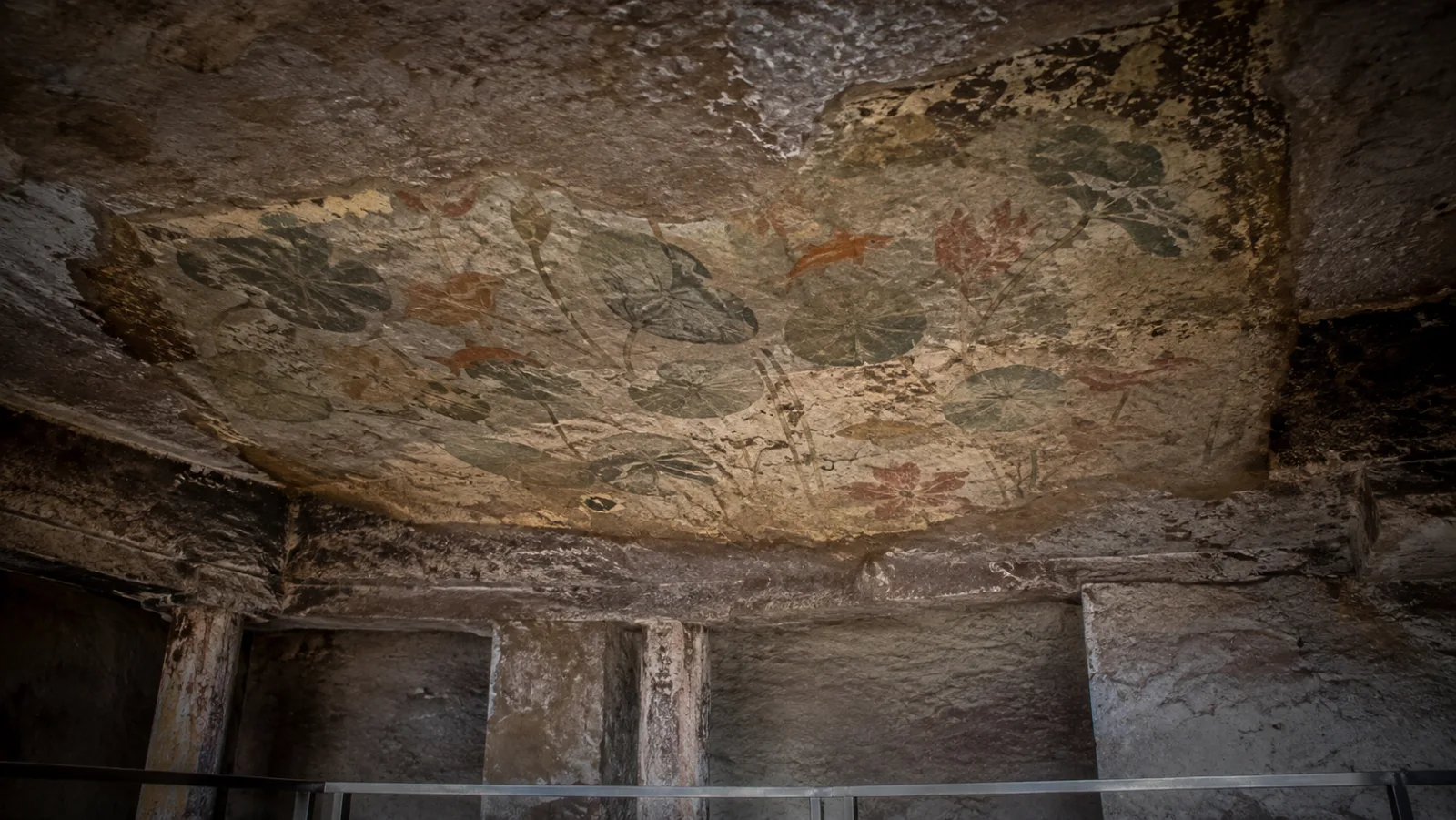
Sittannavasal: Read a Jain Hill Through Paint and Stone
A conservation-first guide connecting Sittannavasal's Jain cave, fragmentary paintings, rock beds and inscriptions without forcing them into one date.
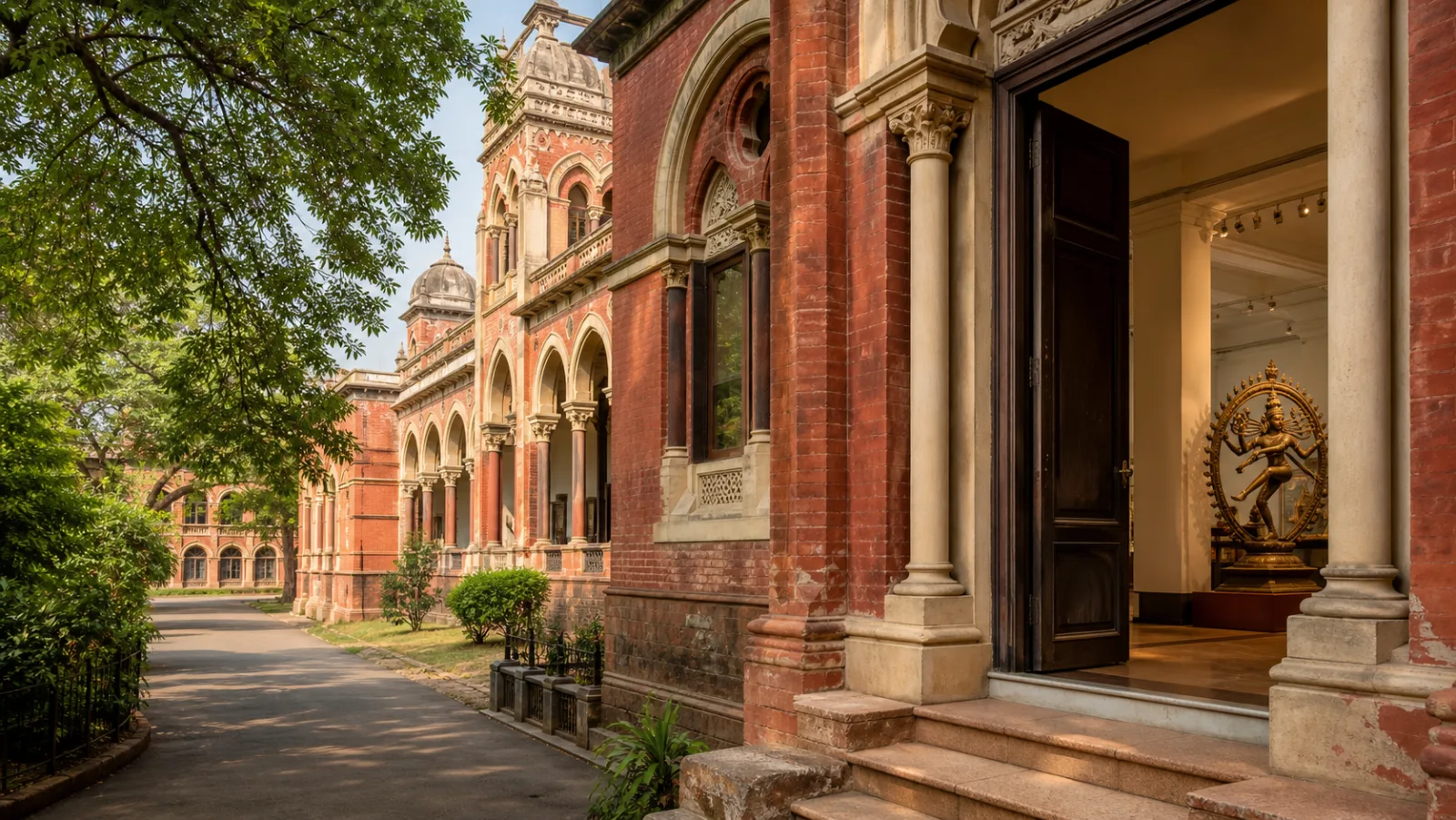
Chennai Government Museum: Read a Campus of Collections
A first-visit method for reading the Egmore museum as an evolving campus of architecture, archaeology, bronzes, inscriptions and public education.