
Learning, resources and recurring work
Mathas and Temple Institutions
Behind a gift carved in stone lay people, provisions and obligations. Follow the institutions that sustained teaching, worship, hospitality and textual transmission.
Orientation
Overview
Medieval inscriptions and later manuscript histories
A temple can dominate a townscape without revealing how its activities were organised. Stone walls survive more readily than the negotiations that supplied food, paid workers or supported a teacher. A matha, usually rendered as monastery, introduces another set of relationships: a teacher and disciples, patrons and residents, visitors and the people who fed them. Neither word identifies one arrangement that remained unchanged across Tamil history.
The useful starting point is a particular obligation. Who promised a daily supply of ghee? Which body accepted a gift? Was land transferred, or a claim on its income? Such questions lead from a monument to an institution. They also connect the history of religion to agriculture and ordinary work without reducing religious commitments to economic motives. A service could be a devotional act and a carefully specified responsibility at the same time.
How to read this guide
Different evidence, different questions
These categories are used throughout the article. A tradition can be historically important without independently proving the earlier event it describes.
Archaeology
Objects, structures and their excavated contexts.
Inscriptions
Words recorded on stone, metal or other material.
Literature
Composition, genre, argument and textual transmission.
Institutional records
Grants, catalogues, accounts and administrative arrangements.
Later tradition
Retrospective narratives, sacred memory and lineage claims.
Scholarly interpretation
Explanations built by comparing evidence, with room for revision.
Chronology
A careful timeline
These entries distinguish dated records, broad historical phases and later transmission. Dates of texts, objects and traditions need not coincide.
Mathas enter the inscriptional record
The published epigraphic study locates early references here; greater frequency follows from the eleventh century.[1]
Teaching and care at Tirumukkudal
The inscription discussed by the Archaeological Survey records provisions for a hospital.[4]
A funded lamp at Vedaranyam
SII XVII.449 records money and an agreed daily ghee supply.[3]
Surviving manuscript copies
Many palm-leaf manuscripts in the Pondicherry collection belong to these centuries, though their texts can be older.[7]
Historical reading
A matha was not simply a smaller temple
Michelle Folk’s study of ninth- to thirteenth-century inscriptions finds a varied population around mathas: ascetics, devotees, disciples and people described as their lords or possessors. Her analysis stresses that the term could cover different services and patterns of residence. The name alone does not establish a uniform curriculum, a single monastic rule or the identity of everyone who entered the building.[2]
The difference matters when reading a heritage description. A temple identifies a setting centred on worship, while a matha may be organised around a teaching lineage and its community. Connections between them must still be demonstrated. A nearby residence might serve a temple, receive an independent endowment or offer hospitality on particular occasions. Its location does not make it administratively identical to the shrine. Looking for the institution’s own name in a record helps prevent distinct bodies from merging into one vague temple establishment.
Historical reading
Six kinds of evidence, six different questions
Archaeology can establish building phases, spatial arrangements and the material setting of activity. Inscriptions identify recorded transactions, offices and obligations. Literature includes texts prescribed for study, commentaries and accounts of exemplary teachers. Institutional records, where they survive, disclose administration and succession. Later religious tradition explains how a community remembers its origins. Scholarly interpretation relates these sources to one another; it should remain distinguishable from the words of an inscription.
These categories sometimes meet in one object. An inscribed wall has a physical location as well as a text, and its blocks may have been reused. A manuscript may transmit an old work in a much later copy. An institutional genealogy can be important evidence for remembered authority even when it cannot independently date a foundation. Good interpretation keeps the question attached to the evidence: a list of teachers is not an account book, and a donor’s promise is not a record of every subsequent payment.
Historical reading
Vedaranyam: following one lamp through an endowment
South Indian Inscriptions XVII, no. 449, records a gift at Vedaranyam dated by the edition to 1181. The donor provided 150 coins for a perpetual lamp. The temple’s Sivabrahmanas accepted responsibility for maintaining it from the return on the endowed sum, with a specified daily quantity of ghee measured by a named local measure. The document joins money, personnel, measurement and a recurring ritual service.[3]
Reading the transaction this way changes the scale of the story. The lamp was not just an object handed over once. Its continued use required a supply and someone answerable for that supply. The inscription makes the arrangement publicly legible, but it does not tell us how much ghee actually arrived on every day thereafter. The precise promise is historical evidence; uninterrupted fulfilment would require other records. This distinction also prevents a single endowment from becoming proof that every temple functioned as a modern bank.
Historical reading
Land grants connected institutions with cultivators
Dharma Kumar’s study of property in medieval South India draws attention to differing rights and the terms under which they could be transferred. Its inscription references include temple transactions in karanmai rights. Such records require more precision than the statement that a religious institution owned the countryside. A grant might concern a particular entitlement, income or obligation rather than all possible claims over a field.[5]
For the institution, the gift offered resources beyond its walls. For people cultivating the land, it could change the recipient of a payment without describing their whole working life. The historian therefore has to follow both ends of the arrangement. A donor’s name may be prominent while cultivators remain unnamed. Religious patronage and agrarian relations belong in the same account, but the inscription’s distribution of attention should not determine whose labour is considered important.
Village bodies were also diverse. Karashima distinguishes institutions such as the ur, sabha, nagaram and nadu rather than treating them as interchangeable village councils. This matters whenever a temple grant involved a local assembly: the body’s constituency, authority and location need to be identified before its action is described as a decision by the entire community.[6]
Historical reading
Teaching depended on support beyond the classroom
The Archaeological Survey’s discussion of the Tirumukkudal inscription of Virarajendra reports a hospital with fifteen beds and a staff including a physician, surgeon, nurses, herb collectors and other workers. This is a specific recorded provision, not evidence that all medieval temples operated hospitals. Its importance lies partly in making the supporting personnel visible alongside the institution receiving the grant.[4]
The Ennayiram inscription of Rajendra Chola I offers a complementary example. Its publication in Epigraphia Indica identifies a substantial section dealing with categories of teachers and students, subjects of study, teachers’ remuneration and student allowances in cash and kind. The same editorial discussion notes provision for Tiruvaymoli recitation elsewhere in the record. Teaching and worship could thus appear within one documented institutional arrangement without becoming the same activity.[10]
The form of the record is revealing. Different categories of recipients received defined support, rather than an undifferentiated gift to learning. A reader can ask how the allocation matched the work expected of each group. The record gives a concrete starting point for institutional comparison; it does not supply an admission register for every school in the Chola realm.
Education likewise required more than the presence of a learned person. Students needed time, food, light and a place to stay; instruction needed continuity. A reference to teaching therefore opens practical questions about residence and maintenance. It does not establish general literacy or equal access to learning. The subjects taught and the qualifications of those admitted have to come from the particular record, not from a modern expectation that an educational institution must resemble a public school.
A scholarly network need not be confined to one building. Teachers, pupils and texts can connect places even where no architectural remains of a classroom survive. For that reason, an institutional history should distinguish a documented teaching relationship from a surveyed campus. The intellectual contribution of an establishment may be substantial without requiring the language of a university or an unverified claim to priority.
Historical reading
Hospitality had beneficiaries and a calendar
In Folk’s inscriptional study, feeding was the most frequently recorded activity of mathas. Endowments could specify the recipients, food and occasions. Her examples include resident or visiting religious people and provisions associated with festivals. The evidence shows several forms of hospitality rather than an unrestricted service available to everyone on identical terms.[2]
The calendar is part of the institution. A daily commitment required one kind of organisation; feeding visitors during a festival required another. A record naming beneficiaries helps explain the social boundaries of a gift. It should not be dismissed as mere bookkeeping, because those boundaries reveal whom patrons chose to sustain. Nor should hospitality be celebrated without asking who prepared the food, obtained fuel and water, and maintained the place where it was served.
Historical reading
A surviving manuscript is a stage in transmission
The French Institute of Pondicherry describes palm-leaf manuscripts collected from temples, priests and monasteries, together with modern paper transcripts. Many surviving palm-leaf copies belong to the eighteenth and nineteenth centuries. Their age must be separated from the age of the works they transmit. The collection makes visible a history of copying and custody as well as the content of religious texts.[7]
The physical copy is consequently evidence in its own right. A title identifies a work, but a colophon, script, annotation or missing leaf may disclose something about this particular witness. Two copies of the same work can preserve different readings. An edition that silently smooths those differences may be easier to read, yet it can conceal the choices through which a text reached its present form.
The institute’s Mahesa project sets out a sequence of manuscript identification, digitisation, comparison of variants and preparation of critical editions. This modern research procedure helps explain what it means to reconstruct a text. A commentary can preserve the way a passage was understood within a school; it is not simply redundant material surrounding an original. Teaching and interpretation leave traces in the transmission itself.[8]
Historical reading
Participation extended beyond royal sponsorship
Karashima, Subbarayalu and Shanmugam interpret the growth of matha inscriptions in relation to changing religious and social networks. Their study connects Shaiva ascetics, local traditions and the participation of non-Brahmana groups, including cultivators, merchants and artisans. This is a scholarly explanation of a changing inscriptional pattern, not a census of membership or proof that every institution opened equally to all.[1]
Leslie Orr’s study of temple women uses epigraphic evidence to examine their roles as donors, devotees and institutional participants. It challenges a picture in which only kings or male religious specialists acted. Recorded female initiative, however, does not erase differences of wealth, status and occupational position among women. The particular gift and its setting remain more informative than a single general description of women’s place in temple society.[9]
Patronage could build a reputation as well as maintain a service. A gift publicly associated a person or group with a place and a recurring activity. That visibility helps explain why a historian should attend to names and titles, but also why a list of donors cannot stand for the whole population. The people with resources to commemorate their acts are especially likely to remain visible in stone.
Historical reading
Continuity involved repeated decisions
An institution survives through renewal: a text is copied, a teaching relationship continued, a building repaired or an endowment reinterpreted. This is a more useful way to approach longevity than imagining an organisation untouched by political or social change. A present-day institution may preserve important traditions while having passed through different arrangements of property, authority and public role.
Foundation stories and lineages deserve careful reading as institutional memory. Their value is not exhausted by whether every date can be independently confirmed. They explain whom a community recognises as a teacher, which texts it treats as authoritative and how it understands its place among other institutions. Historical dating, however, requires comparison with contemporary evidence. The distinction allows a tradition to be described respectfully without treating retrospective claims as automatic proof.
The companion Shaiva and Vaishnava histories follow poetry, theology and canon formation. This guide keeps the attention on the arrangements that allowed learning and service to continue. Together they make it possible to move between an idea and the people who taught it, between a donor’s intention and the work needed to carry it out, and between an old text and the surviving copy through which it can now be read.
Human scale
People and institutions
Named rulers are only one part of the history. These groups and individuals help show how evidence and social life connect.
Teachers and disciples
Learning was sustained through relationships as well as buildings.
Donors and institutional officers
Gifts specified resources, obligations and the people responsible.
Workers and recipients
Hospitality, maintenance and ritual depended on labour and defined access.
Historical geography
Connected places
Explore the landscapes and settlements discussed in this guide.
Questions
Frequently asked questions
Was every matha a school?
No. Inscriptions reveal varied residents and services; teaching should be established for the particular institution.
Did every temple run a hospital?
No. Tirumukkudal supplies a specific example, not a universal model.
Does a manuscript’s date give the date of its text?
Not necessarily. A later copy can transmit an older work, and a critical edition compares surviving witnesses.
Editorial trust
Sources and further reading
Citations in the article point to this full list. Source type and review date are shown so readers can evaluate the evidence.
- 1Mathas and Medieval Religious Movements in Tamil Nadu: An Epigraphical Study (2010)N. Karashima, Y. Subbarayalu and P. Shanmugam / Indian Historical ReviewAcademic epigraphic study; publisher abstract consulted · Reviewed 17 November 2026
- 2Michelle L. Folk, Ascetics, Devotees, Disciples, and Lords of the Matam (2013)Concordia University / Library and Archives CanadaDoctoral research; full text and feeding discussion consulted · Reviewed 17 November 2026
- 3South Indian Inscriptions XVII, no. 449: Vedaranyam lamp endowmentArchaeological Survey of India / DHARMAPrimary epigraphic edition; Tamil text and editorial summary · Reviewed 17 November 2026
- 4Archaeological Survey report: Tirumukkudal inscription, epigraphy discussion, p. 69Archaeological Survey of India / IGNCA digital collectionPrimary archaeological survey publication; indexed epigraphy passage consulted · Reviewed 17 November 2026
- 5Dharma Kumar, Private Property in Asia? The Case of Medieval South India (1985)Cambridge University PressAcademic analysis; accessible extract and inscription references · Reviewed 17 November 2026
- 6Epigraphical Study of Ancient and Medieval Villages in the Tamil Country (2011)Noboru Karashima / Review of Agrarian StudiesAcademic epigraphic study; institutional variation · Reviewed 17 November 2026
- 7Manuscripts: collection history and preservationFrench Institute of PondicherryInstitutional collection description; manuscript dates and provenance · Reviewed 17 November 2026
- 8Manuscript Analysis, Historical Editing, and Saivagama Advancement (Mahesa)French Institute of PondicherryInstitutional research project; critical editing methods · Reviewed 17 November 2026
- 9Leslie C. Orr, Donors, Devotees, and Daughters of God: Temple Women in Medieval TamilnaduOxford University PressAcademic monograph; publisher abstract and contents consulted · Reviewed 17 November 2026
- 10Epigraphia Indica XXXIX, no. 34: Ennayiram inscription of Rajendrachola I, p. 225Archaeological Survey of IndiaPrimary epigraphic publication; indexed editorial discussion of lines 88–164 · Reviewed 17 November 2026
Editorial review: Reviewed 17 November 2026 using accessible archaeological records, published inscriptions, institutional summaries and scholarly research. Some full publications were unavailable; abstracts and indexed excerpts support only the specific claims discussed, while the publications also provide further reading. Dates and interpretations retain their stated uncertainties.
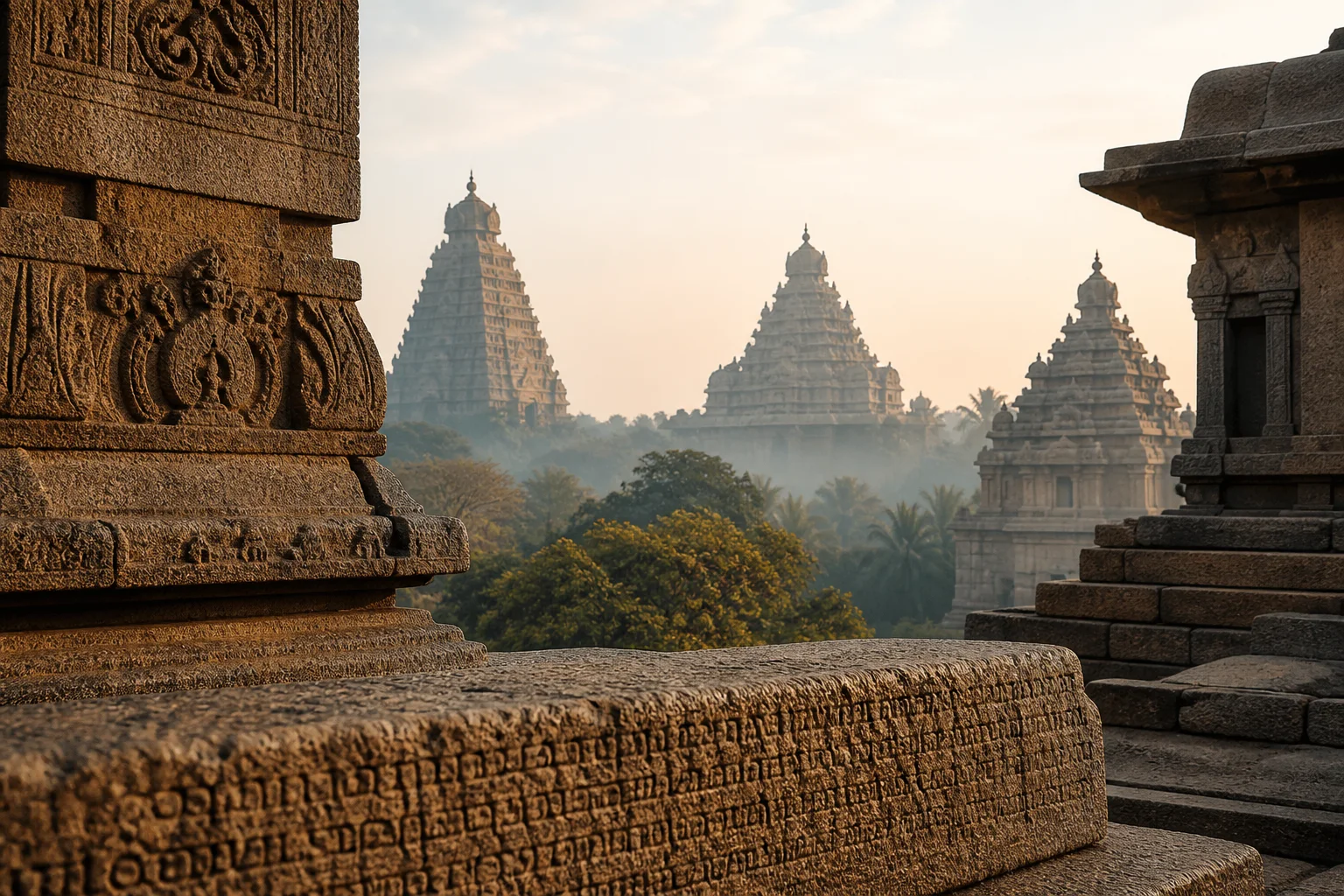
A Journey Through Chola Heritage in Tamil Nadu
Follow a thoughtful route through three living Chola temple landscapes, learning to read architecture, inscriptions, patronage, and place without rushing.
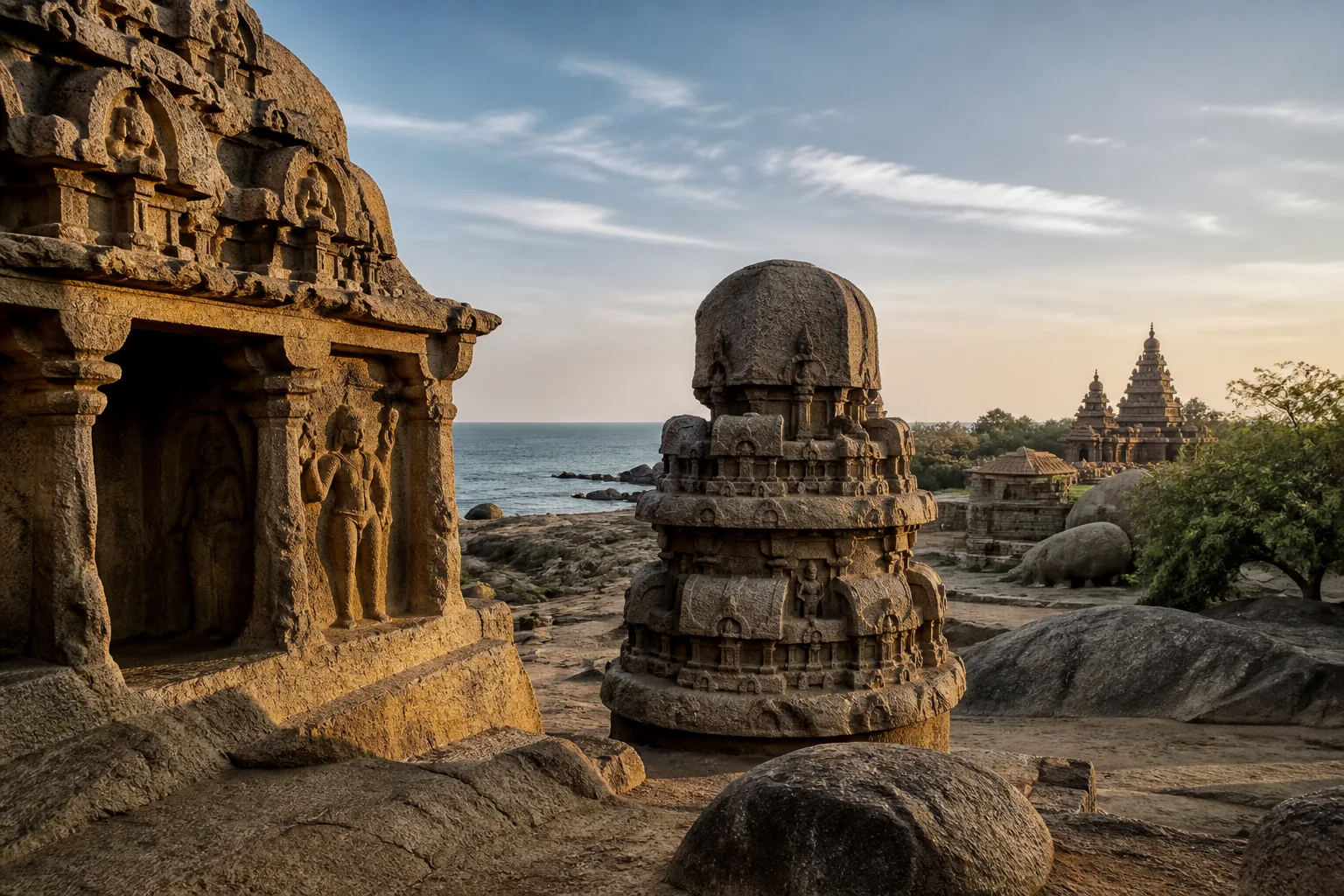
Beyond the Cholas: Exploring Pallava Heritage Across Tamil Nadu
Follow Pallava heritage from Kanchipuram's sacred city to Mamallapuram's coastal stone workshop, learning to compare form, material and evidence.

Mamallapuram: Read a Coastal World Heritage Landscape
A connected reading of Mamallapuram that moves from granite outcrops and carved caves to monolithic experiments, open-air reliefs, the Shore Temple and a living coastal town.