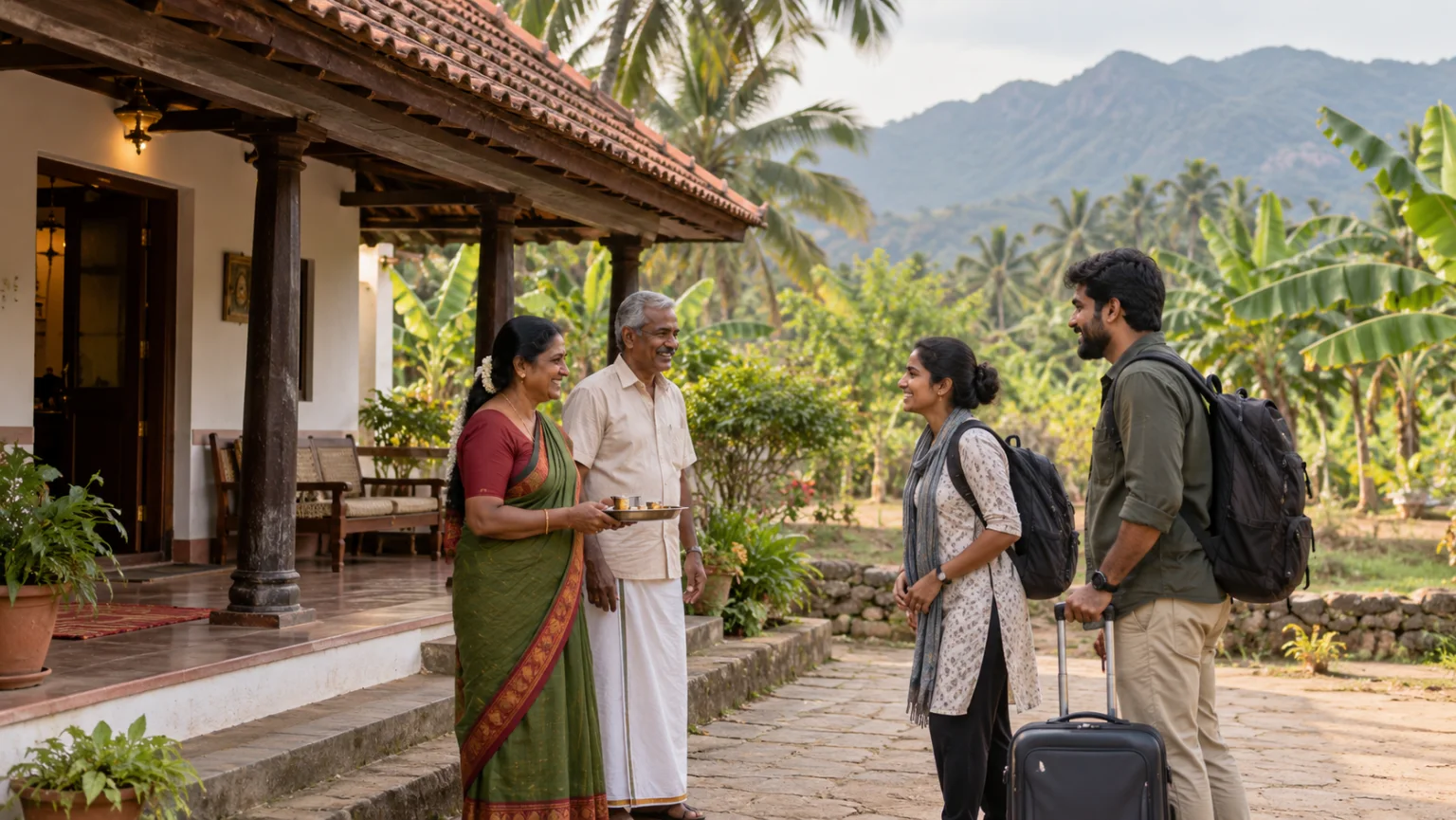
Why homestays matter in the 2026 travel conversation
Travel demand is increasingly described as experience-led: visitors want food, landscape, craft and local interaction rather than only a room near an attraction. India's rural-homestay strategy explicitly connects hosted stays with community livelihoods and responsible tourism. In February 2026, the Ministry of Tourism also described a tribal-area initiative intended to support 1,000 homestays, showing that small-scale accommodation remains part of national destination policy.
Tamil Nadu is well suited to this form of travel because its hill villages, agricultural belts, craft towns and temple regions hold very different rhythms. Yet demand creates loose marketing language. A villa with a lockbox, a row of cottages and a room in an owner-occupied house may all be called a homestay on a platform. The experience, legal category, host contact and services are not necessarily the same.
The trend is useful only when travelers verify what they are buying. A genuine hosted stay should not be romanticized as untouched village life, and a farm should not become a visitor stage that interrupts work. Start with the property's identity and operating evidence; then ask whether the daily reality matches your needs. Beautiful photographs are an introduction, not proof.
Sources for this section: Rural homestay strategy, Rural tourism update 2026, NIDHI+ accommodation types.
Know whether it is a homestay, farm stay or rental
NIDHI+, the Ministry of Tourism's hospitality database, defines a homestay as rooms for rent in a resident-occupied house or flat with meals. It defines a farm stay as rural accommodation on an operating farm. Those definitions give travelers a useful test. If no host lives on site, meals are unavailable and a manager handles several detached units, the property may still be a valid rental or resort, but it should not promise the same hosted experience.
Ask directly: Does the owner or host family live on the property? How many guest rooms are offered? Which meals are included? Is the farm operating, and what work can visitors safely observe? Who will meet us if we arrive after dark? Clear answers reduce disappointment. Avoid demanding constant personal attention merely because the property is a home; hosts need privacy and working hours too.
Category affects expectations, not just vocabulary. A hosted room may share common spaces and follow household meal times. A farm stay may have animals, mud, insects, machinery and early activity. A self-catering rental may offer more privacy but less local interaction. Choose the format that suits the group instead of using authenticity as a ranking system.
- Is the host resident on site?
- How many guest rooms or units operate?
- Which meals are included?
- Is the advertised farm actively working?
- Who handles arrival and emergencies?
Sources for this section: NIDHI+ accommodation types, Rural homestay strategy.
Use three layers of verification before paying
First, match identity. Compare the property name, complete address, host or business name, phone number and payment recipient across the booking page, an independent map or directory and the property's own communication. NIDHI+ provides a searchable national directory and distinguishes records that are registered, showcased or classified. A directory match is useful evidence, but status labels should be read accurately and do not guarantee current availability or quality.
Second, confirm current operation. Call a number obtained independently, ask a question specific to the room and request a recent exterior or access photograph if the listing is unclear. Check whether reviews describe the same host, location and accommodation type over time. Repeated generic reviews, copied images, urgency and a sudden request to move payment off-platform are warnings, not proof of a bargain.
Third, verify the transaction. Obtain the full price, taxes, meal inclusions, deposit, cancellation deadline, refund process and payment recipient in writing. Use a traceable method. If account details change, call the established number rather than replying to the new message. Keep the listing, invoice and conversation. The National Consumer Helpline can assist with consumer grievances, but documentation makes any complaint much easier to explain.
Sources for this section: Tamil Nadu accommodation directory, NIDHI+ public dashboard, National Consumer Helpline.
Inspect access, hygiene and safety in practical terms
Rural does not mean inaccessible, and simple does not mean unsafe. Ask for the route from the nearest all-weather road, the last stretch surface, parking or pickup arrangement, night lighting and mobile-network limitations. In hill areas, a short map distance can include steep steps or an approach that becomes difficult in rain. Never accept a claim of easy access without details that match the least mobile traveler.
For the room, ask about locks, window screening, ventilation, drinking water, hot water, power backup, bathroom type and cleaning. The rural-homestay strategy discusses clean rooms, kitchens and toilets, safe drinking water, waste management and host communication as basic quality concerns. Travelers with allergies should ask about animals, smoke, dampness and bedding rather than assuming that a natural setting is automatically healthier.
Accessibility needs a route description. A ground-floor room may still require steps from the road; an attached bathroom may be too narrow for a mobility aid. Request doorway, step, surface and toilet information, ideally with current photographs. For children, ask about wells, ponds, balconies, farm equipment, dogs and unfenced drops. A responsible host should answer limitations honestly instead of using one accessibility icon for the whole property.
Sources for this section: Rural homestay strategy, NIDHI+ accommodation types.
Treat food and culture as hospitality, not a performance
Meals are central to many homestays, and the national strategy encourages local cuisine. Ask what is normally served, when meals happen and whether tea, snacks or packed food cost extra. Disclose allergies, religious restrictions and dietary needs before paying; a small household kitchen may not prevent cross-contact. Do not expect an extensive restaurant menu, but do expect safe drinking water, clean preparation and honest communication.
A home visit can create conversation about farming, cooking, language or craft, but access requires consent. The kitchen, shrine, family rooms, fields and neighbors are not automatically visitor spaces. Ask before photographing people or posting the precise location. Pay separately for a guided walk, cooking session or craft lesson when it is an offered service rather than assuming that cultural labor is included with the bed.
Be curious without turning the host into a representative of every Tamil village. One family's meal or custom is evidence of that household and place, not a universal rule. Learn a few courteous Tamil words, follow footwear and mealtime practices, and accept a polite boundary. Genuine exchange grows from attention, not from demanding a staged version of local life.
Sources for this section: Rural homestay strategy.
Example 1: verifying a hill-village homestay
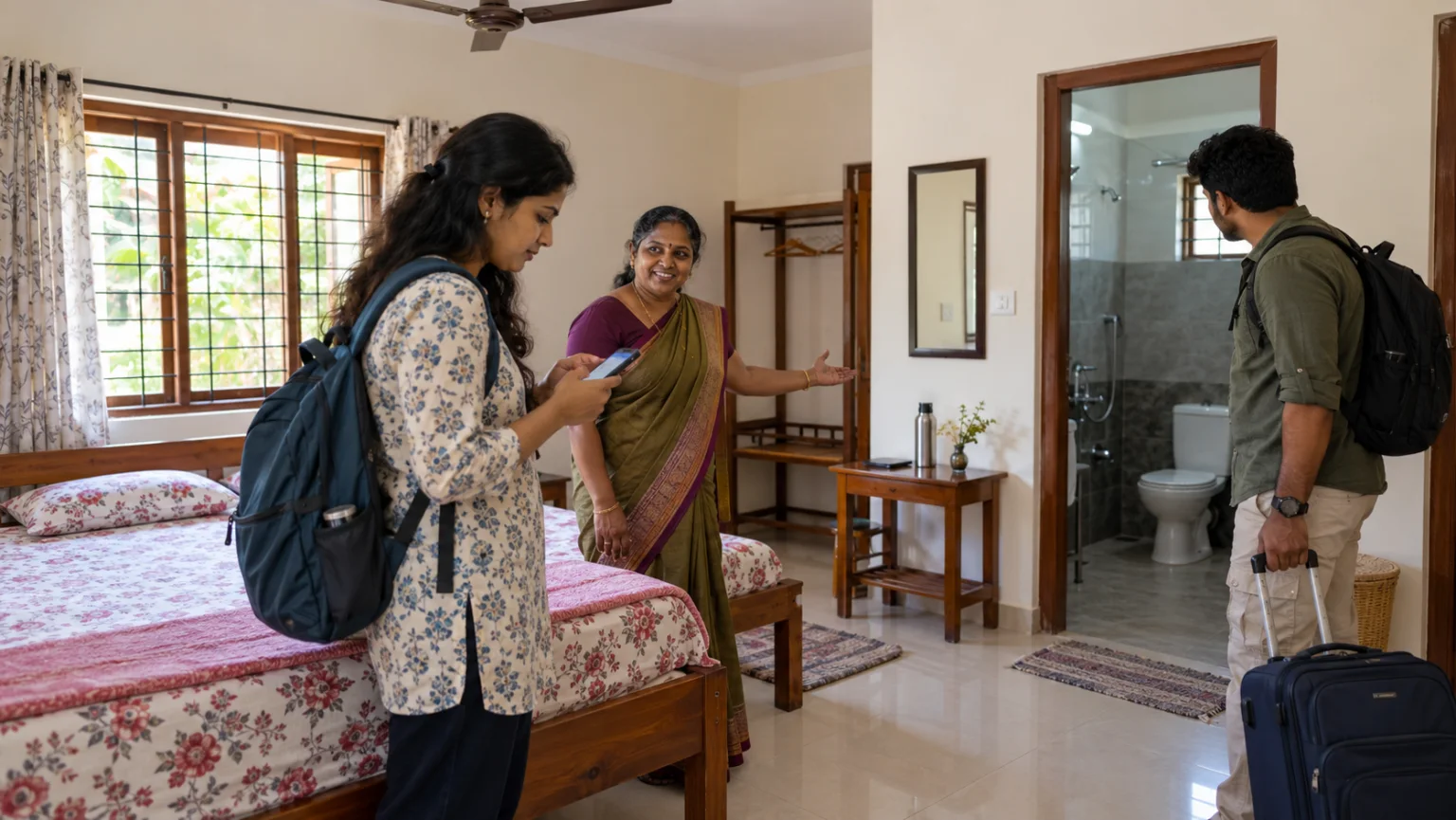
Two friends find a low-priced stay outside Kodaikanal described as a homestay with valley views. The platform shows attractive rooms but no host and only a vague location. They search the NIDHI+ directory, compare the address and call the property's established number. The host confirms that the family lives downstairs, offers three upstairs rooms and serves breakfast and dinner at fixed times.
One traveler has a knee condition. Instead of asking whether the property is accessible, they ask how many steps lead from the vehicle point to the room and bathroom. The host sends current photographs showing an outdoor stair and uneven final path. The view is genuine, but the route is unsuitable. The friends choose another registered property with a ground-floor room and clear pickup arrangement.
They did not prove that the first property was bad; they proved that it did not fit their group. Their questions also prevented an argument on arrival. Verification is most useful when it matches a real need to a real room, not when it tries to award a perfect authenticity score.
Sources for this section: Tamil Nadu accommodation directory, Classified homestays.
Example 2: choosing an operating farm stay responsibly
A family wants a farm experience near Kanniyakumari. One listing promises fruit picking, animal feeding, a waterfall trek and unlimited home food in a single night. Before booking, the adults ask which crops are currently active, whether guests enter working areas, who leads the walk, what footwear is needed and which activities depend on weather. The host explains that harvest participation is unavailable that month and the trek is not on the property.
Another property describes fewer activities but gives precise answers. It is an operating farm, children can join a short supervised garden walk, machinery areas are excluded and meals use some farm produce without claiming that every ingredient is grown there. The family confirms food allergies, fencing near the irrigation pond and the cancellation rule during heavy rain. They choose the narrower, verifiable offer.
During the stay, the children ask before touching plants or animals, and the family pays for the guided activity. They buy produce only at the host's offered price and avoid photographing workers without consent. The experience feels less like an attraction list and more like a respectful encounter with a working place, which is precisely why the smaller promise is stronger.
Sources for this section: NIDHI+ accommodation types, Rural homestay strategy.
Use a responsible booking checklist
A responsible stay should circulate value locally. Ask whether the host employs local staff, buys nearby food or connects guests with paid local guides and makers. Avoid demanding discounts in exchange for exposure. When an activity is led by a neighbor or artisan, confirm the price and pay the person or transparent operator. Community benefit is more credible when the economic relationship can be explained plainly.
Environmental language also needs evidence. Ask how the property manages drinking water, wastewater and solid waste; whether water use changes in dry periods; and whether nature activities follow current access rules. Refilling filtered water and limiting disposable toiletries can be meaningful. A bamboo sign, a green logo or the word eco cannot prove responsible operation by itself.
Forty-eight hours before travel, reconfirm arrival time, host contact, meal needs, exact room and balance due. Download directions and keep an offline copy of the booking. Share the address with someone outside the trip. On arrival, compare the property and room with the agreement before paying an unexpected balance. If the place, host or safety conditions are materially different, document the issue and use the booking channel's support process.
- Match the name, address, host and payment recipient.
- Confirm the accommodation category and exact room.
- Get total price, meals and cancellation terms in writing.
- Describe access and safety needs specifically.
- Ask how local people and the environment benefit.
- Reconfirm the booking 48 hours before arrival.
Sources for this section: Rural homestay strategy, National Consumer Helpline.
Sources & Further Reading
These authoritative references support the historical, geographic, or seasonal context in this story. Current conditions and operating details still require a fresh official check.
- National Strategy for Promotion of Rural Homestays · Ministry of Tourism, Government of India
- National Strategy and Roadmap for Development of Rural Tourism · Press Information Bureau, Government of India
- Accommodation Units · National Integrated Database of Hospitality Industry, Ministry of Tourism
- NIDHI+ Accommodation Directory: Tamil Nadu · Ministry of Tourism, Government of India
- NIDHI+ Public Dashboard · Ministry of Tourism, Government of India
- NIDHI+ Classified Homestays · Ministry of Tourism, Government of India
- National Consumer Helpline · Department of Consumer Affairs, Government of India
Related Stories

Tamil Nadu Travel Trends 2026: How to Plan an Experience-Led First Trip
A practical guide to the experience-led Tamil Nadu travel trend: nature, food, wellness, heritage walks and flexible routes beyond a sightseeing checklist.

Tamil Nadu Tourism Investment 2026: What 127 MoUs Mean for Travelers
Tamil Nadu announced a large pipeline of tourism proposals in 2026. Learn how to separate an MoU from an open attraction and plan only with verified services.

Staying in Chettinad: Reading a Mansion from the Courtyard
How to choose a mansion stay for its architecture, setting and stewardship rather than treating Chettinad as a generic luxury backdrop.
Frequently asked questions
What is a homestay?
NIDHI+ defines it as rooms for rent in a resident-occupied house or flat with meals. Online platforms may use the term more loosely, so ask whether the host lives on site.
What is the difference between a homestay and farm stay?
A homestay centers on accommodation in a host-occupied home, while a farm stay is rural accommodation on an operating farm. A property can share qualities of both, but the actual operation should be explained.
Does a NIDHI+ listing guarantee quality?
No. It is useful identity and status evidence. Read whether the unit is registered, showcased or classified, then still verify current operation, room, price, access and reviews.
How can I avoid a fake homestay listing?
Match the complete address, host, known phone and payment recipient across independent sources. Call directly, obtain written terms and avoid changed bank details or pressure to pay off-platform.
Are meals always included at a homestay?
Official definitions associate homestays with meals, but inclusions vary by booking. Confirm which meals, timings, drinks and snacks are included and disclose dietary needs before paying.
Are rural homestays suitable for older adults?
Some are, but a ground-floor label is not enough. Ask about the road, vehicle drop-off, steps, surfaces, doorway widths, bathroom layout, lighting and emergency access.
What should families ask about a farm stay?
Ask about ponds, wells, animals, machinery, fencing, supervision, food allergies, weather-dependent activities and which areas are off-limits.
Where can I complain about a booking problem?
Start with the booking platform or property's written support process. Keep screenshots, invoice and payment records. India's National Consumer Helpline also accepts consumer grievances.
Editorial attribution
Prepared and reviewed by My Tamil Nadu Editorial Desk. Modified 20 October 2026.