
Monasteries, texts and maritime connections
Buddhism in Tamil Nadu
Buddhist history survives unevenly in Tamil regions. Monastic remains, copper-plate grants, images and Tamil works reveal different communities across time.
Orientation
Overview
Excavated structures, medieval patronage and the afterlives of texts
A Buddhist image in a museum and a poem in a library do not tell the same story. One may preserve an object once used in worship; the other carries an argument, a narrative world and the labour of generations of readers. Buddhist history in Tamil regions depends on bringing such traces into conversation while allowing each its own date, setting and limitations. The surviving material is too uneven to support a simple map of a uniformly Buddhist country.
Three places provide useful points of orientation. Kaveripattinam offers excavated structural remains. Nagapattinam brings together images and documentary evidence for endowed institutions with maritime connections. Kanchipuram appears in literary and travel traditions whose claims need to be read in their own genres. Alongside these places, Tamil Buddhist writing opens a history of language and intellectual work that cannot be reconstructed from monuments alone.
How to read this guide
Different evidence, different questions
These categories are used throughout the article. A tradition can be historically important without independently proving the earlier event it describes.
Archaeology
Objects, structures and their excavated contexts.
Inscriptions
Words recorded on stone, metal or other material.
Literature
Composition, genre, argument and textual transmission.
Institutional records
Grants, catalogues, accounts and administrative arrangements.
Later tradition
Retrospective narratives, sacred memory and lineage claims.
Scholarly interpretation
Explanations built by comparing evidence, with room for revision.
Chronology
A careful timeline
These entries distinguish dated records, broad historical phases and later transmission. Dates of texts, objects and traditions need not coincide.
Kaveripattinam’s structural phases
The excavation report distinguishes a vihara wing from a subsequent Buddhist temple phase.[2]
Manimekalai’s literary world
The poem is an important Tamil Buddhist narrative; its composition date remains a scholarly question.[4]
Grants and grammar
Nagapattinam charters and the Viracoliyam reveal different institutional and intellectual settings.[3][4]
Images continue
Museum catalogues include Buddhist images attributed beyond the eleventh century.[7][8]
Manuscripts and editions
Printed editions make the transmission history of Manimekalai visible.[5]
Historical reading
An uneven archive, read at the right scale
Archaeology asks how structures and deposits relate. Inscriptions can name a donor or record an endowment. Literature presents an intellectual and narrative world. Institutional records, including modern museum and manuscript catalogues, preserve information about an object’s custody and classification. Later religious tradition recalls exemplary journeys and founders. Scholarly interpretation connects these kinds of evidence without turning them into a single continuous chronicle.
The scale of a claim should match its source. An image with a recorded findspot is evidence for that object’s presence there; its date may still depend on stylistic comparison. A charter can securely document an intended grant while leaving the daily life of its recipients largely unrecorded. A poem can show how Buddhist identity was articulated in Tamil without supplying the proportion of Buddhists in a town.
Historical reading
Kaveripattinam: a monastery in the excavation record
The ASI’s Kaveripattinam Excavations 1963–73 publishes a plan of the Buddhist complex at Pallavanisvaram. Its labelled features include a vihara wing, cells, a verandah and an enclosure. This is material evidence for an organised built setting, not simply a literary mention of a monastery. The plan also makes the relationships between rooms visible, allowing the institution to be studied as a place in which activities were arranged.[1]
The report’s structural discussion assigns the vihara wings mainly to the fourth century CE and distinguishes a subsequent temple phase beginning no earlier than roughly the sixth century and continuing into the eighth. These are the excavators’ phase interpretations. They should be cited as such, rather than transferred to every Buddhist object from the wider coastal settlement. The sequence matters because the site was altered and used over time.[2]
A row of rooms can suggest residential organisation, but it cannot recover every resident’s routine. The remains tell us where space was divided and how movement was channelled; the purpose of each activity requires further evidence. Even the familiar word monastery should not conceal questions about which parts were residential, which supported worship, and which belong to a later arrangement.
The archaeological site also has a history of investigation. Excavation boundaries, available land and the survival of brickwork affect the plan that can be recovered. An excavated complex is not automatically the full extent of Buddhist activity in the port. Equally, the unexcavated area should not be filled with imagined buildings. A useful account keeps the documented structure central and leaves its wider setting open to further research.
Historical reading
Kanchipuram: travel accounts and learned reputations
IGNOU’s historical synthesis discusses Xuanzang’s account of monasteries in the Kanchipuram region and the city’s association with Buddhist learning. Such testimony belongs to the history of travel writing and religious institutions. The reported numbers are a traveller’s description, not the result of a modern archaeological survey. They cannot by themselves establish the location or simultaneous operation of every monastery mentioned.[9]
The same distinction applies to an illustrious teacher’s connection with a city. A biographical tradition can preserve a strong association while leaving birthplace, itinerary or institutional affiliation uncertain. Kanchipuram should therefore be understood through separately dated records and material remains, not through a roster of famous names treated as if they all lived there together.
Its wider religious setting matters. Jain, Shaiva, Vaishnava and Buddhist histories touch the city at different times and through different institutions. Shared urban space does not imply equal prominence or an absence of competition. Nor does the later prominence of surviving temples prove that earlier Buddhist establishments were negligible. Different forms of preservation make different communities visible to a visitor today.
Historical reading
Nagapattinam: patronage written on copper
The scholarly dossier prepared for the Chola plates describes charters recording revenue rights for Buddhist institutions at Nagapattinam. The larger charter formalised a grant associated with Rajaraja and confirmed under Rajendra; the institutional foundation had a Srivijayan connection. A later charter under Kulottunga concerned support for two monasteries. These records connect overseas patronage with local revenue arrangements rather than presenting religious exchange as the movement of ideas alone.[3]
An endowed monastery needed resources in the place where it operated. The charter’s political authority and its assignment of revenue belong together: a distant patron could help initiate a foundation, while its continuing support depended on arrangements within the Tamil country. The record does not require the Chola ruler or every local donor to have adopted the recipients’ religious identity.
Such a document is also an institutional possession. Its value lay in preserving a claim that could be asserted beyond the immediate occasion of the grant. The distinction between the inscription as a historical source and as a working instrument of rights helps explain why durable records matter. It also raises questions about confirmation, administration and later custody that a brief foundation date cannot answer.
Historical reading
What the images add
Government Museum Chennai catalogues a standing Buddha recovered as treasure trove at Nanayakkara Street in Nagapattinam in 1934. The museum dates it approximately to the tenth century and interprets holes in its pedestal as fittings for securing the image during processions. The recovery date, proposed production date and interpretation of use are three separate pieces of information. Keeping them separate makes the catalogue more useful.[6]
Other catalogues extend the material picture. Norton Simon assigns its Nagapattinam Buddha to the late eleventh century. The Metropolitan Museum identifies a small seated copper-alloy Buddha as twelfth-century work from Nagapattinam. Differences in scale invite questions about setting and handling, but do not automatically identify one image as domestic and another as monastic. Those functions require more than size alone.[10][7]
An image can remain recognisably Buddhist while sharing techniques and artistic conventions with objects made for other patrons. Material, casting, stance and surface detail help scholars compare workshops and periods. They do not turn a stylistic resemblance into proof of a particular craftsman’s religious identity. The history of production and the history of worship overlap, but are not the same history.
Museum records also need careful use. A provenance attributed to Nagapattinam may be supported by a documented discovery, an older collection record or a curatorial assessment; these are not equivalent chains of custody. A historical page should retain the catalogue’s degree of precision and avoid attaching every sculpture from the port to one named vihara without direct evidence.
Historical reading
Connections across the sea
The Srivijayan connection in the Nagapattinam charters provides unusually concrete evidence for a maritime religious relationship. It identifies an institutional transaction involving political authorities across the Bay of Bengal. That is stronger evidence than assuming that every imported object travelled with a monk, or that every merchant community established a monastery. Religious patronage and commerce could share routes while leaving different kinds of records.[3]
Sri Lanka enters the discussion in more than one way. LACMA’s curatorial notes compare a flame finial on a Nagapattinam Buddha with features on some Sri Lankan images. This is a stylistic comparison, not an inscription identifying the sculptor’s birthplace or the object’s shipping route. It suggests a field of artistic comparison whose particular connections require further evidence.[11]
A useful maritime history distinguishes people, texts, objects and gifts. They could move through related networks without all travelling together. A charter names a foundation and its support; a sculpture gives material for comparison; a literary narrative imagines movement and encounter. None should silently substitute for the others. The trade hub provides the broader port setting while this page concentrates on the religious evidence.
Historical reading
Manimekalai as Buddhist literature
The Central Institute of Classical Tamil identifies Manimekalai as the work of Cittalai Cattanar, a Buddhist author, and describes its thirty episodes in akaval metre. Its heroine is the daughter of Matavi and Kovalan, linking its narrative to Cilappatikaram. Those literary relationships are central to how the work positions itself in Tamil storytelling; they do not make its characters equivalent to people independently documented by inscriptions.[5]
Anne Monius treats the poem as a project that imagines a Buddhist community in a Tamil literary world. Her study pairs it with the later Viracoliyam, a work of grammar and poetics, to examine changing forms of Buddhist intellectual identity. The comparison is valuable because it does not require religious history to consist only of kings, monasteries and conversion. Language and literary form could themselves be places of religious argument.[4]
A narrative can make ethical choices vivid through characters, encounters and extraordinary events. Historical reading asks how those devices work and what kind of audience they address. It need not either certify every episode as an event or discard the text because it contains marvels. The poem is evidence for a literary undertaking and its religious imagination, even where its narrative geography cannot be converted directly into an itinerary.
Historical reading
Learning survives through copies and editions
Monius’s comparison includes the Viracoliyam, an eleventh-century work of grammar and poetics. It extends Buddhist intellectual history beyond overtly religious narrative and asks how the study of language could participate in the formation of a community.[4]
The CICT manuscript catalogue records Manimekalai witnesses on palm leaf and paper in several collections, including the Government Oriental Manuscripts Library and U. V. Swaminatha Iyer Library. Entries distinguish complete and incomplete witnesses. This is evidence for a transmission history, not evidence that the surviving manuscripts were written at the time of the poem’s composition. A catalogue’s material description helps keep those chronologies apart.[12]
The digital edition catalogue also lists late nineteenth-century printed editions and later re-editions. Print did not simply reveal an untouched ancient text: an editor had to compare readings, organise difficult passages and provide explanations. The continuing availability of a Buddhist work may therefore owe much to people and institutions whose identities differ from those of its earliest readers. Literary survival and institutional survival should not be assumed to follow identical paths.[5]
Historical reading
Change without a single disappearance date
The Indian Museum’s catalogue assigns a seated bronze Buddha from Nagapattinam a broad thirteenth–fifteenth-century date. That attribution, together with earlier catalogued images, argues against ending the material history at the first appearance of Shaiva or Vaishnava Bhakti. It remains an object-based chronology, however, and does not show that all earlier monasteries continued unchanged throughout that interval.[8]
Institutional contraction can involve several processes: the end of an endowment, a change in a port’s fortunes, a building’s abandonment, or a shift in the language and location of learning. The available evidence must determine which explanation is appropriate in a particular case. A general story of one religion replacing another is too coarse to account for images, texts and institutions with different histories.
Later tradition may preserve memories of founders, visits and sacred associations where contemporary records are sparse. Those memories are part of the region’s religious history, but should remain labelled as tradition. The most secure account of Tamil Buddhist history is built from specific remains and documented intellectual projects. Its gaps are not an invitation to minimise the tradition or exaggerate its reach; they identify the questions still awaiting better evidence.
Human scale
People and institutions
Named rulers are only one part of the history. These groups and individuals help show how evidence and social life connect.
Monastic communities
Structural remains and endowments illuminate different aspects of organised religious life.
Patrons and administrators
Copper-plate records connect foundations with resources and political authority.
Authors, copyists and editors
Tamil literary works survive through a long history of transmission.
Historical geography
Connected places
Explore the landscapes and settlements discussed in this guide.
Questions
Frequently asked questions
Does a Buddhist image prove a large Buddhist population?
No. It establishes evidence of an object and, where context is secure, a form of religious activity. Population and institutional scale require other evidence.
Is Manimekalai a historical chronicle?
It is a Buddhist literary narrative. Its arguments and imagined world are historical evidence, but its episodes are not automatically documented events.
Did the Cholas support Buddhist institutions?
The Nagapattinam copper-plate grants document support for particular Buddhist institutions. That patronage does not establish the religious identity of every ruler or subject.
Editorial trust
Sources and further reading
Citations in the article point to this full list. Source type and review date are shown so readers can evaluate the evidence.
- 1Kaveripattinam Excavations 1963–73, K. V. Soundara Rajan and K. V. RamanArchaeological Survey of IndiaARCHAEOLOGICAL · Primary excavation report; Pallavanisvaram plan and structural discussion · Reviewed 17 November 2026
- 2Kaveripattinam Excavations: Cuttings and Structural RemainsArchaeological Survey of India / IGNCA archiveARCHAEOLOGICAL · Excavation report extract; published phase interpretation · Reviewed 17 November 2026
- 3Chola Plates: recommendation and provenance research, IND-2025-1Netherlands Colonial Collections CommitteePRIMARY/EPIGRAPHIC · Institutional dossier with scholarly analysis of the charters · Reviewed 17 November 2026
- 4Anne E. Monius, Imagining a Place for Buddhism (2001)Oxford University PressACADEMIC · Publisher abstract; Tamil Buddhist literary communities · Reviewed 17 November 2026
- 5Classical Tamil Digital Library: ManimekalaiCentral Institute of Classical TamilLITERARY · Institutional text and edition catalogue; narrative identity and publication history · Reviewed 17 November 2026
- 6Buddha from Nanayakkara Street, NagapattinamGovernment Museum ChennaiINSTITUTIONAL · Object catalogue; find history, physical features and proposed use · Reviewed 17 November 2026
- 7Seated Buddha, twelfth century, 1996.474Metropolitan Museum of ArtINSTITUTIONAL · Museum object catalogue; material, dimensions and attributed provenance · Reviewed 17 November 2026
- 8Buddha, 6934/A9924, NagapattinamIndian Museum Kolkata / Museums of IndiaINSTITUTIONAL · Museum object catalogue; broad thirteenth–fifteenth-century attribution · Reviewed 17 November 2026
- 9History of India III: religious and educational institutionsIndira Gandhi National Open UniversityACADEMIC · University synthesis; Xuanzang and Kanchipuram traditions · Reviewed 17 November 2026
- 10Buddha Shakyamuni, late eleventh century, F.1972.31.2.SNorton Simon MuseumINSTITUTIONAL · Museum object catalogue; date and attributed provenance · Reviewed 17 November 2026
- 11Buddha Shakyamuni, eleventh century: curatorial notesLACMAINSTITUTIONAL · Museum interpretation; possible monastic context and Sri Lankan stylistic comparison · Reviewed 17 November 2026
- 12Manuscript Catalogue: Manimekalai holdingsCentral Institute of Classical TamilINSTITUTIONAL · Manuscript catalogue; palm-leaf and paper witnesses · Reviewed 17 November 2026
Editorial review: Reviewed 17 November 2026 using accessible archaeological records, published inscriptions, institutional summaries and scholarly research. Some full publications were unavailable; abstracts and indexed excerpts support only the specific claims discussed, while the publications also provide further reading. Dates and interpretations retain their stated uncertainties.
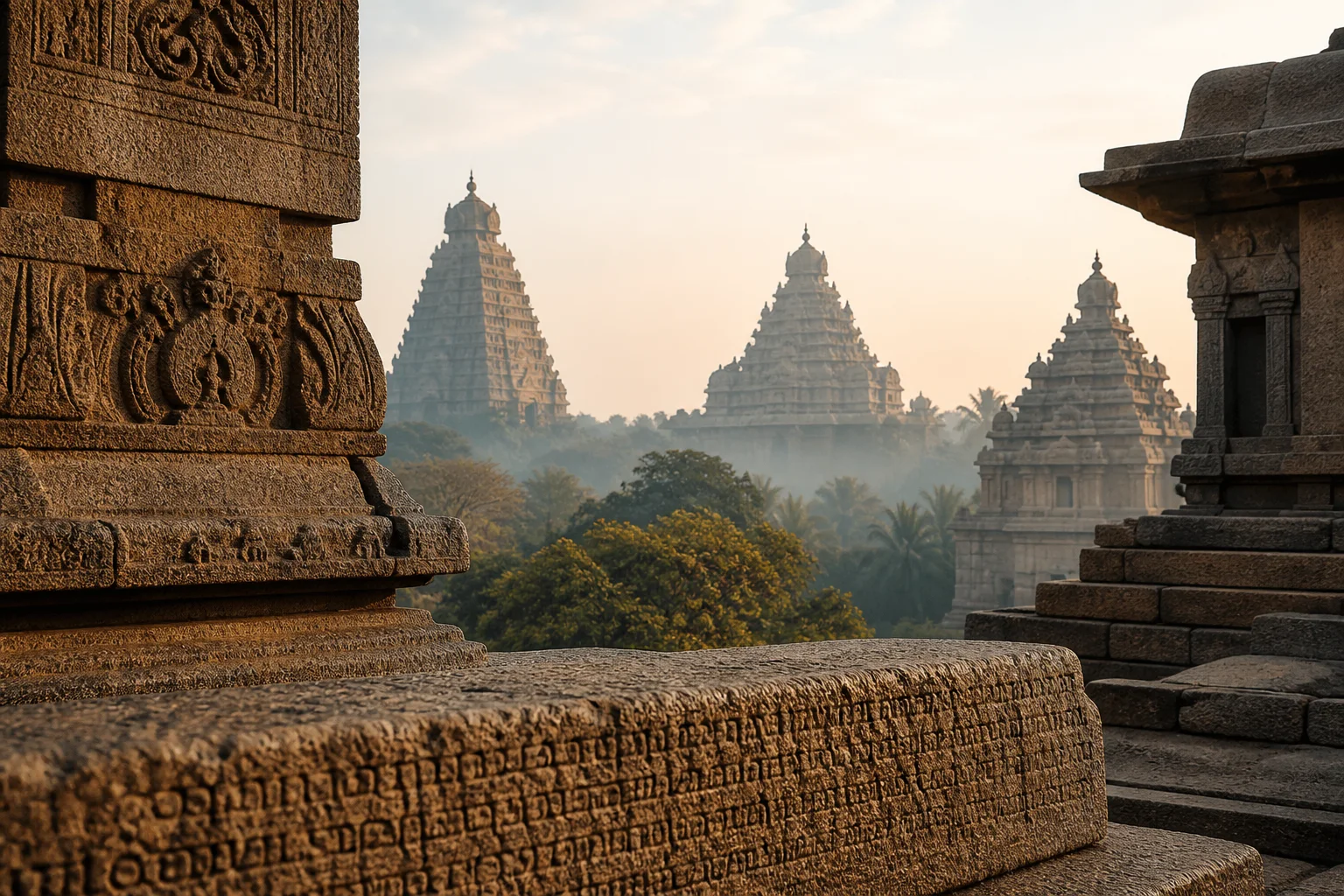
A Journey Through Chola Heritage in Tamil Nadu
Follow a thoughtful route through three living Chola temple landscapes, learning to read architecture, inscriptions, patronage, and place without rushing.
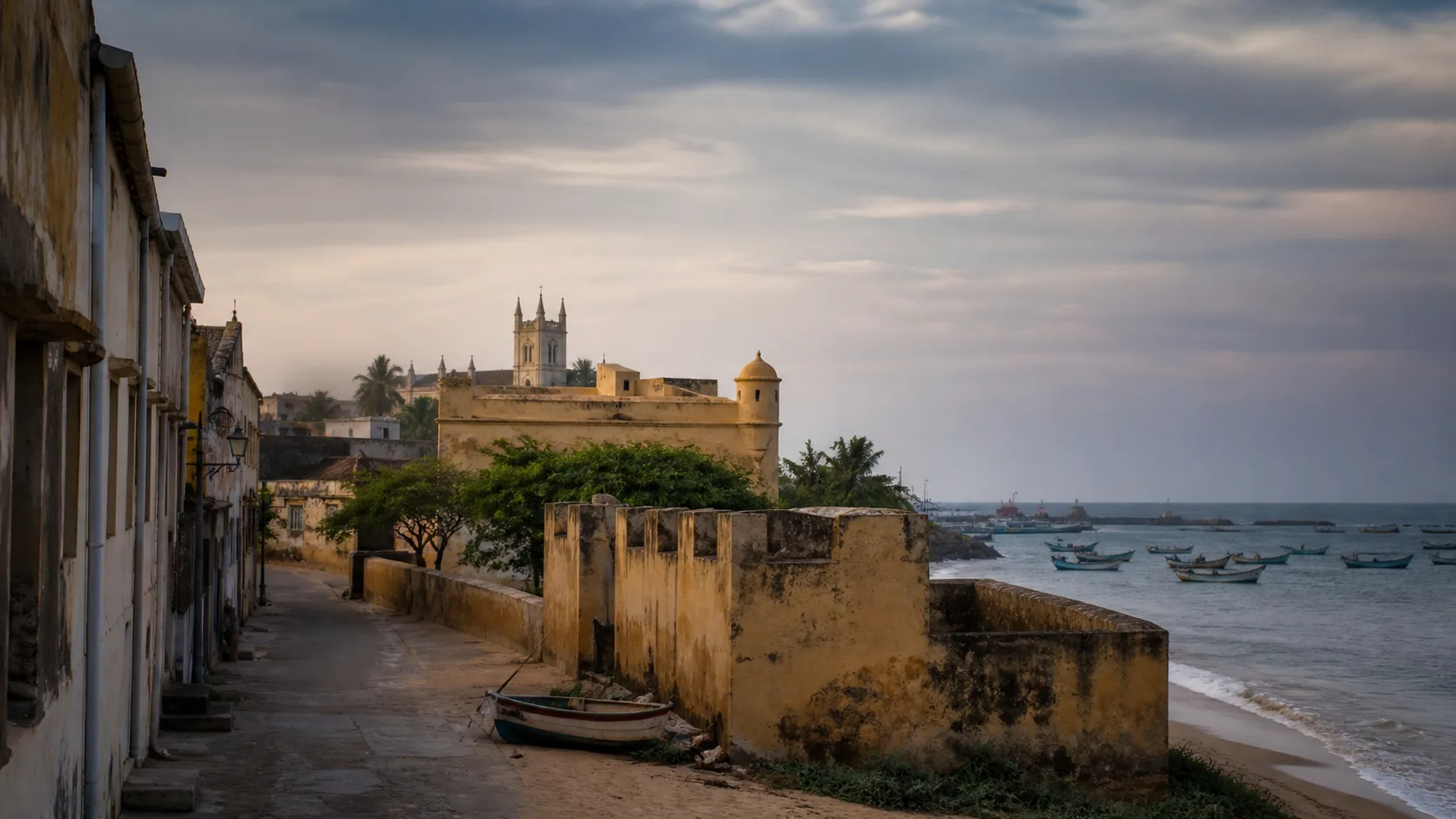
Tharangambadi: Read the Fort, Printing History and Living Coast
A layered coastal-town guide that begins before the Danish fort, follows trade and printing history, and returns heritage to a living Bay of Bengal shoreline.
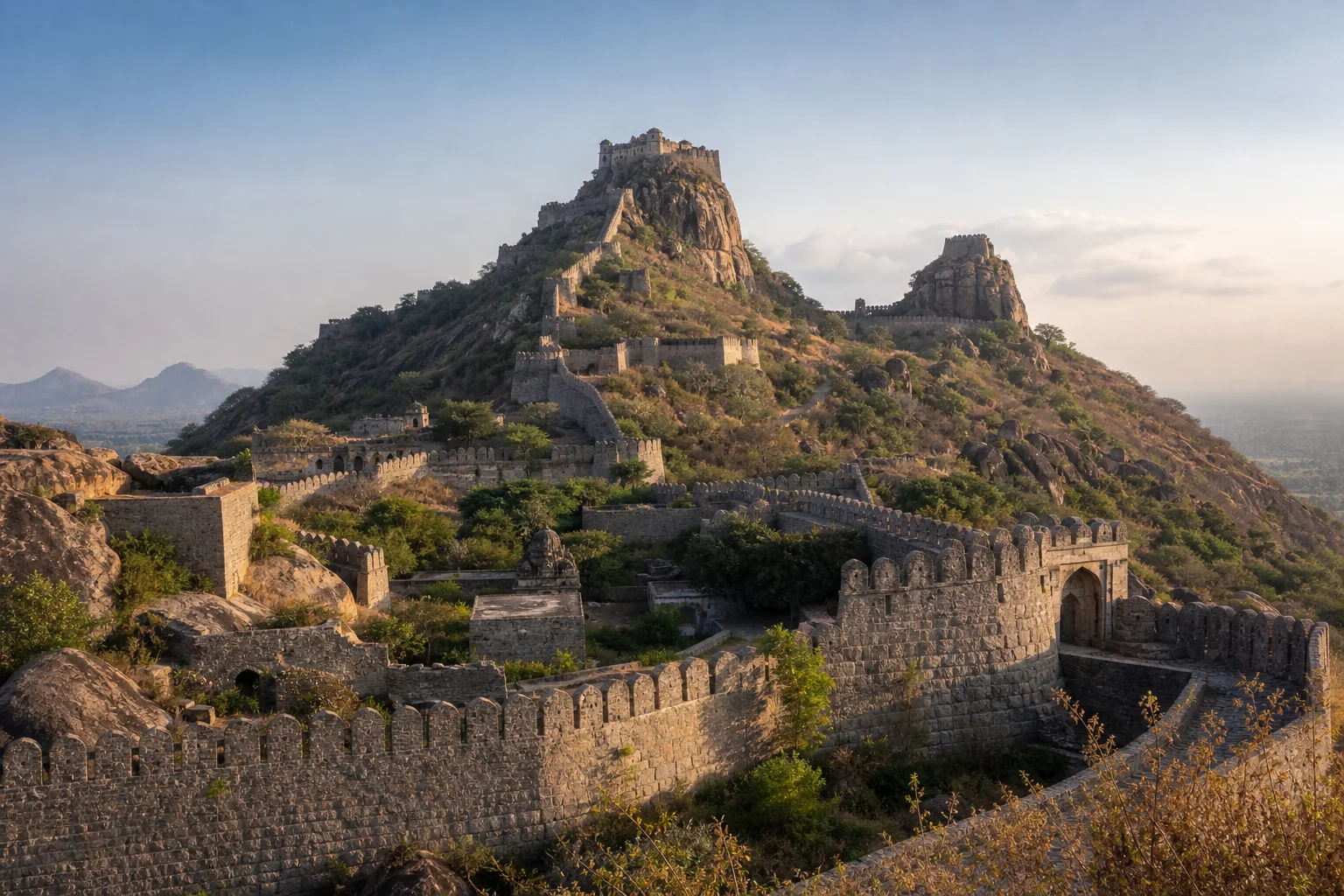
Gingee Fort After UNESCO: Reading a Military Landscape, Not Just a Ruin
What Gingee's place in a 12-fort World Heritage serial property means, and why its granite hills, walls, water and layered history must be read together.