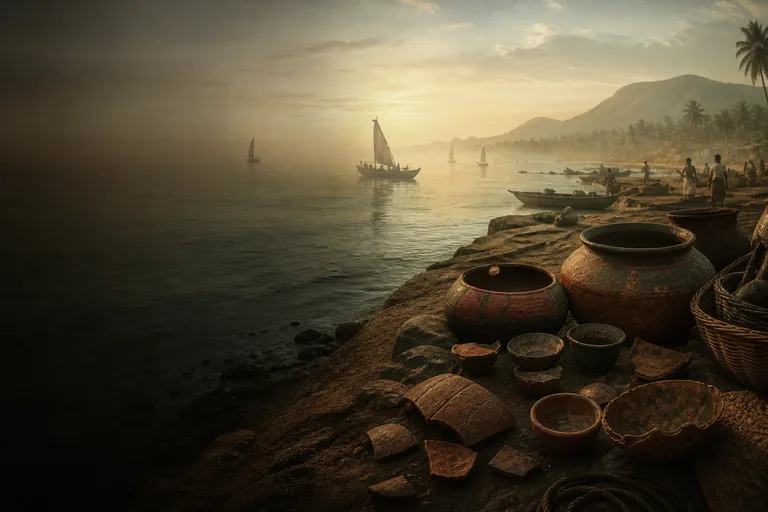
A port at the Kaveri mouth
Poompuhar / Kaveripattinam
A river-mouth town lives in poetry, excavation trenches and the changing sea. Its history is richer when those records are allowed to differ.
Orientation
Overview
Early historic and later occupation; coastal change studied separately
Poompuhar is often introduced with an ending: a magnificent city swallowed by the sea. That image has power, but it can obscure the port before its supposed disappearance and the many forms of evidence that survive. Puhar and Kaveripattinam are names associated with a settlement at the Kaveri’s meeting with the Bay of Bengal. Its history belongs as much to river channels, working waterfronts and religious institutions as to the sea.[1]
The investigation must move between records made for very different purposes. A poem creates a persuasive city in language. An excavation records a structure and its relationship to surrounding deposits. A sonar survey locates features for further examination. A museum brings objects from several places and periods into one room. The connections among these records are valuable, but no one of them can silently substitute for the others.
Chronology
A careful timeline
Dates identify documented phases and broad ranges. They do not imply uninterrupted rule or certainty where the evidence remains debated.
Port and settlement evidence
Structures, ceramics and literary references form the main historical frame.[2]
Religious and urban layers
Buddhist remains and later material complicate a single destruction narrative.[5]
Land excavations
ASI and later state investigations document different parts of the settlement.[13]
Offshore investigation
Geophysical work and diving extend the study beyond the present shore.[8][9]
A dated research status
A parliamentary answer said the report for the newly permitted state exploration had not yet been submitted; this is not a claim about all later work.[14]
Historical reading
The city in Tamil literary memory
Pattinappalai is central to the literary reputation of the port. Chennai Customs’ historical publication uses the poem in discussing exchange and customs practices at Kaveripoompattinam. That is a useful doorway into the text: commerce required movement, recognition and authority as well as ships and desirable goods. Yet a poem’s account of a prosperous city has a literary purpose. Its arrangement of people, wealth and royal power cannot be read as a modern survey or a surviving port ledger.[3]
Silappatikaram and Manimekalai give Puhar another kind of life, through narrative, ethical questions and religious imagination. Their city is inhabited by characters and shaped by the requirements of story. Literary descriptions may preserve knowledge of urban life while also organizing it into meaningful scenes. A reader should therefore ask what a passage is doing before using it to reconstruct a street, a community or an exact date.[4]
The sea’s destruction of the city in Manimekalai belongs to this narrative setting. The account connects the catastrophe to divine displeasure and a failure of observance. Marine archaeology researchers have considered whether it could preserve an echo of coastal damage. That possibility is an interpretation, not a conversion of the supernatural narrative into a dated geological observation. The literary story remains historically important even when its events cannot be matched one for one with an excavated layer.[4]
Historical reading
How a river-mouth port comes into view
A port is more than a deep basin where large ships moor. It is a set of relationships among landing places, river access, storage, settlements and people handling cargo. For Poompuhar, the land record matters because waterfront activity need not leave a monumental harbour visible at sea. The relevant question is which structures can be connected to the movement or control of water and goods, and how securely that function can be established.
The state department’s Kizharveli account describes separated brick walls with platforms and timber posts. It interprets the arrangement as a wharf and places it in the fourth century CE. The wording is interpretative: the form and position suggest a function. This should not be confused with the Kilaiyur remains discussed in other reports, or used to supply one date for every waterfront installation in the wider settlement.[1]
The ASI excavation publication provides the necessary starting point for comparing individual localities. Its plans and discussions distinguish sites and phases that are easily merged in a popular retelling of “the Poompuhar wharf.” Keeping locality names attached to a structure helps prevent that mistake. An older timber determination, a masonry phase and an associated ceramic horizon may address different moments in the life of a waterfront. They should not be reduced to one headline date.[2]
Historical reading
A city of institutions as well as cargo
The excavated Buddhist remains at Pallavanesvaram broaden the picture beyond shipping. The ASI report includes a plan of the Buddhist temple with structural additions and separate phases. Such remains bring buildings and religious practice into the port’s history without requiring every institution to be explained as a service for foreign merchants. A trading settlement was also a place where people worshipped, gathered and maintained relationships that cannot be measured simply by the volume of cargo.[2]
India’s Silk Road Sites tentative-list submission, hosted by UNESCO, connects Kaveripattinam’s Buddhist structures with the literary record. It also distinguishes waterfront and religious features assigned to different periods, and describes material extending into later history. This is a nomination document, not a UNESCO World Heritage inscription and not a replacement for excavation reports. Its value here is the recognition of several overlapping dimensions of the site rather than a single “Roman trade” identity.[5]
The state monograph Kaveripoompattinam draws attention to Buddhist textual traditions associated with the town, including the works linked to Buddhadatta. These are evidence for intellectual and religious connections as well as urban memory. Some proposed identifications depend on equating ancient place-names across texts. Where that argument is needed, the identification itself must remain visible; an ancient donor’s place of origin cannot be located solely because a later story gives a similar name.[6]
Historical reading
What a port’s goods can and cannot reveal
Descriptions of maritime exchange invite a colourful catalogue: textiles, beads, grain, imported vessels and precious materials. The difficulty is assigning each item to a secure place and period. A literary reference to a commodity, a museum object and a fragment from an excavated deposit are not interchangeable entries in one cargo manifest. For Poompuhar, it is more useful to ask where each claim comes from than to assemble the longest possible list of exports.
The Periplus describes east-coast markets and distinguishes coastal shipping from vessels making longer voyages. It also describes goods being forwarded between trading regions. This is a reason to avoid treating every imported object as proof of a direct voyage from its manufacturing centre. Commerce could involve several carriers and transfers. The text offers a wider maritime context for reading Poompuhar; disputed identifications of its named markets should not be resolved by drawing a confident arrow on a modern map.[7]
Textiles pose a particular problem of visibility. A poem can name cloth or clothing where a humid archaeological deposit preserves little recognisable fabric. Ceramics survive differently and may dominate the excavated record without having dominated the value of trade. The editorial consequence is straightforward: absence of cloth does not demonstrate absence of textile exchange, while a general history of Indian textiles does not establish a particular shipment from this port.
Historical reading
What the underwater investigations add
The early offshore surveys used instruments including an echo sounder, side-scan sonar and a magnetometer. The 1982 documentation describes systematic survey lines rather than a diver discovering an intact city in one moment. Instruments offer different ways of finding contrasts in the seabed or buried material. An anomaly is a target for investigation; its shape alone does not identify a building, its date, or the people who used it.[8]
Tripati, Gaur and Sundaresh’s 1996 study reports submerged brick and stone structures and terracotta ring wells around the Poompuhar region. Their interpretation was that the settlement had extended beyond the present shoreline. That is a substantial result: the modern land edge cannot be assumed to be the ancient one. It is nevertheless narrower than a claim that an entire mapped metropolis survives intact underwater, or that every feature belongs to the same episode of occupation.[9]
A ring well is especially helpful because it directs attention to habitation and water use. In a submerged setting, it can also raise questions about the former position of land. The surrounding deposits and associated finds remain essential to that interpretation. If an object has moved, or if the seabed has been scoured, its present position may not preserve its original relationship to nearby structures. Underwater discoveries therefore require recording and contextual analysis as much as discoveries on land.[9]
Historical reading
A changing coast is not a single catastrophe
The 2017 Current Science study combines archaeological observations with geospatial analysis along the Tamil Nadu coast. At Poompuhar it reports shoreline change, submerged features and material from intertidal settings. This brings together evidence at different scales: a ring well or brick pavement, a mapped shoreline and a wider coastal process. Their agreement can strengthen the case for lost land, but the measured recent rate should not simply be projected backward unchanged for two thousand years.[10]
A later shoreline study covering 1972–2020 divides the coast between Puducherry and Point Calimere into zones, including Poompuhar. Its results distinguish erosion, accretion and relatively stable stretches. That variation matters. “The sea advanced” is too broad to describe every part of a delta coast, and a change observed during one interval is not automatically the explanation for an ancient building’s disappearance. River sediment, waves and human interventions can interact differently along the same coastline.[11]
For that reason this guide leaves the mechanism and timing of particular ancient losses open where the cited evidence does not resolve them. A sediment study, a literary catastrophe and an underwater structure may all be relevant without describing the same event. The historical task is to test their connection. Assigning one spectacular disaster to the entire town before those relationships are demonstrated would make the account more dramatic and less informative.
Historical reading
Reading the museum without merging its collections
The Marine Archaeological Site Museum at Poompuhar presents material from offshore and onshore work. Its official list also includes objects from Alagankulam and examples from widely separated historical periods. This makes it a valuable regional introduction, but it means a display cabinet cannot be treated as the contents of one ancient ship or one Poompuhar excavation trench. The findspot on a label is as important as the place where an object is displayed.[12]
The museum’s inventory uses some broad or inherited ceramic labels. A term such as “Roman rouletted” in an older collection description should not be silently expanded into a claim of manufacture in Rome. A careful visitor can ask whether the identification concerns decoration, vessel form, fabric or a documented origin. For detailed Mediterranean-contact questions, the Arikamedu and Alagankulam guides offer a more focused comparison than a single mixed museum inventory.[12]
Historical reading
New exploration and the next evidence to read
A Lok Sabha answer dated 23 March 2026 states that permission had been issued for state exploration in 2025 and that the report on that work had not yet been submitted at the time of the answer. That date is essential: the statement does not describe every subsequent investigation. This article does not use later news announcements to supply new ancient dates or identify a newly reported object before its archaeological context can be checked.[14]
The most useful additions would be published context records, plans, ceramic identifications and scientific dating tied to particular features. They could change the account of waterfront activity or extend the known sequence. Until then, neither a spectacular age claim based on seabed form nor a claim of a direct overseas route belongs on the timeline as settled fact. The substantial evidence already available gives Poompuhar its importance without those additions.
Historical reading
Placing Poompuhar in a wider journey through history
The main Indian Ocean guide connects the Kaveri coast with inland production and other ports. Kodumanal and Karur help explain why a coastal history also needs workshops and routes across the interior. Korkai shifts attention to marine resources and pearling. Arikamedu offers a different ceramic and craft record. These are complementary histories, not rival candidates for one title such as the oldest or greatest Tamil port.
For a visit, use the Mayiladuthurai district guide to orient yourself in the modern landscape and check access with the responsible institution. Do not expect the visible shore, museum and excavated remains to reproduce the city of a poem. Their value lies in the questions they allow you to ask: which locality, which phase, which object, and which kind of evidence connects this place to the sea?
Human scale
People and institutions
Named rulers are only one part of the history. These groups and individuals help show how evidence and social life connect.
Waterfront workers
The history of a port includes handling, storage and local movement as well as long voyages.
Religious communities
Buddhist remains show urban institutions beyond cargo exchange.
Marine archaeologists
Survey, diving, documentation and analysis connect seabed observations to historical questions.
Historical geography
Connected places
Places are linked only when a substantive My Tamil Nadu guide already exists. Other entries remain non-clickable research context.
Visual reading
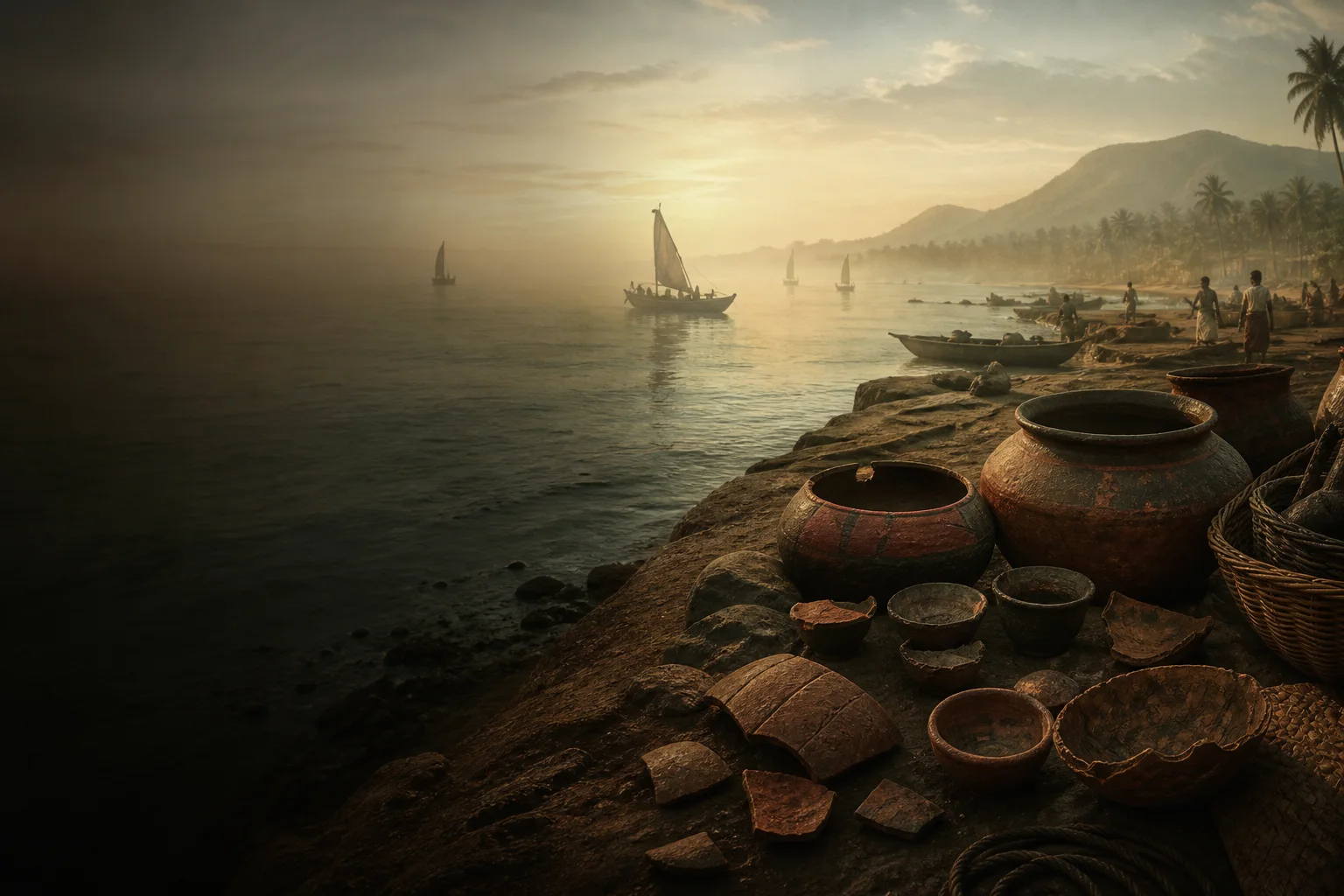
Images with explicit provenance
These project-created visuals support orientation. They are not presented as photographs of an excavation, monument, person, or event.
Questions
Frequently asked questions
Did Poompuhar disappear in one tsunami?
The literary narrative, coastal processes and excavated phases cannot yet be combined into one securely dated destruction story.
Is it a UNESCO World Heritage Site?
Kaveripattinam is included in India’s Silk Road Sites tentative-list submission. A tentative listing is not World Heritage inscription.
Do underwater structures prove a prehistoric port city?
Shape and depth alone cannot date a city. Individual features need archaeological identification and securely associated dating.
Editorial trust
Sources and further reading
Citations in the article point to this full list. Source type and review date are shown so readers can evaluate the evidence.
- 1Poompuhar: Kizharveli and Dharmakulam excavationsTamil Nadu Department of ArchaeologyOfficial excavation summary; indexed text checked · Reviewed 16 November 2026
- 2Kaveripattinam ExcavationsArchaeological Survey of IndiaPrimary excavation report; indexed passages and plan checked · Reviewed 16 November 2026
- 3Sunkam: The Heritage of Chennai CustomsChennai Customs, Government of IndiaInstitutional historical publication; port discussion checked · Reviewed 16 November 2026
- 4Underwater Exploration off Poompuhar and Possible Causes of its Submergence (1998)A. S. Gaur and Sundaresh; Puratattva 28Archaeological research; indexed passages checked · Reviewed 16 November 2026
- 5Silk Road Sites in India: Kaveripattinam componentUNESCO World Heritage Centre; submission by IndiaTentative-list submission; not a World Heritage inscription · Reviewed 16 November 2026
- 6KaveripoompattinamTamil Nadu Department of ArchaeologyDepartment monograph; indexed historical discussion checked · Reviewed 16 November 2026
- 7Periplus of the Erythraean Sea, sections 59–60Anonymous ancient author; W. H. Schoff translation (1912)Primary literary source in an early translation · Reviewed 16 November 2026
- 8Underwater Exploration of Submerged Towns near Tranquebar: offshore survey, 1982National Institute of Oceanography; institutional archive at IGNCASurvey documentation; indexed methods passage checked · Reviewed 16 November 2026
- 9Marine archaeological explorations in the Kaveripoompattinam regions: Fresh light on the structural remains (1996)Sila Tripati, A. S. Gaur and Sundaresh; National Institute of OceanographyAuthor-uploaded research; abstract checked · Reviewed 16 November 2026
- 10Use of Geospatial Techniques in Maritime Archaeology with Reference to the Tamil Nadu Coast (2017)Current Science / National Institute of OceanographyPeer-reviewed research; indexed methods/results passages checked · Reviewed 16 November 2026
- 11Temporal evolution of shoreline changes from 1972 to 2020 along the coast between Pondicherry and Point CalimereGunasekaran and colleagues; Regional Studies in Marine SciencePeer-reviewed coastal research; abstract/results excerpts checked · Reviewed 16 November 2026
- 12Marine Archaeological Site Museum – PoompuharTamil Nadu Department of ArchaeologyOfficial collection guide; indexed text checked · Reviewed 16 November 2026
- 13Underwater Archaeology Wing, question 4019, 28 March 2022Ministry of Culture / Lok SabhaOfficial parliamentary answer · Reviewed 16 November 2026
- 14Archaeological Explorations at Poompuhar, question 4942, 23 March 2026Ministry of Culture / Lok SabhaDated parliamentary status statement · Reviewed 16 November 2026
Editorial review: Reviewed 16 November 2026 using accessible excavation records, institutional summaries and scholarly research. Some full publications were unavailable; abstracts and indexed excerpts support only the specific claims discussed, while the publications also provide further reading. Dates and interpretations retain their stated uncertainties.
A Journey Through Chola Heritage in Tamil Nadu
Follow a thoughtful route through three living Chola temple landscapes, learning to read architecture, inscriptions, patronage, and place without rushing.
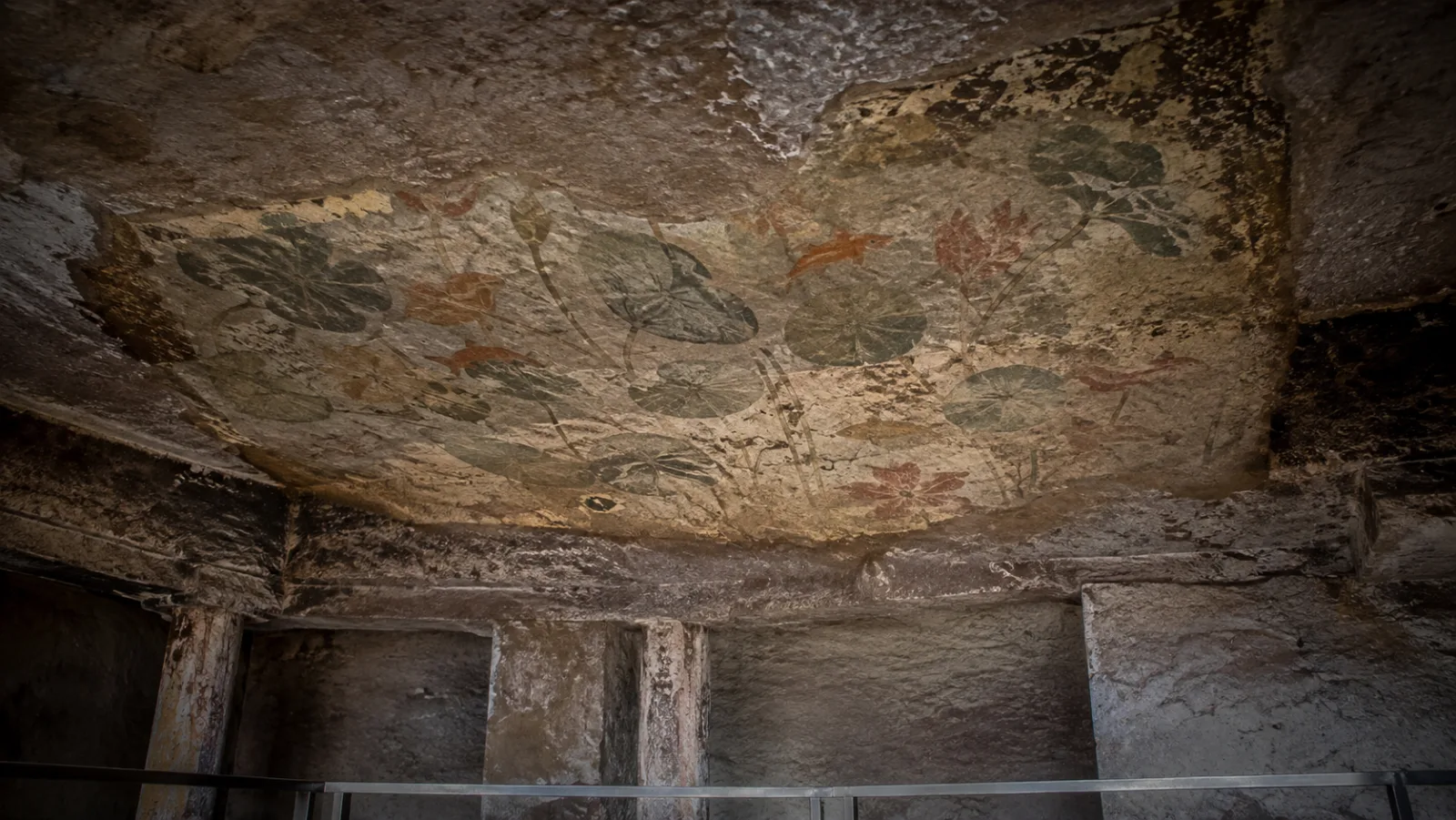
Sittannavasal: Read a Jain Hill Through Paint and Stone
A conservation-first guide connecting Sittannavasal's Jain cave, fragmentary paintings, rock beds and inscriptions without forcing them into one date.
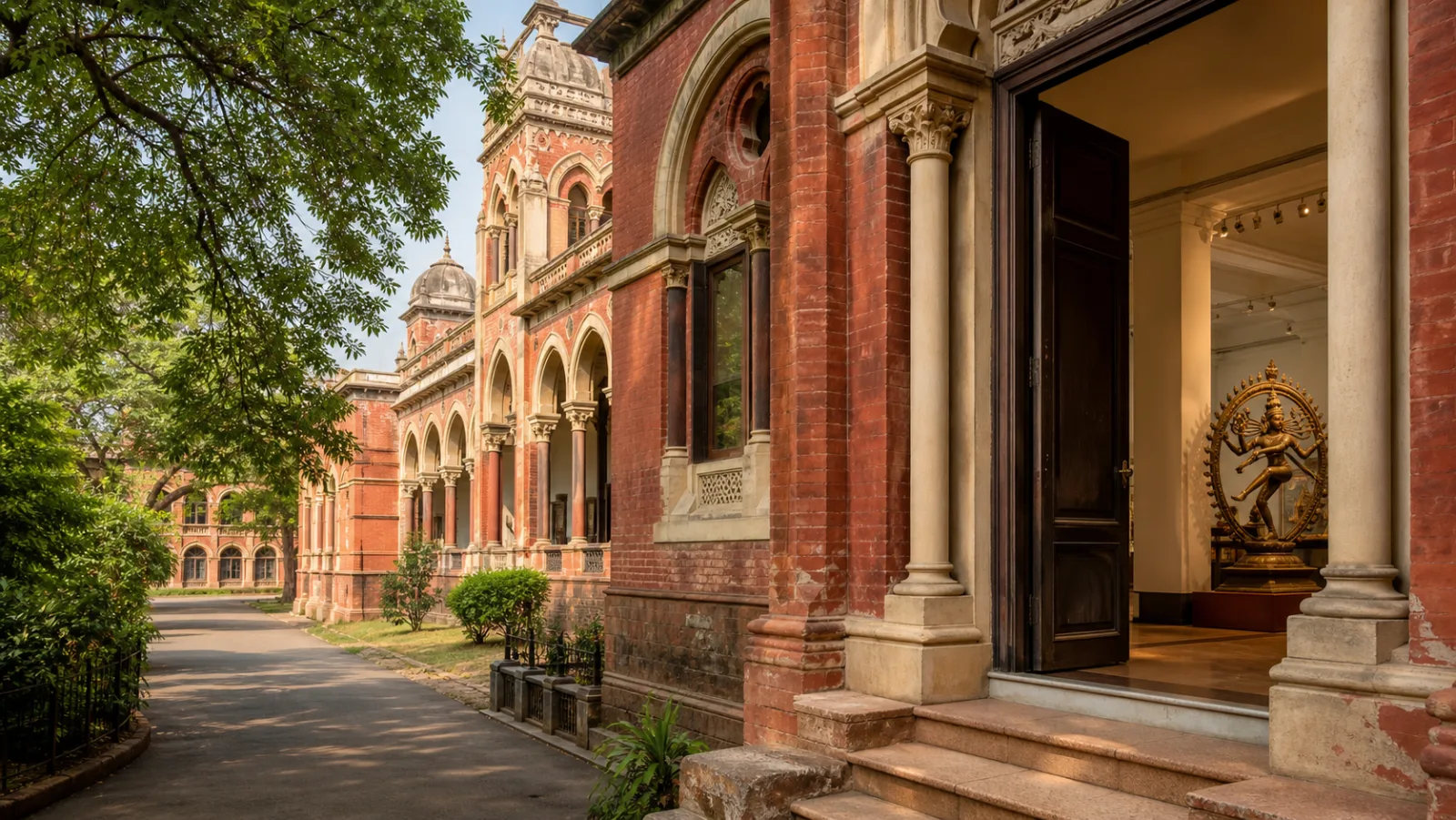
Chennai Government Museum: Read a Campus of Collections
A first-visit method for reading the Egmore museum as an evolving campus of architecture, archaeology, bronzes, inscriptions and public education.